
2.4GHz vs 915MHz LoRa: Frequency Band Selection Guide India
When designing a long-range IoT project in India, one of the most critical decisions you will face is choosing between LoRa 2.4GHz vs 915MHz — or in India’s context, the 865 MHz band. LoRa (Long Range) technology from Semtech has revolutionised low-power wide-area networking, enabling kilometre-scale wireless links on a coin cell battery. But the frequency band you choose dramatically impacts range, building penetration, regulatory compliance, available hardware, and cost — especially for Indian makers deploying systems in farms, factories, and smart cities. This comprehensive guide cuts through the confusion and gives you clear, India-specific guidance.
LoRa Technology Primer: How It Works
LoRa is a proprietary spread-spectrum modulation technique patented by Semtech Corporation. It uses Chirp Spread Spectrum (CSS) modulation — frequency-swept signals that are extremely resilient to noise and interference. This is what allows LoRa to achieve remarkable range even at very low transmit power.
Key LoRa parameters that affect range and data rate:
- Spreading Factor (SF): SF7 to SF12. Higher SF = longer range, lower data rate. SF12 can receive signals 20 dB below the noise floor.
- Bandwidth (BW): 125 kHz, 250 kHz, 500 kHz. Narrower BW = longer range (lower noise), but lower throughput.
- Coding Rate (CR): 4/5 to 4/8. Higher CR = better error correction but lower effective data rate.
- Transmit Power: Typically 14–22 dBm (25–160 mW). Higher power = longer range but more current draw.
LoRaWAN vs LoRa: LoRa is the physical (PHY) layer modulation. LoRaWAN is the MAC protocol on top — it adds star topology, OTAA/ABP provisioning, ADR (Adaptive Data Rate), and device management. You can use LoRa without LoRaWAN for point-to-point links or custom mesh topologies. For India, LoRaWAN gateway deployments typically use the 865 MHz band on The Things Network (TTN) India clusters.
LoRa Frequency Regulations in India (TRAI & WPC)
Understanding Indian spectrum regulations is critical before deploying any LoRa system. Getting this wrong means either illegal operation or customs/import problems with your hardware.
The regulatory authority: Wireless Planning and Coordination (WPC) wing of the Ministry of Communications governs spectrum allocation in India. TRAI (Telecom Regulatory Authority of India) makes recommendations.
865–867 MHz Band (India’s Sub-GHz LoRa Band):
- Delicensed band in India (no individual WPC licence needed below specified ERP)
- Allowed under Short Range Devices (SRD) rules
- Maximum power: 1 Watt ERP (typically 25–30 dBm EIRP at antenna)
- This is why Indian LoRa modules use 868 MHz or specifically target 865–867 MHz
- Indian TTN gateways and The Things Network India use this band
- Frequency plan: IN865 (channels at 865.0625, 865.4025, 865.9850 MHz)
The 915 MHz Band: 915 MHz is the US/Australia ISM band (902–928 MHz). It is NOT delicensed in India — this frequency range is allocated to other services. Using 915 MHz LoRa modules in India is technically non-compliant. Always verify modules sold as “915 MHz” can be tuned to 865 MHz for Indian use.
The 2.4 GHz Band: 2.4 GHz (2.400–2.4835 GHz) is globally delicensed and India is no exception. No WPC licence required. Maximum power varies — typically 100 mW (20 dBm) for 2.4 GHz devices in India. This is the same band used by Wi-Fi, Bluetooth, and Zigbee.
Sub-GHz LoRa: 865 MHz Band for India
The 865 MHz band is the correct choice for Indian LoRa deployments (often loosely called “868 MHz” or “915 MHz” in product listings — always check the module’s actual frequency range).
Physical advantages of sub-GHz LoRa:
- Longer wavelength = better penetration: 865 MHz signals pass through walls, foliage, and building materials far more effectively than 2.4 GHz. This is physics — lower frequency, less attenuation.
- Extended range: In open terrain (farmland, coastal areas), 865 MHz LoRa at SF12 with a good antenna can reach 10–15 km. In dense urban India, 2–5 km is typical.
- Less interference: The 865 MHz band has far fewer competing devices than 2.4 GHz (no Wi-Fi, no Bluetooth, no microwave ovens)
- Lower free-space path loss: Sub-GHz signals lose less energy over distance in free space compared to 2.4 GHz
Practical range benchmarks (India conditions):
- Open agricultural land: 8–15 km (LoS)
- Indian suburban area (2–3 storey buildings): 2–5 km
- Dense urban Mumbai/Delhi high-rises: 500 m–2 km
- Inside a reinforced concrete building: 100–300 m floor-to-floor
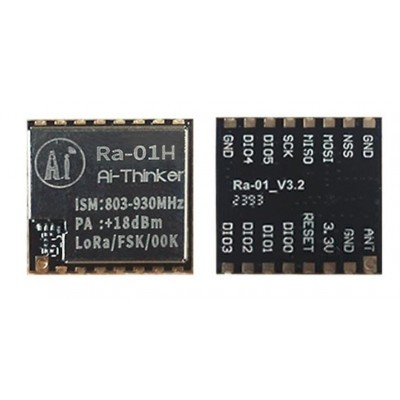
Ai Thinker LoRa Ra-01H Module
The Ra-01H operates in the 803–930 MHz range and can be configured for India’s 865 MHz band. Up to 100 mW output power, SPI interface, ideal for long-range IoT sensor nodes in agriculture and smart city applications.
2.4GHz LoRa: Global Licence-Free Operation
Semtech introduced 2.4 GHz LoRa (SX1280/SX1281 chips) in 2019 to address specific use cases where sub-GHz spectrum is congested or regulated differently. The same Chirp Spread Spectrum modulation runs at 2.4 GHz.
Advantages of 2.4 GHz LoRa:
- Globally unlicensed: Works legally in every country without frequency-specific module variants. One hardware design for global deployment.
- Higher data rate: 2.4 GHz LoRa supports bandwidth up to 1.6 MHz, enabling data rates up to 1.6 Mbps (vs sub-GHz’s max ~37.5 kbps). Useful for small image transfer or audio snippets.
- Two-way ranging: SX1280 includes a ranging engine that measures time-of-flight between two modules for RTLS (Real-Time Location Systems) with ±2 metre accuracy.
- Smaller antennas: 2.4 GHz antennas are physically smaller (6 cm quarter-wave vs 8.6 cm for 865 MHz) — advantage for compact devices.
- Lower module cost: Some 2.4 GHz LoRa modules are cheaper than sub-GHz equivalents
Disadvantages in India:
- Shorter range: Typically 2–5x less range than 865 MHz under the same conditions
- Interference: Competes with Wi-Fi, Bluetooth, microwave ovens, baby monitors — the 2.4 GHz band is extremely congested in Indian cities
- Worse building penetration: 2.4 GHz is absorbed more by walls and moisture (relevant in monsoon season)
- No LoRaWAN infrastructure: Most Indian TTN gateways do NOT support 2.4 GHz LoRa. 2.4 GHz is point-to-point or proprietary mesh only in India currently.
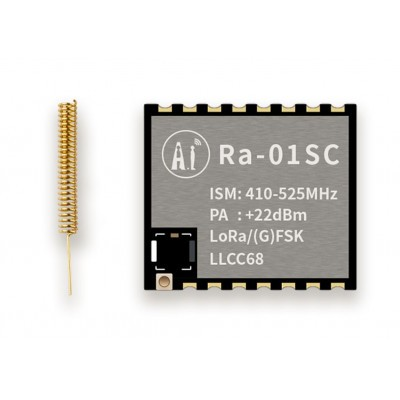
Ai Thinker LoRa Ra-01SC Module (2.4 GHz)
The Ra-01SC is a 2.4 GHz LoRa module based on SX1280 — globally licence-free, supports ranging, and higher data rates. Ideal for indoor RTLS or cross-border deployments needing one hardware SKU.
Side-by-Side: 865MHz vs 2.4GHz LoRa Comparison
| Parameter | 865 MHz LoRa | 2.4 GHz LoRa |
|---|---|---|
| India Legal Status | Delicensed (WPC SRD) | Delicensed (globally) |
| Outdoor Range (open) | 8–15 km | 1–3 km |
| Urban Range | 2–5 km | 200–800 m |
| Wall Penetration | Excellent | Moderate |
| Max Data Rate | ~37.5 kbps | ~1.6 Mbps |
| LoRaWAN (India TTN) | Yes (IN865 plan) | No |
| Ranging Support | No | Yes (±2 m) |
| Interference Risk | Low | High (Wi-Fi, BT) |
| Antenna Size | Larger (8.6 cm QW) | Smaller (3.1 cm QW) |
| Best For | Agriculture, Smart City, Rural IoT | Indoor RTLS, global products |
LoRa Modules Available in India
Ai Thinker (a Shenzhen-based manufacturer popular in India) offers the entire Ra-01 series specifically designed for different frequency bands:
Ra-01SH (865–928 MHz) — Sub-GHz high-power module based on SX1262. Perfect for Indian 865 MHz deployments. Better sensitivity than older SX1276-based modules.
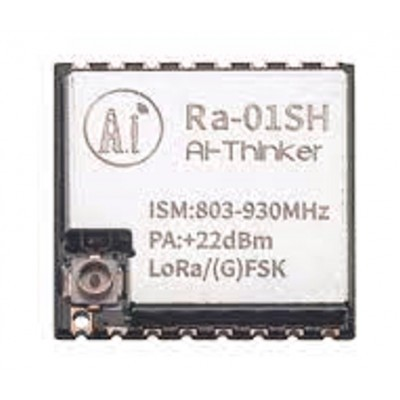
Ai Thinker LoRa Ra-01SH Spread Spectrum Wireless Module
Based on SX1262, the Ra-01SH covers 865–928 MHz, making it ideal for India’s 865 MHz delicensed band. Features -148 dBm sensitivity, up to 22 dBm output, and SPI interface for Arduino/ESP32 integration.
Selecting the right module for India:
- For agriculture/rural IoT: Ra-01SH (SX1262, 865 MHz) — best sensitivity, longest range
- For LoRaWAN on TTN India: Ra-01SH or Ra-01H (both support IN865 frequency plan)
- For indoor RTLS positioning: Ra-01SC (SX1280, 2.4 GHz) — ranging engine built-in
- For global product with one firmware: Ra-01SC (2.4 GHz, universally legal)
Use Cases: Which Band for Which Application?
Choose 865 MHz LoRa for:
- Agricultural IoT: Soil moisture, irrigation control, weather stations across large farms in Maharashtra, Punjab, Rajasthan. Multiple kilometre links on solar/battery power.
- Smart city infrastructure: Utility metering (water, electricity), street lighting control, waste bin monitoring across Indian cities joining Smart City Mission.
- Rural connectivity: Connecting remote villages, forest fire detection, wildlife tracking collars — where there is zero cellular coverage.
- Cold chain monitoring: Temperature tracking in refrigerated trucks across India’s national highways — LoRaWAN gateways at warehouses, modules in trucks.
- LoRaWAN deployment: Any project using TTN India or private LoRaWAN gateways MUST use 865 MHz (IN865 frequency plan).
Choose 2.4 GHz LoRa for:
- Indoor positioning (RTLS): Hospital asset tracking, warehouse AGV guidance — where the ranging feature of SX1280 provides metre-level accuracy.
- Moderate-range indoor links: Factory floor mesh (100–500 m through walls), building automation inside a single structure.
- Products for global market: If you are an Indian startup making a product for export, 2.4 GHz eliminates frequency localisation per country.
- Higher data rate applications: Sending photos from wildlife cameras (low resolution), voice alerts, firmware OTA updates over LoRa.
Antenna Selection and Installation Tips for India
In India’s climate (high humidity, monsoons, extreme heat), antenna selection and weatherproofing are more critical than in temperate countries.
For 865 MHz outdoor nodes:
- Use a fibreglass omnidirectional antenna (2–5 dBi gain) in weatherproof enclosure
- Quarter-wave whip (8.6 cm wire): simple, effective, free — suitable for field deployments
- Avoid rubber duck antennas for permanent outdoor installations — UV degradation in Indian sun
- Keep the antenna vertical (vertical polarisation matches most gateway antennas)
- Mount on rooftop or raised pole for Line-of-Sight — even 2 metres higher = significant range increase
For 2.4 GHz nodes:
- PCB antenna (on-module trace) is sufficient for indoor use up to 100 m
- IPEX/U.FL connector + external antenna for better range
- Ceramic patch antenna for 2.4 GHz RTLS (better directional control)
Indian-specific tips:
- Use IP65/IP67 enclosures for outdoor nodes — Indian monsoon is brutal on exposed electronics
- Add silica gel desiccant inside enclosures — humidity causes corrosion on PCB traces
- Use conformal coating on PCBs in coastal (high salt air) deployments (Mumbai, Chennai, Kochi)
- Solar panels in India receive excellent irradiance (5.5 kWh/m²/day average) — a 5W panel + 3.7V Li-Ion is sufficient for most LoRa sensor nodes
Frequently Asked Questions
Is it legal to use 915 MHz LoRa modules in India?
Technically, 902–928 MHz is not part of India’s delicensed SRD bands. The Indian delicensed band for LoRa is 865–867 MHz. However, many “915 MHz” modules (including SX1262/SX1276-based) can be software-configured to transmit at 865 MHz — check the module’s frequency range before purchase. Ra-01H and Ra-01SH from Ai Thinker cover 803–930 MHz and can be tuned to 865 MHz in code.
Can I use LoRa without a LoRaWAN gateway in India?
Yes. LoRa supports direct point-to-point (P2P) communication between two modules without any gateway or network server. This is called “LoRa P2P” mode. Both modules run the same frequency, BW, SF, and CR settings. You write your own application protocol. P2P LoRa is simpler to set up and has no monthly fees — ideal for farm-to-farm sensor links or home-to-gateway single hops.
What spreading factor should I use for maximum range in India?
SF12 gives the maximum range (typically 15+ km in open terrain) at the cost of very low data rate (250 bps) and high time-on-air (~2 seconds per packet). For most Indian agricultural applications sending 10–50 bytes every 10 minutes, SF10 or SF11 offers a good balance of range (~8–12 km) and time-on-air (~500 ms). Avoid SF12 in dense deployments — network capacity drops dramatically.
What is the LoRa duty cycle restriction in India?
India’s WPC rules for the 865–867 MHz band specify a maximum of 1% duty cycle per channel (similar to European ETSI regulations). This means if you transmit for 1 second, you must wait 99 seconds before transmitting again on the same frequency. LoRaWAN enforces this automatically. For P2P LoRa, you must implement duty cycle management in your firmware to remain compliant.
How do I connect a LoRa module to Arduino or ESP32?
All Ai Thinker Ra-01 series modules use an SPI interface. Connect MOSI, MISO, SCK to your microcontroller’s SPI pins, NSS (CS) to a GPIO, DIO0 to an interrupt-capable GPIO, and RST to another GPIO. Use the RadioLib or LoRa.h library on Arduino. On ESP32 with ESP-IDF, use Semtech’s LoRa driver from their LoRaMac-node repository. Voltage: all Ra-01 modules are 3.3V — use a level shifter with 5V Arduino.
Get Your LoRa Modules Delivered Across India
Zbotic stocks the full Ai Thinker LoRa Ra-01 series — 865 MHz and 2.4 GHz variants — with fast shipping to all Indian pin codes. Build your IoT network today.


Add comment