
Tethered Drone Build: Unlimited Flight Time for Events and Surveillance
Imagine a drone that can hover for eight hours at a stretch without landing for a battery swap. Imagine a multi-day security perimeter at a large event — the Kumbh Mela, an IPL final, or a major government event — with continuous aerial coverage from a stationary overhead vantage point. This is the promise of tethered drones, and it is increasingly being realised by Indian operators who need persistent aerial presence without the operational headache of rotating battery packs every 20 minutes.
Tethered drones are not science fiction or a niche hobbyist concept. They are used by police forces, event management companies, live broadcasters, and infrastructure inspection teams globally and increasingly in India. In this guide we will walk through the complete build process: choosing a frame, selecting a power supply, designing the tether system, configuring the flight controller for tethered operation, and navigating India’s regulatory landscape for tethered UAV operations.
1. How Tethered Drones Work
A tethered drone system has three main components:
- The Ground Power Unit (GPU): A mains-powered or generator-powered voltage converter that produces high-voltage DC power for efficient cable transmission. Typical output is 48V–400V DC at low current to minimise resistive losses in the thin cable.
- The Tether Cable: A lightweight composite cable carrying power (two conductors) plus optionally fibre optic strands for high-bandwidth video uplink. The cable typically weighs 10–30g per metre depending on specification.
- The Drone-Side Power Converter: An onboard step-down converter (DC-DC converter) that takes the high-voltage tether power and converts it to the battery voltage the drone’s ESCs and electronics expect (typically 22.2V/6S or 25.2V).
The high-voltage transmission approach is critical. Transmitting power at, say, 300V DC instead of 22V means the current in the cable is 14x lower for the same power delivered. Since resistive losses scale with the square of current (P = I²R), transmitting at high voltage reduces cable losses dramatically — making it practical to use very thin, lightweight cables.
A typical tethered drone system might transmit 300V DC at 2A to deliver 600W to the drone (enough for a heavy-lift hexacopter). The same power at 22V would require 27A, requiring a cable so thick and heavy it would be impractical beyond 20–30 metres.
2. Use Cases in India: Where Tethered Makes Sense
2.1 Event Security and Crowd Monitoring
India’s large public gatherings — religious festivals, political rallies, sporting events, concerts — require sustained aerial surveillance. A tethered drone at 50–80 metres altitude provides a stable overhead view for security teams and can stream live to a command post via fibre optic tether or WiFi. The continuous operational time eliminates the coordination overhead of battery rotations and the risk of coverage gaps.
2.2 Live Event Broadcasting
TV and OTT platform production teams at cricket matches, music festivals, and political events increasingly use tethered drones for stable aerial shots that standard broadcast helicopters cannot achieve economically. A tethered drone at 60m provides clean, stable, vibration-free footage for 4–8 hours straight.
2.3 Border and Perimeter Security
State police and paramilitary units in India are deploying tethered drones for persistent perimeter monitoring of sensitive installations, border areas, and VIP security cordons. The tethered approach is approved for BVLOS operation in many cases, as the tether inherently limits the operational radius.
2.4 Telecom and Network Extension
Tethered drones carrying WiFi mesh nodes or LTE base station payloads provide temporary connectivity over areas with damaged or inadequate ground infrastructure — post-disaster operations, temporary event venues in rural areas, or military forward operating bases.
2.5 Environmental Monitoring
Air quality sensors, weather instruments, and gas detection equipment can be carried aloft and held at a fixed altitude for extended monitoring periods — useful for industrial site monitoring, pollution mapping in Indian cities, and agricultural meteorology.
3. Frame Selection: What Makes a Good Tether Platform
A tethered drone frame has different priorities than a regular drone frame:
Key Requirements
- Stability over agility: Wide motor-to-motor spacing improves hovering stability. A hexa or octo configuration provides redundancy — if one motor fails, the drone can continue flying.
- High payload capacity: The frame must carry the onboard power converter (typically 200–500g), the payload camera/sensor (200g–2kg), and the mechanical attachment point for the tether cable.
- Tether attachment point: The frame must have a robust mechanical attachment point directly above or at the centre of gravity for the tether cable. This prevents the tether from pulling the drone into an unintended attitude.
- Cable routing: Power cables from the tether attachment point to the onboard converter must be routed cleanly without strain on connectors.
- Weatherproofing: Tethered drones often operate in conditions where a battery drone would be called in (rain, wind). Weatherproof frames and/or IP-rated components are preferred.
Recommended Frame Types for Tethered Build
- EFT 6120 Hexacopter Frame: Purpose-built for heavy-lift surveillance applications. The six-motor layout provides stability and redundancy. Carbon fibre arms keep weight manageable. This is an excellent base for a professional tethered surveillance system.
- Large agricultural quad frames: EFT E410P / E416P agricultural frames have the payload capacity for heavy tether converters and sensors. Their wide motor spacing provides inherent stability.
- Custom builds: Many professional tether operators build custom welded aluminium or carbon frames sized to their specific payload and flight time requirements.
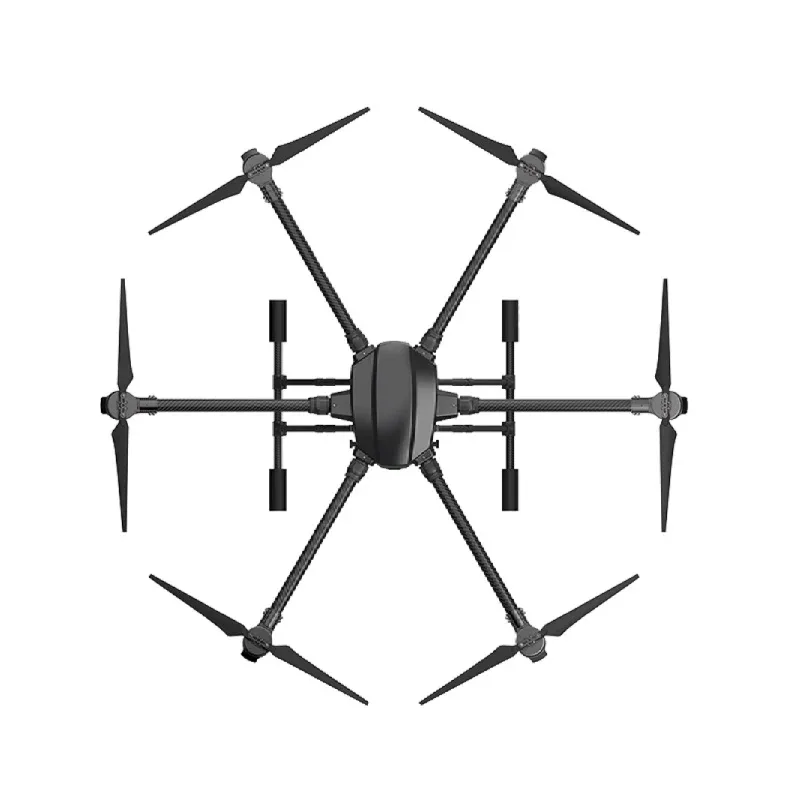
EFT 6120 Multifunction Surveillance Drone Frame
Heavy-duty hexacopter frame designed for surveillance and multi-mission payloads. The ideal platform for a professional tethered drone build — robust, spacious, and designed for continuous operation.
4. Power System Design: Ground Power to Drone
The power system is the heart of a tethered drone build. Getting it wrong means either insufficient power reaching the drone or a dangerously hot cable that becomes a fire and safety hazard.
4.1 Calculate Your Power Budget
Start by determining how much power the drone actually needs. For a hexacopter weighing 5kg all-up:
- Hover requires approximately 60–70W per kg for typical drone efficiency
- 5kg × 65W = 325W hover power
- Add 20–30% safety margin and payload electronics: ~420W
- Onboard converter efficiency: ~90%
- Ground power needed: 420W / 0.9 = ~470W at the cable exit
- Cable losses (15% for 50m cable): Ground supply needs to deliver ~540W
4.2 Ground Power Supply Options
- Mains AC power (230V, 50Hz India standard): Use an industrial AC-DC converter. These are available as DIN rail PSUs from brands like Mean Well, available at industrial electronics suppliers in India.
- Generator: For field deployments without mains access. A 1kVA petrol generator is sufficient for most tethered builds. Honda and Kirloskar generators are widely available in India.
- Large capacity LiFePO4 battery bank: For shorter tethered operations (2–4 hours), a 100Ah LiFePO4 battery at 48V (4.8kWh) can supply ~500W for nearly 9 hours. LiFePO4 is safer than LiPo for extended ground-level operation.
4.3 Transmission Voltage Selection
Higher transmission voltage means less cable loss but also higher safety risk and more expensive high-voltage components. Common choices:
- 48V: Safest, uses widely available components, good for tether lengths up to 30m
- 100V: Good for 30–60m tether range
- 200V–400V: Needed for 60m+ tether lengths, requires proper HV safety precautions
For Indian hobby/commercial builders, 48V–100V systems are most practical and source-able. Industrial DC-DC converters stepping from 100V down to drone voltage (22V–25V) are available from industrial suppliers in major cities.
4.4 Onboard DC-DC Converter
The converter mounted on the drone steps tether voltage down to battery voltage. Requirements:
- Input range must exceed your transmission voltage + voltage drop in cable
- Output voltage must match your ESC input voltage (typically 22.2V for 6S or 25.2V for 6S HV)
- Continuous output power must exceed your max hover power with margin
- Weight should be minimised — typically 150–400g for commercial units
- Efficiency above 90% to minimise heat generation on the drone
5. Tether Cable: Design and Safety
5.1 Cable Construction
A purpose-built tether cable for drones typically consists of:
- Two copper conductors (power supply) — sizing depends on transmission voltage and current
- Optional: 2–4 fibre optic strands (gigabit video uplink, immune to EMI)
- Kevlar or Dyneema load-bearing core (takes the mechanical tension away from conductors)
- UV-resistant polyurethane jacket
5.2 Cable Sizing for Copper Conductors
At 48V transmission, a 500W system draws 10.4A. The cable must be sized to keep resistive heating below the jacket’s temperature rating and to limit voltage drop:
- For 50m of cable (100m total round trip), use minimum 1.5mm² per conductor to keep voltage drop under 10% at 48V
- For 100V transmission at 5A, 0.75mm² conductors are sufficient for 100m cable
5.3 Mechanical Attachment and Anti-Twist
The tether must attach to the drone at the centre of gravity with a swivel (anti-rotation) joint to prevent cable twist as the drone yaws. Never attach the tether rigidly — the swivel is safety-critical. On the ground side, use a spring-tensioned reel system to keep the cable taut as the drone ascends and descends, preventing the cable from going slack and tangling in the props.
5.4 Cable Weight vs Length Trade-off
For a 50m tether cable weighing 15g/m, the cable adds 750g of suspended weight plus tension from cable catenary. This additional load must be included in your drone’s payload capacity calculation. Most professional tethered drones are designed with 2x the tether weight as additional hover reserve.
6. Flight Controller Configuration for Tethered Flight
Tethered drone flight has unique configuration requirements compared to free-flight:
6.1 Flight Mode
Use GPS Loiter/Position Hold mode as the primary mode. The drone should hold a fixed GPS position with altitude hold. In ArduPilot, set the SIMPLE mode flag so orientation is always relative to the home point — not to pilot facing direction.
6.2 Tether Tension Compensation
The tether exerts a downward and lateral force on the drone. This affects the effective hover throttle and can cause position drift as tether tension changes. Set the THR_MID parameter in ArduPilot (or mid_throttle in Betaflight for hover calibration) to account for the additional tether load.
6.3 Altitude Limiting
Set a hard altitude ceiling in ArduPilot (FENCE_ALT_MAX geofence) that matches your physical tether length minus 5m safety margin. This prevents the drone from ascending to tether limit and suddenly going under tension — which can destabilise the aircraft violently. Set the geofence breach action to LOITER or LAND.
6.4 Wind Compensation
In strong wind, the tether cable acts like a kite — wind catches the hanging cable and pushes the drone. ArduPilot’s EKF handles this through its wind estimation, but set conservative position hold parameters. Increase WPNAV_LOIT_SPEED to allow the drone to lean more aggressively into wind without losing position.
6.5 Disable Battery Failsafe
In a tethered build running on ground power (no onboard LiPo or only a small buffer battery), the flight controller’s battery voltage and current readings will be different from a standard LiPo flight. Configure the battery monitor for the actual buffer LiPo (if used) and disable any failsafe actions based on flight-time voltage that would apply to tethered power input.

3DR 100mW Radio Telemetry 915MHz for APM/PX4/Pixhawk
Wireless telemetry link for real-time monitoring of your tethered drone’s health from the ground station. Essential for long-duration tethered operations — monitor battery, GPS, and system health without handling the drone.
7. Payload Options: Cameras and Sensors
The primary advantage of unlimited flight time is unlocked when paired with a mission-appropriate payload:
7.1 PTZ Cameras for Surveillance
Pan-Tilt-Zoom IP cameras (Sony, Hikvision, Dahua variants available in India) on a gyro-stabilised gimbal provide full surveillance capability. These cameras stream H.264/H.265 video via the tether’s fibre optic or WiFi to a ground station. A 30x optical zoom provides effective surveillance range to 500+ metres from the drone’s position.
7.2 Broadcasting and Production Cameras
For live events, a Sony or Blackmagic camera on a 3-axis gimbal provides broadcast-quality footage. The fibre optic tether carries uncompressed SDI video directly to a broadcast truck. This approach is used by major broadcasters at Indian cricket matches and concerts.
7.3 Sensor Payloads
Air quality monitoring (PM2.5, NO2, CO sensors), thermal cameras (useful for night-time event security), and LiDAR units are all viable tethered drone payloads. The continuous power supply makes high-power sensors practical that would be impractical on battery.
8. Complete Parts List and Estimated Cost (India)
| Component | Specification | Est. Cost (INR) |
|---|---|---|
| Frame | EFT 6120 Hexacopter or equivalent | ₹30,000–60,000 |
| Motors (6x) | T-Motor or Hobbywing X series, appropriate KV | ₹30,000–80,000 |
| ESCs (6x or 1x 6-in-1) | DShot-capable, appropriate amperage | ₹10,000–25,000 |
| Flight Controller | Matek H743 or Pixhawk Cube | ₹8,000–25,000 |
| GPS Module | Here3+ or M8N/M9N with compass | ₹5,000–20,000 |
| Onboard DC-DC Converter | 600W, 48V/100V input, 6S output | ₹8,000–25,000 |
| Ground Power Supply | Mean Well 48V/1000W DIN rail PSU | ₹8,000–15,000 |
| Tether Cable (50m) | Custom or commercial composite cable | ₹15,000–50,000 |
| Cable Reel System | Spring-tensioned with level wind | ₹10,000–30,000 |
| RC System | FrSky/Futaba/ExpressLRS | ₹5,000–20,000 |
| Telemetry Radio | 3DR 915MHz or 433MHz pair | ₹2,000–5,000 |
| Payload Camera/Sensor | Varies by application | ₹10,000–5,00,000+ |
| Total (frame + electronics, without payload) | ₹1,31,000–3,55,000+ |
9. Regulatory Framework in India for Tethered UAVs
Tethered UAVs have a special provision under India’s DGCA UAS Rules 2021 that makes them more operationally accessible than free-flying drones:
9.1 The Tethered UAV Definition
DGCA defines a tethered UAV as one constrained by a physical cable to a fixed ground point. Tethered UAVs are explicitly categorised differently from free-flying UAVs in some DGCA guidance, often with relaxed operational permissions since the tether limits the effective range.
9.2 Height Limits
Tethered UAVs are typically permitted to operate within the drone registration requirements based on MTOW (Maximum Take-Off Weight). The 120m AGL ceiling applies. Most tethered operations target 50–80m for practical surveillance and broadcasting use, well within this limit.
9.3 Registration and Pilot Certification
If the tethered drone exceeds 250g MTOW (virtually all commercial tether platforms do), it must be registered on the DigitalSky portal. Commercial operations require an RPAS pilot certificate (Remote Pilot Certificate — RPC) from a DGCA-approved training organisation. Operators must obtain permission via the Digital Sky platform for controlled and restricted airspace.
9.4 Commercial Operator Approval (ROC)
For providing tethered drone services commercially (events, security, broadcasting), you need a Remote Pilot Organisation Certificate (RPOC) and file Unique Air Traffic Operator Permit (UATOP) for each operation in non-green zones. In Green Zones, No-Permission-No-Takeoff (NPNT) compliant systems can operate with automated permission.
10. Recommended Products from Zbotic

T-Motor A10-KV120-CCW Modular Propulsion System
Professional T-Motor propulsion system for heavy-lift tethered drones. The A10 series offers high efficiency at large propeller diameters — critical for long-duration continuous hover.

T-Motor A10-KV120-CW Modular Propulsion System
CW-rotation partner to the A10-CCW — buy as a pair for quadcopter or hexacopter builds. Professional efficiency ratings suitable for continuous-duty tethered hover operations.

Hobbywing X9 Plus Motor CCW
Hobbywing’s X9 Plus is a top-tier agricultural and heavy-lift motor. Its integrated drive system (motor + ESC in one unit) simplifies tethered drone wiring significantly.
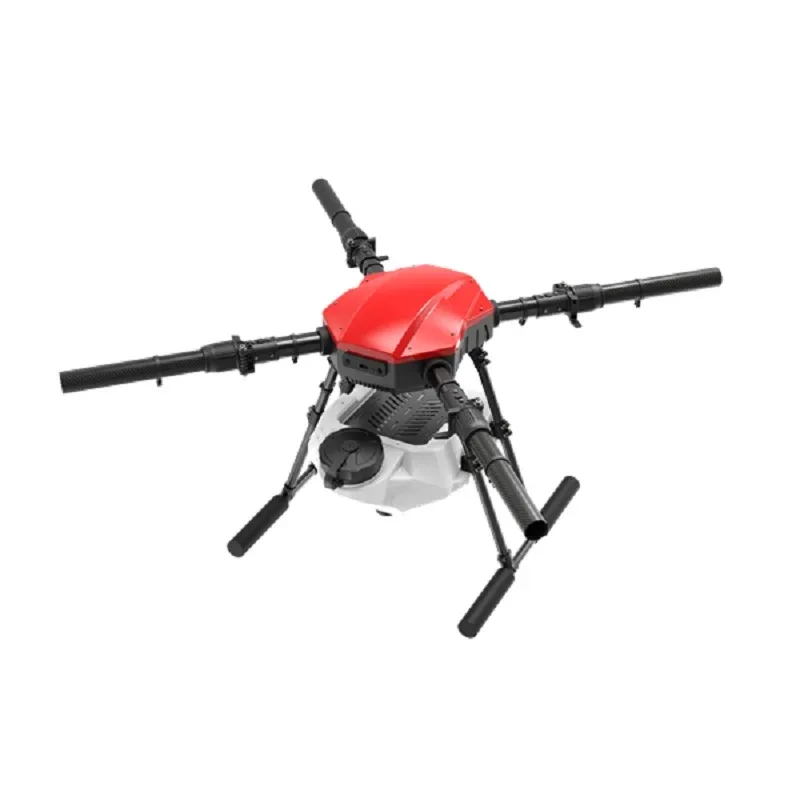
EFT E416P 16L 4-Axis Agricultural Drone Frame
Rugged agricultural frame with high payload capacity — adaptable for tethered operations by replacing the spray tank with an onboard power converter and camera payload.

110cm Fast-fold Landing Pad / Helipad for RC Drone
Define your tethered drone take-off and landing zone clearly at events. A marked, flat landing pad also protects the tether cable connector from ground contamination.
11. Frequently Asked Questions
Q: What is the maximum altitude for a tethered drone in India?
A: The standard drone altitude limit of 120m AGL applies to tethered drones in India unless you have specific permission from Air Traffic Control for higher operations in uncontrolled airspace. Most practical tethered operations target 50–80m for good surveillance coverage without excessive cable weight and wind loading.
Q: Can a tethered drone fly BVLOS (Beyond Visual Line of Sight) in India?
A: The tether physically limits the operational radius to cable length, which means the drone never actually goes beyond line of sight in most deployments. However, DGCA’s formal BVLOS provisions still apply for regulatory purposes. The confined radius of a tethered system makes it easier to obtain operational approval compared to free-flying BVLOS operations.
Q: What happens if the tether cable breaks?
A: A tether cable failure means the drone is now a free-flying aircraft without controlled ground power. The onboard system should have a small buffer LiPo that immediately takes over power supply, giving the pilot 30–60 seconds to initiate a safe landing via RC control. In ArduPilot, configure a voltage failsafe that triggers LAND mode if main power drops below the buffer LiPo voltage — this automates the emergency landing if the pilot is unable to react quickly enough.
Q: How do I prevent the tether cable from wrapping around the drone’s propellers?
A: The tether cable must attach to a swivel above the centre of gravity, so the cable hangs straight down below the attachment point. The props are above and around the drone’s body — if the tether hangs vertically below the centre, there is no mechanism for it to reach the props under normal conditions. In high winds, the cable can be pushed laterally — prop guards help in this scenario. Never fly a tethered drone in wind speeds where the cable could be pushed into the rotor plane.
Q: Is it cheaper to buy a commercial tethered drone system or build one?
A: Commercial tethered drone systems from companies like Elistair (France), Hoverfly (USA), or Indian manufacturers like ideaForge cost ₹5–30 lakh for a complete system. A custom build can achieve similar performance for ₹1.5–4 lakh with significant DIY effort. The commercial systems offer certification documentation, after-sales support, and operator training that justifies the premium for commercial operators. DIY builds are best for R&D, pilot projects, and budget-conscious operators comfortable with the technical complexity.
Q: Can I use a tethered drone at a large public event in India?
A: Yes, with proper permissions. Large public events require coordination with local authorities, DGCA permissions via Digital Sky, and possibly permission from Air Traffic Control if near an airport. Event organisers typically obtain these as part of broader event security planning. Contact a DGCA-approved drone operator or RPOC-holder to handle the regulatory process for commercial event operations.
Start Your Tethered Drone Build with Zbotic
Zbotic stocks professional-grade drone frames, motors, ESCs, power distribution components, and flight controllers for heavy-lift and commercial drone builds across India. Get expert advice on component selection for your tethered drone project.


Add comment