
If you’ve ever watched a colony of ants coordinate to carry food far larger than any individual ant, you’ve witnessed swarm intelligence in nature. Swarm robotics DIY algorithms India enthusiasts are now replicating this behaviour with small, affordable robots that communicate and cooperate without any central controller. Whether you’re a student, hobbyist, or researcher based in India, this guide breaks down everything you need to understand and build your first swarm robot system.
What Is Swarm Robotics?
Swarm robotics is a branch of robotics inspired by the self-organised collective behaviour seen in social insects such as ants, bees, and termites. Instead of relying on a single powerful robot, a swarm system uses many simple robots that follow local rules and interact with each other and the environment to accomplish complex global tasks.
The defining characteristics of a true swarm are:
- Decentralisation: No single robot acts as the brain. Each unit operates independently based on sensor input and simple rules.
- Scalability: Adding more robots improves performance without redesigning the whole system.
- Robustness: If a few robots fail, the swarm continues to function — unlike a centralised system.
- Flexibility: The same swarm can adapt to different tasks by tweaking only the local rules.
For Indian students and makers, swarm robotics presents an exciting frontier because the individual robots can be built from low-cost, widely available components.
Core Swarm Algorithms Explained
Understanding the algorithms is crucial before picking up a soldering iron. Here are the most important ones used in swarm robotics:
1. Flocking (Reynolds’ Rules)
Flocking simulates bird-like movement using three rules applied to each robot: separation (avoid crowding neighbours), alignment (steer towards the average heading of neighbours), and cohesion (steer towards the average position of neighbours). The result is smooth, coordinated group movement without any central command.
2. Stigmergy / Pheromone-Based Navigation
Ant colony optimisation (ACO) is the most popular stigmergy-based algorithm. Robots leave virtual or physical markers (pheromones) in the environment. Other robots follow the strongest pheromone trail, which reinforces efficient paths. This is excellent for foraging and shortest-path problems.
3. Particle Swarm Optimisation (PSO)
In PSO, each robot (particle) remembers its own best-known position and shares information about the swarm’s best-known position. Velocities are updated iteratively, causing the swarm to converge on an optimal solution. PSO is widely used in sensor coverage and target-search tasks.
4. Self-Assembly and Morphogenesis
Robots detect each other via infrared or Bluetooth and physically connect or align based on gradient signals, forming shapes or bridges. This is useful for search-and-rescue where robots must navigate irregular terrain.
5. Consensus Algorithms
Consensus algorithms allow all robots in a swarm to agree on a common value (such as a direction or a decision) through repeated local communication. Popular variants include average consensus and Byzantine fault-tolerant consensus for noisy environments.
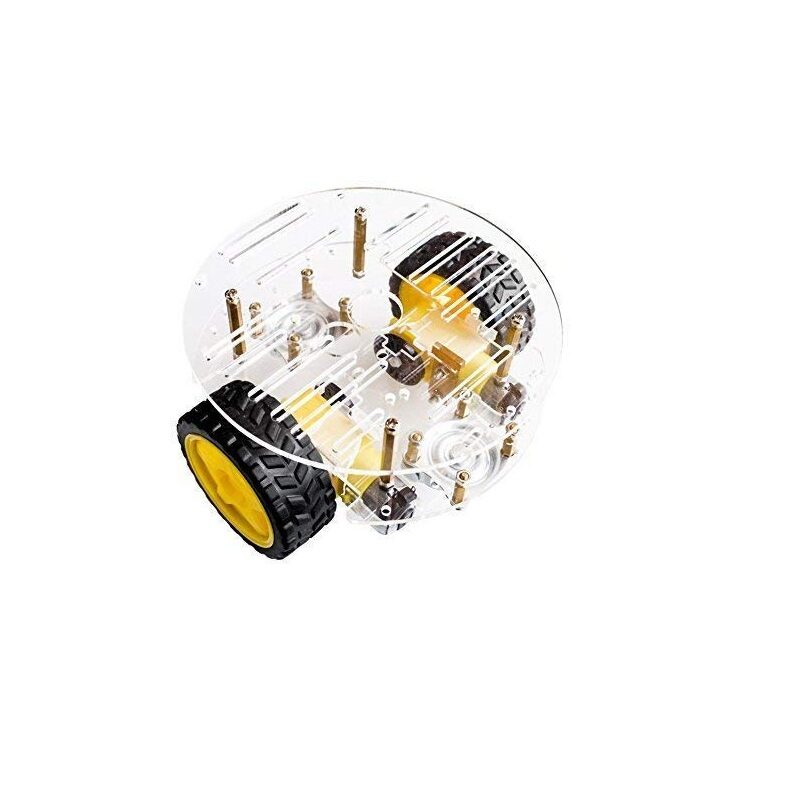
2WD Mini Round Double-Deck Smart Robot Car Chassis DIY Kit
Perfect entry-level chassis for building swarm robot nodes. Compact, lightweight round platform with dual DC motors ideal for flocking and foraging experiments.
Hardware You Need for a DIY Swarm
A practical DIY swarm for students in India typically consists of 3–10 identical robot nodes. Each node needs:
- Chassis: A small wheeled or tracked platform. Circular or square shapes work well to avoid directional bias.
- Microcontroller: ESP32 is the top choice because it has built-in Wi-Fi and Bluetooth for inter-robot communication.
- Motor driver: L298N or L9110S for driving DC gear motors.
- Proximity sensors: IR sensors or ultrasonic HC-SR04 for obstacle/neighbour detection.
- Communication module: ESP-NOW (ESP32 native), nRF24L01, or Bluetooth classic.
- Power: 3.7V LiPo battery with a TP4056 charging module for each node.
Keeping each node’s cost under ₹800–₹1,200 is very achievable in India using components sourced from Zbotic, making a 5-robot swarm accessible for under ₹6,000 total.
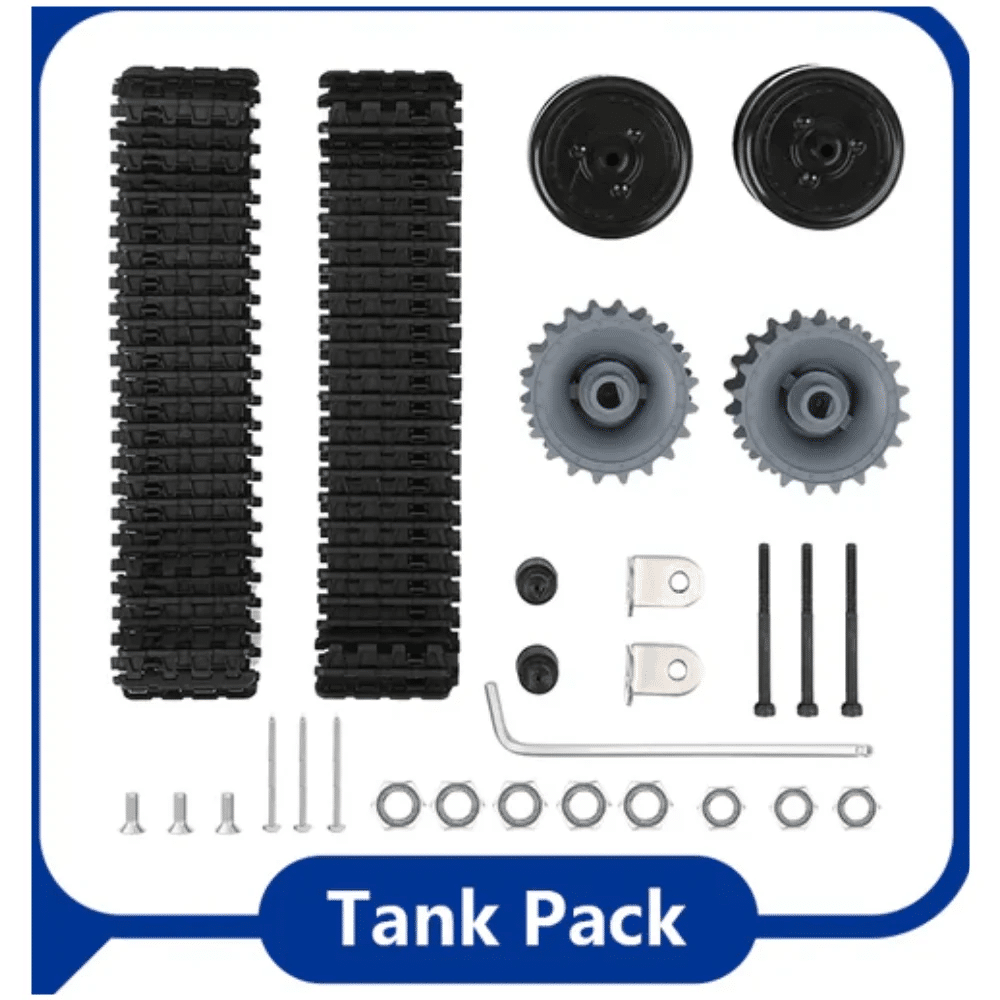
ACEBOTT ESP32 Tank Robot Car Expansion Pack
ESP32-powered tank platform with built-in wireless — ideal for replicating swarm algorithms. Each unit can participate in ESP-NOW mesh networks right out of the box.
Communication Methods Between Robots
Communication is the backbone of any swarm. The choice of protocol directly affects latency, range, and energy consumption:
ESP-NOW (Best for ESP32 Swarms)
ESP-NOW is a connectionless Wi-Fi protocol developed by Espressif. It allows ESP32 boards to send short packets (up to 250 bytes) directly to each other without a router, with latency under 2 ms. It supports broadcast mode — perfect for flocking where every robot must hear every other robot. Range is roughly 200 m line-of-sight.
nRF24L01 Radio Modules
These 2.4 GHz transceivers are cheap (₹60–₹100 each) and reliable. They require SPI wiring to an Arduino or similar board. The library supports up to 6 simultaneous communication pipes, making small swarms easy to manage.
Infrared (Local Neighbour Detection)
IR emitter-receiver pairs on each robot allow direct neighbour detection at short range (5–30 cm). They cannot carry complex data but are excellent for separation and alignment rules in flocking since they encode proximity and direction physically.
Bluetooth Classic / BLE Mesh
For swarms requiring pairing reliability, Bluetooth Classic works well at short range. BLE mesh (ESP32 native) allows true multi-hop communication, enabling larger swarms where not all robots are in direct radio range of each other.
Software and Simulation Tools
Before building physical hardware, simulate your swarm. This saves enormous time and cost.
- ARGoS: The most popular open-source swarm robotics simulator, used in academic research worldwide. Supports hundreds of virtual robots in real time.
- Webots: Free, cross-platform robot simulator. Has built-in e-puck and Khepera models commonly used in swarm research.
- NetLogo: Agent-based modelling environment with a shallow learning curve — great for Indian students new to swarm algorithms. Many flocking and foraging models available out of the box.
- ROS 2 + Gazebo: For advanced users who want to move to production-level swarms. Steep learning curve but industry-standard.
- Arduino IDE + ESP-NOW library: For programming your physical ESP32 swarm nodes once algorithms are validated in simulation.
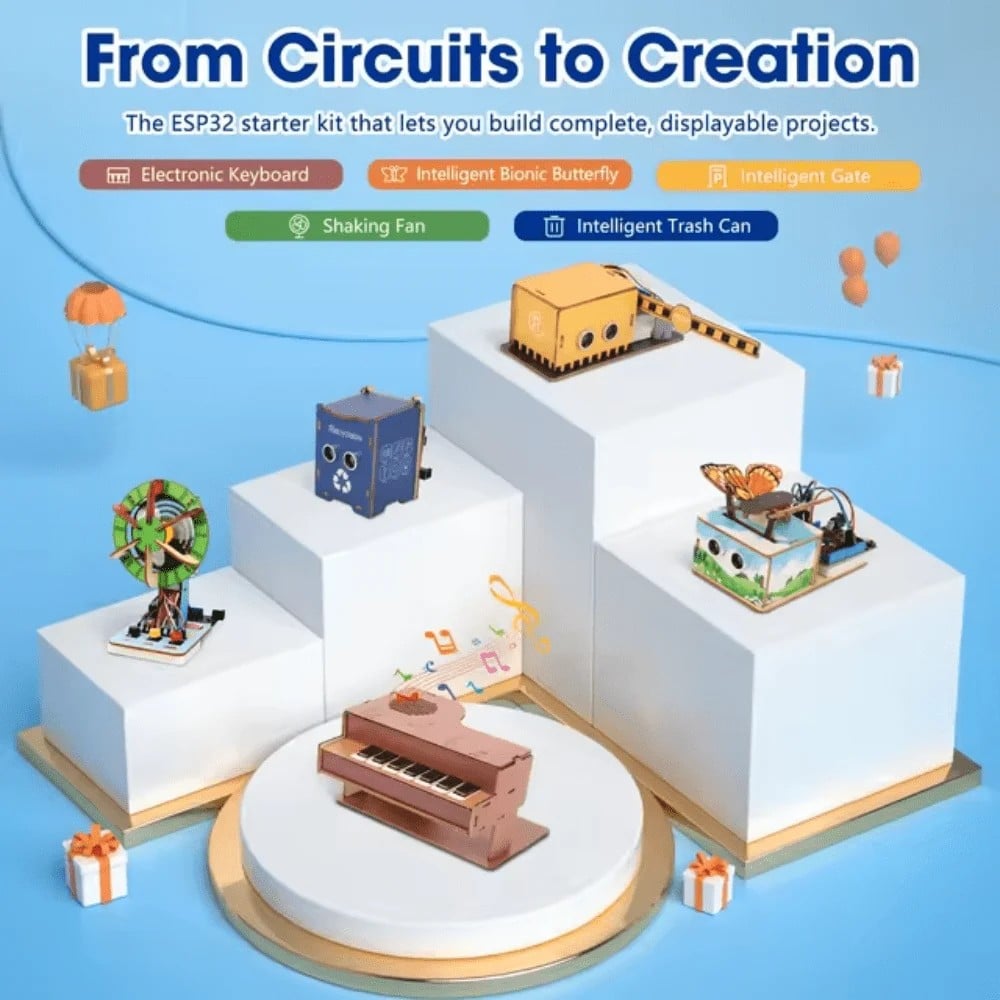
ACEBOTT ESP32 Basic Starter Kit (QE201)
Comprehensive ESP32 starter kit with sensors, LEDs, and expansion boards — a cost-effective way to prototype your swarm node electronics before committing to multiple units.
Step-by-Step DIY Implementation
Here is a practical roadmap to build a 3-robot flocking swarm in India:
Step 1: Choose and Build Your Node
Use the 2WD round chassis as a base. Mount an ESP32 DevKit, L298N motor driver, 2 HC-SR04 ultrasonic sensors (front and back), and a 1000 mAh LiPo. Wire the motor driver to GPIO pins 26/27 (left motor) and 14/12 (right motor). Power the ESP32 from the LiPo via a TP4056 + MT3608 boost module to 5V.
Step 2: Implement ESP-NOW Broadcast
Each robot broadcasts its current velocity vector (vx, vy) every 50 ms. All robots listen in broadcast mode. In the receive callback, store the last received vectors from up to 10 neighbours in a circular buffer.
Step 3: Code the Flocking Rules
In the main loop (running at 20 Hz), calculate three steering vectors:
- Separation: sum of unit vectors away from any neighbour closer than 30 cm (ultrasonic).
- Alignment: average velocity of all known neighbours (from ESP-NOW data).
- Cohesion: vector toward average broadcast-estimated position (use RSSI as a crude distance proxy).
Weight them (e.g., 1.5 × separation + 1.0 × alignment + 0.8 × cohesion) and map the resulting vector to left/right motor PWM values.
Step 4: Test on a Flat Surface
Start with a large open area (a classroom floor works well). Power on all three robots within 2 m of each other. Watch for emergent group movement. Tune the weights in code until cohesion is maintained while collisions are avoided.
Step 5: Add a Goal
Add a light sensor (LDR) to each robot. Implement a simple foraging algorithm: robots move toward stronger light (the goal), but flocking rules prevent them from bunching up. This closely mimics ant foraging behaviour.
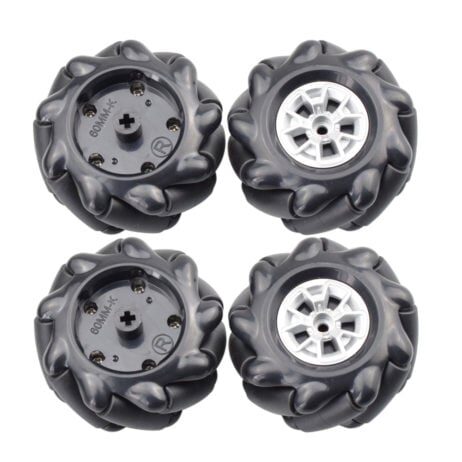
60MM-K Mecanum Wheel (Pack of 4) – Black
Upgrade your swarm nodes with holonomic movement. Mecanum wheels let each robot move in any direction without turning, dramatically improving flocking responsiveness on flat floors.
Real-World Applications of Swarm Robotics
Swarm robotics is no longer just academic. Here are areas where it is being deployed or actively researched:
- Agriculture: Drone swarms for precision spraying of large fields, covering areas faster than a single drone.
- Search and Rescue: Ground robot swarms can explore collapsed building areas in parallel, mapping hazards faster than human teams.
- Warehouse Logistics: Amazon Robotics uses swarm-inspired principles for its Kiva robot fleets to move shelves efficiently.
- Environmental Monitoring: Aquatic robot swarms mapping pollution levels across large water bodies.
- Military and Defence: Autonomous drone swarms for surveillance and electronic warfare — active area of research globally and in India’s DRDO.
- Space Exploration: NASA and ESA are researching swarms of small rovers to explore planetary surfaces where a single large rover would be too risky.
For Indian engineering students, presenting a working swarm robot at competitions like Techfest (IIT Bombay) or Smart India Hackathon is a strong differentiator that often impresses judges with its emergent complexity from simple rules.
Frequently Asked Questions
How many robots do I need to demonstrate swarm behaviour?
You can observe emergent behaviour with as few as 3 robots, though 5–7 makes patterns much more obvious. Academic research typically uses 10+ for meaningful statistical results.
Can I use Arduino instead of ESP32 for a swarm?
Yes, but you’ll need external communication modules (nRF24L01 or XBee). ESP32 is strongly recommended because its built-in wireless dramatically reduces wiring complexity and cost.
What is the difference between swarm robotics and multi-robot systems?
Multi-robot systems often have centralised coordination (a master robot or computer). True swarm robotics requires fully decentralised control — each robot makes decisions only from local sensor data and local communication, with no global knowledge.
Is swarm robotics a good project for B.Tech or M.Tech thesis in India?
Absolutely. It combines embedded systems, wireless communication, control theory, and AI algorithms — covering multiple engineering domains. Many Indian universities accept swarm robotics projects, and there are active research groups at IITs, NITs, and BITS Pilani.
What is the typical budget for a 5-robot swarm in India?
Expect to spend ₹800–₹1,200 per robot node (chassis + ESP32 + motors + sensors + battery). Total project cost including simulation tools (which are free) is roughly ₹5,000–₹8,000 for a functional 5-node swarm.
Zbotic stocks all the components you need — ESP32 boards, robot chassis, motor drivers, sensors, and more — with fast delivery across India. Browse our Robotics & Automation collection and get building today.







Add comment