
Table of Contents
- Introduction
- Stepper Motor Electrical Basics
- Understanding Rated Voltage vs Operating Voltage
- Current Rating and Why It Matters
- The Driver’s Role in Power Delivery
- NEMA 17 Power Supply Guide
- NEMA 23 Power Supply Guide
- Types of Power Supplies for Stepper Motors
- How to Size Your Power Supply
- Thermal Management
- Frequently Asked Questions
- Conclusion
Introduction
Choosing the right power supply for a stepper motor is one of the most misunderstood aspects of DIY CNC machines, 3D printers, and precision robotics. Get it wrong, and you will face overheating drivers, lost steps, sluggish torque, or simply motors that refuse to work correctly. Get it right, and your machine runs smoothly, reliably, and at peak efficiency.
This guide explains the relationship between stepper motor voltage, current, and power supply selection in plain language — no electrical engineering degree required. We cover the two most common stepper motor sizes in the Indian maker market (NEMA 17 and NEMA 23), the role of drivers like the A4988 and DRV8825, and practical tips for selecting and using the right power supply for your project.
Stepper Motor Electrical Basics
A stepper motor is a brushless DC motor that moves in discrete steps. Each step corresponds to a fixed angular displacement — typically 1.8° per step (200 steps per full revolution) for the most common types. The motor has two (or more) coil windings, and the driver alternately energises these coils to rotate the rotor one step at a time.
From an electrical standpoint, each coil is a resistive-inductive (RL) load. The coil has:
- Resistance (R): The DC resistance of the coil wire, typically 1–10 Ω
- Inductance (L): The coil’s opposition to changing current, typically 1–10 mH
- Rated Current (A): The maximum continuous current the coil should carry
- Rated Voltage (V): Calculated as Rated Current × Resistance (V = I × R)
Here is the crucial insight: the rated voltage on a stepper motor datasheet is NOT the voltage you power it with. It is simply the voltage at which the coil reaches its rated current based on its DC resistance. In practice, you run stepper motors at voltages much higher than their rated voltage — and the driver limits the current to the safe level.
Understanding Rated Voltage vs Operating Voltage
Let us use the popular 28BYJ-48 5V stepper motor as an illustrative contrast, then move to NEMA motors.
The 28BYJ-48 is rated at 5V because its coil resistance is high enough that 5V across the coil produces safe current levels. It connects directly to a ULN2003 driver (not a current-limiting driver) and genuinely needs 5V.
In contrast, a NEMA 17 stepper motor with a coil resistance of 1.4Ω and rated current of 1.5A has a rated voltage of: V = 1.5A × 1.4Ω = 2.1V. Yet you would never power it from a 2.1V supply! At 2.1V, the current rises slowly because of the coil’s inductance, limiting the motor’s ability to step quickly. The torque falls off sharply at higher speeds.
The solution: use a much higher supply voltage (12V, 24V, or even 48V) and let the driver’s current-limiting circuit (chopper circuit) rapidly switch the supply to maintain exactly the rated current in the coil. This dramatically improves high-speed torque.
Rule of thumb: Use a supply voltage 5–10× the motor’s rated voltage for good performance. For that 2.1V-rated NEMA 17, a 12V–24V supply is ideal.
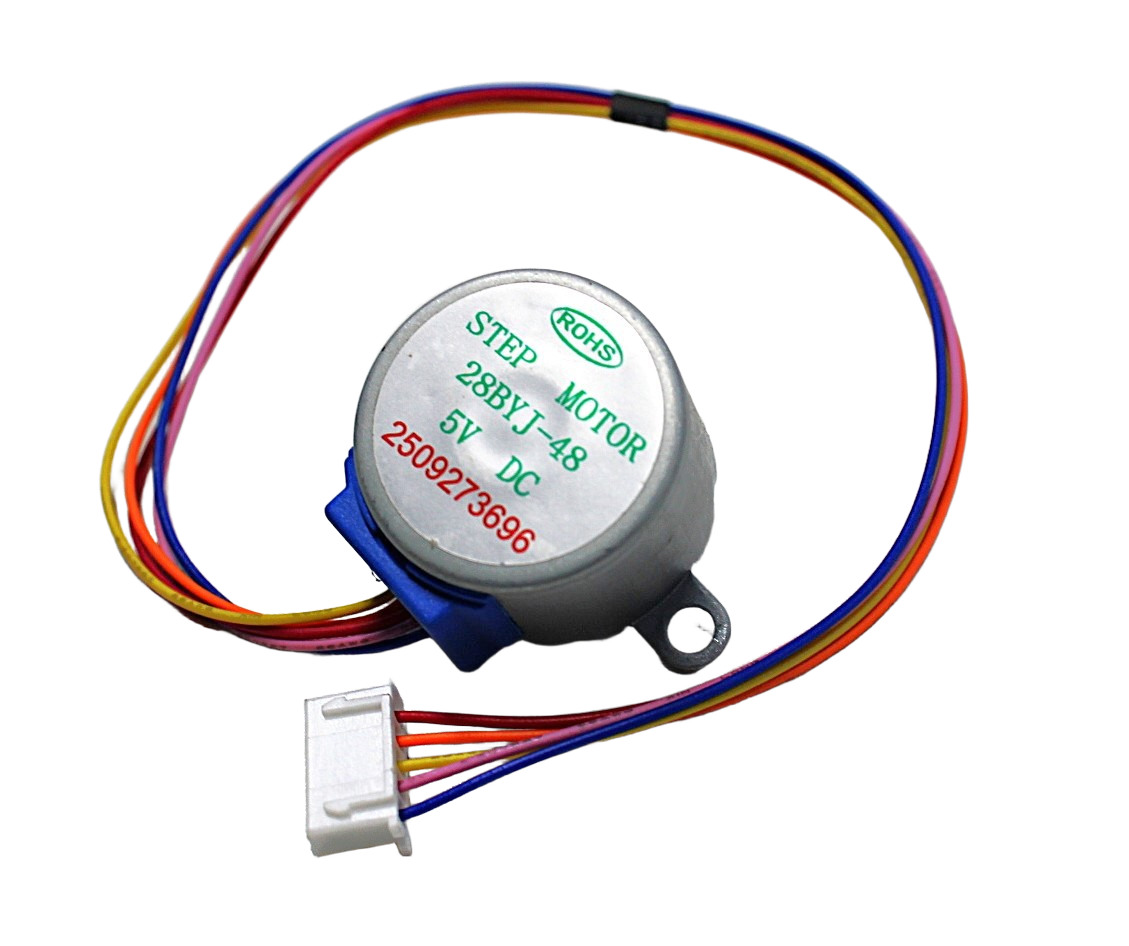
28BYJ-48 5V Stepper Motor
The classic beginner stepper motor — genuinely 5V operated, perfect for learning stepper control with a ULN2003 driver board and Arduino.
Current Rating and Why It Matters
The current rating (per phase/coil) is the most important parameter when choosing a stepper motor power supply and driver. Getting this wrong is the number one cause of motor problems.
Too Little Current
If you limit the driver below the motor’s rated current, the motor produces less torque — sometimes much less. At 50% of rated current, torque drops to roughly 50%. You get more missed steps, especially under load. The motor may also stall when it should not.
Too Much Current
Running a motor above its rated current generates excessive heat in the coils. Stepper motors are thermally limited — continuous overdriving degrades the wire insulation, demagnetises the permanent magnets over time, and can cause catastrophic failure. The driver also runs hotter.
Setting Driver Current Correctly
Modern stepper drivers like the A4988 and DRV8825 have a small potentiometer for current adjustment. The formula to set the current (for A4988) is:
VREF (volts) = Current_limit × 8 × Rsense
Where Rsense is the driver’s current-sense resistor value (typically 0.1Ω on the red A4988 modules). So for 1.5A: VREF = 1.5 × 8 × 0.1 = 1.2V. Measure VREF at the potentiometer wiper with a multimeter and adjust accordingly.

A4988 Stepper Motor Driver Controller Board (Red)
The industry-standard STEP/DIR stepper driver for NEMA 17 motors — supports microstepping up to 1/16, adjustable current limiting, and works with 8–35V supply.
The Driver’s Role in Power Delivery
A stepper motor driver does much more than just switch power to the coils. Modern drivers (A4988, DRV8825, TMC2208, etc.) are constant-current chopper controllers. They:
- Apply the full supply voltage to the coil to force current to rise quickly
- Sense the coil current via a low-value resistor
- When current reaches the set limit, switch the supply off (or on in a complementary cycle)
- Repeat this at high frequency (typically 20–50 kHz) to maintain the average current at the set value
This chopper action is why you can use 24V with a 2.1V-rated motor without burning the coils — the driver ensures the actual sustained current never exceeds your set limit. The higher supply voltage just means the current rises faster at each step, giving you better high-speed performance.
NEMA 17 Power Supply Guide
NEMA 17 is by far the most popular stepper motor size for 3D printers and desktop CNC machines. Common specs for popular Indian market NEMA 17 motors (like the 42HS48-1204A from Zbotic):
- Rated current: 1.2A per phase
- Coil resistance: ~3.3Ω
- Rated voltage (calculated): 1.2 × 3.3 = ~4V
- Holding torque: 5.6 kg-cm (55 N·cm)
Recommended Power Supply for NEMA 17
- Voltage: 12V (minimum) to 24V (recommended for best performance)
- Current capacity: At least 1A per motor × number of motors + 20% overhead. For a 3-motor system at 1.2A each: 3 × 1.2 × 1.3 ≈ 4.7A. Use a 5A or 10A supply.

42HS48-1204A NEMA17 5.6 kg-cm Stepper Motor (D-Type Shaft)
High-torque NEMA 17 stepper with detachable cable and D-shaft — compatible with standard 3D printer and CNC setups using A4988 or DRV8825 at 12–24V.
NEMA 23 Power Supply Guide
NEMA 23 motors are physically larger (57mm flange) and produce more torque — typically 10–25 kg-cm or more. They are used in router CNC machines, laser cutters, and heavy-duty automation.
Recommended Power Supply for NEMA 23
- Voltage: 24V to 48V for best performance (higher inductance means higher voltage needed for good high-speed torque)
- Current capacity: NEMA 23 motors often draw 2–4A per phase. For a 3-axis system at 3A: 3 × 3 × 1.3 ≈ 11.7A. Use a 15A–20A 24V or 48V PSU.
- Driver: A4988 is not suitable for NEMA 23 (limited to 2A). Use DRV8825 (2.2A) or TB6600 (3.5A), or industrial drivers like DM542 for 4A+.
Types of Power Supplies for Stepper Motors
1. Switching Power Supply (SMPS)
The most common choice for CNC and 3D printers. Available in standard sizes: 12V/10A, 12V/30A, 24V/10A, 24V/20A. Compact, efficient, regulated output. The S-350-24 and S-400-24 units are popular in India for mid-size CNC machines.
2. Laptop/Notebook Adapter
A 12V laptop power supply (often salvaged) provides 3–5A and works well for a 2–3 motor NEMA 17 system. Not ideal for NEMA 23. Ensure the connector polarity matches your circuit.
3. 12V SLA (Sealed Lead-Acid) Battery
Good for portable or battery-operated systems. 12V 7Ah provides substantial current headroom. The battery’s internal resistance limits available peak current — ensure your battery is rated for the combined motor stall current.
4. ATX Computer Power Supply
A salvaged ATX PSU provides 12V at 20–30A — more than enough for any multi-motor stepper system. Requires a power-on jumper (short the green PS_ON wire to ground) to run without a motherboard. Add a resistive load (like an old hard drive or an 8Ω/10W resistor) on the 5V rail as some ATX units need a minimum load to regulate properly.
How to Size Your Power Supply
Follow this step-by-step process:
- Find each motor’s rated current per phase (A) from the datasheet or product label.
- Multiply by number of motors to get total motor current demand.
- Add 20–30% margin for start-up spikes and other electronics (controller board, fans, spindle if applicable).
- Choose supply voltage: 12V for basic NEMA 17 work, 24V for better NEMA 17 performance and basic NEMA 23, 48V for high-speed NEMA 23 CNC.
- Verify driver input voltage range supports your chosen supply voltage. A4988: 8–35V, DRV8825: 8.2–45V, TB6600: 9–40V.
Example sizing for a 3D printer with 3× NEMA 17 (1.2A each) + hotend + fans:
Motor current: 3 × 1.2 = 3.6A (but only 2 motors active simultaneously usually)
Other loads: ~3A (heaters, fans, electronics)
Total: ~6.6A with margin → Use a 12V 10A or 24V 10A PSU.
Thermal Management
Heat is the enemy of stepper driver reliability. Here is how to manage it:
- Heatsink on driver ICs: Always add the small adhesive heatsink (often included with A4988/DRV8825 modules) to the driver IC.
- Active cooling: For machines that run for hours, add a small 5V or 12V fan blowing over the driver board area.
- Motor idle current reduction: Most modern drivers support automatic current reduction when the motor is stationary. Enable this feature (typically via a dedicated pin or firmware setting). Reduces heat by ~50% at idle.
- Adequate ventilation: Enclosed electronics enclosures must have ventilation holes or dedicated fans. Stepper drivers in sealed boxes will overheat within minutes at full load.
Frequently Asked Questions
Q: Can I use a 12V 2A power supply for a NEMA 17 stepper?
Technically the motor might run, but a 2A supply is likely insufficient margin for a 1.2–2A rated NEMA 17 motor, especially with a controller board also drawing current. Use at least 5A at 12V for a single-motor system, and scale up for multi-motor systems.
Q: My stepper motor gets very hot — is something wrong?
Some heat is normal for stepper motors — up to 60–70°C surface temperature is acceptable. If you cannot hold your hand on the motor for more than a second, it is too hot. Causes include driver current set too high, no idle current reduction, running at high duty cycle, or poor ventilation. First check: measure and reduce driver VREF by 10–20%.
Q: Can I run 3 NEMA 17 motors from a single 12V 5A supply?
Yes, if not all three run at full load simultaneously (common in 3D printers where not all axes move at once). For CNC where all axes move together, calculate total simultaneous current and ensure your PSU can handle it.
Q: Does higher voltage damage the stepper motor?
No — as long as the driver limits current correctly. The driver’s chopper circuit protects the motor from overcurrent. However, higher voltage can stress the driver MOSFETs if beyond their rating, and can increase RF interference. Stay within the driver’s rated input voltage range.
Q: What voltage does the 28BYJ-48 stepper need?
The 28BYJ-48 is a 5V unipolar motor driven by a ULN2003 darlington array. It genuinely runs at 5V (not a current-limiting driver). Powering it at higher voltage without current limiting will burn out the coils.
Conclusion
The key takeaways for choosing a stepper motor power supply: the motor’s rated voltage from the datasheet is not your supply voltage — run at 5–10× that value for good performance. The driver limits current to protect the motor. Size your power supply amperage for the total simultaneous current draw of all motors plus a 30% margin. Use 12V for simple NEMA 17 systems and 24V+ for demanding applications or NEMA 23 motors.
Getting power supply selection right from the start prevents the most common failure modes in DIY CNC and 3D printer builds: skipped steps, overheating drivers, and mysteriously sluggish motors.
Shop Stepper Motors & Drivers on Zbotic
Zbotic stocks NEMA 17, NEMA 23, stepper drivers, and accessories. All shipped across India with technical support from the Zbotic team.




Add comment