
Before ultrasonic sensors became the default choice for beginner obstacle avoidance projects, the Sharp infrared distance sensor series was the go-to solution for robot navigation, proximity detection, and short-range distance measurement. Even today, Sharp IR sensors have significant advantages in specific scenarios — they are faster, immune to sound interference, work reliably on soft surfaces that absorb ultrasound, and have a compact form factor.
The most well-known model is the GP2D12 (now superseded by the GP2Y0A21YK0F), but the entire Sharp GP2Y series follows the same operating principle. This guide covers everything: how the sensors work, which model to choose, correct wiring, accurate distance conversion formulas, Arduino code, and the tricky non-linearity that trips up many beginners.
How Sharp IR Distance Sensors Work
Sharp IR distance sensors use a technique called triangulation, not time-of-flight. Here is how it works:
- An infrared LED emits a beam of modulated IR light at a specific angle.
- The light reflects off the target object and returns to the sensor.
- The returned light hits a Position Sensitive Detector (PSD) — a linear photodiode array that is sensitive to the position of the incident light spot.
- A signal processing circuit calculates where on the PSD the reflected beam lands. Closer objects create a steeper reflection angle, landing further along the PSD. Distant objects create a shallower angle.
- The circuit outputs an analog voltage proportional to this PSD position — which is inversely related (but not linearly) to distance.
The key advantage of triangulation over time-of-flight: the sensor does not need to measure nanosecond time delays. The PSD position is a robust electrical measurement, making the sensor more immune to ambient light interference than simple IR reflection sensors (like the TCRT5000).
GP2D12 Series: Model Comparison
| Model | Range | Supply | Update Rate | Notes |
|---|---|---|---|---|
| GP2D12 | 10–80 cm | 4.5–5.5V | 25 Hz | Original model, now obsolete |
| GP2Y0A21YK0F | 10–80 cm | 4.5–5.5V | 25 Hz | Drop-in replacement for GP2D12 |
| GP2Y0A02YK0F | 20–150 cm | 4.5–5.5V | 25 Hz | Long-range version |
| GP2Y0A41SK0F | 4–30 cm | 4.5–5.5V | 25 Hz | Short-range for tight spaces |
| GP2Y0A51SK0F | 2–15 cm | 2.7–5.5V | 75 Hz | Very short range, 3.3V compatible |
For most obstacle-avoidance robot projects, the GP2Y0A21YK0F (10–80 cm, drop-in replacement for GP2D12) is the right choice. Its 80 cm maximum range gives enough time for a robot travelling at moderate speed to detect and avoid obstacles.
The Non-Linear Voltage Curve
The most important thing to understand about Sharp IR sensors is that the output voltage vs. distance relationship is strongly non-linear. It is not a straight line — it is approximately an inverse relationship: V ∝ 1/distance.
Moreover, there is a close-range inversion zone. For the GP2Y0A21, the voltage peaks at around 3–4V at approximately 8 cm. For objects closer than ~10 cm, the voltage actually decreases as the object gets closer. This means if you naively map higher voltage = closer, the sensor will report incorrect distances for very close objects.
The raw voltage vs distance curve for GP2Y0A21 looks approximately like this:
| Distance (cm) | Output Voltage (V, typical) |
|---|---|
| 10 | 2.50 |
| 15 | 1.80 |
| 20 | 1.40 |
| 30 | 0.95 |
| 40 | 0.72 |
| 60 | 0.50 |
| 80 | 0.39 |
Wiring to Arduino
The Sharp GP2Y0A21 (and GP2D12) has a JST 3-pin connector with 0.1″ spacing. The pin order from left to right when viewing the connector face is: VO (output), GND, VCC.
Sharp GP2D12 / GP2Y0A21 Pinout:
  Pin 1 (VO)  → Arduino A0 (analog input)
  Pin 2 (GND) → Arduino GND
  Pin 3 (VCC) → Arduino 5V
Important: Add a 10μF electrolytic capacitor (positive to VCC, negative to GND) as close to the sensor’s VCC/GND pins as possible. The sensor draws significant peak current when the IR LED fires, and without decoupling capacitors this causes voltage spikes that corrupt the Arduino’s ADC readings.
Also add a 10nF ceramic capacitor between VO and GND to filter high-frequency noise on the analog output.
Distance Conversion: Formula and Lookup Table
Method 1: Empirical Inverse Formula
The relationship between output voltage (V) and distance (cm) for GP2Y0A21 is approximated well by:
distance_cm = 29.988 * pow(voltage, -1.173);Where voltage is the ADC reading converted to volts: voltage = analogRead(A0) * (5.0 / 1023.0).
This formula is derived from a power-law regression fit to the Sharp datasheet characteristic curve. It gives approximately ±1–2 cm accuracy in the 10–80 cm range.
Method 2: Lookup Table + Linear Interpolation
For better accuracy, use a lookup table based on your own calibration measurements:
// Calibrated lookup table: {ADC_raw, distance_cm} pairs
// Measured with objects at known distances
const int LUT[][2] = {
  {800, 10}, {650, 12}, {520, 15}, {400, 20},
  {300, 25}, {240, 30}, {195, 35}, {160, 40},
  {130, 50}, {110, 60}, {90, 70},  {78, 80}
};
const int LUT_SIZE = 12;

float adcToDistance(int raw) {
  if (raw >= LUT[0][0]) return LUT[0][1];
  if (raw <= LUT[LUT_SIZE-1][0]) return LUT[LUT_SIZE-1][1];
  for (int i = 0; i < LUT_SIZE-1; i++) {
    if (raw <= LUT[i][0] && raw > LUT[i+1][0]) {
      // Linear interpolation
      float frac = (float)(LUT[i][0] - raw) / (LUT[i][0] - LUT[i+1][0]);
      return LUT[i][1] + frac * (LUT[i+1][1] - LUT[i][1]);
    }
  }
  return -1;  // out of range
}
Complete Arduino Code
// Sharp GP2D12 / GP2Y0A21 Distance Sensor with Arduino
// Uses power-law formula + moving average filter

#define IR_PIN A0
#define NUM_SAMPLES 5  // Moving average samples

void setup() {
  Serial.begin(115200);
  analogReference(DEFAULT);  // 5V reference
  Serial.println("Sharp IR Distance Sensor");
  Serial.println("Distance (cm)");
}

// Convert raw ADC to voltage
float rawToVoltage(int raw) {
  return raw * (5.0f / 1023.0f);
}

// Convert voltage to distance (cm) — GP2Y0A21 formula
// Valid range: 10-80cm. Returns -1 if out of range.
float voltageToDistance(float v) {
  if (v < 0.35f) return -1;   // Too far (>80cm)
  if (v > 2.8f)  return -1;   // Too close (<10cm) OR in inversion zone
  return 29.988f * pow(v, -1.173f);
}

// Moving average filter
float movingAverage(float newVal) {
  static float buffer[NUM_SAMPLES] = {0};
  static int idx = 0;
  static float sum = 0;
  sum -= buffer[idx];
  buffer[idx] = newVal;
  sum += newVal;
  idx = (idx + 1) % NUM_SAMPLES;
  return sum / NUM_SAMPLES;
}

void loop() {
  int raw = analogRead(IR_PIN);
  float voltage = rawToVoltage(raw);
  float distance = voltageToDistance(voltage);

  float filtered = movingAverage(distance > 0 ? distance : 90);

  if (distance < 0) {
    Serial.println("Out of range");
  } else {
    Serial.print("Raw: "); Serial.print(raw);
    Serial.print("  Voltage: "); Serial.print(voltage, 3);
    Serial.print("V  Distance: "); Serial.print(distance, 1);
    Serial.print(" cm  Filtered: "); Serial.print(filtered, 1);
    Serial.println(" cm");
  }

  delay(50);  // ~20 readings/second
}
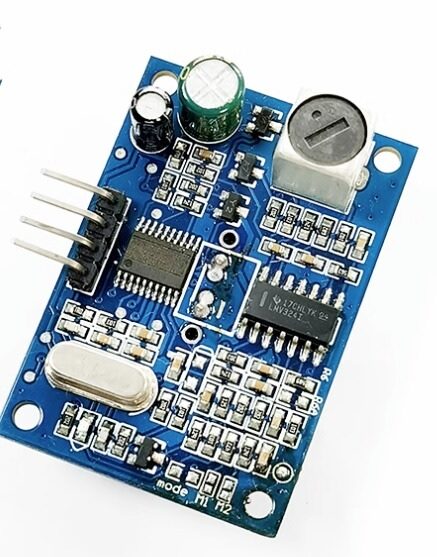
JSN-SR04T Waterproof Ultrasonic Rangefinder Module Version 3.0
When IR is not enough — the JSN-SR04T gives up to 4.5m waterproof ultrasonic ranging. Perfect complement to the Sharp IR for longer-range obstacle detection.
Tips for Better Accuracy
1. Decoupling Capacitors Are Non-Negotiable
Without the 10μF + 10nF capacitor combination, you will get random spikes in your readings every time the IR LED pulses. Always add decoupling capacitors. This is the single most common cause of erratic Sharp IR readings.
2. Avoid Black and Reflective Surfaces
The sensor relies on reflected IR light. Matte black surfaces absorb IR and return very little signal, causing the sensor to underestimate distance. Highly reflective or transparent surfaces (mirrors, glass) give unpredictable reflections. White and grey surfaces are ideal.
3. Avoid Direct Sunlight
The sun emits enormous amounts of IR radiation that can saturate the PSD. Sharp IR sensors are not suitable for outdoor use in direct sunlight. Use an ultrasonic sensor (HC-SR04 or JSN-SR04T) for outdoor applications instead.
4. Use Multiple Samples
Read the sensor 5-10 times in rapid succession and average the results. The moving average filter in the code above does this over time. Alternatively, take 10 analogRead() calls in a tight loop before computing distance.
5. Ensure Stable 5V Supply
Use the AREF pin with an external 5V reference if your board’s 5V rail is noisy. Alternatively, use analogReference(INTERNAL) with a voltage divider, though this complicates the conversion formula.
6. The 80ms Rule
The GP2Y0A21 updates its output at 25 Hz (one reading every 40ms). The signal settling time after direction change is about 80ms. Do not sample faster than every 80ms when tracking a moving target — you will read stale data.
Project Ideas and Applications
Obstacle-Avoidance Robot
Mount a Sharp IR sensor on the front of a two-wheeled robot. When the reading drops below 20 cm, the robot stops and turns. IR sensors respond faster than ultrasonic and work well with robot chassis noise (ultrasound can detect the robot’s own vibrations).
Line-Following Robot Height Adjustment
A Sharp short-range IR sensor (GP2Y0A41 or GP2Y0A51) can be used to maintain consistent ground clearance on uneven surfaces, keeping a line sensor array at the optimal height for reliable line detection.
Automatic Hand Sanitiser Dispenser
Use a GP2Y0A41 (4–30 cm range) to detect when a hand is placed below a nozzle. Trigger a pump relay to dispense hand sanitiser. Touchless dispensers built with this approach are fast and reliable.
Parking Sensor
Mount a GP2Y0A02 (20–150 cm) at the rear of a garage. LED or buzzer feedback changes intensity as a car backs in, alerting the driver when they are within 30 cm of the wall.
Liquid Level Measurement
Mount a GP2Y0A21 pointing downward into a tank. The distance reading from sensor to liquid surface corresponds to liquid level. Because IR does not need to contact the liquid, this works with corrosive or hot liquids (within the sensor’s operating temperature range).
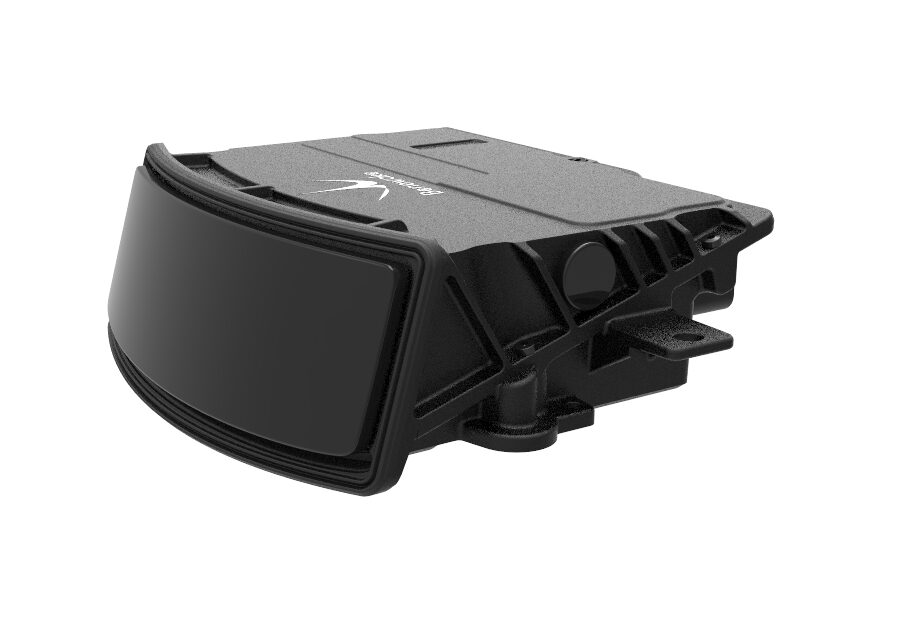
Benewake AD2-S-X3 High-Performance Automotive-Grade LiDAR
When your project outgrows the Sharp IR sensor — professional-grade 3D LiDAR for autonomous robot navigation and advanced distance sensing.
Frequently Asked Questions
Q: Is the GP2D12 still available, or should I buy the GP2Y0A21?
The GP2D12 is officially discontinued by Sharp. The GP2Y0A21YK0F is the direct replacement with identical specifications and pin-out. Buy the GP2Y0A21 for any new project — it is widely available from Indian electronics suppliers.
Q: Why does my Sharp sensor read negative or impossible values?
The most common causes are: (1) missing decoupling capacitors causing voltage spikes — add 10μF between VCC and GND; (2) object closer than 10 cm — the sensor is in its inversion zone; (3) reading too fast — add a small delay (at least 40ms between readings).
Q: Can Sharp IR sensors work with a 3.3V Arduino?
Not directly. Most Sharp sensors require 4.5–5.5V supply for the IR LED. However, the GP2Y0A51 supports down to 2.7V. For 3.3V systems with other models, use a 5V boost converter for the sensor supply while connecting the analog output (max ~3V) directly to the 3.3V ADC input.
Q: Can I use two Sharp IR sensors side by side without interference?
Yes. Sharp sensors emit modulated IR (not continuous), and the modulation frequency is different from common ambient IR sources. Adjacent sensors can interfere if they share a field of view at very close range (under 5 cm apart), but in normal mounting configurations interference is not a problem.
Q: How do I convert the GP2Y0A21 formula for the GP2Y0A02 (150 cm version)?
The GP2Y0A02 has a different characteristic curve. Its approximate formula is: distance_cm = 60.374 * pow(voltage, -1.16). Always verify against your own calibration measurements — individual sensor variation and supply voltage affect the curve.
Q: Is a Sharp IR sensor better or worse than HC-SR04 ultrasonic?
Both are useful. HC-SR04 is cheaper and handles longer ranges (up to 4m) and works outdoors. Sharp IR responds faster, handles soft surfaces better (clothing, foam), and detects transparent objects that ultrasound misses. For indoor robots, Sharp IR is often preferable at short ranges. For medium range (>80 cm) or outdoor use, choose ultrasonic.
Explore distance and proximity sensors at Zbotic. From Sharp IR to ultrasonic rangefinders and professional LiDAR modules, we stock a complete range for every detection need. Fast shipping to all parts of India.
Conclusion
The Sharp GP2D12 / GP2Y series infrared distance sensors remain excellent tools for indoor distance measurement and obstacle detection. Their triangulation-based approach gives fast, reliable results on most surfaces, and their analog output integrates naturally with any Arduino. The key to success is understanding and accounting for the non-linear voltage curve, adding proper decoupling capacitors, and applying a moving average filter to smooth the readings. Once you have mastered these techniques, the Sharp IR sensor becomes a precise and dependable component in any robotics or automation project.



Add comment