
The ROS2 vs ROS1 comparison in 2026 is no longer a debate — ROS1 (Noetic) reached its official end-of-life in May 2025, making ROS2 the only actively maintained Robot Operating System for all new projects. Yet many Indian robotics students and developers still start projects on ROS Noetic because of the abundance of older tutorials. This guide explains every major architectural difference, what practically changed for developers, and exactly how to approach migrating or starting fresh on ROS2 in 2026.
A Brief History: ROS1 to ROS2
ROS (Robot Operating System) was created at Willow Garage in 2007 and became the de-facto standard middleware for research robots worldwide. ROS1 was brilliant for its time but built around assumptions that did not age well: single-machine operation, reliable networks, no real-time requirements, and no multi-robot scenarios. By 2014 the community started ROS2 development to fix these fundamental limitations.
Key milestones:
- 2017: ROS2 Ardent Apalone — first public release
- 2019: ROS2 Dashing Diademata — first LTS release
- 2022: ROS2 Humble Hawksbill — widely used LTS (EOL 2027)
- 2023: ROS2 Iron Irwini
- 2024: ROS2 Jazzy Jalisco — current LTS (EOL 2029)
- May 2025: ROS1 Noetic officially reaches end-of-life
- 2026: ROS2 Kilted Kaiju released (rolling distro cycle continues)
For new projects in India starting in 2026, use ROS2 Humble (still in LTS support until 2027) or ROS2 Jazzy (LTS until 2029). Do not start new projects on ROS Noetic.
Core Architecture Differences
This is the most important section for developers switching from ROS1. The fundamental communication model changed completely.
ROS1 Architecture
ROS1 relies on a central rosmaster process. All nodes register with rosmaster to discover each other. This is a single point of failure — if rosmaster crashes, the entire robot system goes down. Communication uses custom TCP/UDP protocols (ROSTCP, ROSUDP). No built-in security, no real-time guarantees.
ROS2 Architecture
ROS2 has no central master. Discovery is distributed via DDS (Data Distribution Service) — an industry-standard publish-subscribe middleware used in aerospace and defence. Nodes discover each other automatically on the network without any central coordinator. This enables:
- Multi-robot systems with no shared master
- Distributed systems spanning multiple machines and networks
- Automatic reconnection after node crashes without system restart
- Per-topic Quality of Service (QoS) policies (reliability, durability, latency)
DDS Middleware: The Biggest Change
DDS (Data Distribution Service) is the most significant architectural change in ROS2. In ROS1, the communication middleware was custom and proprietary to ROS. In ROS2, the communication layer is a pluggable DDS implementation. Current options:
| DDS Implementation | License | Best For |
|---|---|---|
| Fast DDS (eProsima) | Apache 2.0 (free) | Default, general use |
| Cyclone DDS (Eclipse) | Eclipse Public (free) | Lower latency, recommended for Nav2 |
| Connext DDS (RTI) | Commercial | Safety-critical, certified systems |
For most DIY robot projects in India, use Cyclone DDS as your RMW (ROS MiddleWare). It performs better in local network scenarios and is the recommended choice for Nav2 (the ROS2 navigation stack):
export RMW_IMPLEMENTATION=rmw_cyclonedds_cppReal-Time and Safety-Critical Support
ROS1 had no real-time support. All callbacks executed in a single-threaded spinner with unpredictable scheduling. This was acceptable for research robots but unusable for industrial or safety-critical applications.
ROS2 addresses this with:
- Executor model: Choose single-threaded, multi-threaded, or static single-threaded executors based on timing requirements.
- Real-time Linux integration: Works with PREEMPT_RT kernel patches for deterministic scheduling.
- ros2_realtime_benchmarks: Official benchmarking framework to measure latency jitter.
- rclc: A C-language ROS2 client library for microcontrollers (used with FreeRTOS and Zephyr).
- micro-ROS: Runs directly on ESP32, STM32, Teensy — brings ROS2 to microcontrollers directly without a full Linux host.
The micro-ROS development is particularly exciting for Indian DIY builders: you can now run a ROS2 node directly on an ESP32, communicating via DDS over Wi-Fi to a Raspberry Pi running Nav2 and RViz2.
API and Node Model Changes
The Python and C++ APIs changed significantly. Here is a practical comparison:
Python Node — ROS1 vs ROS2
# ROS1 (rospy)
import rospy
from std_msgs.msg import String
rospy.init_node('my_node')
pub = rospy.Publisher('topic', String, queue_size=10)
rospy.spin()

# ROS2 (rclpy)
import rclpy
from rclpy.node import Node
from std_msgs.msg import String
class MyNode(Node):
    def __init__(self):
        super().__init__('my_node')
        self.pub = self.create_publisher(String, 'topic', 10)
rclpy.init()
rclpy.spin(MyNode())
Key API changes: Nodes are now class-based (not function-based). No global rospy state — all state is per-node instance. This makes ROS2 nodes easier to test and compose. Services use async/await in Python for non-blocking calls. Parameters changed from a separate rosparam server to per-node parameters declared in code.
Build System: catkin vs ament/colcon
ROS1 used catkin (built on CMake). ROS2 uses ament (for individual packages) and colcon (the workspace build tool). Key changes:
catkin_make→colcon buildcatkin_ws/→ros2_ws/(just a convention, naming is flexible)source devel/setup.bash→source install/setup.bashpackage.xmlformat 2 → format 3 (addsament_cmakeorament_pythonas build type)- Python packages now use
setup.pyorpyproject.tomlalongside package.xml
# Build a ROS2 workspace
cd ~/ros2_ws
colcon build --symlink-install
source install/setup.bash
Ecosystem and Package Availability in 2026
The ecosystem gap that made ROS2 impractical in 2019–2021 has largely closed by 2026. Key status:
- MoveIt 2: Full-featured motion planning, actively maintained, works with ROS2 Humble and Jazzy
- Nav2: Navigation stack, significantly improved over ROS1 move_base, with pluggable planners
- Gazebo (Fortress/Harmonic): New simulator (Ignition/Gazebo) is the standard; classic Gazebo deprecated
- ROS2 Control: Hardware abstraction layer for actuators and sensors, much cleaner than ROS1 ros_control
- RViz2: Near feature-parity with ROS1 RViz
- rosbag2: Replaces rosbag, now supports SQLite and MCAP formats
Most popular ROS1 driver packages (Hector SLAM, GMapping, robot_localization) have been ported to ROS2. The only gaps remaining are some highly specialized research packages that depend on ROS1 only — check ROS Index (index.ros.org) before assuming a package is unavailable.
ROS2 with Real Robot Hardware
ROS2 integrates well with the hardware available from Indian electronics stores. Common setups in 2026:
- Raspberry Pi 4/5 + Ubuntu 22.04 + ROS2 Humble: The standard setup for mobile robots. Pi 5 recommended for improved processing headroom.
- ESP32 + micro-ROS: Publish sensor data directly from ESP32 to ROS2 over Wi-Fi or serial.
- NEMA17 + ros2_control: Use the diff_drive_controller or joint_trajectory_controller for arm joints.
- LIDAR: RPLiDAR packages available for ROS2 (sllidar_ros2).
- Camera: RealSense D435/D415 have official ROS2 packages; OpenCV bridge (cv_bridge) ported to ROS2.
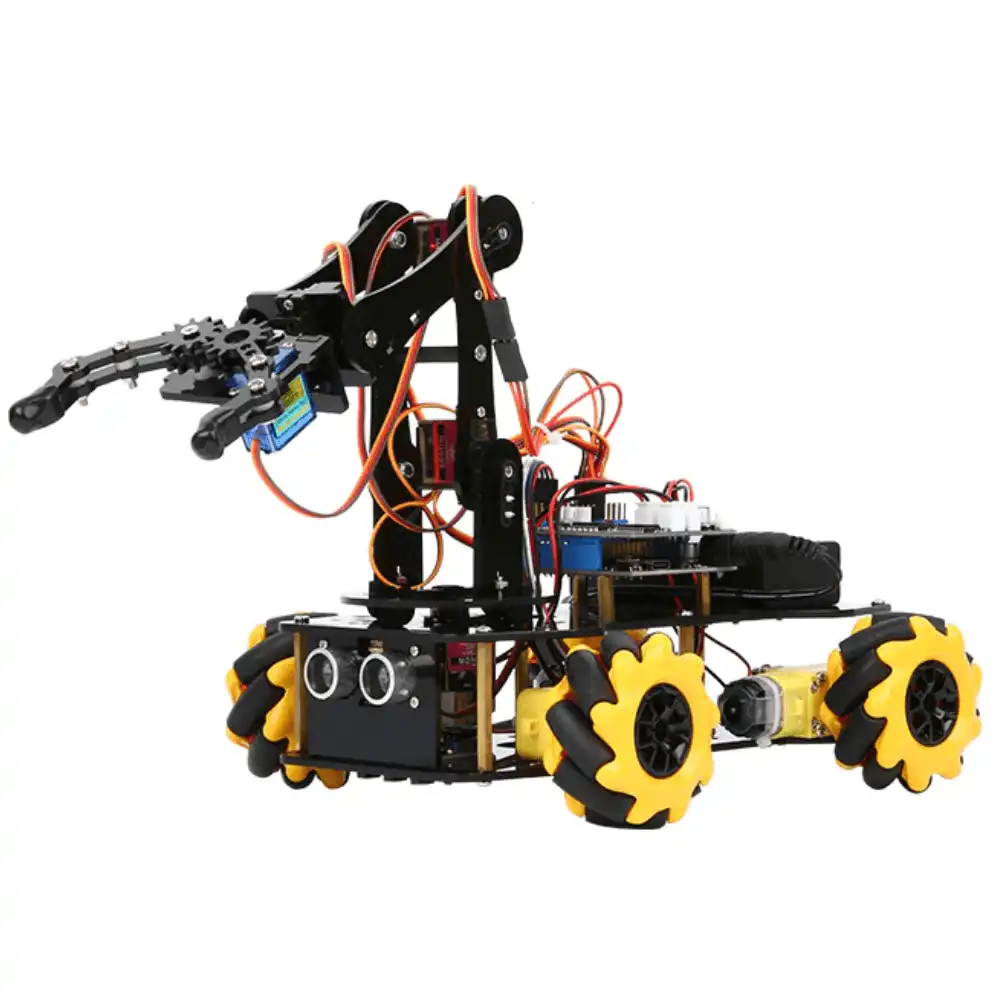
ACEBOTT ESP32 5-DOF Robot Arm Kit Expansion Pack – QD007
An ESP32-powered 5-DOF robot arm kit — a perfect hardware platform for experimenting with ROS2 joint control, micro-ROS, and MoveIt 2 motion planning.

42HS48-1204A NEMA17 5.6 kg-cm Stepper Motor
Industry-standard NEMA17 stepper motor compatible with ros2_control and A4988 drivers — the go-to actuator for ROS2-controlled robot joints in India.
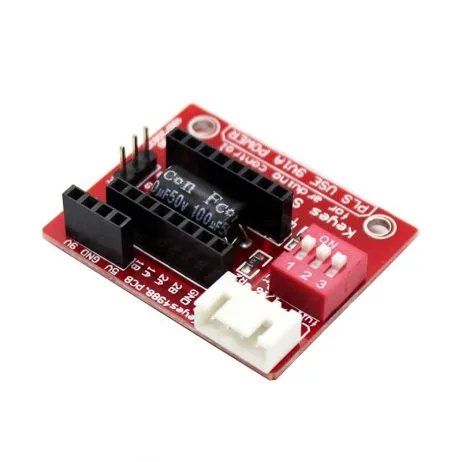
A4988 Stepper Motor Driver Controller Board
The standard A4988 stepper driver for NEMA17 motors — pairs with ROS2 control nodes for precise, commanded joint movement in robot arms and mobile bases.
Should You Upgrade? Decision Guide
Use this decision framework for your situation in 2026:
| Your Situation | Recommendation |
|---|---|
| Starting a new project from scratch | Use ROS2 Jazzy — no question. |
| Existing ROS1 project, active development | Migrate now. ROS1 has no security patches since May 2025. |
| Existing ROS1 project, production/stable | Plan migration within 12 months. No rush if not network-connected. |
| Learning ROS for job/placement | Learn ROS2 directly. Industry has moved on; ROS1 skills not valued. |
| Required package only available in ROS1 | Use ros1_bridge temporarily. File an issue or fork to port the package. |
Frequently Asked Questions
Is ROS1 completely dead in 2026?
Yes, ROS Noetic (the last ROS1 LTS) reached end-of-life in May 2025. There are no more official bug fixes, security patches, or package updates from the ROS community. ROS2 is the only actively maintained Robot Operating System.
Which ROS2 version should I install in 2026?
Use ROS2 Jazzy Jalisco (LTS, supported until 2029) on Ubuntu 24.04 for new projects. ROS2 Humble on Ubuntu 22.04 is also still in LTS support until 2027 and has more tutorials available for beginners.
Can I run ROS2 on a Raspberry Pi in India?
Yes. Raspberry Pi 4 (4 GB RAM) with Ubuntu 22.04 Server and ROS2 Humble is a very capable mobile robot brain. Pi 5 is even better. Use the official ROS2 arm64 packages — they install via apt on Ubuntu for Raspberry Pi.
What is ros1_bridge and when should I use it?
ros1_bridge is a ROS package that translates messages between ROS1 and ROS2 in real-time. Use it if you have a critical ROS1 dependency that has not been ported to ROS2 yet. It lets you run a mixed ROS1/ROS2 system as a transition measure.
Does ROS2 work on Windows?
Yes, ROS2 has official Windows support (unlike ROS1 which was Linux-only). However, most robotics development in India and globally still uses Ubuntu Linux for maximum package compatibility and community support.
Build Your ROS2 Robot Today
Get the motors, robot arm kits, stepper drivers, and ESP32-based platforms you need to experiment with ROS2 in the real world — from Zbotic, India’s robotics store.


Add comment