
Table of Contents
- Why Convert a Power Tool Battery from NiCd to Lithium?
- Understanding 18V NiCd vs 18V Lithium Pack Architecture
- What You Need for the Conversion
- Step-by-Step Conversion Guide
- Selecting and Wiring the BMS
- Charger Compatibility and Safe Charging
- Recommended Products
- FAQ
That old cordless drill with a dead battery pack does not have to become e-waste. A power tool battery rebuild converting NiCd to lithium at 18V can give it a new lease of life with longer run time, lighter weight, and no memory effect. In India, imported replacement NiCd packs cost Rs.800-2,500 and degrade just as fast as the original. A lithium rebuild using 18650 cells with a proper BMS costs a similar amount but lasts 3-5 times longer. This project guide walks you through the full conversion step by step.
Why Convert a Power Tool Battery from NiCd to Lithium?
NiCd (nickel-cadmium) was the dominant chemistry in cordless power tools through the 1990s and 2000s. It survives high discharge rates and cold temperatures better than many chemistries, but it has serious disadvantages:
- Memory effect: Frequent partial charges cause NiCd to lose effective capacity — the battery “remembers” the lower charge depth and will not discharge below that point.
- Heavy: NiCd is significantly heavier than lithium for the same energy storage. A 1.5 Ah NiCd pack typically weighs 500-700g; a 2.0 Ah Li-ion pack weighs under 250g.
- Self-discharge: NiCd loses 15-20% of charge per month at room temperature vs 1-3% for Li-ion.
- Toxic: Cadmium is a hazardous metal requiring special disposal.
- Replacement availability: 18V NiCd sub-C cells are increasingly hard to source in India.
Lithium conversion gives you: 30-40% more capacity in the same space, half the weight, no memory effect, and far better shelf life. The trade-off is you must add a Battery Management System (BMS) since lithium cells require precise charge cutoff and over-discharge protection that NiCd packs do not need.
Understanding 18V NiCd vs 18V Lithium Pack Architecture
A standard 18V NiCd power tool pack contains 15 cells in series. Each NiCd sub-C cell has a nominal voltage of 1.2V, so 15 x 1.2V = 18V nominal.
To replace with lithium (18650 Li-ion, nominal 3.6V), you need 5 cells in series: 5 x 3.6V = 18V nominal. This is the standard “5S” configuration. Fully charged, a 5S Li-ion pack reads 5 x 4.2V = 21V — which is higher than the NiCd pack’s fully charged voltage (typically 22.5V for NiCd, 21V for Li-ion). Most 18V tools designed post-2010 handle this fine.
You can also wire cells in parallel groups for higher capacity: 5S2P gives 10 cells total and double the capacity at the same voltage. A 5S2P pack with 2500 mAh cells delivers 5.0 Ah — significantly more than most original NiCd packs.
What You Need for the Conversion
Tools
- Spot welder (recommended) or high-power soldering iron (60W minimum) and nickel strip
- Multimeter for voltage verification
- Wire strippers, heat gun, shrink tubing
- Utility knife or dremel for case modification
Materials
- 5x (or 10x for 5S2P) matched 18650 Li-ion cells — same brand and batch preferred. 20A+ discharge rated (INR chemistry) for tool loads.
- 5S 20A (or higher) BMS with balancing — specifically a power tool BMS designed for high pulse discharge
- Nickel strip (0.15mm thickness minimum, 0.2mm preferred for high current)
- 16-18 AWG silicone wire for main power connections
- Heat shrink tubing (various sizes)
- Double-sided tape or foam tape for securing cells in the case
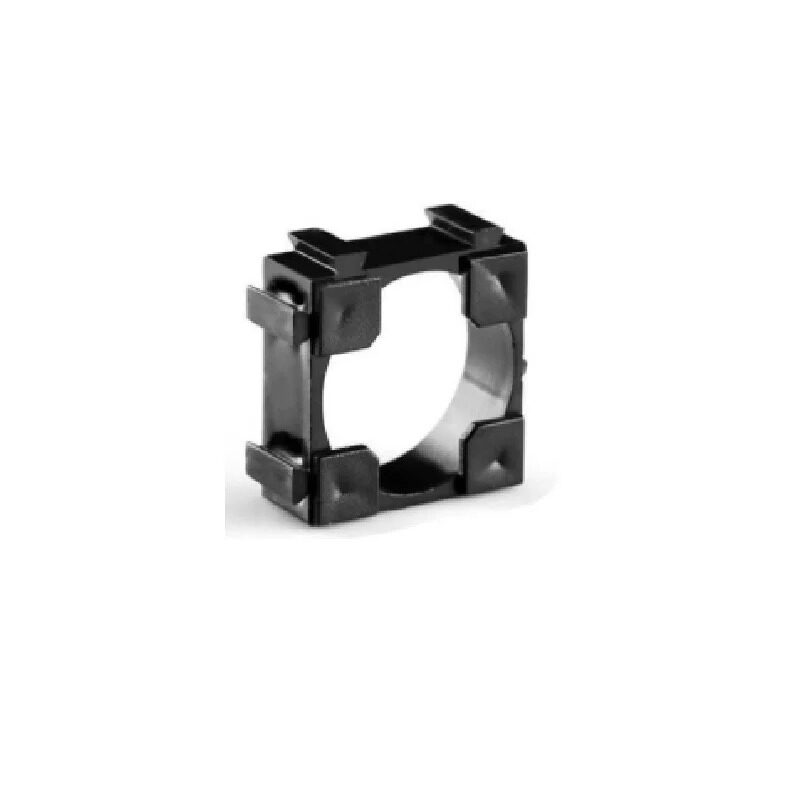
1×18650 Battery Holder with 18.4mm Bore (Pack of 4)
Temporarily hold 18650 cells in position while you plan your pack layout and measure voltages before spot-welding. Essential for prototype and test fitting.
Step-by-Step Conversion Guide
Step 1 — Disassemble the old battery pack
Open the battery shell by removing screws or prying the case apart carefully. NiCd packs are usually retained by screws under label stickers. Note the position of the terminal contacts at the top — you will reuse these. Remove the old NiCd cell assembly and set aside. Inspect the terminal contacts and wiring for condition.
Step 2 — Match and test your 18650 cells
Measure the open-circuit voltage of all cells using a multimeter. Group cells within 0.05V of each other. All cells in a parallel group must be within 0.02V before connecting in parallel — larger voltage differences cause a high equalisation current that can damage cells. If needed, charge each cell to 4.10V using a dedicated single-cell charger before assembling.
Step 3 — Plan your pack layout
Measure the internal volume of the battery case. Most 18V drill packs have space for 5 cells in a flat row (5S1P) or 10 cells in two rows (5S2P). Use battery holders or tape to mock up the layout before spot-welding. Mark positive and negative ends clearly.
Step 4 — Assemble the cell groups
For 5S2P: spot weld or solder nickel strip across the top of two cells in parallel (both positive ends together, both negative ends together) to make one 3.6V 2P group. Repeat for all 5 groups. Then connect groups in series with nickel strip or 16 AWG wire from the negative of group 1 to the positive of group 2, continuing through all 5 groups. The total pack voltage should read 18-21V depending on cell state of charge.
Step 5 — Attach the BMS
Connect the balance wires from the BMS to each cell group tap: B0 (ground), B1 (after cell group 1), B2 (after group 2), B3, B4, B5. Connect B- (pack negative) and B+ (pack positive) to the respective pack terminals. Connect P- (protected negative output) to the tool’s negative terminal contact. Route the pack positive directly to the tool’s positive contact. See the BMS section below for specifics.
Step 6 — Test before closing
Before reassembling the shell, verify pack voltage at the terminal contacts (should read 18-21V), verify no short circuits, and test-fit the assembly in the original drill. If your drill powers on and operates normally, proceed to close the case.
Selecting and Wiring the BMS
The BMS is the most critical component in the conversion. For a power tool application you need:
- 5S configuration (matches 5-cell series lithium pack)
- Continuous current rating 20A minimum — drills draw 15-20A under stall conditions
- High pulse current rating — many BMS boards have a much higher 10-second pulse current; look for 40A+ pulse
- Built-in cell balancing — ensures cells stay matched through hundreds of cycles
- Short circuit and over-temperature protection — non-negotiable for power tool use
Wiring note: Power tools use the battery in discharge mode only — the charger connects via the same terminals. Most 5S power tool BMS boards have a common-port configuration (charge and discharge share P- and B-). Some have separate charge and discharge ports — verify before wiring.
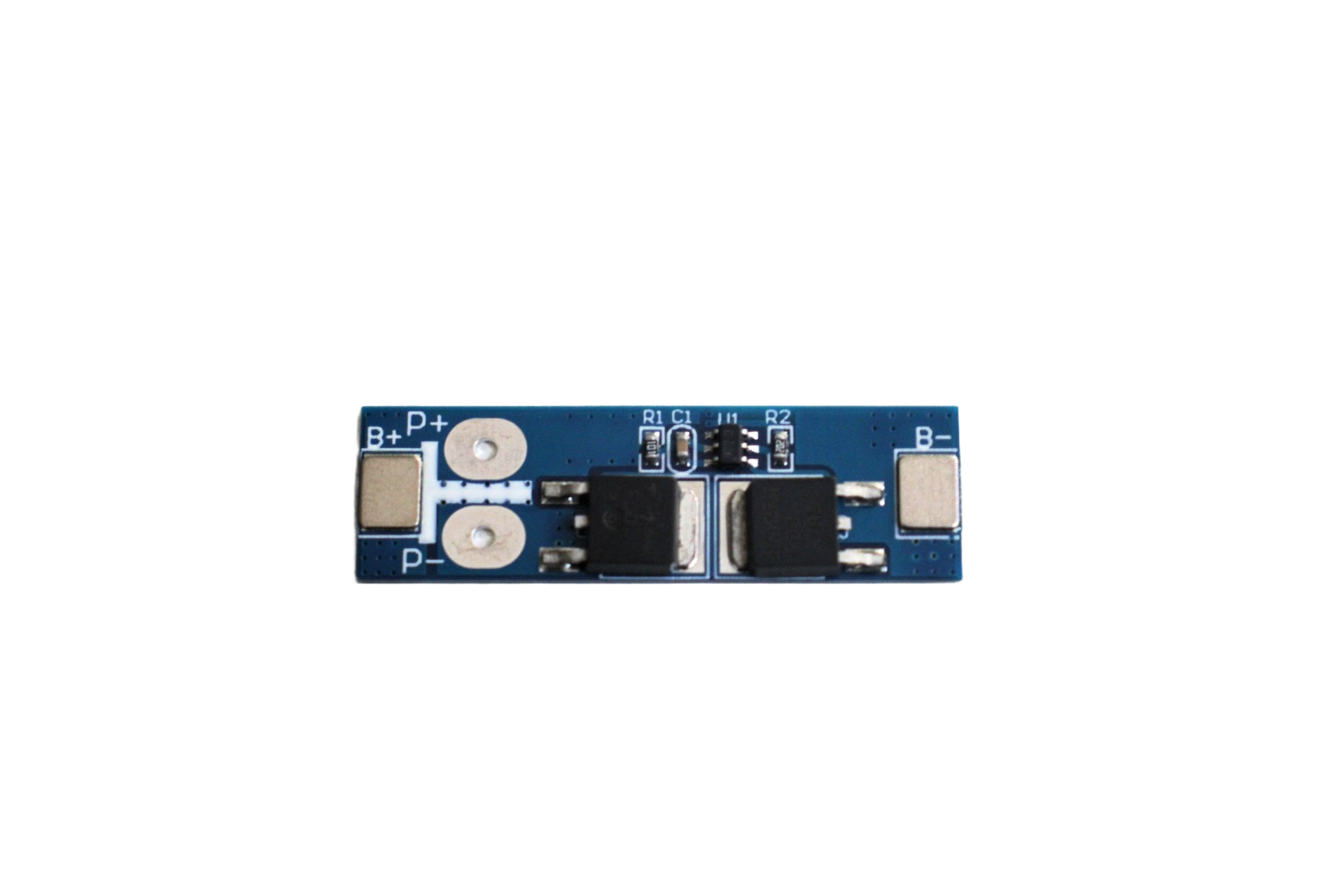
1S 12A 3.6V BMS Battery Protection Board for Li-ion
Per-cell protection boards that can be stacked in series for custom multi-cell packs when a dedicated 5S board is not available. Good for understanding the BMS architecture before building.
Charger Compatibility and Safe Charging
This is where most DIY conversions go wrong. The original NiCd charger that came with your drill is a delta-V NiCd/NiMH charger and will OVERCHARGE lithium cells. Do not use it.
Your options for charging the converted lithium pack:
- Dedicated lithium lab charger: A balance charger like the ISDT models can charge the pack via balance leads at a controlled CC/CV rate — the safest and most flexible option for occasional charging.
- Compatible brand lithium charger: If another 18V lithium tool in the same brand ecosystem has a lithium charger, sometimes the pack shell is modifiable to accept that charger (requires matching terminal layout).
- DIY charging circuit: A 5S lithium charger module (21V output) from an XT60 or barrel jack can be wired into the pack’s charge contacts. Ensure it has CC/CV profile and current limit appropriate for your cell capacity (1C = 2.5A for 2500 mAh cells).

ISDT A4 Air Smart Battery Charger — NiMH, NiCd, Li-ion, LiFePO4
Multi-chemistry smart charger with Bluetooth. Charge your rebuilt lithium pack via balance leads using the correct Li-ion CC/CV profile. Also handles NiCd if you are still running old packs in parallel.
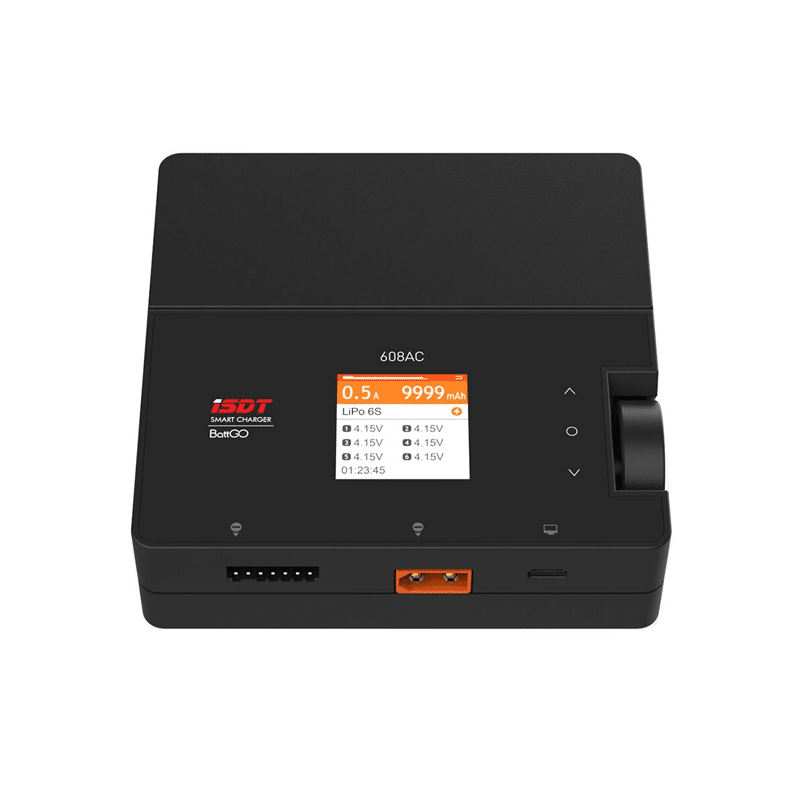
ISDT 608 AC LiPo Charger — AC 50W / DC 200W
Powerful dual-mode charger. Use in DC 200W mode to fast-charge your 5S rebuilt pack from a 24V DC source, or in AC mode from a wall outlet for bench charging.
Frequently Asked Questions
Will the original drill work normally after lithium conversion?
In most cases, yes. The drill motor and electronics only care about the voltage — they do not know whether it is coming from NiCd or Li-ion cells. The torque and speed may feel slightly different due to the flatter discharge curve of lithium versus NiCd, but functionally the drill operates normally.
Is it safe to leave the converted battery in the original charger?
No — this is dangerous. The original NiCd charger will attempt to charge the lithium pack using a delta-V termination algorithm designed for NiCd, which can overcharge and damage or ignite the lithium cells. Always use a lithium-specific charger.
How do I choose the right 18650 cells for a power tool?
Power tools have high current demands — a 500W drill draws over 20A at 18V. Choose 18650 cells rated for 20A or higher continuous discharge. Samsung 25R, Sony VTC5A, and LG HB6 are well-regarded high-drain cells. Avoid capacity-focused cells (like Panasonic NCR18650B) in high-drain applications as they will overheat.
Can I convert a 12V NiCd tool to lithium?
Yes, using the same approach with a 3S configuration (3 cells in series, 10.8V nominal, 12.6V full charge). The process is identical but uses a 3S BMS instead of a 5S board.
What is the expected run time improvement after conversion?
Lithium 18650 cells have 2000-3500 mAh capacity versus 1200-1500 mAh for typical NiCd sub-C cells. Combined with lithium’s flatter discharge curve (more energy available at usable voltage), expect 50-100% longer run time per charge.
Give Your Old Tool a New Life
A power tool battery rebuild converting 18V NiCd to lithium is one of the most satisfying DIY projects in the battery space — you save money, reduce e-waste, and end up with a better battery than the original. With quality 18650 cells, a properly rated 5S BMS, and a compatible charger, your rebuilt pack will outlast several rounds of cheap NiCd replacements. Browse Zbotic’s selection of BMS boards, 18650 holders, and smart chargers to get everything you need for your rebuild.




Add comment