
The NB-IoT vs LTE-M vs LoRa comparison is the central question every serious IoT developer in India must answer before committing to hardware. Each of these Low Power Wide Area Network (LPWAN) technologies offers a different trade-off between power consumption, range, data rate, infrastructure cost, and carrier dependency. This guide cuts through the marketing to give you the practical information you need to choose the right technology for your Indian IoT deployment in 2025.
Why LPWAN? The Case for Low Power Networks
Traditional cellular (2G/3G/4G) is overkill for most IoT applications. A water meter that sends a 50-byte reading once per hour does not need a 150Mbps LTE connection. What it needs is the ability to run on two AA batteries for 5–10 years, penetrate through concrete walls and basement installations, and connect at minimum cost per device per year.
LPWAN technologies (NB-IoT, LTE-M, LoRa) were designed specifically for this use case. They sacrifice data rate (tens to hundreds of kilobits per second, not megabits) in exchange for dramatic gains in battery life, range, and unit cost. Understanding when this trade-off makes sense — and which LPWAN technology fits your specific application — is what this guide addresses.
NB-IoT: Deep Penetration, Cellular Reliability
NB-IoT (Narrowband IoT) is a 3GPP standard that operates within existing LTE frequency bands, using a 200 kHz channel. It was designed specifically for stationary devices in challenging coverage environments — underground utility meters, basement sensors, deep indoor deployments.
Key Technical Characteristics
- Downlink: ~26 kbps (single tone) to 170 kbps (multi-tone)
- Uplink: ~20–250 kbps
- Battery life: 10+ years (with PSM/eDRX power saving)
- Coverage gain: +20 dB over standard LTE (20 km open, deep indoor capable)
- Latency: 1.4–10 seconds (PSM wake-up adds more)
- Roaming: Limited globally; within India, only on supporting operators
- Mobility: None — designed for stationary devices; handoff is not supported
When NB-IoT Is Right
NB-IoT excels for static deployments sending small, infrequent data: smart electricity/gas/water meters, structural monitoring sensors, parking spot detectors, and agricultural soil sensors. The 20 dB coverage gain over standard LTE means it works in locations where 4G LTE barely reaches — inside walls, underground, in metal enclosures.
Limitations of NB-IoT
NB-IoT cannot handle mobility (a tracking device moving between cells will drop connection), streaming data, or latency-sensitive applications. In India, NB-IoT coverage is concentrated in metro cities (Mumbai, Delhi, Bangalore, Chennai, Hyderabad) via Airtel and Jio’s JioThings platform. Rural deployment is still sparse as of 2025.
LTE-M: Mobility & Voice for Moving Assets
LTE-M (Long Term Evolution for Machines, also called Cat-M1) is the other 3GPP LPWAN standard. It runs in a 1.4 MHz channel within LTE bands and supports a broader feature set than NB-IoT — at the cost of higher power consumption and data rates that, while lower than full LTE, are higher than NB-IoT.
Key Technical Characteristics
- Downlink: ~375–1000 kbps
- Uplink: ~375–1000 kbps
- Battery life: 10+ years (with PSM/eDRX)
- Coverage gain: +15 dB over standard LTE
- Latency: ~10–15ms (much lower than NB-IoT)
- Mobility: Full handoff support — devices can move at speed
- VoLTE: Supports voice calls — unique among LPWAN technologies
When LTE-M Is Right
LTE-M is the technology of choice for asset tracking (vehicles, shipping containers, livestock), wearables (emergency buttons, medical devices), and applications that need voice capability combined with low power. The mobility support makes it superior to NB-IoT for anything that moves. Higher data rates support OTA firmware updates without resorting to multiple message chunks.
Limitations of LTE-M
LTE-M coverage in India is extremely limited as of 2025. Unlike NB-IoT which Jio and Airtel have commercially deployed, LTE-M is not widely available on Indian networks. This is the biggest practical barrier for Indian makers and deployers. Additionally, LTE-M modules cost slightly more than NB-IoT modules.
LoRa / LoRaWAN: Own Your Infrastructure
LoRa (Long Range) is a proprietary spread-spectrum modulation technology developed by Semtech. LoRaWAN is the MAC layer protocol built on top of LoRa. Unlike NB-IoT and LTE-M, LoRa operates in unlicensed spectrum (865–867 MHz in India) and can be deployed with privately owned gateways — no monthly operator fees required once your gateway is deployed.
Key Technical Characteristics
- Data rate: 0.3–50 kbps (depends on spreading factor SF7–SF12)
- Battery life: 10+ years (extremely low transmit power)
- Range: 2–5 km urban, up to 15+ km rural open terrain
- Infrastructure: Self-deployed gateways (one gateway covers 10 km radius)
- Cost: No SIM, no operator fees — gateway + module one-time cost
- Duty cycle: 1% duty cycle limit in ISM band limits transmissions
- Latency: Hundreds of milliseconds to seconds
When LoRa Is Right
LoRa is the best choice when you control your deployment area (a factory campus, farm, housing society, smart city zone), need no recurring SIM costs, and your devices transmit infrequently (temperature readings, tank levels, door alerts). One LoRa gateway at ₹8,000–15,000 can serve hundreds of sensor nodes across a 5 km radius, with zero per-device monthly cost.
Limitations of LoRa
LoRa requires you to deploy and maintain gateway infrastructure. It doesn’t roam — outside your gateway’s range, devices are unreachable. Data rates are very limited (a GPS coordinate + temperature = 50 bytes maximum payload per message). Not suitable for firmware updates, video, or high-frequency telemetry.
Head-to-Head Comparison Table
| Parameter | NB-IoT | LTE-M | LoRa/LoRaWAN |
|---|---|---|---|
| Spectrum | Licensed (operator) | Licensed (operator) | Unlicensed ISM |
| India Coverage (2025) | Metro cities (Airtel, Jio) | Very limited | Self-deployed anywhere |
| Max Data Rate | ~250 kbps | ~1 Mbps | ~50 kbps |
| Battery Life | 10+ years | 10+ years | 10+ years |
| Mobility | No | Yes | Limited (gateway range) |
| Monthly Cost (per device) | ₹30–150 | ₹50–200 | ₹0 (own gateway) |
| Indoor Penetration | Excellent (+20 dB) | Good (+15 dB) | Good (sub-1 GHz) |
| Infrastructure Cost | None (use operator) | None (use operator) | ₹8K–15K per gateway |
| Module Cost | ₹600–1500 | ₹800–2000 | ₹300–800 |
Coverage in India: Who Has What in 2025
NB-IoT in India
Airtel: Commercially launched NB-IoT in major metros. Partners with M2M service providers. Enterprises can get dedicated NB-IoT SIM cards through Airtel Business. Individual makers are largely locked out of official NB-IoT SIMs — you need a business account.
Jio: JioThings division operates NB-IoT infrastructure in tier-1 cities. Focus is on smart city and enterprise deployments rather than individual developer access.
BSNL: Piloting NB-IoT in some circles but no commercial launch yet.
LTE-M in India
No Indian operator has commercially deployed LTE-M as of early 2025. This is in contrast to the US and Europe where LTE-M is widely available. Indian IoT deployments that need mobility LPWAN must currently use 2G/4G or wait for LTE-M rollout, which is tied to network upgrade timelines.
LoRa in India
LoRa operates on 865–867 MHz in India (IN865 frequency plan, WPC-compliant). There is a nascent public LoRaWAN network via The Things Network (TTN) with community gateways in Bangalore, Mumbai, Delhi, and Pune. For private deployments — smart buildings, campuses, farms — LoRa is fully available today with no operator dependency. The IN865 band offers excellent range due to lower frequencies and minimal congestion compared to European/US bands.
How to Choose: Decision Framework
Use these questions to narrow down your choice:
- Does your device move? → Yes: LTE-M (unavailable in India 2025, use 4G fallback) or LoRa with overlapping gateway coverage. No: NB-IoT or LoRa.
- Do you control the deployment area? → Yes: LoRa is most cost-effective. No: NB-IoT (if in metro coverage).
- How much data per day? → Under 50 bytes/hour: LoRa. Up to 1KB/day: NB-IoT. More: standard 4G.
- Need operation in rural India today? → LoRa with your own gateway is the only practical choice.
- Need 5–10 year battery life on coin cell? → All three support this, but LoRa at low spreading factors achieves the lowest transmit current.
- Building a commercial product for India? → Start LoRa for proof-of-concept, plan NB-IoT for scale in metro markets.
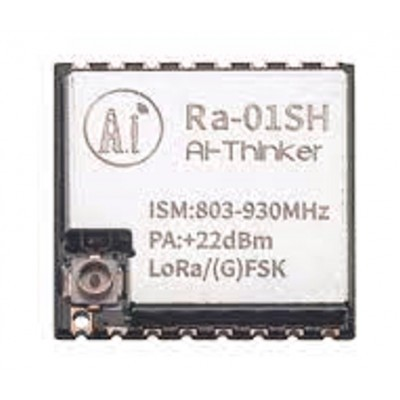
Ai Thinker LoRa Ra-01SH Module
The Ra-01SH is a high-frequency LoRa module operating at 915 MHz with SX1262 chipset. Delivers excellent sensitivity and range for LoRaWAN node applications. Ideal for Indian LPWAN deployments with up to 10km range in open terrain.
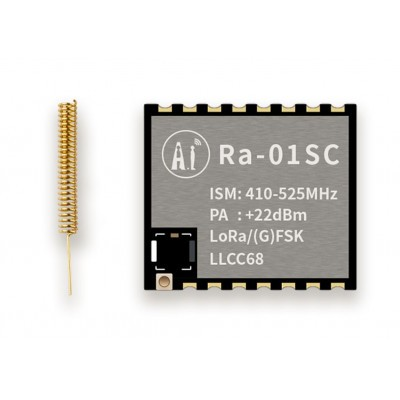
Ai Thinker LoRa Ra-01SC Module
A 433 MHz LoRa module with SX1278 chipset and compact SMD form factor. Supports spreading factors SF6–SF12 for the range-power trade-off suited to Indian ISM band deployments. SPI interface, compatible with Arduino and ESP32.
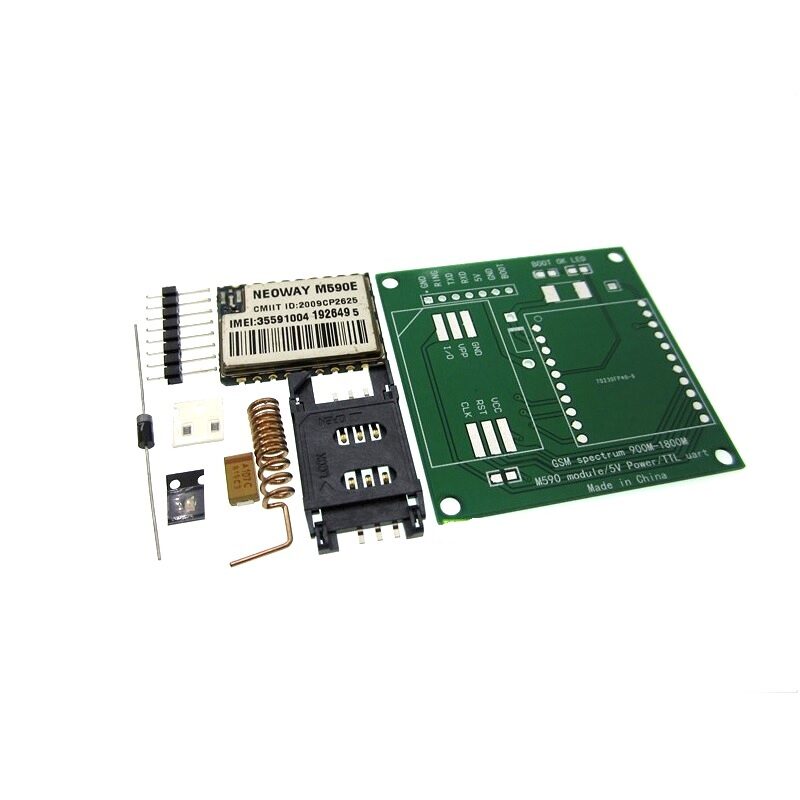
DIY GSM/GPRS M590E Module Kit
While LPWAN is the future, GSM GPRS remains the practical choice for Indian rural IoT today. The M590E module provides 2G GPRS connectivity across India on Airtel and BSNL, ideal as a bridge while NB-IoT coverage expands.
Frequently Asked Questions
Is NB-IoT available in rural India in 2025?
No — NB-IoT commercial coverage in India is predominantly limited to tier-1 metro cities (Mumbai, Delhi, Bangalore, Chennai, Hyderabad, Kolkata) as of 2025. Tier-2 cities may have partial coverage. For rural IoT applications, LoRa with privately deployed gateways or traditional 2G GPRS (Airtel/BSNL) remains the practical choice.
Can a LoRa device work across India without deploying gateways?
Not reliably — there is no national-scale public LoRaWAN network in India equivalent to what exists in Europe or the US. The Things Network has community gateways in major cities, but coverage is patchy. For national-scale IoT (fleet tracking, logistics), NB-IoT (metro only) or standard 4G LTE remains the practical choice until a public LoRaWAN network scales further.
What spreading factor should I use for LoRa in India?
Use SF7 or SF8 for nodes within 2–3 km of the gateway (highest throughput, shortest airtime). Use SF11 or SF12 only for devices at maximum range. In India’s 865 MHz band (IN865 plan), 1% duty cycle applies — SF12 at maximum payload can mean only a few transmissions per hour. Keep payloads small and choose the lowest spreading factor that provides reliable reception at your deployment distance.
Is LoRa/LoRaWAN free to use in India?
LoRa hardware and the LoRaWAN protocol are not free (you buy modules and gateways), but operating in the 865–867 MHz ISM band requires no spectrum licence for low-power devices. There are no monthly operator fees when running your own private LoRaWAN network. Public LoRaWAN network providers may charge per-device fees. The WPC (Wireless Planning & Coordination) in India permits ISM band devices below specified power levels without individual licences.
Which is more power-efficient: NB-IoT or LoRa?
Both can achieve 10+ year battery life with correct configuration. LoRa transmit current is typically lower (10–25mA vs NB-IoT’s 200–300mA peak). However, NB-IoT’s PSM (Power Saving Mode) and eDRX (Extended Discontinuous Reception) keep average current comparable. In practice, LoRa at SF7 with frequent short bursts often has lower average consumption than NB-IoT with TCP/IP stack overhead. For ultra-low-power applications, LoRa with a small coin cell is the pragmatic choice.
Build Your LPWAN Project with Zbotic
Zbotic stocks LoRa modules, GSM/GPRS modules, antennas, and all the components you need to deploy LPWAN networks across India. Fast shipping, competitive prices.

Add comment