
When your project needs to send data over kilometres rather than metres, the LoRa SX1278 module Arduino IoT stack is the answer. LoRa (Long Range) is a patented spread-spectrum modulation technique that achieves remarkable communication distances — up to 10 km in open terrain — using very little power and with no SIM card, Wi-Fi, or monthly data plan required. For Indian hobbyists and engineers building agricultural sensors, smart city deployments, wildlife trackers, or rural telemetry systems, LoRa opens up possibilities that Bluetooth, Wi-Fi, and even GSM simply cannot match for cost and power efficiency.
What Is LoRa and Why SX1278?
LoRa is a wireless modulation technique developed by Semtech that uses Chirp Spread Spectrum (CSS). Instead of transmitting data on a narrow frequency like a conventional radio, LoRa sweeps across a wide band, making it extremely resistant to noise and interference. This is how it achieves long range at very low power — a sensor node running on two AA batteries can transmit data every 10 minutes and last over a year.
The SX1278 is Semtech’s chip that operates in the 433 MHz band, while the SX1276 operates at 868/915 MHz. In India, the 433 MHz ISM band is freely usable for low-power devices under TRAI regulations, making the SX1278 (and modules based on it like the popular Ra-02 from Ai-Thinker) the preferred choice for Indian deployments. The 433 MHz frequency also penetrates walls and foliage better than higher frequencies.
SX1278 Specifications & Ra-02 Module
The Ai-Thinker Ra-02 is the most popular SX1278-based breakout module in India’s maker market:
- Chip: Semtech SX1278
- Frequency: 410–525 MHz (433 MHz for Indian use)
- Range: Up to 10 km (open terrain), 1–3 km urban
- Output power: +20 dBm (100 mW) maximum
- Receive sensitivity: -148 dBm (at SF12, 125 kHz BW)
- Data rates: 0.018–37.5 kbps (LoRa mode)
- Supply voltage: 3.3 V (strictly — 5V will damage it)
- Sleep current: ~0.2 µA
- Interface: SPI
- Antenna connector: 1.27mm pitch spring pad (solder a wire antenna) or IPEX connector on some variants
- Module size: 17×16 mm (Ra-02)
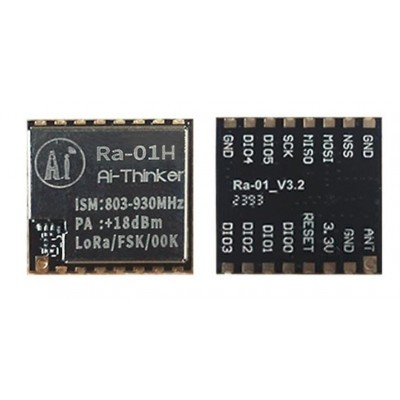
Ai Thinker LoRa Ra-01H Module
High-frequency LoRa module from Ai-Thinker — ideal for long-range IoT applications with excellent sensitivity and compact form factor.
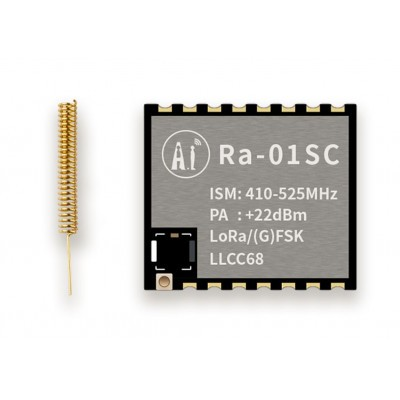
Ai Thinker LoRa Ra-01SC Module
Sub-GHz LoRa module with ultra-low power consumption — perfect for battery-operated sensor nodes in agricultural and remote monitoring applications.
LoRa vs LoRaWAN: What’s the Difference?
This is one of the most common points of confusion:
- LoRa refers to the physical layer modulation technique (the radio). You can use LoRa for point-to-point or star communication with no network server involved.
- LoRaWAN is a network protocol built on top of LoRa. It defines how devices connect to gateways, how data is routed to cloud servers (like The Things Network or Helium), how encryption works, and how multiple devices share channels.
For most beginner and intermediate maker projects — sensor to Arduino to display, or farm node to farmhouse base station — you do NOT need LoRaWAN. Simple point-to-point LoRa with the Arduino LoRa library is sufficient, simpler, and more flexible. LoRaWAN becomes relevant when you need to connect many devices across a city or want to use public gateway infrastructure.
Wiring SX1278 (Ra-02) to Arduino
The Ra-02 module operates at 3.3 V strictly — never connect VCC to 5 V. Use a 3.3 V regulator if your Arduino Uno cannot supply enough current. The SPI lines (MOSI, MISO, SCK) are also 3.3 V and should be level-shifted when connecting to a 5 V Arduino. In practice, many users connect directly and it works, but proper level shifting with a 74AHCT125 or BSS138 MOSFET shifter is recommended for reliability.
| Ra-02 Pin | Arduino Uno Pin | Notes |
|---|---|---|
| 3.3V | 3.3V | Or external 3.3V regulator |
| GND | GND | Common ground |
| NSS (CS) | D10 | SPI chip select |
| MOSI | D11 | Level shift recommended |
| MISO | D12 | 3.3V output — Uno reads fine |
| SCK | D13 | Level shift recommended |
| RST | D9 | Reset pin |
| DIO0 | D2 | Interrupt for TX done / RX ready |
Antenna: Never operate the module without an antenna attached — transmitting without an antenna can damage the RF front end. For 433 MHz, a quarter-wave monopole antenna is a 16.4 cm length of wire soldered to the antenna pad.
Library Installation
The easiest library for SX1278 point-to-point communication is the Arduino-LoRa library by Sandeep Mistry:
- Arduino IDE → Sketch → Include Library → Manage Libraries
- Search for LoRa by Sandeep Mistry
- Install the latest version
For the 433 MHz Ra-02 module, you need to call LoRa.begin(433E6) to set the frequency. The default in most examples is 915E6 or 868E6 (for North America/Europe) — using the wrong frequency means zero range.
Sender Arduino Code
#include <SPI.h>
#include <LoRa.h>

#define SS    10
#define RST   9
#define DIO0  2

int counter = 0;

void setup() {
  Serial.begin(9600);
  LoRa.setPins(SS, RST, DIO0);
  if (!LoRa.begin(433E6)) {  // 433 MHz for India
    Serial.println("LoRa init failed!");
    while (true);
  }
  LoRa.setSpreadingFactor(10);  // SF7–SF12
  LoRa.setSignalBandwidth(125E3);
  LoRa.setCodingRate4(5);
  Serial.println("LoRa sender ready");
}

void loop() {
  Serial.print("Sending packet: ");
  Serial.println(counter);
  LoRa.beginPacket();
  LoRa.print("Temp: 28.5C Humidity: 65%");
  LoRa.print(" Packet: ");
  LoRa.print(counter);
  LoRa.endPacket();
  counter++;
  delay(5000);
}
Receiver Arduino Code
#include <SPI.h>
#include <LoRa.h>

#define SS    10
#define RST   9
#define DIO0  2

void setup() {
  Serial.begin(9600);
  LoRa.setPins(SS, RST, DIO0);
  if (!LoRa.begin(433E6)) {
    Serial.println("LoRa init failed!");
    while (true);
  }
  LoRa.setSpreadingFactor(10);
  LoRa.setSignalBandwidth(125E3);
  LoRa.setCodingRate4(5);
  Serial.println("LoRa receiver ready");
}

void loop() {
  int packetSize = LoRa.parsePacket();
  if (packetSize) {
    String received = "";
    while (LoRa.available()) {
      received += (char)LoRa.read();
    }
    Serial.print("Received: ");
    Serial.print(received);
    Serial.print(" | RSSI: ");
    Serial.println(LoRa.packetRssi());
  }
}
Maximising Range: Spreading Factor & Bandwidth
LoRa’s range vs data-rate tradeoff is controlled by three parameters:
- Spreading Factor (SF7–SF12): Higher SF = longer range, lower data rate. SF12 gives maximum range (~10 km) with ~250 bps throughput. SF7 gives ~37 kbps but much shorter range. For sensor data (small payloads, low frequency), SF10–SF12 is ideal.
- Bandwidth (125/250/500 kHz): Lower bandwidth = better sensitivity = longer range. 125 kHz is standard for maximum range. 500 kHz doubles the data rate but reduces range.
- Coding Rate (4/5 to 4/8): Higher coding rate adds more error correction. CR4/8 gives best error correction but halves throughput. CR4/5 is a good balance.
For maximum India rural range: SF12, BW 125 kHz, CR 4/8. Expect 2–5 km in typical Indian agricultural fields with some trees. Both sender and receiver MUST use identical SF, BW, and CR settings.
Real-World IoT Applications in India
- Smart agriculture: Soil moisture, temperature, and humidity sensors in fields reporting to a central base station — no SIM needed
- Water level monitoring: Tank or river level sensors sending alerts via LoRa to a village panchayat office
- Wildlife tracking: Lightweight LoRa tags on animals reporting to forest department base stations
- Smart meters: Electricity/water meters in apartments reporting to a building-level gateway wirelessly
- Disaster early warning: Seismic or flood sensors in remote areas with no mobile connectivity
- Campus asset tracking: Tool and equipment tracking across large factory or college campuses
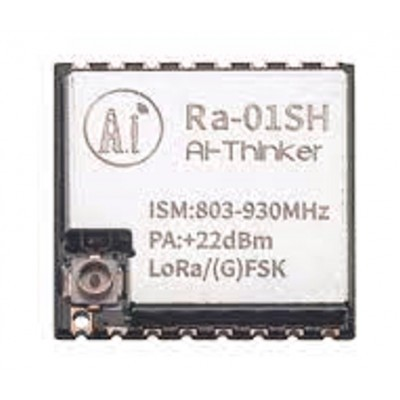
Ai Thinker LoRa Ra-01SH Spread Spectrum Module
The Ra-01SH offers higher power output and extended range — suited for demanding outdoor IoT deployments across Indian farms and industrial sites.
Troubleshooting
- LoRa.begin() returns false: SPI wiring error, VCC at 5 V (must be 3.3 V), or no 100 nF decoupling capacitor near VCC pin. Double-check all pin connections.
- Packets not received: Frequency mismatch — ensure both modules are initialised with exactly the same frequency (433E6 for Ra-02). Also check SF, BW, and CR match on both ends.
- Very short range (1–10 metres only): No antenna or wrong antenna length. For 433 MHz, cut 16.4 cm of wire for a quarter-wave antenna.
- Intermittent reception: The Ra-02’s stamp module pads can have cold solder joints on the breakout board — reflow all pads. Also try reducing to SF12 for better link margin.
- Library compiles but nothing happens: Check the SS (NSS/CS) pin number passed to
LoRa.setPins()— incorrect SS pin prevents SPI communication.

NEO-6M GPS Module with EPROM
Pair a GPS module with LoRa for a low-power, long-range asset tracker — no SIM card required, kilometres of range.
Frequently Asked Questions
Q1: Is LoRa legal to use in India without a license?
Yes. The 433 MHz ISM band is license-free in India under WPC regulations for low-power Short Range Devices (SRD). The SX1278/Ra-02 transmit power limit is typically 10–20 mW EIRP, which is within Indian regulatory limits. Always keep output power at or below the legal limit for your use case.
Q2: Can LoRa send images or audio data?
Not practically. LoRa is designed for small, infrequent data packets (typically 10–250 bytes). Maximum data rate is ~37.5 kbps at the lowest range settings. Use NRF24L01, ESP-NOW, or Wi-Fi for higher bandwidth requirements.
Q3: What is the difference between Ra-02 and Ra-01SC/Ra-01H?
Ra-02 uses SX1278 (433 MHz). Ra-01 uses SX1276 (433 MHz variant) or can be 868/915 MHz. Ra-01SC and Ra-01H are newer Ai-Thinker modules using newer Semtech chips with better power consumption and some additional features. All are programmable with the same Arduino LoRa library.
Q4: How many nodes can communicate with one gateway in a LoRa network?
For simple point-to-point or point-to-multipoint (broadcast) with the Arduino LoRa library, you can have many senders but need to manage time-slots manually to avoid collisions. In a proper LoRaWAN network, the network server handles scheduling, and a single gateway can theoretically serve thousands of nodes (at very low duty cycles).
Q5: Can I use the SX1278 Ra-02 with an ESP32 or Raspberry Pi?
Yes. The SPI interface works with any 3.3 V SPI-capable microcontroller. The Arduino LoRa library is compatible with ESP32 natively. For Raspberry Pi, use the Python LoRa library with appropriate SPI configuration. ESP32 + LoRa is a popular combination for Wi-Fi-to-LoRa bridge (LoRa node that uploads data via Wi-Fi to the cloud).
Start Your Long-Range IoT Build with Zbotic
Zbotic stocks Ai-Thinker LoRa modules, GPS modules, and all the components for building long-range IoT networks in India. Explore our Communication & Wireless Modules collection and get started today.
One comment
Eteily Technologies
Great and insightful article!
IoT LoRa antennas are key to enabling long-range, low-power communication in LPWAN networks. Proper antenna selection, frequency tuning (433/868/915 MHz), and gain optimization are critical for achieving reliable coverage and stable data transmission in applications like smart agriculture, asset tracking, and industrial monitoring.
At Eteily Technologies, we design and manufacture high-performance LoRa and LoRaWAN antennas built for strong signal penetration, low VSWR, and durable outdoor performance. Our solutions help IoT systems achieve extended range and consistent connectivity even in challenging environments.
Thanks for sharing such valuable information—this content is very helpful for professionals working with IoT and LoRa-based wireless systems 📡