
Table of Contents
- Why Proper Storage Matters
- Ideal Storage Voltage (The 50% Rule)
- Temperature & Humidity Guidelines
- LiPo-Specific Storage Tips
- Storing 18650 and Cylindrical Cells
- Long-Term Storage Checklist
- FAQ
Whether you are an RC hobbyist who parks your drone for a few months, a maker with spare 18650 cells on the bench, or a student who has built a lithium-powered project, understanding lithium battery storage guidelines for long term care can literally double the usable life of your packs. Indian summers are brutal, monsoon humidity is relentless, and power cuts mean inverters sit idle for weeks — all of these scenarios demand you store lithium chemistry cells correctly. Get it wrong and you face swollen packs, reduced capacity, or outright dead cells. Get it right and a good lithium cell can still deliver 80% capacity after five years on the shelf.
Why Proper Storage Matters
Lithium-ion and lithium-polymer cells degrade through two primary mechanisms: calendar aging (time-based, accelerated by high charge or high temperature) and cycle aging (use-based). When you store a battery, you are fighting calendar aging. The three main enemies are:
- High state of charge (SoC): A fully charged cell has electrolyte under oxidative stress. Storing at 100% accelerates cathode degradation.
- High temperature: Every 10 degrees C rise roughly doubles the rate of electrolyte decomposition.
- Deep discharge: Lithium cells left at zero volts suffer copper dissolution inside the cell — often irreversible.
Understanding these three enemies is the foundation of every good storage practice listed below.
Ideal Storage Voltage (The 50% Rule)
The most impactful thing you can do for a lithium cell before putting it away is to charge or discharge it to approximately 50% state of charge. In voltage terms:
- Li-ion / 18650: Store at 3.7 V to 3.8 V per cell (nominal = 3.6-3.7 V fully rested).
- LiPo (3.7 V nominal): Store at 3.8 V per cell — most smart chargers have a dedicated Storage mode that targets exactly this.
- LiFePO4 (3.2 V nominal): Store at 3.2 V to 3.3 V per cell.
- LiHV (3.8 V nominal): Store at 3.85 V per cell.
Most RC chargers such as those from ISDT have a dedicated Storage charge/discharge mode. If yours does not, simply charge to full and then run a light load until the cell reads the target voltage. Never skip this step for packs you plan to shelve for more than two weeks.
For multi-cell packs, also check that cells are balanced before storage — a drifted cell sitting at 4.2 V while others are at 3.8 V will over-stress that cell over months.
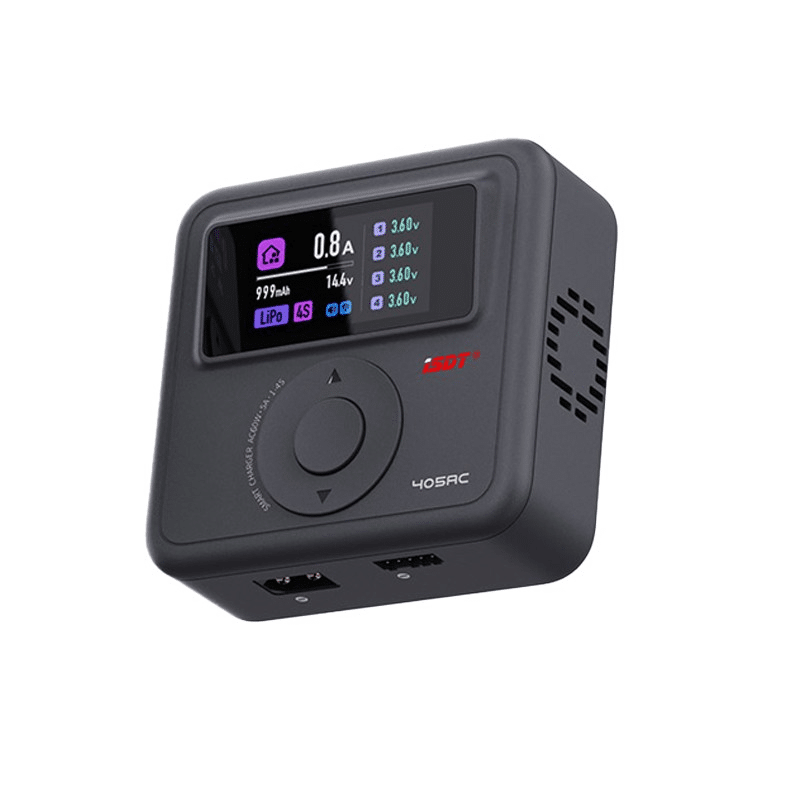
ISDT 405AC 60W AC GaN Smart Charger
Compact GaN charger with dedicated Storage mode — charges or discharges your 1-4S LiPo/LiFe pack to the optimal 3.8 V storage voltage automatically.
Temperature and Humidity Guidelines
Temperature is the single biggest lever you can pull when it comes to long-term cell health. Here are the key numbers to keep in mind:
| Temperature Range | Effect |
|---|---|
| -10 C to 15 C | Ideal; slowest calendar aging |
| 15 C to 25 C | Acceptable; standard room storage |
| 25 C to 40 C | Accelerated aging; avoid if possible |
| Above 40 C | Rapid degradation; risk of thermal runaway |
In Indian conditions, a room without AC can easily hit 42-45 degrees C in May-June. If you are storing expensive LiPo packs or 18650 cells over summer, consider a small cooler bag, a temperature-controlled cabinet, or even the vegetable compartment of your fridge (0-8 C is fine for short-term storage of a few months, but let cells warm to room temperature before charging).
Humidity: Keep relative humidity below 60%. High humidity can corrode terminals and swell soft-pouch LiPo packs. Use silica gel sachets inside your battery storage box. Re-dry the sachets every 3 months by placing them in the sun for a few hours.
LiPo-Specific Storage Tips
LiPo (lithium polymer) packs used in RC drones, planes, and cars are the most storage-sensitive cells. Their soft-pouch construction provides no mechanical protection, so gas expansion (puffing) is visible early — a sign you must take seriously.
- Always use a LiPo-safe bag or metal ammo box. Even a properly stored LiPo can vent gas in rare cases. A fire-resistant enclosure prevents a small incident from becoming a house fire.
- Never store at full charge overnight. If you charged for a flight that got cancelled, discharge to storage voltage within 24 hours using your charger’s Storage mode.
- Exercise the pack every 3 months. Run a gentle charge-discharge cycle at 0.5 C to keep the chemistry active and catch capacity drift early.
- Inspect for puffing before each session. A puffed LiPo has generated internal gas — continuing to use it is a fire risk. Dispose of it at an e-waste centre.
- Secure packs with velcro or straps. Movement and vibration can cause internal short circuits in pouches with thin separators.
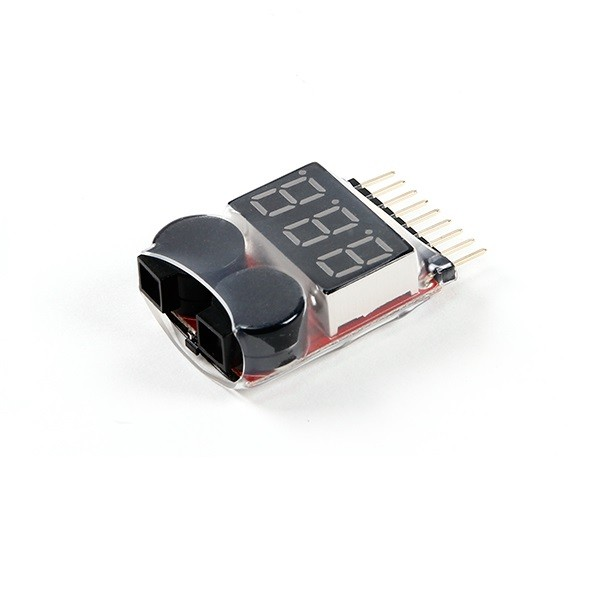
1-8S LiPo Battery Voltage Tester
Instantly reads individual cell voltages on 1-8S packs. Essential for verifying storage voltage and checking cell balance before and after long storage periods.
Storing 18650 and Cylindrical Cells
18650 cells are the backbone of DIY power banks, e-bike packs, and laptop battery rebuilds. Because they come in rigid metal cans, they are more robust than LiPos, but the chemistry inside is equally sensitive.
- Use proper holders or cases: Loose cells in a drawer can short against each other or against metal objects. Always store in dedicated plastic holders or cases.
- Mark polarity clearly: Unlabelled cells have caused countless accidental reverse-polarity incidents during reassembly after storage.
- Store at 3.6-3.7 V: This corresponds to roughly 40-50% SoC for most 18650 chemistries.
- Check voltage before use: Cells that have self-discharged below 2.5 V during storage may have suffered lithium plating. Attempt a slow recovery charge at 0.1 C maximum, and retire cells that do not recover above 3.0 V.
- Group by matched capacity: When rebuilding a pack after storage, re-test all cells and group them within 50 mAh of each other to prevent cell imbalance.

1×18650 Battery Holder (Pack of 4)
Secure individual 18650 cells during storage and transport. Prevents shorts and keeps polarity oriented. Pack of 4 perfect for workshop use.
Long-Term Storage Checklist
Use this checklist every time you plan to store a lithium pack for more than two weeks:
- Charge or discharge to storage voltage (3.7-3.8 V/cell for LiPo, 3.6-3.7 V/cell for Li-ion)
- Verify cell balance — no cell should differ by more than 0.02 V from the others
- Clean terminals with isopropyl alcohol and dry thoroughly
- Place in a LiPo-safe bag or secure plastic case
- Add a silica gel sachet for humidity control
- Store in a cool, dry location away from direct sunlight (target 15-25 C)
- Label with date of storage and current voltage
- Schedule a 3-month maintenance cycle — check voltage, perform one gentle charge-discharge
- Before re-use: inspect for swelling, re-check voltage, charge slowly at 0.5 C first cycle

25 cm LiPo Battery Strap Belt Reusable
Keep your LiPo packs securely bundled during storage. Reusable velcro wrap prevents pouch expansion and keeps multiple packs organised neatly.
Frequently Asked Questions
Can I store a lithium battery in the fridge?
Yes. A household fridge (4-8 C) is acceptable for short-term storage of a few months, especially in Indian summers. Make sure the pack is in a sealed zip-lock bag to prevent condensation. Let it warm to room temperature for at least 2 hours before charging.
What happens if I store a LiPo at full charge for months?
Storing at 100% SoC (4.2 V/cell) accelerates cathode degradation through electrolyte oxidation. You will likely see 10-20% permanent capacity loss after 3-6 months at full charge, plus increased risk of puffing in soft-pouch cells.
How long can a lithium cell be safely stored?
A quality lithium cell stored at the correct voltage and temperature can retain 80-90% capacity for 1-2 years. Even after 3-5 years at ideal conditions, many cells still function usefully. Poor conditions (full charge plus high temperature) can ruin a cell in 6 months.
My stored LiPo is puffed — can I use it?
No. A visibly puffed LiPo has vented gas internally and is a fire hazard. Do not attempt to charge or discharge it. Discharge it completely through a resistive load outdoors, then puncture the pouch and soak in saltwater for 24 hours before disposing at an authorised e-waste facility.
Should I remove cells from a device during long storage?
Yes, if possible. Devices with always-on circuits (smart BMS, LED indicators) will slowly drain the cell below safe limits. Remove the cell, bring it to storage voltage, and store it separately.
Start Storing Smarter Today
Lithium cells are not cheap — especially quality 18650s, RC LiPo packs, or cells for your DIY e-bike. Investing five minutes to set the correct storage voltage and finding a cool spot in your home will pay dividends for years. Combine these lithium battery storage guidelines for long term care with the right tools and you will never face a dead pack when you need it most. Browse Zbotic’s full range of battery accessories, chargers, and BMS boards to build your ideal storage setup.







Add comment