
Joule Thief Circuit: Light LED from Dead Battery Project
What if you could squeeze every last bit of energy from a battery that your other devices have given up on? The joule thief circuit does exactly that — it lights an LED from a “dead” battery that reads as low as 0.3V. This classic DIY electronics project is one of the best for beginners: it teaches transformer winding, transistor switching, and energy harvesting concepts in a single small circuit. In this project guide, we walk you through the theory, build steps, and variations of the joule thief so you can build one in under 30 minutes using components from your parts bin.
What Is a Joule Thief?
The Joule Thief is a minimalist boost converter circuit that steps up a low input voltage (as low as 0.3V from a nearly exhausted AA or AAA battery) to a higher voltage capable of forward-biasing and lighting an LED. White and blue LEDs require about 3.0-3.5V to light up, far more than a “dead” 1.5V battery can provide directly. The joule thief bridges this gap using inductive energy storage and transistor switching magic.
The name is delightfully apt — it “steals” the remaining joules from a battery you were about to throw away. The circuit is small enough to fit on a 20mm square piece of veroboard, and the components cost less than Rs. 20 from any Indian electronics shop. It is one of the most popular beginner projects in the Indian maker community for these reasons.
Beyond its educational value, the joule thief has practical applications: emergency LED lighting, powering low-current wireless sensors from near-dead cells, and demonstrating boost converter principles without a complex IC-based design.
How the Joule Thief Works: Circuit Theory
At its heart, the Joule Thief is a self-oscillating blocking oscillator boost converter. Here is what that means step by step:
The Core Components and Their Roles
- NPN Transistor (e.g. 2N2222 or BC547) — Acts as a switch, toggling between fully saturated (ON) and fully cut-off (OFF) at high frequency
- Toroidal inductor with two windings — The bifilar-wound toroid forms a transformer with positive feedback that causes self-oscillation
- Resistor (1k ohm) — Sets the base current and controls oscillation frequency
- LED — The load; lit by the high-voltage spike from the collapsing inductor field
- Battery (the dead one) — Energy source, even at 0.3-0.8V
The Oscillation Cycle
- Start: Battery voltage applies current through resistor to transistor base. Transistor begins to turn on.
- Transistor turns on: Collector current flows through the primary winding (W1) of the toroid. The changing current induces a voltage in the secondary winding (W2).
- Positive feedback: The W2 voltage is connected (with correct polarity) back to the transistor base. This additional base current drives the transistor harder into saturation. The transistor switches ON fully and very rapidly.
- Saturation and core saturation: The transistor is fully ON, current builds up in W1. The toroid core begins to saturate magnetically — the inductance drops, the rate of current increase slows.
- Core saturates: Once the core is fully saturated, the induced voltage in W2 collapses to zero. The base current disappears. The transistor begins to turn OFF.
- Transistor turns off, flyback spike: When the transistor turns OFF, the magnetic field in the toroid collapses. The collapsing field induces a large voltage spike (the “flyback”) across both windings. This spike can easily reach 3-5V even from a 0.5V supply. This spike forward-biases the LED, causing it to flash briefly.
- Repeat: With the field fully collapsed, the base resistor again supplies a small base current, the transistor begins to turn on, and the cycle repeats. Oscillation frequency is typically 50kHz to 300kHz depending on component values.
The LED receives a train of brief but intense voltage pulses. Because these pulses are very rapid (thousands per second), the eye perceives the LED as continuously lit. The circuit effectively converts the battery energy in two stages: first storing it in the magnetic field, then releasing it as a high-voltage pulse to the LED.
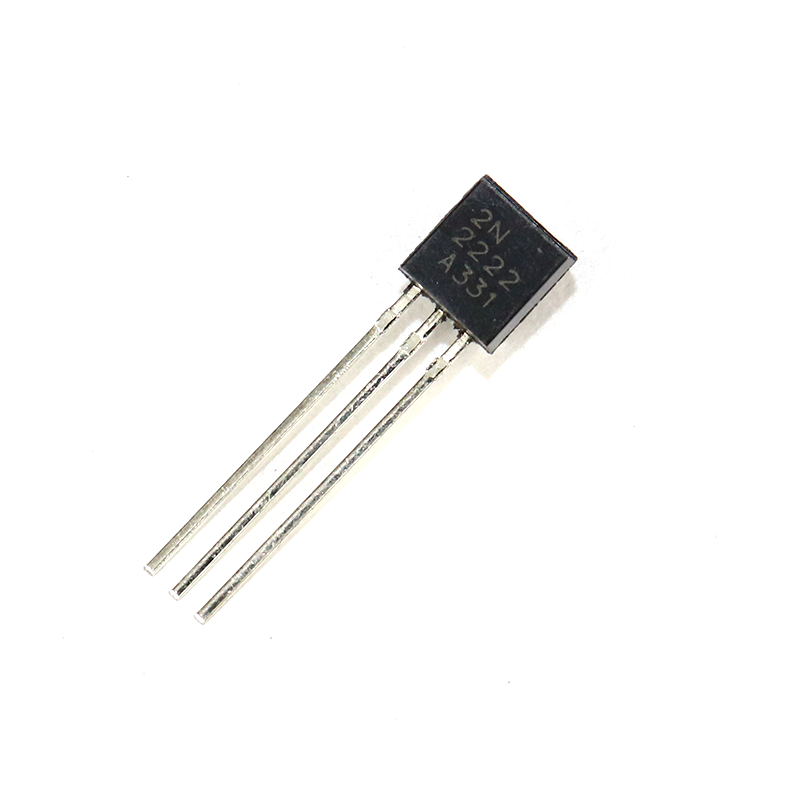
2N2222 NPN Transistor (Pack of 20)
The classic 2N2222 is ideal for the Joule Thief circuit. Its fast switching speed (fT = 300MHz) and low saturation voltage make it perfect for this high-frequency self-oscillating design.
Components Needed to Build a Joule Thief
Here is the complete parts list:
| Component | Value / Part | Notes |
|---|---|---|
| NPN Transistor | 2N2222 or BC547 | 2N2222 preferred for slightly faster switching |
| Resistor | 1k ohm, 1/4W | Carbon or metal film both work |
| LED | Any colour; white/blue most impressive | High-efficiency 5mm LED recommended |
| Toroid Core | Small ferrite toroid (from old CFL, router, PSU) | About 1cm diameter works well |
| Magnet Wire | ~30cm of 26-30AWG enamelled copper wire | Use two colours for clarity (yellow + blue) |
| Battery | AA or AAA (dead or low, 0.3V-1.5V) | This is the whole point of the project! |
| Battery holder | Single AA holder | Or just use wire leads clipped to the battery |
Where to Find a Toroid Core
The toroid is the hardest component to source for beginners. Good news for Indian makers: toroid cores are everywhere in old electronics you are about to discard:
- Old CFL tube driver boards — The yellow ring-shaped inductors are toroids
- Computer motherboard or power supply inductors
- Old router or network switch mainboards
- Cheap power adapters (the ferrite rings on cables are not suitable, but the PCB inductors are)
Any small ferrite toroid approximately 8-15mm outer diameter will work. Yellow-white and grey toroids (typically mix 26 and mix 2 material) from CFL boards are especially well-suited to this circuit.
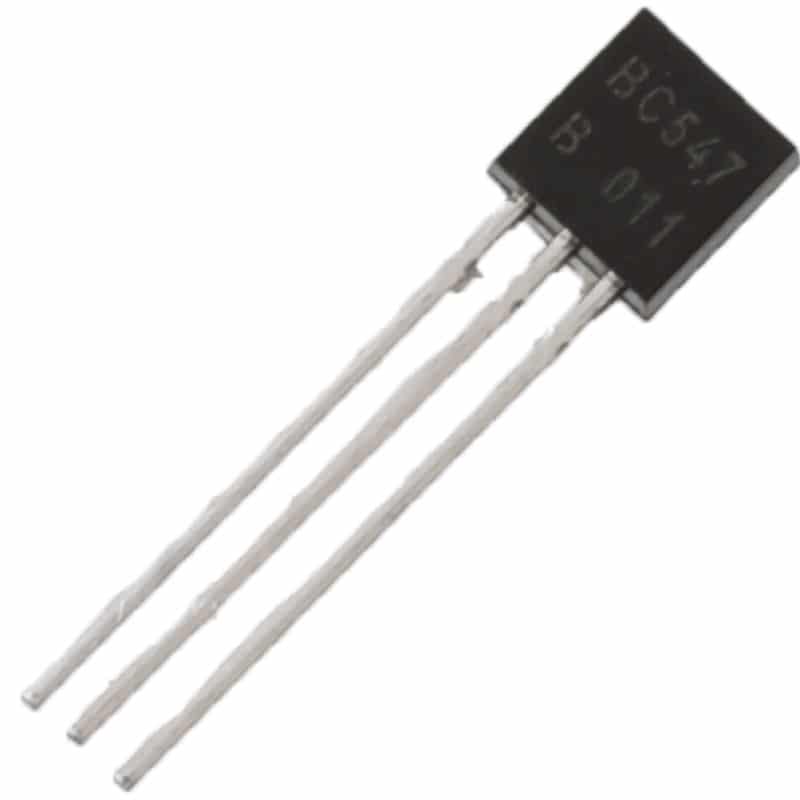
BC547 NPN 100mA Transistor TO-92 (Pack of 10)
The BC547 is an excellent alternative transistor for the Joule Thief circuit. Widely available, low cost, and proven in countless hobbyist builds across India.
Winding the Toroid Inductor
This is the most important step. The toroid needs a bifilar winding — two wires wound together simultaneously. Here is how:
Method: Bifilar Winding
- Cut two pieces of enamelled copper wire (magnet wire), each about 30cm long. Use two different colours if possible — it makes identifying which end is which much easier. Yellow and blue is the traditional combination.
- Hold both wires together side by side and wind them as one twisted pair through the toroid hole. Start from one side of the toroid and thread both wires through the hole.
- Continue winding, keeping both wires together, going through the hole and around the outside of the toroid each time. You want about 8-15 turns.
- You will have four wire ends: two at the start and two at the finish. Label them:
- Wire A, start end = A1
- Wire A, finish end = A2
- Wire B, start end = B1
- Wire B, finish end = B2
- Scrape the enamel insulation from all four ends using sandpaper or a lighter (briefly). This exposes the copper for soldering.
Winding Orientation Matters
Both wires must be wound in the same direction. This ensures the feedback winding (W2) reinforces rather than opposes the primary winding (W1). If you wind them in opposite directions, the circuit will not oscillate at all — just short-circuit the base and emit no light.
Circuit Assembly Step-by-Step
Schematic
Battery+ ----+---- W1_start
             |
            1kR
             |
             +------- Transistor Base
             |
           W2_end (feedback winding end)

Battery- ---- Transistor Emitter ---- W2_start ---- W1_end (connected together)

Transistor Collector ---- LED_cathode (short leg)
LED_anode (long leg) ---- Battery+
Step-by-Step Build (Breadboard or Veroboard)
- The toroid has W1 and W2 windings. Connect W1_end and W2_start together — this is the centre tap / common node, connected to Battery negative (GND).
- Connect W1_start to Battery positive (Vcc).
- Connect W2_end through the 1k resistor to the transistor base.
- Connect the transistor emitter to GND (Battery negative).
- Connect the transistor collector to the LED cathode (shorter leg).
- Connect the LED anode (longer leg) back to Battery positive (Vcc).
- That is it. Connect the battery and the LED should light up.
If using a breadboard, this fits very neatly on a half-size 400-point breadboard. The toroid dangles off the edge slightly, which is fine for testing.
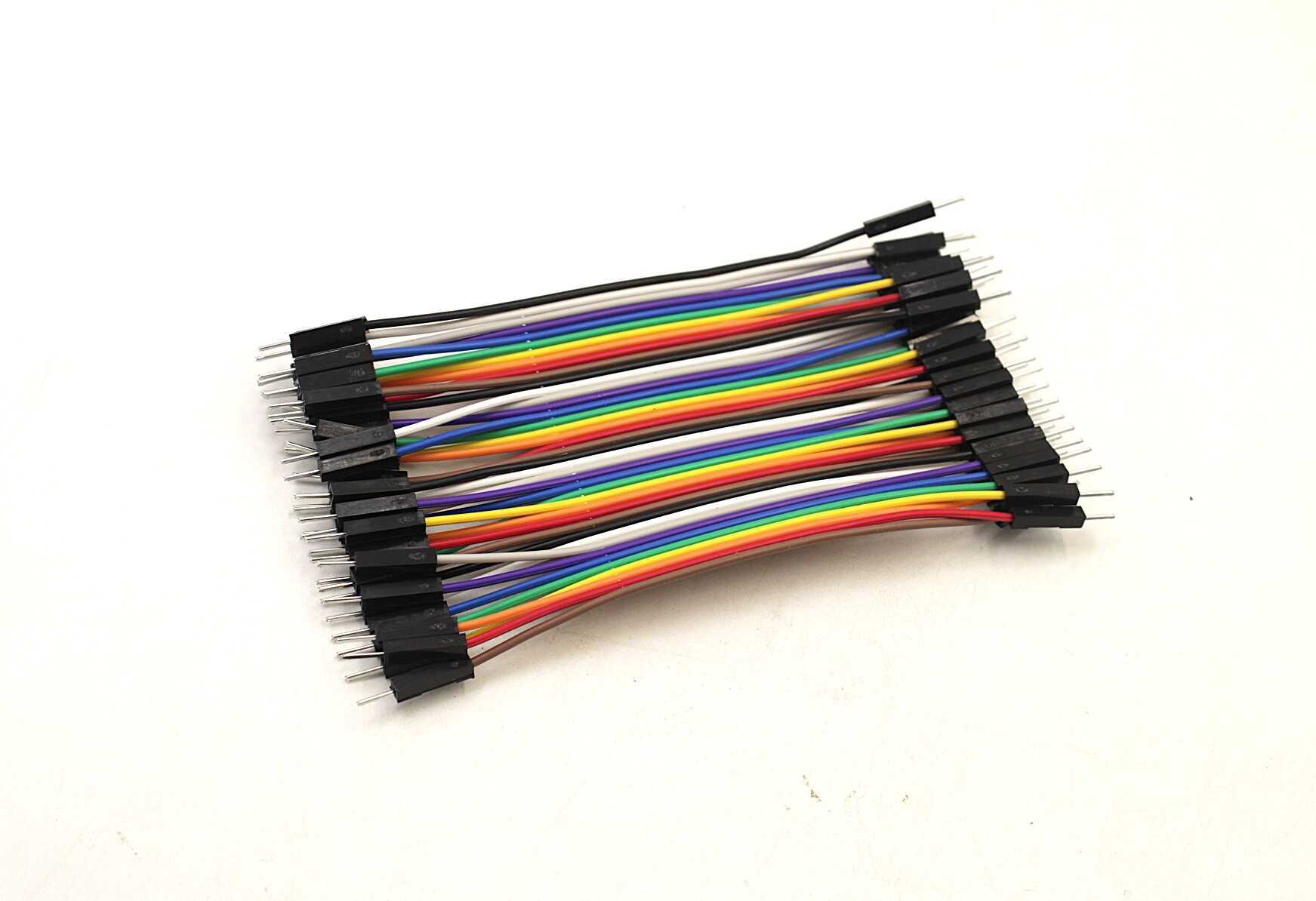
10CM Male To Male Breadboard Jumper Wires 2.54MM – 40Pcs
40-piece male-to-male jumper wire kit for connecting your Joule Thief components on a breadboard. Essential for any electronics hobbyist toolkit.
Testing and Troubleshooting
Expected Results
With a fresh battery (1.5V), the LED will shine brightly — actually brighter than if connected directly (because the Joule Thief boosts the voltage). With a “dead” battery (0.8V), the LED will glow dimly but visibly. With a battery at 0.3V, you may see a very faint glow in a dark room. The circuit should work all the way down to about 0.3V input.
LED Does Not Light Up at All
- Check winding polarity. Swap the two ends of one winding. If you have W2_end connected to the base resistor and W1_start to Vcc, try swapping so W1_end goes to the base (changing which winding is primary and which is feedback).
- Check enamel removal. The most common mistake. The wire ends must have all enamel removed. Use fine sandpaper until shiny copper is visible. Test with a multimeter on continuity mode.
- Check transistor orientation. BC547 and 2N2222 pin order: Emitter, Base, Collector (EBC) for BC547 flat-side forward; for 2N2222 in TO-18 round metal can, pinout is different — check your specific package datasheet.
- Try a different transistor. Some transistors (especially very old ones from unknown sources) have degraded hFE. Try a fresh component.
LED Barely Glows on a Fresh Battery
This usually indicates poor winding — either insufficient turns, wrong direction of one winding, or poor core material. Add more turns (increase from 8 to 15 turns) and try again.
Variations and Improvements
Multi-LED Joule Thief
Add more LEDs in parallel (not series) at the collector. Each LED draws its own current pulse. The circuit can often light 2-3 LEDs from a single dead battery, though brightness per LED decreases.
Joule Thief with 555 Timer
Replace the self-oscillating transistor/toroid with a 555 timer generating a fixed square wave to drive the transistor. This gives you control over the operating frequency and produces a more stable output voltage, at the cost of the 555 timer adding to minimum supply voltage requirements.
Powering Small Sensors
The Joule Thief principle scales up. Replace the LED with a voltage regulator output capacitor to provide a regulated 3.3V or 5V supply from a low-voltage cell. Add a Schottky diode in series with the toroid output to rectify the flyback pulses into a smoothed DC supply. This is essentially how many commercial “super capacitor” and “energy harvesting” ICs work internally.
PCB Version
Once you have your breadboard version working, lay it out on a small piece of veroboard and solder it permanently. The finished circuit can be hot-glued into a small box with a battery holder for a compact emergency LED torch — an excellent gift for a fellow maker.
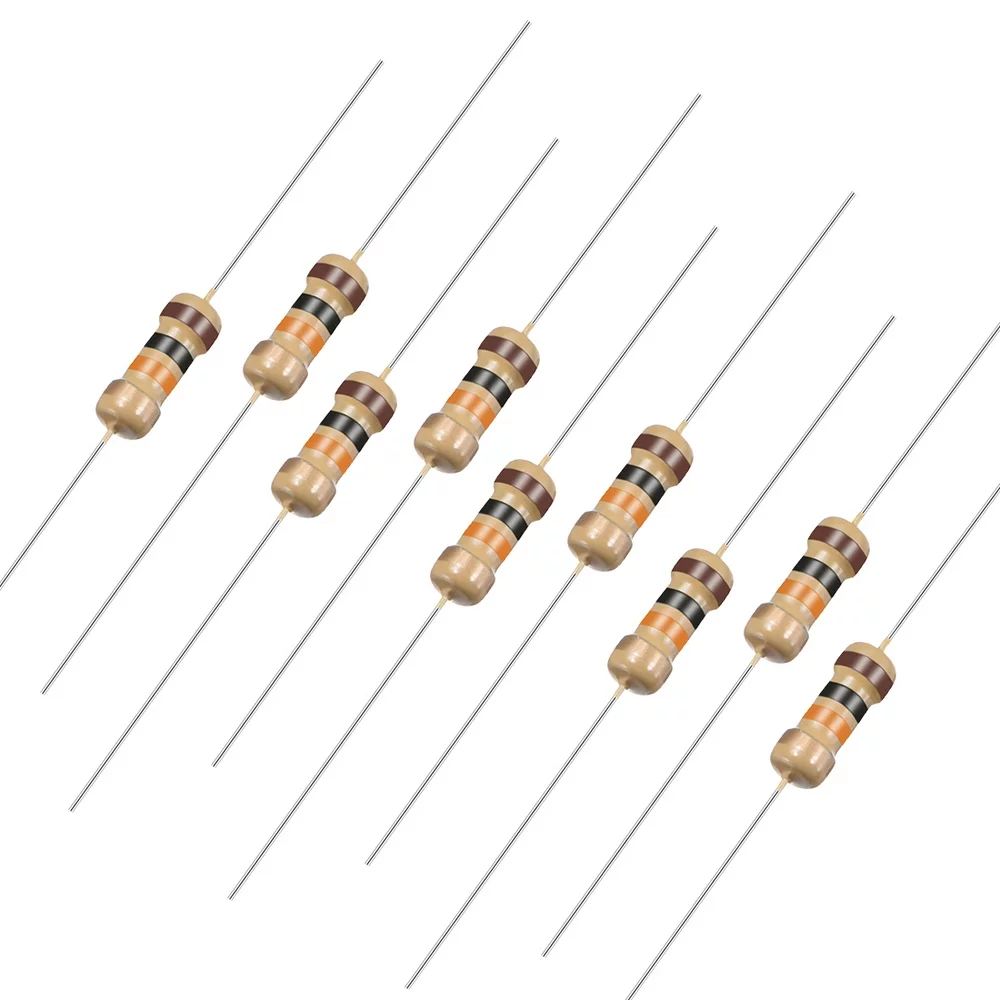
10 Ohm 0.25W Carbon Film Resistor (Pack of 50)
Carbon film resistors for your Joule Thief base resistor and circuit experiments. Keep a variety of values in your parts kit for electronics prototyping.
Frequently Asked Questions
Q: What is the minimum voltage the Joule Thief can work from?
A well-built Joule Thief using a 2N2222 and a good ferrite toroid can operate from as low as 0.3V. A typical build stops working reliably somewhere between 0.3V and 0.5V. The limiting factor is the transistor base-emitter voltage (Vbe), which needs about 0.2-0.3V to turn on. Below this, the transistor cannot be triggered at all.
Q: Why does the LED appear brighter in the Joule Thief than when connected directly to a full 1.5V battery?
When an LED is connected directly to a 1.5V battery without a current-limiting resistor, the battery internal resistance limits the current. A typical AA battery has 0.1-0.5 ohm internal resistance, so the LED gets perhaps 20-30mA. In a Joule Thief, the LED receives a brief but intense flyback pulse with peak current potentially hundreds of milliamps. While the average current may be similar, the high peak current during each pulse drives the LED at a point of much higher efficiency on its luminous efficacy curve, so it appears brighter.
Q: Can I use this to charge a capacitor or small battery?
Yes — replace the LED with a large capacitor (or small supercapacitor) and a Schottky diode in series. The flyback pulses charge the capacitor. This is the basis of simple energy harvesting circuits. Be careful: without a load, the output voltage can rise very high (tens of volts) and damage the transistor. Always have a load connected.
Q: Does the core material matter?
Yes, significantly. Yellow-white mix 26 ferrite (common in CFL ballasts) and mix 2 materials are ideal for the 100kHz frequency range. Black ferrite cores (mix 43, common in EMI suppression beads) have much higher losses at these frequencies and give a dimmer result. Powdered iron cores (grey/beige, common in RF work) also work. If your LED is very dim with one core, try a different core before blaming the circuit.
Q: What transistors besides 2N2222 and BC547 work well in this circuit?
Almost any small signal NPN transistor with reasonable hFE and gain-bandwidth product will work. Try: BC548, BC549, 2N3904, S8050, S9013. High-power transistors like TIP31 work but are overkill and may oscillate poorly at low supply voltages due to high Vbe. Avoid Darlington transistors — their 2x Vbe drop (about 1.4V) is too high for dead-battery operation.
Get your project components from Zbotic.in. We stock transistors, resistors, capacitors, LEDs, and jumper wires — everything you need to build the Joule Thief and explore electronics. Shop now and get fast delivery across India.







Add comment