
When it comes to hexapod vs bipedal robot stability, the debate goes far beyond the number of legs. Whether you are a robotics hobbyist building your first legged machine or an engineering student studying locomotion algorithms, understanding the fundamental trade-offs between six-legged crawling robots and two-legged walking robots is critical. This guide breaks down gait mechanics, center of mass management, terrain adaptability, and real-world build considerations so you can make an informed decision for your next project.
Stability Fundamentals: What Makes a Robot Stable?
Robot stability is analyzed through two primary lenses: static stability and dynamic stability. A robot is statically stable when its center of mass (CoM) projects inside the polygon formed by its ground contact points — even when it is standing still. Dynamic stability, on the other hand, allows a robot to remain balanced only while in motion, like a bicycle that falls over when stopped.
The support polygon is the convex hull drawn around all ground contact points. A larger support polygon means more tolerance for disturbances, uneven surfaces, and payload shifts. This single concept explains why hexapods dominate in rough terrain applications while bipedal robots require sophisticated real-time balance algorithms to remain upright.
For DIY builders, static stability is far easier to implement because it does not require high-frequency sensor feedback loops. A hexapod standing still is passively stable; a biped standing still requires active control or clever mechanical design like wide flat feet.
Hexapod Mechanics: How Six Legs Win at Static Stability
A hexapod robot has six legs, and with a tripod gait — the most common locomotion pattern — three legs are always on the ground at any instant. Those three ground contacts form a triangle, and as long as the robot’s CoM stays within that triangle, the robot is statically stable. This is an enormous advantage.
Key characteristics of hexapod designs:
- Redundancy: Even if one leg fails, the robot can redistribute weight across the remaining five legs and continue walking. This is critical for outdoor or mission-critical applications.
- Static stability during pauses: A hexapod can freeze mid-step and remain upright without any active control.
- Payload tolerance: The wide support polygon accommodates top-heavy payloads — cameras, sensors, grippers — without tipping.
- Leg count per DOF: Each leg typically uses 2–3 degrees of freedom (DOF). A 3-DOF-per-leg hexapod has 18 servos total, which is hardware-intensive but computationally manageable with pre-computed gait tables.
The trade-off is mechanical complexity and power consumption. Eighteen servos draw significant current, and the frame requires careful weight distribution. However, inverse kinematics for hexapods is well-documented and libraries like Arduino Hexapod IK or ROS MoveIt make implementation accessible.
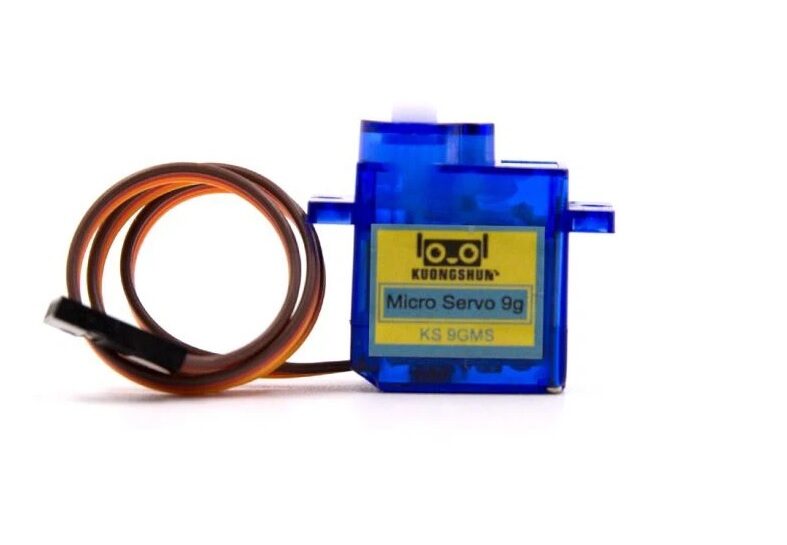
Servo SG90 9g 180 Degree
Lightweight 9g micro servo ideal for hexapod legs — 18 of these power a full 3-DOF hexapod build at low cost.
Bipedal Mechanics: Dynamic Balance and Why It Is Hard
Bipedal robots — like ASIMO, Boston Dynamics Atlas, or the humble humanoid kit — walk on two legs the way humans do. At any moment during walking, only one foot (or no foot during the flight phase) may be on the ground. This makes bipedal locomotion an inherently dynamic problem.
The most common stability criterion used for bipedal robots is the Zero Moment Point (ZMP). If the ZMP — the point where the net ground reaction force acts — stays within the support polygon of the contact foot, the robot does not tip over. ZMP-based controllers require IMUs, force sensors in the feet, and fast feedback loops running at 100–1000 Hz.
For DIY builders, this is the hard part. A bipedal robot without active balance control will simply fall over when pushed or when it steps on an uneven surface. Workarounds include:
- Wide, flat feet: Increase the support polygon per foot, reducing the sensitivity to CoM shifts.
- Low CoM design: Keep motors and batteries as low as possible.
- Pre-programmed gait cycles: Walk on flat surfaces only with carefully tuned step trajectories that keep ZMP inside the foot polygon.
- IMU feedback: MPU6050 or similar IMU feeds tilt data into a PID controller that adjusts ankle and hip servos in real time.
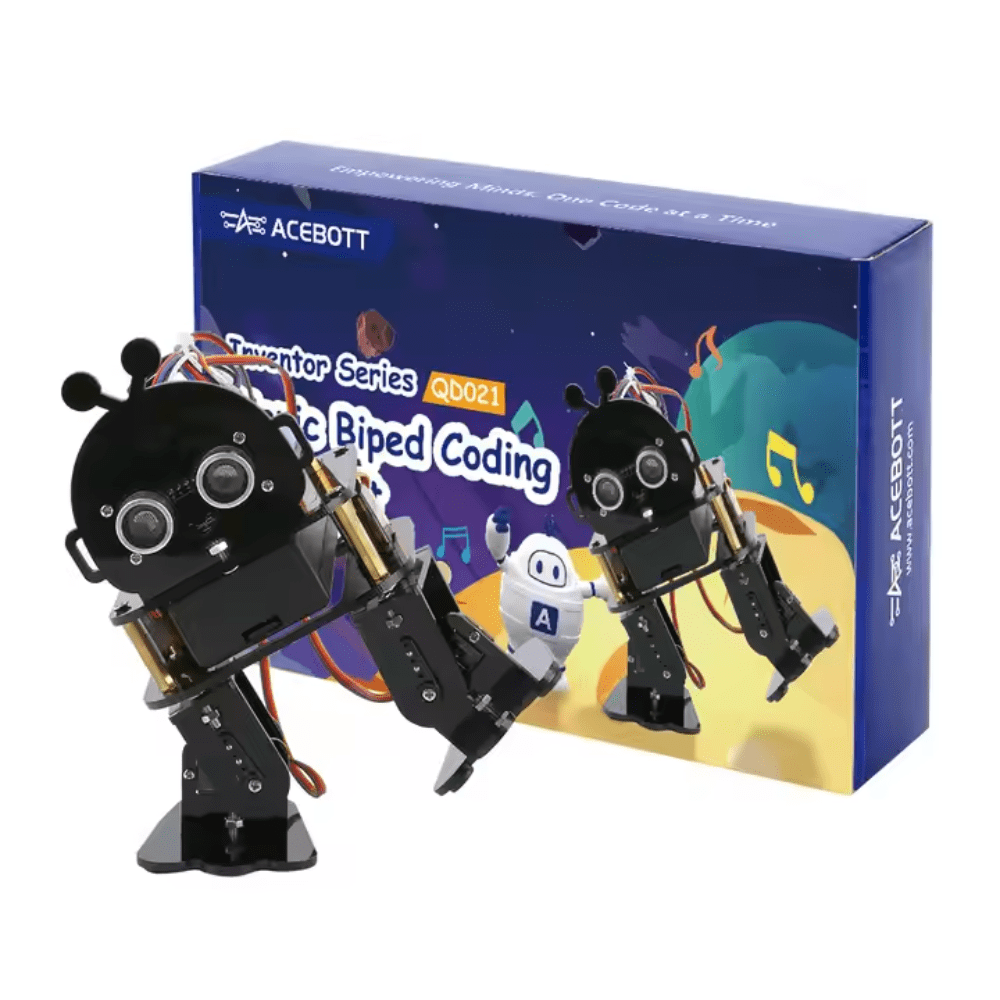
ACEBOTT Biped Robot Kit – QD021
Ready-to-assemble bipedal robot kit powered by ESP32 — perfect for learning dynamic balance and humanoid gait programming.
Gait Pattern Comparison: Tripod vs Alternating Steps
The gait pattern — the sequence in which legs leave and contact the ground — determines both stability and speed. Here is how the two architectures compare:
Hexapod Gaits
- Tripod gait: Legs 1, 3, 5 move while 2, 4, 6 support, then swap. Always 3 legs on ground. Fast and statically stable. Most popular choice for DIY builders.
- Wave gait: Only one leg lifts at a time. Maximum stability but slowest speed. Used in very rough terrain.
- Ripple gait: Two legs lift at a time from opposite sides. Good balance between speed and stability.
Bipedal Gaits
- Static walk: Robot shifts CoM over the support foot before lifting the other. Slow but achievable with pre-programmed moves and no IMU.
- Dynamic walk: Inverted pendulum model — robot falls forward and catches itself. Requires real-time ZMP control.
- Running: Both feet off ground briefly (flight phase). Extremely difficult; requires high-bandwidth actuators and sensors.
For beginners, the hexapod tripod gait is orders of magnitude easier to implement reliably than a dynamic bipedal walk. You can implement tripod gait with simple timed sequences; bipedal dynamic walking needs control theory, sensor fusion, and tuning patience.
Terrain Adaptability and Real-World Performance
This is where the practical difference between the two architectures becomes most apparent. Consider these scenarios:
| Scenario | Hexapod | Bipedal |
|---|---|---|
| Flat hard floor | Excellent | Good (with tuning) |
| Gravel / outdoor | Excellent | Poor without active balance |
| Stairs | Possible (small steps) | Possible (advanced control) |
| One leg failure | Robot continues | Robot falls |
| Carrying payload | Excellent | Difficult (CoM shifts) |
| Narrow corridors | Poor (wide stance) | Excellent |
Hexapods shine in unstructured environments. Bipedal robots shine in human-designed spaces — stairs built for human stride, narrow doorways, ladders. The long-term goal for bipedal robots is exactly this: operating in spaces built for humans without modifying the environment.
Servo and Hardware Requirements for Both Designs
Both robot types rely on servo motors as their primary actuators, but the requirements differ significantly.
Hexapod Hardware
- 18 servos for a 3-DOF design (9g–20g servos adequate for small builds)
- Servo driver board (PCA9685 recommended for I2C control of 16 channels)
- Microcontroller: Arduino Mega, STM32, or ESP32 with sufficient PWM outputs
- Power: 5V 5A minimum for 18 × SG90 servos at full load
- Frame: laser-cut acrylic or 3D printed, aluminum for heavier builds
Bipedal Hardware
- 10–20 servos depending on DOF (ankle, knee, hip, waist, shoulder, elbow)
- Higher-torque servos required (MG996R or DS3218 class) — legs must support full robot weight on one foot
- IMU sensor (MPU6050 or MPU9250) for orientation feedback
- Microcontroller with fast loop: STM32 or Raspberry Pi + real-time co-processor
- Optional: foot force sensors (FSRs) for ZMP feedback
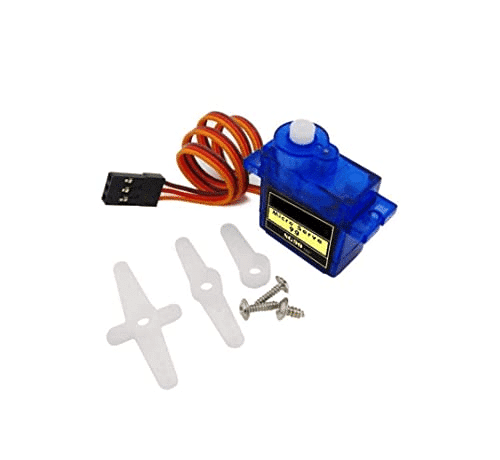
TowerPro SG90 180 Degree Rotation Servo Motor
The go-to servo for small walking robots — reliable 180° rotation, compact form factor, works perfectly with PCA9685 boards.
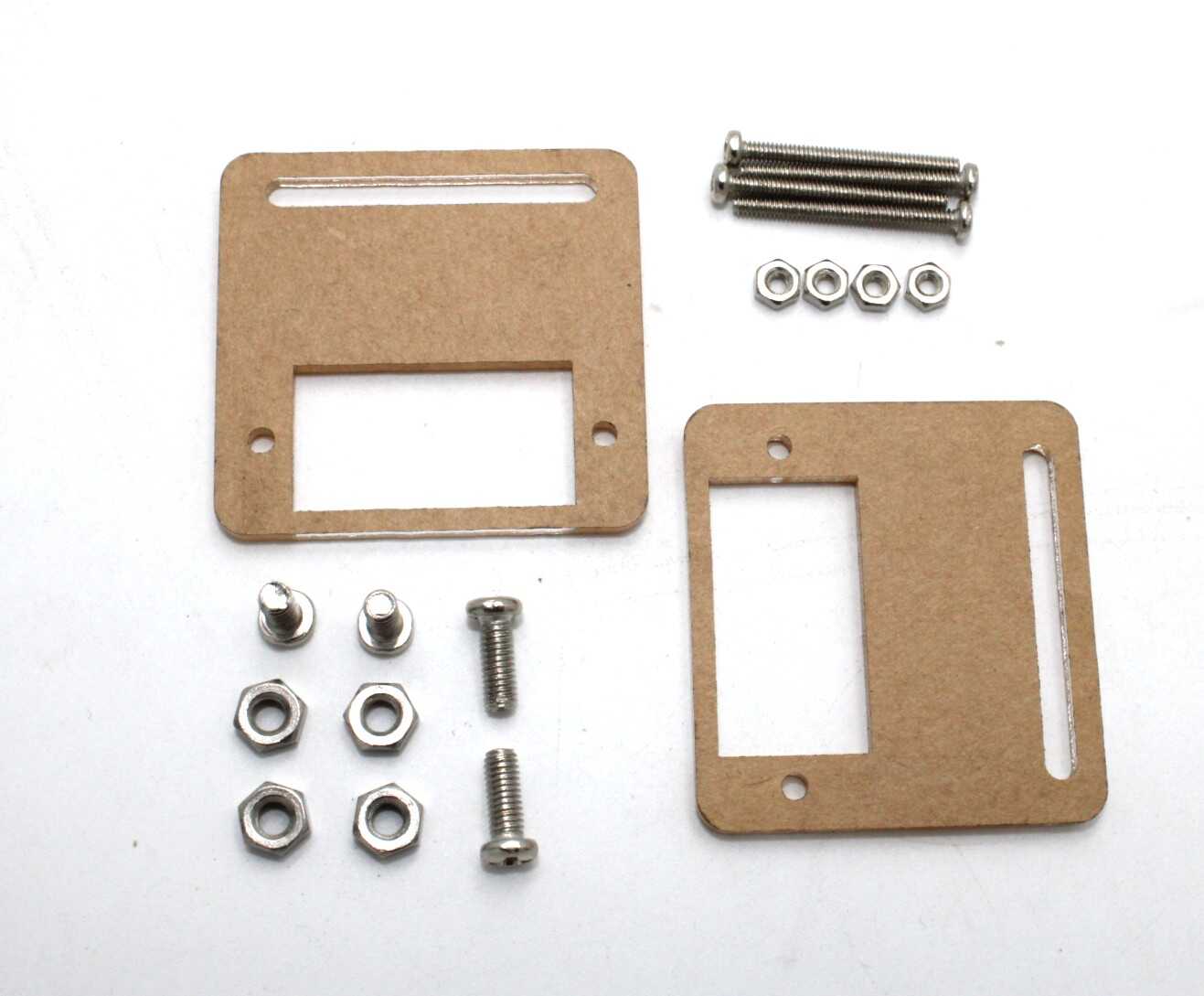
Servo Mount Holder Bracket for SG90/MG90 (Pack of 2)
Essential servo mounts for building leg joints in both hexapod and bipedal robots — compatible with SG90 and MG90 servos.
Which Should You Build? Choosing Based on Goals
Use this framework to decide:
- Build a hexapod if: You want reliable outdoor locomotion, you are new to legged robots, you want to focus on IK and gait planning without fighting balance, or your application involves carrying a payload or sensor suite.
- Build a bipedal if: You want to learn control theory, you are targeting a humanoid form factor, you need to operate in human-centric environments (stairs, narrow spaces), or you are studying ZMP / model predictive control algorithms.
- Skill level: Hexapod — beginner to intermediate. Bipedal — intermediate to advanced.
- Budget: Hexapod costs more in servo count but less in sensor and compute requirements. Bipedal saves on servos but demands IMU, fast MCU, and more programming time.
Both are deeply rewarding projects. Many roboticists build a hexapod first, master inverse kinematics and gait programming, then tackle a bipedal robot with a far stronger foundation. There is no wrong choice — only the one that matches your current goals and skill level.
Frequently Asked Questions
Is a hexapod more stable than a bipedal robot?
Yes, in terms of static stability. A hexapod using a tripod gait always has three ground contacts forming a stable triangle. A bipedal robot requires dynamic balance and active control to stay upright, making it inherently less statically stable.
How many servos does a hexapod robot need?
A standard 3-DOF-per-leg hexapod requires 18 servos. A 2-DOF version uses 12 servos but has reduced leg workspace and maneuverability. SG90 class servos are sufficient for robots weighing under 500g.
Can a bipedal robot walk on uneven terrain?
Yes, but it requires advanced control: IMU feedback, ZMP calculation, and often foot force sensing. Without these, most DIY bipedal robots are limited to flat, smooth surfaces with pre-programmed gait cycles.
What is the Zero Moment Point (ZMP)?
ZMP is the point on the ground where the net horizontal inertial and gravity forces balance to zero. If ZMP stays within the contact foot’s support polygon, the robot will not tip over. It is the core stability criterion for bipedal locomotion control.
Which robot is better for outdoor use?
Hexapod robots are far better suited for outdoor, unstructured terrain. Their redundant legs, large support polygon, and static stability make them robust to obstacles and surface irregularities that would cause a bipedal robot to fall.
Ready to start building? Whether you choose a six-legged hexapod or a humanoid biped, Zbotic has the servos, brackets, and electronics you need. Browse our Robotics & Automation collection and get your build started today.







Add comment