
If you have ever shopped for a GPS module for your drone, robot, vehicle tracker, or IoT asset management project, you have almost certainly encountered the three most popular u-blox modules: the NEO-6M, NEO-M8N, and NEO-M9N. They look similar, they all output NMEA sentences over UART, and they are all compatible with Arduino and Raspberry Pi — yet their performance, feature sets, and price points are dramatically different.
Choosing the wrong module can mean the difference between a GPS tracker that drifts 10 metres indoors and one that holds sub-metre accuracy outdoors. This in-depth comparison covers every specification that matters: horizontal accuracy, satellite constellation support, time to first fix, cold-start performance, power consumption, and value for money — so you can make the right choice for your specific application.
1. Quick Comparison Table
| Specification | NEO-6M | NEO-M8N | NEO-M9N |
|---|---|---|---|
| Generation | 6th (2012) | 8th (2014) | 9th (2019) |
| CEP Accuracy | 2.5 m | 2.5 m | 1.5 m |
| Constellations | GPS only | GPS+GLONASS+BeiDou+Galileo (2 concurrent) | GPS+GLONASS+BeiDou+Galileo (4 concurrent) |
| Max Channels | 50 | 72 | 92 |
| Cold Start TTFF | ~27 s | ~26 s | ~24 s |
| Hot Start TTFF | 1 s | 1 s | 2 s |
| Tracking Power | ~22 mA | ~29 mA | ~25 mA |
| Update Rate | 5 Hz | 10 Hz | 25 Hz |
| Supply Voltage | 2.7–3.6 V | 1.71–1.89 V (core), 3.3 V module | 1.71–1.89 V (core), 3.3 V module |
| Approx. Module Price (India) | ₹400–600 | ₹900–1400 | ₹2500–4000 |
| Best For | Learning, basic trackers | Drones, vehicles, production IoT | Precision agriculture, robotics |
2. NEO-6M: The Affordable Entry Point
The u-blox NEO-6M was released around 2012 and remains the most widely sold GPS IC on platforms like Amazon and electronics hobby stores across India — largely because of its extremely low price. The popular blue-PCB breakout module with the ceramic patch antenna costs under ₹500 and is genuinely capable for its price.
What the NEO-6M Does Well
- Price: The lowest entry point in the u-blox lineup for makers.
- Plug-and-play simplicity: Outputs standard NMEA 0183 sentences (GGA, RMC, VTG) at 9600 baud by default. Works with any UART on Arduino Uno, ESP32, or Raspberry Pi.
- Established documentation: Thousands of tutorials, libraries, and forum answers available.
- AssistNow compatible: Supports u-blox AssistNow Autonomous (offline AGPS) to cache almanac data and speed up subsequent fixes.
NEO-6M Limitations
- GPS-only constellation: The biggest limitation. In dense urban environments (urban canyon effect) or under tree cover, GPS-only reception can drop to 4–6 satellites, leading to poor accuracy or complete loss of fix. In Mumbai or Delhi city centres with tall buildings, this is a real problem.
- 5 Hz maximum update rate: Fine for slow-moving vehicles or asset trackers, but not suitable for high-speed drone navigation or robotics requiring fast position updates.
- Older silicon: The NEO-6M chip uses a 65 nm process. While it functions correctly, its noise rejection and weak-signal acquisition are inferior to newer generations.
Verdict on NEO-6M: An excellent choice for learning GPS programming, prototyping vehicle trackers in open environments, and budget-constrained projects where ₹200 extra matters. Do not use it for drones, where loss of fix at a critical moment is a safety hazard.
3. NEO-M8N: The Sweet Spot
The NEO-M8N (released 2014, M8 series) is the module that made multi-constellation GPS accessible to hobbyists and small drone manufacturers. It sits in a size-compatible footprint with the NEO-6M but delivers dramatically better real-world performance at roughly double the price.
What Makes the NEO-M8N Better
The M8N’s most important upgrade over the 6M is multi-constellation support. The chip can track GPS + GLONASS simultaneously, and with firmware configuration can add BeiDou or Galileo (two constellations active at once). In a typical outdoor scenario in India, this means 16–22 satellites in view instead of 8–12 — and more satellites directly translates to better accuracy and resilience.
With 72 tracking channels and a more sensitive RF front end, the NEO-M8N can acquire and track satellites 3–5 dB weaker than the NEO-6M. This makes an enormous difference in challenging environments: under tree canopy, near buildings, or in valleys.
NEO-M8N Real-World Accuracy
On paper, both the 6M and M8N specify 2.5 m CEP (Circular Error Probable). In practice, the M8N consistently achieves better results because:
- More satellites reduce PDOP (Position Dilution of Precision)
- GPS+GLONASS together have better sky coverage geometry than GPS alone
- The M8N supports SBAS (GAGAN in India, WAAS in the US) for additional 1–2 m accuracy improvement in supported areas
In open-sky testing in Indian cities, the M8N typically achieves 1.8–2.2 m CEP versus 2.5–4 m for the NEO-6M under identical conditions.
NEO-M8N for Drones
The 10 Hz update rate is what makes the M8N suitable for ArduPilot and PX4-based drones. At 10 Hz, the flight controller receives a new position fix every 100 ms — fast enough for stable GPS-hold mode and auto-landing. The NEO-6M at 5 Hz introduces 200 ms position latency, which is noticeable in gusty conditions.
4. NEO-M9N: The Modern Precision Option
The NEO-M9N (released 2019) represents u-blox’s 9th generation platform. It is the most capable of the three and the most expensive. For professional IoT products, precision agriculture drones, and autonomous robots, it is the correct choice.
NEO-M9N Advantages
Four concurrent constellations: This is the headline feature. The M9N can simultaneously track GPS, GLONASS, BeiDou, and Galileo. In a typical sky view you might see 30+ satellites total, with 25+ usable. This over-determined position solution dramatically reduces the impact of any single satellite going bad, multipath, or signal loss.
1.5 m CEP accuracy: The combination of 4 constellations, 92 channels, and improved signal processing yields a specified 1.5 m CEP — 40% better than the M8N spec. In good open-sky conditions, real-world testing often shows 0.8–1.2 m performance.
25 Hz update rate: At 25 updates per second, position latency drops to 40 ms. This is critical for high-speed autonomous vehicles or camera gimbals that use GPS for stabilisation.
Anti-spoofing and anti-jamming: The M9N includes advanced RF monitoring features to detect spoofing attacks and jamming. For commercial drone operators and security applications, this matters.
NEO-M9N Limitations
- Price: Genuine NEO-M9N modules cost significantly more than M8N clones. Be cautious of very cheap M9N modules — the market has counterfeits.
- 2 s hot start TTFF: Slightly slower than the 1 s hot start of the 6M and M8N. In practice this is imperceptible for most applications.
- Configuration complexity: u-center software is needed to fully utilise M9N features. The default NMEA output is straightforward, but enabling all 4 constellations and optimising the filter settings requires time investment.
5. Accuracy Deep Dive: Factors That Really Matter
The specification sheet CEP values are measured in open-sky conditions with a good patch antenna. In the real world, many other factors determine how accurate your GPS position actually is:
Antenna Quality
The ceramic patch antenna included with hobby modules is adequate but not exceptional. A larger active antenna (28 mm × 28 mm vs the typical 18 mm × 18 mm patch) with a proper ground plane can improve sensitivity by 3–5 dBi and meaningfully improve accuracy in difficult environments. For fixed installations, a helical or blade antenna with a larger ground plane is even better.
SBAS / DGPS
India’s GAGAN (GPS Aided GEO Augmented Navigation) SBAS system broadcasts differential corrections from geostationary satellites, improving accuracy to ~1 m in GAGAN-covered areas. All three modules support SBAS — but it must be enabled in firmware configuration (it is enabled by default on most modules).
Multipath
GPS signals reflecting off buildings are the dominant accuracy killer in urban environments. No amount of constellation upgrade overcomes severe multipath — you need physical line-of-sight to the sky. For urban deployments, consider adding a compass and wheel odometry to dead-reckon through GPS-poor zones.
Update Rate vs Accuracy Trade-off
At higher update rates, the receiver has less time to integrate signals, which can reduce accuracy slightly. The M9N at 25 Hz is less accurate per position fix than at 1 Hz. For precision surveying, set your module to 1 Hz and average many readings. For navigation, use the higher rate for responsiveness.
6. Satellite Constellation Support Explained
Understanding which constellations each module supports is crucial for choosing the right device for India-based projects:
- GPS (USA): 31 active satellites in MEO. Best coverage globally. All three modules support it.
- GLONASS (Russia): 24 satellites. Has notably better coverage in high-latitude locations (northern India, Himalayas). NEO-M8N and M9N only.
- BeiDou (China): 35+ satellites, including GEO satellites over Asia. Excellent coverage in India. NEO-M8N (with GLONASS switched off) and NEO-M9N.
- Galileo (EU): 28 operational satellites as of 2025. Higher accuracy atomic clocks. NEO-M8N (with switching) and NEO-M9N.
- NavIC (India): India’s own IRNSS with 7 satellites, strong coverage in South Asia. Note: None of the three u-blox modules listed here natively support NavIC — that requires u-blox NEO-M10S or dedicated NavIC chips from ISRO’s ecosystem.
7. Time to First Fix (TTFF) Comparison
TTFF is how long the GPS takes to produce its first valid position after power-on. There are three types:
- Cold Start: No cached almanac data. The receiver must download the full GPS almanac from satellites (~12.5 minutes to download a full almanac, but a valid fix can be obtained from partial data in 27–30 seconds).
- Warm Start: Almanac and approximate position are cached from a previous session within the last few days. TTFF ~5–15 seconds.
- Hot Start: Recent (within 2 hours) full ephemeris data is cached. TTFF ~1–2 seconds. All three modules achieve this with a backup battery (CR1220 coin cell) on the module PCB.
For drone operations, always ensure the battery-backed RTC and almanac cache are functional — a 27-second cold start delay at an outdoor field is no big deal, but in an emergency return-to-home scenario, a pre-warmed GPS is safety-critical.
8. Power Consumption Analysis
For battery-powered projects (asset trackers, wildlife monitoring, solar IoT nodes), GPS power draw is often the dominant factor in battery life calculations.
| Module | Continuous Tracking | Power Save Mode | Acquisition |
|---|---|---|---|
| NEO-6M | ~22 mA @ 3.3V | ~11 mA (1 Hz cyclic) | ~37 mA |
| NEO-M8N | ~29 mA @ 3.3V | ~15 mA (1 Hz cyclic) | ~47 mA |
| NEO-M9N | ~25 mA @ 3.3V | ~7 mA (1 Hz cyclic) | ~39 mA |
The NEO-M9N’s power save mode is significantly more efficient than older generations — its power management architecture allows it to power-gate most of the RF chain between position updates. For a battery tracker that wakes every 30 seconds, the M9N can extend battery life by 30–40% compared to an M8N.
9. Which Module Should You Choose?
Choose NEO-6M if:
- Budget is the primary constraint (under ₹600)
- Project is in an open rural/highway environment with clear sky view
- Learning GPS programming for the first time
- Update rate of 1–5 Hz is sufficient
- GPS-only constellation is adequate for your location
Choose NEO-M8N if:
- Building a drone or unmanned vehicle
- Project will operate in semi-urban environments
- Need 10 Hz update rate for flight controller compatibility
- Want multi-constellation without paying M9N prices
- Production IoT tracker where accuracy and reliability matter
Choose NEO-M9N if:
- Precision agriculture (RTK base for cm accuracy) or survey grade requirements
- High-speed autonomous vehicle (25 Hz update critical)
- Urban environment with challenging multipath
- Commercial product where GPS is a key differentiator
- Long battery life with power-save cycling
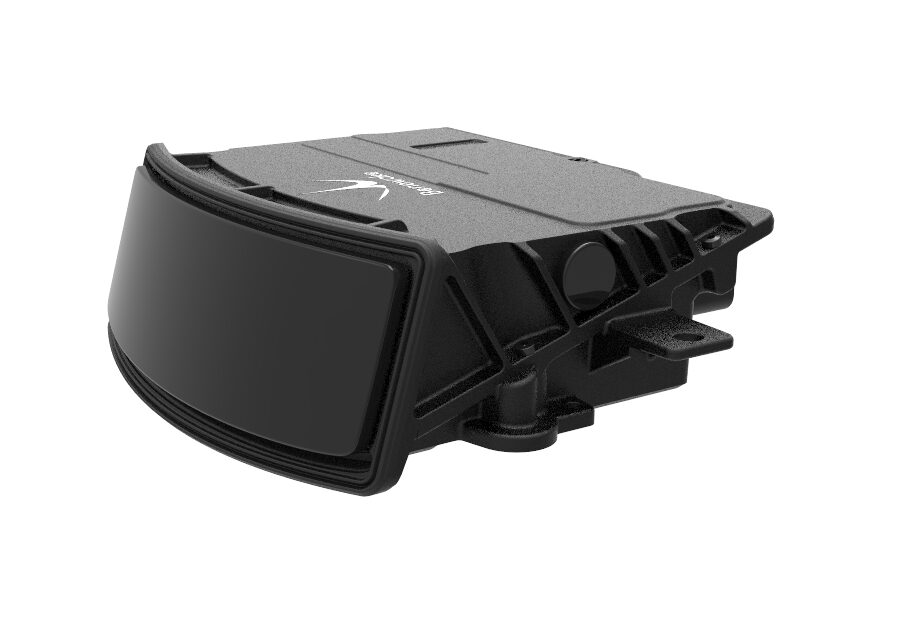
Benewake AD2-S-X3 Automotive-Grade LiDAR
Complement your GPS with LiDAR for GPS-denied environments — perfect for autonomous vehicles, robots, and drones that need both precise positioning and obstacle detection.
10. Arduino / ESP32 Wiring and Code
All three modules use the same UART interface and NMEA protocol, so the wiring and basic code is identical. The module communicates at 3.3 V logic — use a logic level converter with 5 V Arduino boards.
| GPS Module Pin | Arduino Mega (5V with LLC) | ESP32 (3.3V direct) |
|---|---|---|
| VCC | 3.3 V | 3.3 V |
| GND | GND | GND |
| TX (GPS out) | RX1 (through LLC) | GPIO16 (RX2) |
| RX (GPS in) | TX1 (through LLC) | GPIO17 (TX2) |
#include <TinyGPS++.h>
#include <HardwareSerial.h>

// ESP32: use Serial2 for GPS
HardwareSerial GPSSerial(2);
TinyGPSPlus gps;

void setup() {
  Serial.begin(115200);
  GPSSerial.begin(9600, SERIAL_8N1, 16, 17); // RX=16, TX=17
}

void loop() {
  while (GPSSerial.available() > 0) {
    gps.encode(GPSSerial.read());
  }
  if (gps.location.isUpdated()) {
    Serial.printf("Lat: %.6f | Lng: %.6f | HDOP: %.2f | Sats: %dn",
      gps.location.lat(),
      gps.location.lng(),
      gps.hdop.hdop(),
      gps.satellites.value());
  }
}
Use HDOP (Horizontal Dilution of Precision) as a real-time accuracy indicator: HDOP < 1 is excellent, 1–2 is good, 2–5 is moderate, and > 5 means avoid navigation decisions.
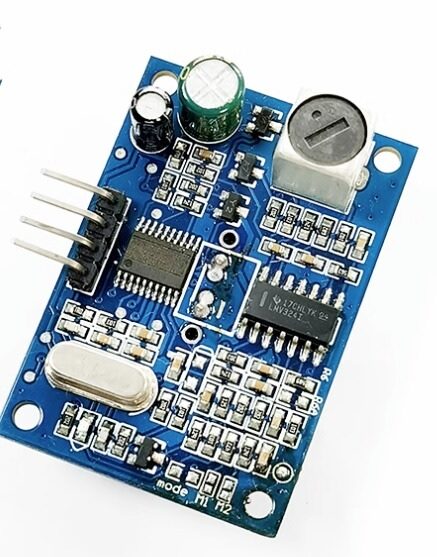
JSN-SR04T Waterproof Ultrasonic Rangefinder
Add ultrasonic altitude sensing to your GPS-equipped drone or robot — the waterproof JSN-SR04T measures ground distance for landing and obstacle avoidance.
Frequently Asked Questions
Q: Can I upgrade from NEO-6M to NEO-M8N without changing code?
Yes. Both modules use the same NMEA protocol at the same default baud rate (9600). Drop-in replacement works for any NMEA-parsing library like TinyGPS++. To take advantage of multi-constellation, you may need to send UBX configuration commands to enable GLONASS on the M8N (some modules have it enabled by default).
Q: Are cheap NEO-M8N clones on Indian e-commerce sites genuine?
Many are not. Common signs of counterfeit modules: PCB markings that say M8N but the chip is actually a 6M silicon, modules that only support GPS despite claiming multi-constellation, and update rates that cap at 5 Hz. Buy from reputable suppliers. Use u-center’s firmware version query (UBX-MON-VER) to verify the chip version.
Q: What is RTK GPS and how does it relate to these modules?
RTK (Real-Time Kinematic) adds centimetre-level accuracy by using a fixed base station to calculate and transmit differential corrections to a rover. The NEO-M8P and NEO-F9P support RTK hardware. The NEO-6M, M8N, and M9N do NOT support RTK by themselves. The M9N can receive RTCM corrections externally (making it compatible with SBAS/network RTK) but lacks the onboard RTK engine.
Q: My GPS shows wrong location indoors. Is the module faulty?
No — GPS signals cannot penetrate most building materials. This is a fundamental physics limitation, not a module defect. Indoors, you might get a very poor fix based on signal bleed-through windows, or no fix at all. For indoor positioning, use Wi-Fi triangulation, Bluetooth beacons, or UWB (Ultra-Wideband) modules instead.
Conclusion
For the vast majority of Indian makers and engineers, the NEO-M8N strikes the best balance of price, performance, and compatibility. It supports multi-constellation (GPS+GLONASS), achieves 10 Hz updates suitable for drone flight controllers, and is widely compatible with ArduPilot, PX4, and Arduino/ESP32 projects at a reasonable price point.
Reserve the NEO-6M for pure learning exercises or extremely cost-sensitive production trackers in open environments. Step up to the NEO-M9N when you need 25 Hz updates, four concurrent constellations, or sub-2-metre accuracy in challenging urban conditions.
Ready to Start Your GPS Project?
Find GPS modules, antennas, and all related components at Zbotic — India’s trusted source for electronics and embedded components.


Add comment