
ESP32 CAN Bus: Industrial Communication with SN65HVD230
The ESP32 CAN bus SN65HVD230 industrial communication combination is quickly becoming the go-to choice for Indian engineers building robust, noise-immune communication networks in automotive, factory automation, and building management applications. The ESP32’s built-in TWAI (Two-Wire Automotive Interface) controller — Espressif’s implementation of the CAN 2.0B standard — eliminates the need for an external CAN controller IC, while the SN65HVD230 transceiver from Texas Instruments bridges the logic-level signals to the differential bus lines required by the standard. In this guide we cover everything from hardware wiring and termination resistors to fully working Arduino IDE code and industrial deployment best practices.
CAN Bus Fundamentals for IoT Engineers
Controller Area Network (CAN) was originally developed by Bosch in 1986 for automotive applications, where dozens of ECUs (Electronic Control Units) need to communicate reliably over a shared two-wire bus in an electrically noisy environment. The differential signalling (CANH and CANL) provides excellent immunity to electromagnetic interference — a critical requirement in factory environments with VFD drives, welding machines, and high-current switching equipment that are common in Indian manufacturing plants.
CAN bus key characteristics:
- Data rate: 125 kbps to 1 Mbps (CAN 2.0B standard); CAN FD supports up to 8 Mbps
- Network length: Up to 40 metres at 1 Mbps, up to 500 metres at 125 kbps
- Nodes: Up to 110 nodes on a single bus
- Frame types: Data frames (up to 8 bytes payload), Remote frames, Error frames, Overload frames
- Error handling: Built-in CRC, bit stuffing, acknowledgement, and error confinement — makes CAN extremely reliable without application-level retries
- Priority arbitration: Lower message ID = higher priority; multi-master collision resolution without data loss
CAN is used in automotive (OBD-II, CANopen), industrial (CANopen, DeviceNet), medical devices, aerospace, and increasingly in IoT gateways that need to interface with legacy industrial equipment.
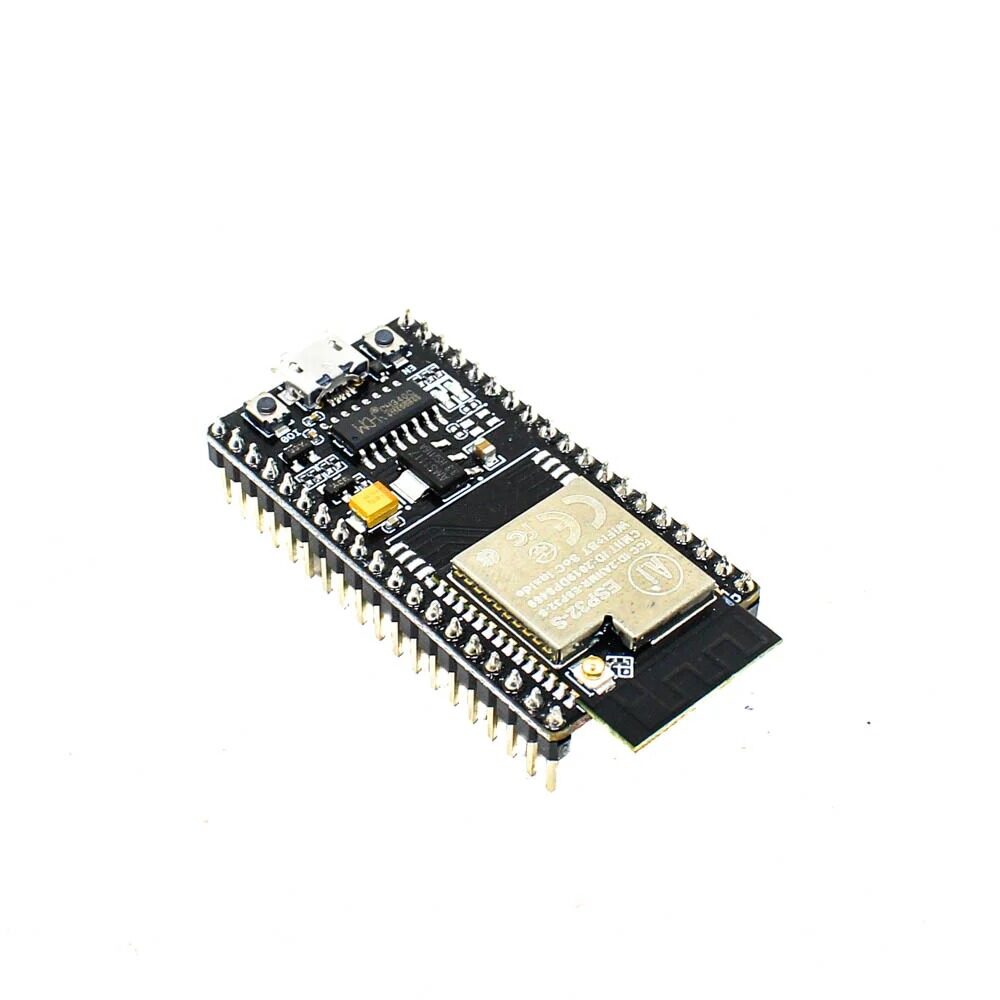
Ai Thinker NodeMCU-32S-ESP32 Development Board – IPEX Version
The ESP32’s built-in TWAI/CAN controller makes this board an ideal CAN bus node for industrial IoT gateways and automation projects.
ESP32 TWAI Controller Architecture
The ESP32’s TWAI (Two-Wire Automotive Interface) controller is a fully compliant CAN 2.0B controller integrated on-chip. It handles frame encoding/decoding, CRC calculation, bit stuffing/de-stuffing, arbitration, and error handling entirely in hardware — the CPU only needs to write frames to the transmit buffer and read frames from the receive FIFO.
TWAI key features on ESP32:
- Supports CAN 2.0B standard (11-bit standard frames and 29-bit extended frames)
- Configurable baud rate from ~25 kbps to 1 Mbps
- 64-byte receive FIFO (stores up to 64 frames in some configurations)
- Acceptance filter for hardware message filtering (saves CPU from processing unwanted messages)
- Bus error detection with configurable error recovery
- The TWAI TX and RX pins are configurable to any available GPIO (using the GPIO matrix)
Important: The ESP32 TWAI controller is the CAN controller (logic layer) — it generates 3.3V logic signals. You cannot connect TWAI TX/RX directly to the CAN bus. You need a CAN transceiver like the SN65HVD230 to convert these logic signals to the differential CAN bus voltages (0V to 5V on CANH/CANL).
SN65HVD230 Wiring and Termination
The SN65HVD230 is Texas Instruments’ 3.3V CAN transceiver — perfect for the ESP32 since it operates on 3.3V logic directly. Unlike the older TJA1050 or MCP2551 transceivers that require 5V logic, the SN65HVD230 interfaces natively with the ESP32 without level shifters.
Pin connections:
| SN65HVD230 Pin | ESP32 Connection | Notes |
|---|---|---|
| VCC (pin 3) | 3.3V | 3.3V supply only — do NOT use 5V |
| GND (pin 2) | GND | Shared ground with CAN bus GND |
| TXD (pin 1) | GPIO_NUM_5 (TX) | Any GPIO via matrix |
| RXD (pin 4) | GPIO_NUM_4 (RX) | Any input-capable GPIO |
| CANH (pin 7) | CAN bus CANH | Twisted pair wire |
| CANL (pin 6) | CAN bus CANL | Twisted pair wire |
| RS (pin 8) | GND | Pull low for normal mode; high for standby |
Termination resistors: The CAN bus must be terminated at both physical ends of the bus with 120-ohm resistors between CANH and CANL. Never omit termination — it causes reflections that corrupt frames. If you are using a pre-built SN65HVD230 breakout module, check if a termination resistor is already soldered on board; many modules include a 120-ohm resistor with a solder jumper to enable/disable it.
Wiring best practices:
- Use twisted pair cable (CAT5/CAT6 is ideal) for the CANH and CANL lines
- Keep the stub length (from the main bus to each node) under 30 cm at 1 Mbps
- Run a common ground wire alongside the CAN bus to prevent ground potential differences between nodes
- For long runs in industrial environments, use shielded twisted pair (STP) cable and ground the shield at one end only
Arduino Code: Transmit and Receive
The ESP32 Arduino core (version 2.x+) includes the ESP32-Arduino-CAN library by Georgi Angelov, or you can use the official ESP-IDF TWAI driver via the driver/twai.h header. The following example uses the popular CAN library by sandeepmistry available in the Arduino Library Manager.
First install the “CAN” library by sandeepmistry in Arduino IDE Library Manager, then:
#include <CAN.h>

#define CAN_TX_PIN 5
#define CAN_RX_PIN 4

void setup() {
  Serial.begin(115200);

  // Set custom TX/RX pins
  CAN.setPins(CAN_RX_PIN, CAN_TX_PIN);

  // Start CAN at 500 kbps
  if (!CAN.begin(500E3)) {
    Serial.println("CAN init failed!");
    while (1);
  }
  Serial.println("CAN bus ready at 500 kbps");

  // Register receive callback
  CAN.onReceive(onCANReceive);
}

void loop() {
  // Send a CAN frame every 1 second
  CAN.beginPacket(0x123);      // 11-bit standard frame, ID 0x123
  CAN.write(0xDE);             // Payload byte 1
  CAN.write(0xAD);             // Payload byte 2
  CAN.write(0xBE);             // Payload byte 3
  CAN.write(0xEF);             // Payload byte 4
  CAN.endPacket();
  Serial.println("Frame sent");
  delay(1000);
}

void onCANReceive(int packetSize) {
  Serial.printf("Received ID: 0x%X  Len: %d  Data: ", CAN.packetId(), packetSize);
  while (CAN.available()) {
    Serial.printf("0x%02X ", CAN.read());
  }
  Serial.println();
}
Using Extended (29-bit) Frames
// Extended frame example (CANopen, SAE J1939 etc.)
CAN.beginExtendedPacket(0x18FF50E5); // 29-bit extended ID
uint8_t data[8] = {0x01, 0x23, 0x45, 0x67, 0x89, 0xAB, 0xCD, 0xEF};
for (int i = 0; i < 8; i++) CAN.write(data[i]);
CAN.endPacket();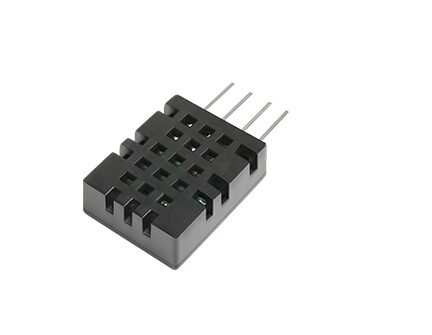
DHT20 SIP Packaged Temperature and Humidity Sensor
Transmit DHT20 sensor readings over CAN bus to a central controller — ideal for distributed HVAC monitoring in Indian factories.
Industrial Use Cases and Node Addressing
Here are common industrial applications where the ESP32 + SN65HVD230 combination is deployed in Indian industry:
1. Distributed Sensor Network
Multiple ESP32 nodes, each connected to temperature, pressure, or flow sensors, transmit data over CAN to a central gateway ESP32. The gateway aggregates data and sends it to a cloud MQTT broker via WiFi. CAN bus ensures reliable communication even in the electrically noisy environment of a pump room or boiler house.
2. Motor Controller Interface
Many industrial VFD (Variable Frequency Drive) manufacturers support CANopen protocol. An ESP32 can act as a CANopen master, sending speed setpoints and reading status registers from VFDs over CAN bus — enabling PLC-like control without a ₹50,000 PLC.
3. OBD-II Vehicle Diagnostics
For automotive applications, the ESP32 + SN65HVD230 can read OBD-II PIDs (vehicle speed, RPM, fuel level, engine temperature) from a car’s CAN bus. At 500 kbps, you can log data in real-time to an SD card or stream it over WiFi.
4. Battery Management System (BMS) Communication
Modern BMS units in EV and energy storage applications communicate over CAN. An ESP32 gateway can read cell voltages, temperatures, and state-of-charge from the BMS and publish them to a monitoring dashboard.
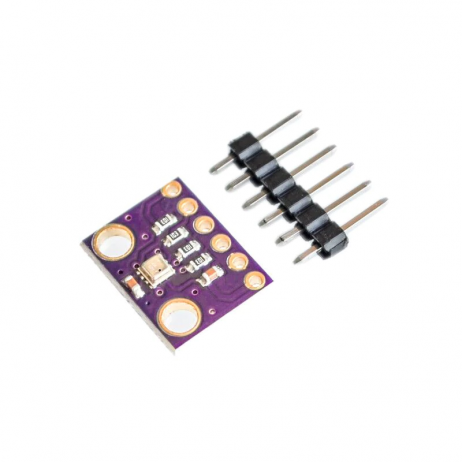
GY-BME280-3.3 Precision Altimeter Atmospheric Pressure Sensor Module
Combine with CAN bus nodes for industrial environmental monitoring — temperature, humidity, and pressure data reliably transmitted over long wire runs.
Troubleshooting CAN Bus Issues
CAN bus is robust, but improper wiring and configuration cause most issues. Here is a systematic troubleshooting guide:
| Symptom | Likely Cause | Fix |
|---|---|---|
| No frames received | Missing termination resistor | Add 120 ohm at both ends |
| Corrupted frames | Baud rate mismatch | Verify all nodes use same baud rate |
| Bus-off state | Too many bit errors | Check wiring, termination, ground loop |
| TX fails with timeout | No ACK from any receiver | Ensure at least one other node is online |
| Intermittent errors | Ground potential difference | Run common GND wire along bus |
Frequently Asked Questions
Q: Can I use the ESP32 CAN controller at 1 Mbps over long distances?
A: The maximum bus length at 1 Mbps is approximately 40 metres due to propagation delay constraints. For longer runs, use 500 kbps (100 m) or 250 kbps (200 m). In Indian industrial settings with long cable runs, 250 kbps or 125 kbps is a common practical choice.
Q: Is the SN65HVD230 the same as the VP230?
A: Yes, the VP230 is essentially a compatible alternative (made by various manufacturers) with the same pinout and electrical characteristics as the SN65HVD230. Both are 3.3V CAN transceivers suitable for ESP32. The TJA1050 is NOT compatible without a 3.3V-to-5V level shifter.
Q: How many ESP32 nodes can I put on one CAN bus?
A: The CAN 2.0B standard theoretically supports up to 110+ nodes. The SN65HVD230 supports up to 120 nodes on a single bus (1/8 unit load per node). In practice, for reliable operation in noisy industrial environments, keep it under 50 nodes per segment and use CAN repeaters for larger networks.
Q: Does the ESP32-S3 also have a TWAI controller?
A: Yes, the ESP32-S3 and ESP32-C3 both include one TWAI controller. The original ESP32 also has one TWAI controller. All support the same CAN 2.0B standard. The ESP32-C3 has one controller; higher-end variants of ESP32-S3 may support TWAI as well — check the specific datasheet.
Build Industrial IoT Solutions with ESP32
Zbotic.in stocks ESP32 development boards, sensors, and accessories for industrial IoT projects. Get genuine components with fast delivery across India — perfect for your CAN bus automation project.






Add comment