
Bluetooth Mesh Networking with ESP32: Scalable IoT Systems
Building a Bluetooth mesh network with ESP32 for IoT applications unlocks a powerful paradigm for Indian makers and engineers: a self-healing, scalable wireless network where dozens or hundreds of devices communicate without any single point of failure. Unlike traditional star-topology Bluetooth where every device connects to a central hub, Bluetooth mesh creates a fabric of interconnected nodes — perfect for smart homes, industrial monitoring, agriculture automation, and building management systems. In this guide, we cover everything from ESP-BLE-MESH architecture to provisioning, code examples, and real-world deployment tips.
What Is Bluetooth Mesh and Why Use It?
Bluetooth Mesh (defined in Bluetooth SIG Mesh Profile Specification 1.0) is a networking standard released in 2017 that enables many-to-many device communication over Bluetooth Low Energy (BLE). Traditional BLE operates in a 1:1 or 1:few star topology — one central device (master) connects to several peripherals. Mesh breaks this limitation entirely.
In a Bluetooth mesh network:
- Every node can relay messages to other nodes (managed flooding with TTL)
- Self-healing: if one node fails, messages route around it
- Scalable: add hundreds of nodes without redesigning the network
- Secure: AES-128 encryption at network, transport, and application layers
- Standardised: interoperable between manufacturers (unlike proprietary WiFi mesh)
Why ESP32 for Bluetooth mesh? The ESP32 by Espressif is unique in the hobbyist/maker space because Espressif provides a complete, open-source Bluetooth mesh stack (ESP-BLE-MESH) integrated into the ESP-IDF framework and exposed through Arduino-compatible examples. No other sub-$5 module offers this combination of Wi-Fi + classic Bluetooth + BLE mesh in one chip.
ESP32 and Bluetooth Mesh: The ESP-BLE-MESH Stack
Espressif’s ESP-BLE-MESH is a full implementation of the Bluetooth Mesh Profile and Mesh Model specifications. It runs on all ESP32 variants (ESP32, ESP32-S3, ESP32-C3) and is part of ESP-IDF v4.0 and later.
Key features of ESP-BLE-MESH:
- Full Mesh Profile and Mesh Model compliance
- Node provisioning over BLE (PB-ADV and PB-GATT methods)
- Relay, Proxy, Friend, and Low Power Node roles
- Network and application key management
- Up to 32,767 nodes per network (theoretical)
- Example applications: lighting control, sensor reporting, generic on/off
Development environment options:
- ESP-IDF (recommended for production): Full access to all ESP-BLE-MESH features, C-based API
- Arduino with ESP32 core: Limited mesh support, but sufficient for learning and prototyping with third-party libraries like PainlessMesh
- PlatformIO: Works with both IDF and Arduino frameworks, better dependency management
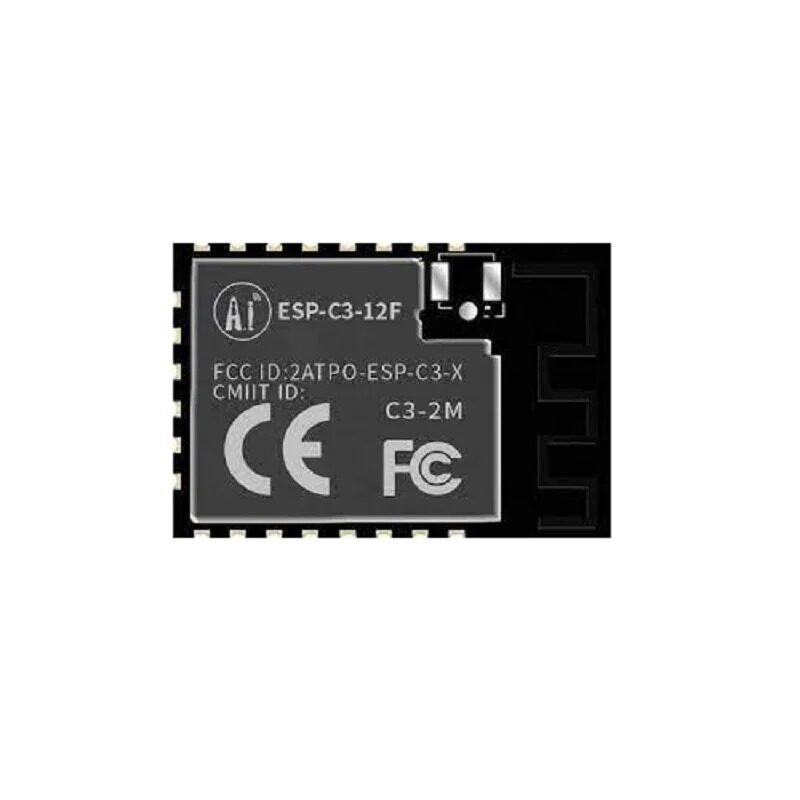
Ai-Thinker ESP32-C3-12F Wi-Fi + BLE Module
ESP32-C3 is a cost-effective single-core RISC-V module with full BLE 5.0 and Wi-Fi. Ideal for Bluetooth mesh sensor nodes with low per-unit cost for large deployments.
Mesh Architecture: Nodes, Elements, and Models
Understanding the terminology is critical before writing any code. Bluetooth mesh has a specific object hierarchy:
Node: Any device in the mesh network. A node can have one or more roles:
- Relay: Re-broadcasts received mesh messages to extend range
- Proxy: Bridges between GATT (smartphone BLE) and mesh network, enabling phone control
- Friend: Stores messages on behalf of low-power nodes
- Low Power Node (LPN): Sleeps most of the time, wakes to retrieve buffered messages from Friend
Element: An addressable entity within a node. Each ESP32 node has at least one element (the primary element). Nodes with multiple sensors may have multiple elements — e.g., a node with temperature + humidity could have 2 elements, each independently addressable.
Model: Defines the functionality of an element. Models can be Server (expose functionality) or Client (control other nodes). Standard models include:
- Generic OnOff Server/Client — relay switching, LED control
- Generic Level Server/Client — dimmer control, fan speed
- Sensor Server/Client — sensor data publishing
- Light Lightness Server — LED brightness
- Vendor Models — custom application-specific data
Addresses: Each element has a unicast address (assigned during provisioning). Groups use multicast addresses (0xC000–0xFEFF). A single publish message to a group address triggers all subscribed nodes simultaneously — e.g., turning off all lights in a room with one command.
Network Provisioning: Adding Devices to the Mesh
Provisioning is the process of adding an unprovisioned device to a mesh network. It distributes network keys and assigns addresses. There are two bearer types:
PB-ADV (Advertising Bearer): Uses BLE advertising packets. Works with dedicated provisioner devices (another ESP32 running provisioner firmware, or a laptop with Bluetooth). Range limited to BLE advertising distance (~10 m direct).
PB-GATT (GATT Bearer): Uses standard BLE GATT connection. Allows smartphone apps (nRF Mesh, ESP-BLE-MESH app) to provision nodes directly. This is the easiest approach for testing — you can provision with an Android phone.
Provisioning steps:
- Flash unprovisioned node firmware on ESP32
- Open provisioner (phone app or another ESP32 provisioner node)
- Scan for unprovisioned devices — they advertise with a specific UUID
- Provisioner authenticates the device (OOB or no-OOB method)
- Network Key (NetKey) and Application Key (AppKey) are distributed to the node
- Unicast address is assigned to the node’s element(s)
- Node is now part of the mesh and can send/receive messages
Step-by-Step ESP32 Bluetooth Mesh Setup
Here is a minimal Bluetooth mesh LED control setup using ESP-IDF and the example from ESP-BLE-MESH:
Prerequisites:
- ESP-IDF v5.x installed (or Arduino with ESP32 BLE Mesh library)
- 2 or more ESP32 dev boards
- Android phone with ESP-BLE-MESH app or nRF Mesh app
1. Clone ESP-IDF Mesh example:
cd ~/esp/esp-idf/examples/bluetooth/esp_ble_mesh/ble_mesh_node/onoff_server
idf.py set-target esp32
idf.py menuconfig  # configure mesh settings
idf.py flash monitor
2. Key configuration in menuconfig:
- Enable Generic OnOff Server model
- Set Relay, Friend, Proxy node features as needed
- Configure company ID and product ID for vendor identification
3. Core ESP-BLE-MESH node init (simplified):
static esp_ble_mesh_elem_t elements[] = {
  ESP_BLE_MESH_ELEM(0, root_models, ESP_BLE_MESH_MODEL_NONE),
};

static esp_ble_mesh_comp_t composition = {
  .cid = CID_ESP,
  .elements = elements,
  .element_count = ARRAY_SIZE(elements),
};

void esp_ble_mesh_init(void) {
  esp_err_t err = esp_ble_mesh_register_generic_server_callback(
    ble_mesh_generic_server_cb);
  err = esp_ble_mesh_init(&prov, &composition);
  err = esp_ble_mesh_node_prov_enable(
    ESP_BLE_MESH_PROV_ADV | ESP_BLE_MESH_PROV_GATT);
  ESP_LOGI(TAG, "BLE Mesh Node initialized");
}
4. Provision and test: Flash the same firmware on 3+ ESP32 boards. Open the ESP-BLE-MESH Android app. Scan and provision each node. Assign Group Address 0xC000 to all OnOff Server models. Send a Group Set message — all LEDs toggle simultaneously through the mesh.
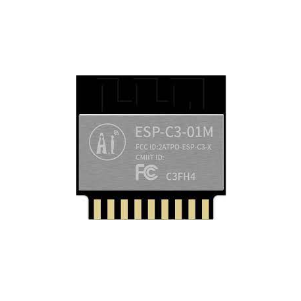
Ai Thinker ESP32-C3-01M Wi-Fi + BLE Module
Ultra-compact ESP32-C3 module with BLE 5.0 mesh support. Perfect for embedding in custom PCBs as a mesh node for smart home or agriculture monitoring.
Real IoT Project Examples
Smart Warehouse Sensor Network: Deploy 20 ESP32-C3 nodes across a warehouse floor. Each node reads temperature, humidity, and occupancy. Sensor data flows through the mesh to a gateway node (ESP32 with Wi-Fi enabled) that uploads to AWS IoT or Firebase. Advantages: no Wi-Fi infrastructure needed throughout the warehouse — the BLE mesh self-routes data to the gateway.
Greenhouse Monitoring: 10 nodes with soil moisture sensors spaced 5 metres apart in a greenhouse. Low Power Nodes sleep for 55 seconds, wake and send readings, sleep again. Friend nodes buffer the messages. Battery life per node: 6–12 months on 3 AA batteries. The mesh extends coverage far beyond a single gateway’s Wi-Fi range.
Smart Street Lighting: Bluetooth mesh is used commercially in Indian smart city projects (Gurgaon, Pune). Each street light is a mesh node — lights can be individually controlled, dimmed, and fault-reported through the mesh without running dedicated cables or installing dense Wi-Fi infrastructure.
Home Automation (DIY): Control up to 10 smart switches in a 3BHK apartment. Each ESP32 switch module acts as a Relay + Proxy node. Your phone connects via GATT to any nearby node and commands propagate through the mesh. No internet connection required for local control.
Range, Scalability, and Power Management
Range: Each BLE link covers approximately 10–30 metres in a typical indoor environment. With relay nodes, messages hop through the mesh. A 20-node deployment spanning 200 metres is achievable if nodes are placed every 10–15 metres. Use the Relay feature on mains-powered nodes; disable it on battery nodes to save power.
Scalability: The Bluetooth Mesh specification supports up to 32,767 nodes per network. Practical limits depend on message throughput — a busy mesh with 100 sensor nodes publishing every second will see latency increase due to flooding. Best practice: use publish periods of ≥5 seconds for high-density deployments, and use Friendship for low-power nodes to reduce traffic.
Power management strategies:
- Low Power Node + Friend: LPN sleeps 98% of the time. Friend stores messages until polled. Suitable for battery-powered sensors.
- Advertising interval tuning: Increase advertising interval reduces duty cycle and power draw
- Transmit power reduction: Set
esp_ble_tx_power_set()to -12 dBm for short-range nodes - MOSFET-controlled sensors: Cut sensor VCC during sleep using a P-channel MOSFET controlled by ESP32 GPIO
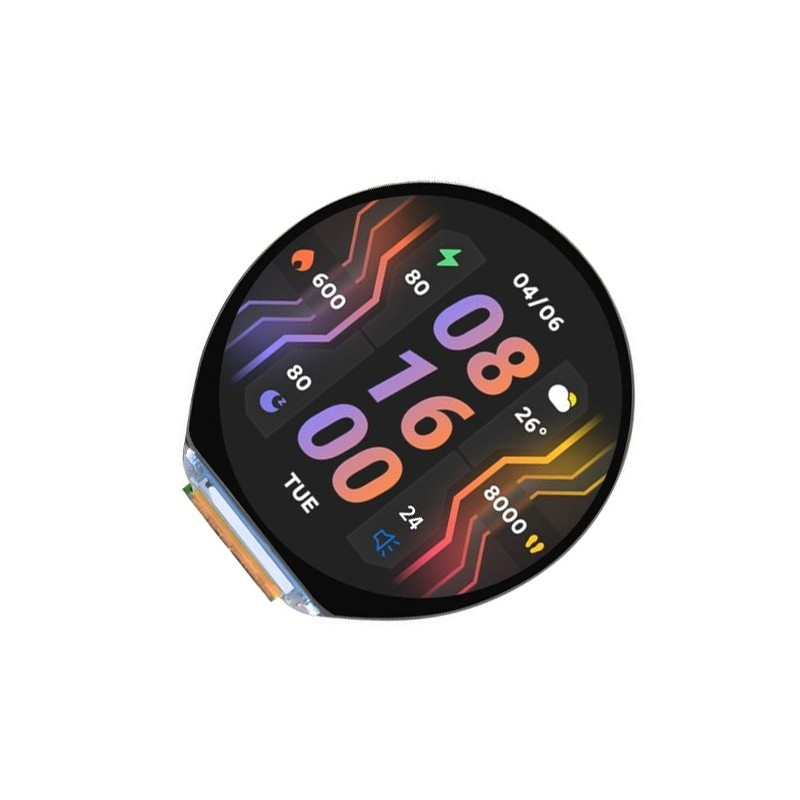
Waveshare ESP32-S3 1.46inch Round Display Dev Board
ESP32-S3 with a beautiful round display — use it as a mesh network dashboard node showing live sensor data from all nodes across the BLE mesh.
Bluetooth Mesh vs Wi-Fi Mesh vs Zigbee
vs Wi-Fi Mesh (ESP-MESH/ESP-WIFI-MESH): Wi-Fi mesh consumes 10–50x more power than BLE mesh but offers much higher bandwidth. Use Wi-Fi mesh for video surveillance or audio streaming. Use BLE mesh for battery-powered sensors, switches, and actuators.
vs Zigbee (CC2530, XBee): Zigbee also runs at 2.4 GHz and supports mesh. Zigbee has lower power draw than BLE mesh in some implementations and a larger installed base in industrial settings. However, ESP32 BLE mesh is free (no coordinator hardware cost), easier to prototype, and benefits from ESP32’s dual Wi-Fi + BLE capability for cloud gateway functionality.
vs Thread/Matter: Thread is an IPv6-based mesh protocol (used in Matter, Apple Home, Google Home). Matter-certified devices use Thread for mesh. ESP32-H2 and ESP32-C6 support Thread natively. For future-proof smart home projects, consider Thread/Matter over BLE mesh. For custom industrial IoT where you control the whole stack, BLE mesh remains excellent.
Frequently Asked Questions
How many ESP32 nodes can I have in one Bluetooth mesh network?
The Bluetooth Mesh specification allows up to 32,767 nodes. In practical ESP32 deployments, performance stays solid up to 50–100 nodes with good network design (proper relay placement, reasonable publish intervals). Espressif has tested their stack with 100+ nodes in certification testing.
Does Bluetooth mesh work with smartphones?
Yes, via Proxy nodes. A Proxy node bridges GATT (standard BLE) and the mesh network. Your Android or iOS app connects to any Proxy node via standard BLE and can control the entire mesh through it. The free nRF Mesh app and ESP-BLE-MESH app both work for provisioning and control.
Can I mix ESP32 and ESP32-C3 nodes in the same mesh?
Yes. Since Bluetooth Mesh is a standardised protocol, any BLE 4.2+ device running compliant mesh firmware can coexist in the same network. ESP32, ESP32-S3, ESP32-C3, ESP32-H2 can all participate in the same mesh alongside third-party Bluetooth mesh devices.
What is the latency of a Bluetooth mesh message?
End-to-end latency depends on the number of hops and TTL. A direct message (1 hop): ~10–50 ms. Through 3 relay hops: ~100–300 ms. This is sufficient for lighting control and sensor reporting but not for real-time audio/video. The BLE mesh spec recommends TTL≤7 for most deployments.
Is Bluetooth mesh secure enough for IoT deployments?
Yes. Bluetooth mesh uses AES-128-CCM encryption at three independent layers: network, transport, and application. Even relay nodes cannot decrypt application-layer data if they are not part of the application key group. This is more secure than most DIY Wi-Fi IoT setups which rely solely on TLS transport security.
Start Building Your ESP32 Mesh Network
Zbotic has ESP32, ESP32-C3, and ESP32-S3 modules in stock — ready for your next Bluetooth mesh IoT project. Fast shipping across India.

Add comment