
Battery State of Charge: Voltage vs Coulomb Counter
Understanding battery state of charge (SoC) is one of the most critical challenges in any battery-powered electronics project. Whether you are building a solar charge controller, an e-bike battery pack, or a portable power bank, knowing exactly how much energy remains in your battery determines your system’s reliability and safety. In this guide, we compare two popular methods — voltage-based SoC estimation and coulomb counting — to help Indian makers and engineers choose the right approach for their projects.
What Is Battery State of Charge?
Battery State of Charge (SoC) is a percentage value that represents the remaining energy in a battery relative to its fully charged capacity. Think of it like a fuel gauge — 100% SoC means fully charged, and 0% means fully discharged (beyond which you risk damaging the cells).
For lithium-ion and LiPo batteries commonly used in Indian maker projects, accurate SoC is vital because:
- Overcharging above 4.2V per cell causes thermal runaway and can lead to fires.
- Deep discharge below 2.5V per cell permanently degrades capacity.
- Battery Management Systems (BMS) rely on SoC to balance cells and protect packs.
- User-facing displays (power banks, drones, EVs) need accurate readings to be useful.
Two primary methods dominate the field: open-circuit voltage (OCV) lookup and coulomb counting (CC). Both have distinct advantages, and real-world Battery Management Systems often combine them.
Voltage-Based SoC Estimation
The simplest method is to measure the terminal voltage of a battery and look up the corresponding SoC from a pre-characterised discharge curve. For a standard 3.7V Li-ion cell:
- 4.20V = 100% SoC
- 4.00V ≈ 76% SoC
- 3.80V ≈ 52% SoC
- 3.60V ≈ 28% SoC
- 3.40V ≈ 12% SoC
- 3.00V ≈ 0% SoC (cut-off)
Advantages of voltage-based SoC:
- Extremely simple — requires only an ADC (analog-to-digital converter).
- No accumulated error over time.
- Works well for open-circuit voltage measurements (battery at rest for 30+ minutes).
- Low cost — a simple voltage divider and microcontroller ADC suffice.
Disadvantages:
- Terminal voltage drops under load due to internal resistance (IR drop), causing significant errors during discharge.
- The OCV-SoC curve is very flat in the 20–80% range for Li-ion cells, making it hard to distinguish small SoC differences.
- LiFePO4 batteries have an even flatter curve, making voltage-only SoC nearly useless in the 20–90% range.
- Temperature shifts the curve, introducing more error (critical for Indian climates where ambient temperature swings between 10°C and 45°C).
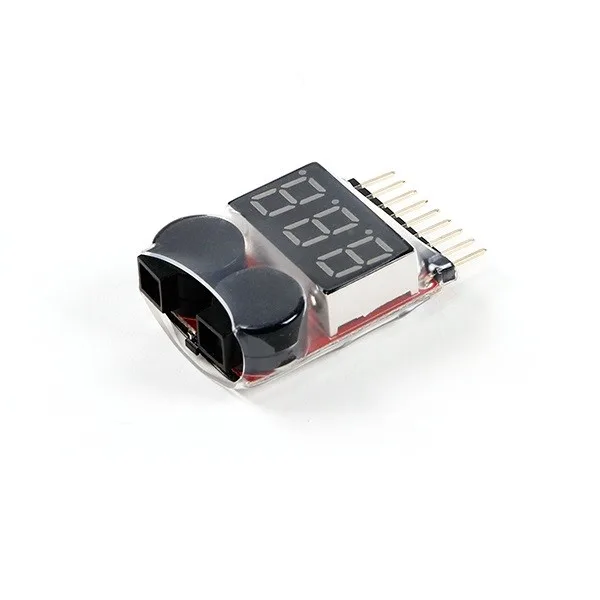
1-8S Lipo Battery Voltage Tester without Alarm
Instantly check the voltage of each cell in a 1S–8S LiPo pack. Great for field SoC estimation on RC batteries and drone packs without any microcontroller setup.
Coulomb Counting Method
Coulomb counting (also called current integration or amp-hour counting) measures the actual current flowing in and out of the battery and integrates it over time. The fundamental equation is:
SoC(t) = SoC(t₀) + (1/Q_nominal) × ∫[t₀ to t] I(τ) dτ
Where Q_nominal is the rated capacity in ampere-hours, and I is the instantaneous current (positive for charging, negative for discharging).
In practice, this is implemented with a precision current-sense resistor (shunt) and an integrating IC such as the Texas Instruments BQ27441, Maxim DS2782, or the popular INA219 used in maker projects.
Advantages of coulomb counting:
- Tracks SoC accurately under load — not fooled by IR drop.
- Works well for batteries with flat OCV curves (LiFePO4, NiMH).
- Can account for Coulombic efficiency (the ratio of charge out vs. charge in, typically 99.5% for Li-ion).
- Fast response — updates SoC continuously as current flows.
Disadvantages:
- Requires a precise initial SoC — the system must know where it started. Getting this wrong propagates indefinitely.
- Small current measurement errors accumulate over time (drift). A 1% current error means 1% SoC error per hour, and after 100 hours the reading is completely unreliable.
- Requires calibration on a known reference point (usually full-charge detection at CV stage end).
- Higher component cost: a precision shunt resistor, low-offset op-amp, or dedicated fuel gauge IC.

18650 5V 1A/2A Lithium Battery Digital Display Charging Module
A handy module with dual USB output and a built-in display for SoC indication. Uses voltage-based estimation with a visual bar graph — perfect for DIY power banks.
Voltage vs Coulomb Counter: Side-by-Side Comparison
| Parameter | Voltage Method | Coulomb Counter |
|---|---|---|
| Accuracy at rest | Good (±5%) | Excellent (±1%) |
| Accuracy under load | Poor (±15–25%) | Good (±2–5%) |
| LiFePO4 suitability | Very poor | Excellent |
| Component cost | Very low | Moderate |
| Long-term drift | None | Yes — needs recalibration |
| Firmware complexity | Low | Medium |
| Best use case | Simple displays, LiPo drones | EV packs, solar storage |
Temperature Effects on SoC Accuracy (India-Specific)
India’s climate presents unique challenges for SoC accuracy. In summer, battery temperatures can exceed 50°C inside enclosures — at these temperatures, a Li-ion cell’s internal resistance drops, making voltage readings higher than actual SoC. In northern India winters, temperatures near 5–8°C cause the OCV curve to shift downward by 50–80mV, making the battery appear more discharged than it actually is.
For coulomb counters, temperature affects Coulombic efficiency and the actual usable capacity. At 45°C, a 2000mAh cell may deliver 2100mAh effectively (capacity increase), while at 10°C the same cell delivers only 1700mAh. A well-designed fuel gauge IC (like BQ27441) includes temperature compensation tables. If you are building your own system with an Arduino or ESP32, you should measure the NTC thermistor value alongside current and apply a temperature-correction factor to your capacity estimate.
Practical tip for Indian makers: always use a 10K NTC thermistor glued to the battery cell surface and read it alongside your voltage/current measurements. The correction formula for capacity is approximately:
Q_effective = Q_rated × (1 + 0.005 × (T_celsius - 25))
This gives roughly ±0.5% capacity change per degree Celsius, which is a first-order approximation valid for most Li-ion chemistries.
Hybrid SoC Estimation: Best of Both Worlds
Modern battery management systems combine both methods in what is called Extended Kalman Filter (EKF) or Sigma-Point Kalman Filter (SPKF) based SoC estimation. However, for most Indian maker projects, a simpler hybrid works extremely well:
- Boot-time initialisation: Measure OCV after the battery has rested for at least 10 minutes. Use this to set the initial SoC from a lookup table.
- Run-time tracking: Switch to coulomb counting once load is applied. Integrate current continuously.
- Recalibration points: Reset SoC to 100% when the charger enters constant-voltage (CV) phase and charge current falls below C/20. Reset to 0% (or minimum) when voltage hits the low-voltage cut-off.
- Drift correction: Periodically compare the coulomb-count SoC with the OCV-based SoC during low-load periods (e.g., standby mode). If they differ by more than 5%, weight the OCV estimate more heavily.
This hybrid approach is what commercial fuel gauge ICs like the BQ27441 implement internally, and it can be replicated on an Arduino Nano or ESP32 with an INA219 breakout board and a spare ADC pin for voltage measurement.

ISDT A4 Air Smart Battery Charger (NiMH/NiCd/Li-Ion/LiFePO4) with Bluetooth
Professional-grade charger with Bluetooth connectivity that displays live SoC, voltage per cell, and internal resistance — ideal for calibrating your coulomb counter against a trusted reference.
Recommended Products for SoC Monitoring Projects
Here are some products from Zbotic that will help you build accurate battery SoC monitoring systems:

1S 12A 3.6V BMS Battery Protection Board for Li-Ion Cell
A solid BMS that handles over-voltage, under-voltage, and over-current protection for single-cell Li-ion packs. Essential companion to any SoC monitoring circuit.
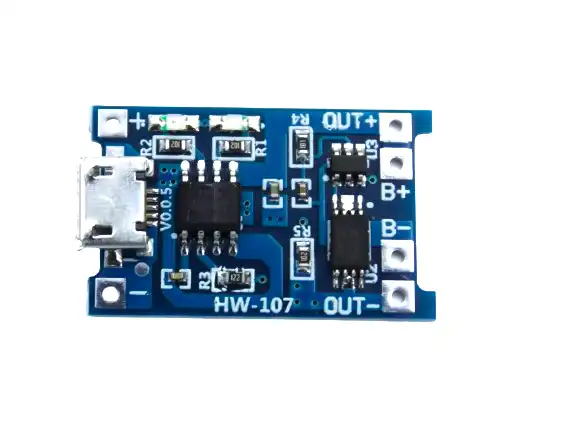
TP4056 1A Li-Ion Battery Charging Board Micro USB with Protection
The classic TP4056 module for single-cell Li-ion charging. The PROG resistor sets charge current — a known charge current means coulomb counting starts from a reliable 100% SoC.
Frequently Asked Questions
Q1: Which method is more accurate for Li-ion batteries?
For Li-ion batteries under load, coulomb counting is significantly more accurate (±2–5% vs ±15–25%). However, for a quick resting voltage check with no current flowing, voltage-based estimation with a good OCV lookup table gives ±3–5% accuracy. The best systems use both together.
Q2: Can I implement coulomb counting on an Arduino?
Yes. Use an INA219 module connected via I2C to your Arduino or ESP32. It measures both current and voltage simultaneously. Write code to integrate current × time interval at your sampling rate (e.g., every 100ms) and accumulate the mAh consumed. Reset to 100% when you detect the end of a charging cycle.
Q3: Why is voltage-based SoC unreliable for LiFePO4?
LiFePO4 has an extremely flat discharge curve — the voltage stays between 3.2V and 3.3V for most of its 20–90% SoC range. A 10mV voltage change can represent a 50% SoC swing. Without extremely precise voltage measurement (16-bit ADC, ±1mV accuracy), voltage-based SoC is nearly useless for LiFePO4. Coulomb counting is the preferred method.
Q4: How does temperature affect SoC readings in Indian summers?
At 45°C (common under direct sunlight in India), Li-ion internal resistance drops and terminal voltage under load is closer to OCV than at 25°C. This makes voltage-based SoC appear more optimistic than reality. Coulomb counters are less affected by temperature directly, but the actual deliverable capacity increases slightly at high temperatures. Always include NTC temperature sensing in your design.
Q5: What is the simplest way to add a battery fuel gauge to my project?
The easiest route is the Maxim DS2438 or TI BQ27441 breakout board. These are standalone fuel gauge ICs with built-in coulomb counting, temperature measurement, and I2C/HDQ communication. They eliminate the need to write complex integration code. Connect over I2C and read the StateOfCharge() register directly.
Ready to Build Your Battery Monitoring Project?
Zbotic stocks a wide range of battery holders, BMS boards, charger modules, and testing equipment to help you build accurate and safe battery systems. From simple LiPo voltage testers to professional smart chargers — we have everything the Indian maker community needs.






Add comment