
Active vs Passive Battery Balancer: Which Is More Efficient?
If you have ever built or maintained a multi-cell battery pack, you have probably encountered the frustrating scenario where one cell reaches full charge while the others are still partially depleted — or one cell drains first while the rest still have capacity. Cell imbalance is unavoidable in real-world battery packs, and the solution is a balancer circuit. But when comparing active vs passive battery balancer efficiency, the differences in cost, heat, complexity, and real-world energy savings are significant enough to change which technology you should choose for a given application. This guide breaks it all down.
Why Do Battery Cells Need Balancing?
No two lithium cells are perfectly identical, even from the same batch. Differences in internal resistance, self-discharge rate, and manufacturing tolerances mean that cells charged in series will reach their maximum voltage at slightly different times. The faster cell trips the BMS cut-off before the slower cells are full, reducing effective pack capacity. On the discharge side, the weaker cell hits the low-voltage cut-off first, leaving energy stranded in the other cells.
Over hundreds of cycles, these small differences compound. A pack that starts with cells within 10mV of each other can drift to hundreds of millivolts of imbalance within a year of heavy use. At that point, pack capacity may fall to 60–70% of its rated value even though most cells are still healthy.
Balancing redistributes charge among cells to keep them at the same state of charge (SoC), maximising usable capacity and extending pack life.
Passive Balancing: How It Works
Passive balancing is the simpler of the two approaches. The principle: if one cell is more charged than the others, bleed its excess energy as heat until it matches the lowest cell.
In practice, each cell in the pack has a resistor and a switch (usually a MOSFET) in parallel. The BMS measures cell voltages and, when one cell is higher than the pack average (or above a threshold), it closes that cell’s switch and current flows through the resistor. The excess energy is dissipated as heat.
Passive Balancing Characteristics
- Simple circuit — just resistors and MOSFETs, easily integrated into a compact BMS module
- Low cost — no inductors, capacitors, or complex switching circuits needed
- Reliable — fewer components mean fewer failure points
- Energy wasteful — excess charge is thrown away as heat, not transferred to other cells
- Balancing current is limited — typical passive balance current is 50–200mA to manage heat
- Only balances at full charge — most passive BMS modules only activate balancing near the top of charge (e.g. above 4.1V per cell)
The efficiency of passive balancing depends entirely on the state of imbalance. If cells differ by 100mV on a 3.7V cell (about 2.7% SoC difference), the wasted energy is small. If one cell is 500mV ahead of the others, a larger percentage of that cell’s charge is thrown away.
Active Balancing: How It Works
Active balancing takes a fundamentally different approach: instead of wasting excess energy as heat, it transfers charge from the stronger cells to the weaker cells. Energy is conserved rather than dissipated.
There are several active balancing topologies:
Inductor-Based (Cell-to-Cell)
A small inductor shuttles charge from one cell to an adjacent cell. A switched-mode circuit charges the inductor from the higher-voltage cell, then discharges it into the lower-voltage cell. Efficiency is typically 80–95% per transfer step.
Capacitor-Based (Flying Capacitor)
A capacitor is charged from one cell and then discharged into a neighbouring cell. Simple to implement but efficiency drops to 70–80% due to capacitor losses, and balancing speed depends on the number of switches.
Transformer-Based (Pack-to-Cell)
More complex designs use a multi-winding transformer to draw from the entire pack and top up the weakest cell. This can balance any cell directly, not just adjacent pairs, and is the architecture used in high-end EV battery management systems.
Active Balancing Characteristics
- High efficiency — transfers 80–95% of charge rather than wasting it
- Can balance throughout the discharge/charge cycle — not just at full charge
- More complex circuitry — requires inductors, transformers, or capacitors and more sophisticated control logic
- Higher cost — active balancer modules are 3–10× the cost of passive BMS boards
- More components = more potential failure points
Efficiency Comparison: The Real Numbers
Let us put concrete numbers to the efficiency argument with a worked example. Consider a 4S 18650 pack where one cell has drifted 200mAh higher than the other three.
Passive Balancing
The BMS dissipates the 200mAh excess at 100mA balance current. That takes 2 hours. The energy lost = 4.2V × 0.2Ah = 0.84Wh. Every balancing cycle throws away 0.84Wh. Over 500 cycles, that is 420Wh of wasted energy — roughly equivalent to 5–6 full charges of the pack.
Active Balancing
The same 200mAh imbalance is transferred to the weaker cells at 90% efficiency. The receiving cells gain 180mAh (10mAh lost as heat). Energy wasted = 0.084Wh per cycle. Over 500 cycles = 42Wh wasted — ten times less than passive.
However, if the cells in your pack only differ by 20–30mV (well-matched cells), passive balancing wastes so little energy that the difference becomes academic. The real efficiency advantage of active balancing shines when:
- Cells are significantly mismatched (>100mV difference)
- The pack is cycled hundreds of times per year
- The pack is large (>10Ah) where 1% energy waste matters financially
- The application is temperature-sensitive (passive balancing generates heat)
Cost and Complexity Trade-offs
| Factor | Passive Balancer | Active Balancer |
|---|---|---|
| Module cost (4S) | ₹50–200 | ₹500–3000 |
| Balance current | 50–200mA | 500mA–5A |
| Heat generated | Significant | Minimal |
| Board size | Small | Larger |
| Control complexity | Low | High |
| Balancing speed | Slow (hours) | Fast (minutes) |
| Suitable pack size | <20Ah | Any, ideal for >20Ah |
Which Should You Choose? Use Cases Explained
Choose Passive Balancing When:
- You are building a small hobby pack (<10Ah) with good quality, matched cells
- Budget is the primary constraint
- The pack is used infrequently (monthly or less)
- Heat generation is acceptable (outdoor or well-ventilated enclosure)
- You need a simple, reliable BMS with a proven track record
Choose Active Balancing When:
- You are building a large pack (>20Ah) — solar home storage, EV, e-bike
- The pack will cycle daily (the energy savings pay back the higher module cost)
- Thermal management is critical — tight enclosure where heat causes problems
- Cells are from mixed batches or second-life (recycled) cells with significant initial mismatch
- You need maximum usable capacity from every cycle

1S 18650 Li-ion Lithium Battery BMS Charger Protection Board for 3.7V Battery
Compact 1S BMS with overcharge, over-discharge, and short-circuit protection. The starting point for any single-cell build, and easy to stack per-cell for multi-cell packs.
BMS Modules and Balancing in Practice
Most off-the-shelf BMS modules for hobbyist use — the kind you find on 3S, 4S, 6S, 10S, and 13S boards — use passive balancing. This is the dominant choice because it works reliably, costs little, and is sufficient for the vast majority of consumer applications (power banks, e-bikes, UPS systems).
The balancing circuit in these modules typically activates only when a cell exceeds a threshold voltage (often 4.15–4.18V for lithium-ion) during charging. The shunt resistors (usually 10–33Ω, resulting in 100–400mA balance current) bleed off the excess until all cells reach the threshold. Then charging continues.
When shopping for a BMS module in India, check the datasheet for:
- Balance start voltage — the per-cell voltage that triggers balancing
- Balance current — how aggressively it bleeds (higher is faster but generates more heat)
- Overcharge cutoff — must match your cell chemistry (4.2V for standard Li-ion, 3.65V for LiFePO4)
- Over-discharge cutoff — typically 2.5–3.0V for Li-ion, 2.5V for LiFePO4

ISDT A4 Air Smart Battery Charger – NiMH, NiCd, Li-Ion, LiFePO4 with Bluetooth
A professional-grade charger with per-cell monitoring and balancing for multi-cell LiPo/LiFePO4 packs. Bluetooth connectivity lets you track balance status from your phone.
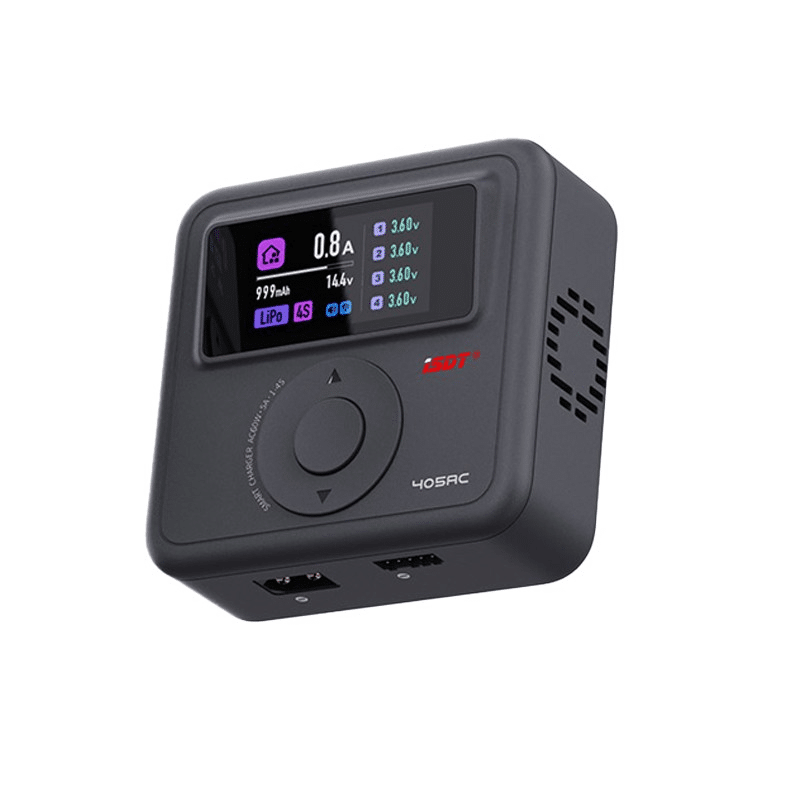
ISDT 405AC 60W AC GaN Smart Charger – 1–4S LiPo/LiHv/LiFe (XT60)
Compact GaN charger with built-in AC input and smart balancing for 1–4S packs. Ideal for RC hobbyists who want precise CC-CV charging with cell-level visibility.
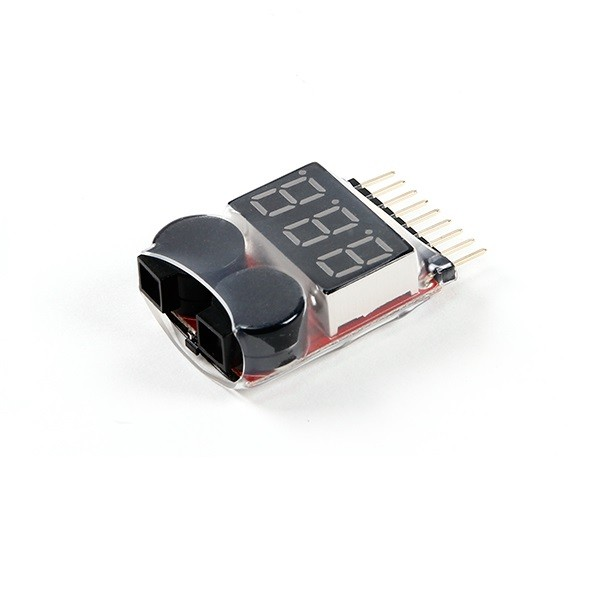
1-8S LiPo Battery Voltage Tester without Alarm
Check per-cell voltage on 1S to 8S LiPo packs instantly. Essential for identifying imbalanced cells before they cause capacity loss or a safety issue.
Frequently Asked Questions
Can I add an active balancer to a pack that already has a passive BMS?
Yes — and this is actually a popular approach for upgrading e-bike and solar storage packs. You connect a standalone active balancer module across the cell tap wires (the same balance connector your charger uses). The passive BMS still handles protection (overcharge, over-discharge, short circuit), while the active balancer handles charge redistribution. The two circuits operate independently and complement each other.
How much imbalance is acceptable?
For a healthy pack, cell voltages at rest (after 30 minutes off charge) should be within 20–30mV of each other. Differences above 50mV will start to visibly reduce pack capacity. Above 100mV, the pack needs balancing before further use. If you cannot bring cells within 50mV even after a full balance charge, one or more cells may be degraded and should be replaced.
Do LiFePO4 batteries need balancing?
Yes, but less urgently. LiFePO4 has an extremely flat discharge curve, meaning that cell voltages stay very close together through most of the state-of-charge range. This self-limiting behaviour makes passive balancing at the top of charge adequate for most LiFePO4 packs. Active balancing is still beneficial for large (>100Ah) or heavily cycled packs.
Why does my LiPo charger get hot during balancing?
Your charger uses passive balancing through its balance lead. The heat comes from the resistors inside the charger dissipating the excess cell charge. This is normal and expected behaviour. If the charger becomes uncomfortably hot to the touch, reduce the charge current or improve ventilation around the charger.
Is it safe to charge a severely imbalanced LiPo pack?
Be cautious. If one cell is significantly above the others, it may reach overcharge voltage (4.2V+) before the BMS or charger terminates charging. At best, this reduces the cell’s cycle life. At worst, an overcharged LiPo cell can vent or catch fire. Always check per-cell voltages with a tester before charging a pack that has been in storage for a long time.
From single-cell BMS protection boards to professional multi-chemistry smart chargers, Zbotic.in has everything you need to build, maintain, and extend the life of your battery packs. Shop now and keep your cells balanced.







Add comment