
Table of Contents
- What Are Supercapacitors?
- How Batteries Store Energy
- Key Differences: Supercapacitor vs Battery
- Hybrid Energy Storage: Combining Both
- Practical Applications for Indian Makers
- Which Should You Choose?
- Frequently Asked Questions
When designing a power system for your electronics project, the choice between a supercapacitor vs battery for hybrid energy storage is one of the most important decisions you will make. Both technologies store electrical energy, but they do it in fundamentally different ways — and understanding those differences can mean the life or death of your circuit. This in-depth comparison will help Indian hobbyists, engineers, and makers choose the right energy storage solution or intelligently combine both for maximum performance.
What Are Supercapacitors?
A supercapacitor (also called an ultracapacitor or electrochemical double-layer capacitor, EDLC) is an energy storage device that sits between a conventional electrolytic capacitor and a rechargeable battery. Instead of using a chemical reaction to store energy, it stores charge electrostatically at the interface between an electrode (typically activated carbon) and an electrolyte.
Key characteristics of supercapacitors:
- Capacitance: Ranges from 0.1F to 3000F+
- Voltage per cell: 2.5V to 2.7V (for organic electrolyte EDLCs)
- Cycle life: 500,000 to 1,000,000+ charge/discharge cycles
- Charge time: Seconds to minutes
- Energy density: 1–10 Wh/kg (much lower than batteries)
- Power density: 1–10 kW/kg (much higher than batteries)
- Self-discharge: Significant — can lose 50% charge in days to weeks
- Temperature range: -40°C to +70°C (far wider than Li-ion)
Supercapacitors cannot be damaged by rapid charge/discharge, making them ideal for applications that require frequent bursts of power — something that would destroy a conventional battery in a matter of months.
How Batteries Store Energy
A rechargeable battery (Li-ion, LiPo, NiMH, LiFePO4) stores energy through reversible electrochemical reactions. Lithium ions intercalate (insert) into the anode during charging and de-intercalate back to the cathode during discharge. This reaction is far more energetically dense than electrostatic charge storage.
Key characteristics of a typical 18650 Li-ion cell:
- Capacity: 2000–3500 mAh per cell
- Nominal voltage: 3.6–3.7V
- Cycle life: 300–1000 cycles (to 80% capacity)
- Charge time: 1–4 hours (standard) or 30–45 min (fast charge)
- Energy density: 150–265 Wh/kg
- Power density: 250–340 W/kg
- Self-discharge: Low — 1–3% per month
- Temperature sensitivity: Performance drops below 0°C; unsafe above 60°C
Batteries are fundamentally energy sources — great at storing large amounts of energy and releasing it slowly. Supercapacitors are power sources — great at releasing energy very quickly.
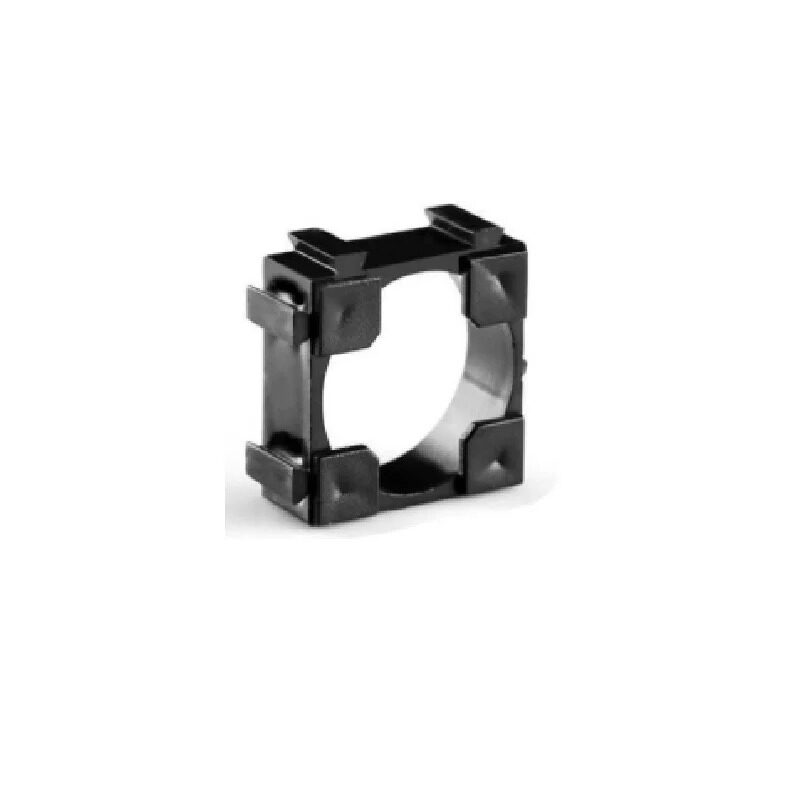
1 x 18650 Battery Holder (Pack of 4)
Sturdy 18650 cell holders for building multi-cell battery packs for hybrid storage experiments. Build series/parallel configurations easily with these holders.
Key Differences: Supercapacitor vs Battery
Here is a direct head-to-head comparison across the parameters that matter most for maker projects:
| Parameter | Supercapacitor | Li-ion Battery |
|---|---|---|
| Energy Density | Low (1–10 Wh/kg) | High (150–265 Wh/kg) |
| Power Density | Very High (1–10 kW/kg) | Moderate (250–340 W/kg) |
| Cycle Life | 500,000–1M cycles | 300–1000 cycles |
| Charge Time | Seconds to minutes | 30 min to 4 hours |
| Self-Discharge | High (lossy for storage) | Low (1–3%/month) |
| Temperature Range | -40°C to +70°C | 0°C to 45°C (charging) |
| Cost per Wh | Very High | Moderate |
| Safety Risk | Very Low | Moderate (thermal runaway risk) |
The verdict is clear: supercapacitors win on power, longevity, and safety. Batteries win on energy storage capacity and cost per stored watt-hour. Neither is universally better — the right choice depends entirely on your application’s load profile.
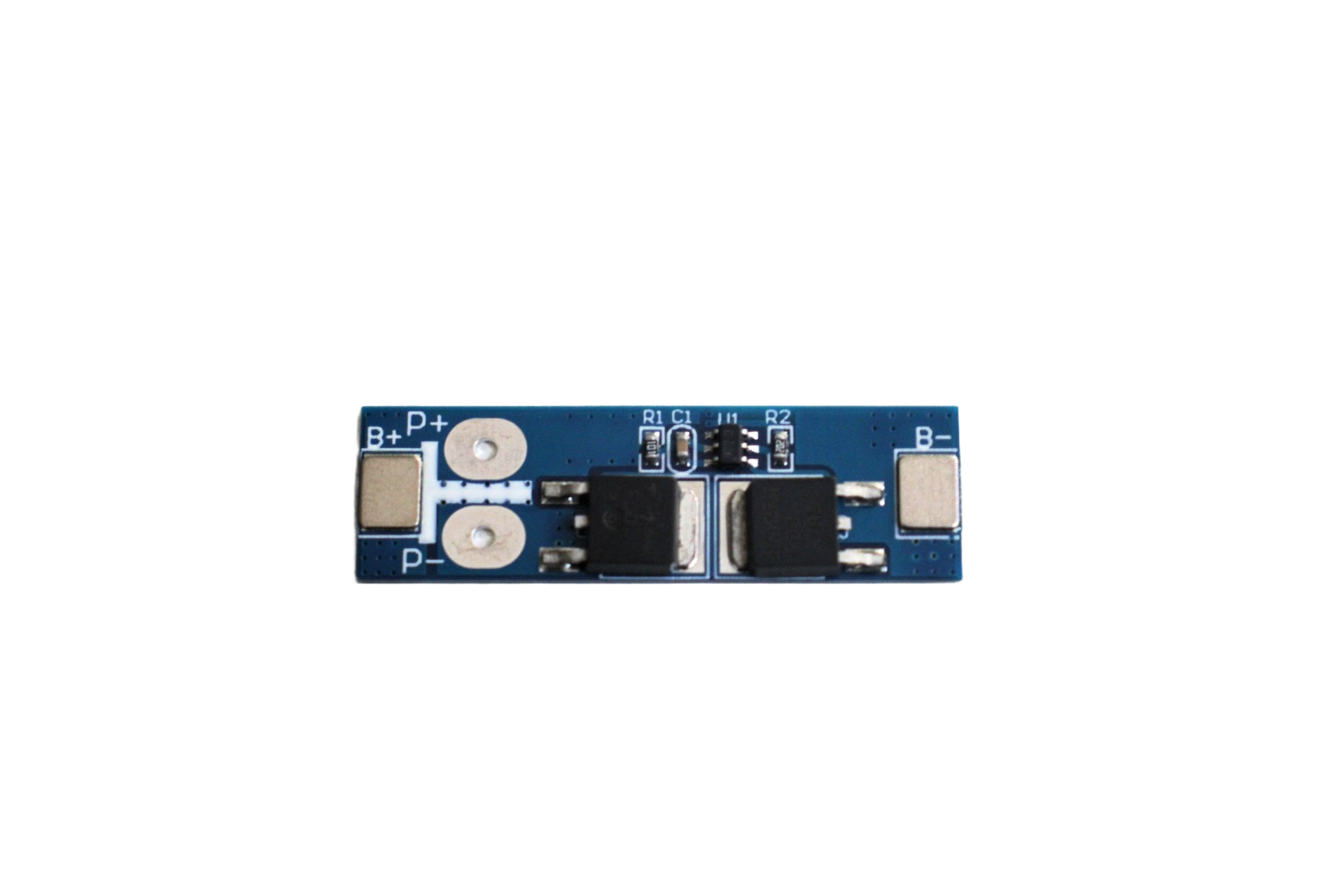
1S 12A 3.6V BMS Battery Protection Board for Li-ion Cell
When building battery-based storage, a BMS is non-negotiable. This 12A protection board prevents overcharge, overdischarge, and short-circuit events in your Li-ion energy storage builds.
Hybrid Energy Storage: Combining Both
The most sophisticated approach — and the one increasingly used in electric vehicles, industrial UPS systems, and advanced maker projects — is hybrid energy storage: using supercapacitors and batteries together, each doing what it does best.
How a Hybrid System Works
In a typical hybrid topology:
- The battery acts as the long-term energy reservoir, providing steady baseline current to the load.
- The supercapacitor bank is connected in parallel (often via a bidirectional DC-DC converter) and handles all instantaneous power spikes and regenerative energy recovery.
- A simple diode-OR or active switching circuit ensures the supercapacitor absorbs peak currents instead of the battery.
The benefits are significant: battery cycle life can increase by 3–5x because high-rate discharge events (which degrade batteries most) are absorbed by the supercapacitor. The supercapacitor also acts as a buffer against voltage sag during high-current pulses, stabilising the supply rail.
Simple Passive Hybrid Circuit for Makers
The simplest hybrid approach is a direct parallel connection of a supercapacitor across the battery terminals through a series resistor (typically 0.1–1Ω). The resistor limits inrush current when the cap charges, while still allowing fast discharge from the capacitor during load spikes. This circuit requires no active control and is widely used in small robots, drones, and IoT devices.
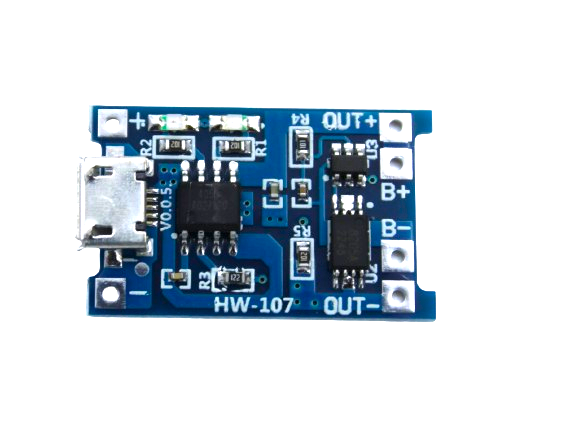
TP4056 1A Li-Ion Battery Charging Board with Protection
The TP4056 is the go-to charging IC for the battery side of any hybrid energy storage project. Built-in over-current and over-voltage protection makes it a reliable base for your builds.
Practical Applications for Indian Makers
Here are real-world project ideas where the supercapacitor-battery hybrid makes a noticeable difference:
- Solar lantern with burst lighting: A Li-ion cell stores solar energy all day; a supercapacitor delivers the instantaneous current spike when LEDs switch on, preventing voltage droop and flicker.
- Arduino-based data logger in remote locations: Battery provides long-term power; supercapacitor maintains power during GSM/4G module transmission bursts (which can draw 2A for 100ms).
- Mini electric vehicle (go-kart/robot): Supercapacitors absorb regenerative braking energy that would otherwise be wasted as heat, while the battery provides range.
- Industrial UPS for PLC panels: Replace bulky lead-acid backup batteries in small PLC UPS systems with a compact supercapacitor bank for 10–30 second ride-through capability.
- RC car racing: A small supercapacitor in parallel with the LiPo pack eliminates voltage sag during full-throttle acceleration bursts.
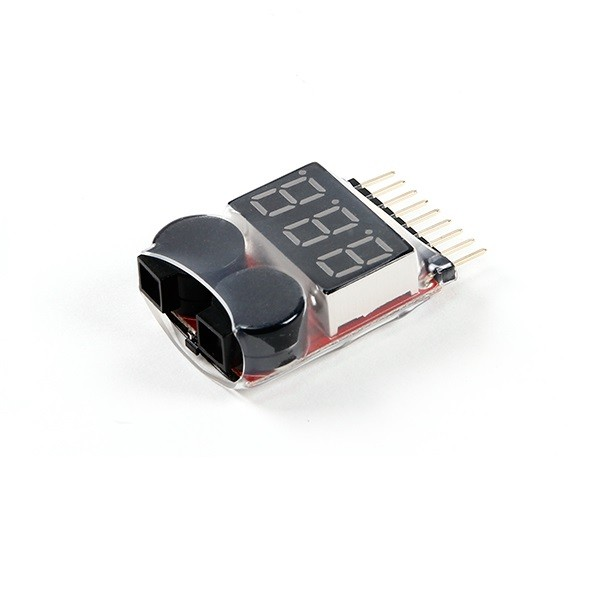
1–8S Lipo Battery Voltage Tester (No Alarm)
Monitor individual cell voltages in your hybrid storage pack. This tester works on 1–8S LiPo packs, helping you maintain cell balance and detect degradation early.
Which Should You Choose?
Use this decision guide:
- Choose a battery alone if your project needs hours of runtime, low self-discharge, and the load current is steady and moderate.
- Choose a supercapacitor alone if your project has very short runtime needs (seconds to minutes), needs millions of cycles, operates in extreme temperatures, or cannot risk battery swelling/fire.
- Choose hybrid storage if your project has both steady baseline loads AND large instantaneous current spikes, or if you want to maximise battery lifespan in a demanding application.
For most Indian maker projects — drones, robots, solar lanterns, IoT nodes — the hybrid approach offers the best of both worlds at only a small increase in circuit complexity.
Frequently Asked Questions
Q1. Can I replace a battery entirely with a supercapacitor?
In most cases, no. A supercapacitor cannot store enough energy to replace a battery for applications requiring more than a few minutes of runtime. However, for very short-burst applications like power-loss memory protection (keeping an MCU running long enough to save data to flash), a supercapacitor is a perfect, maintenance-free replacement.
Q2. How do I charge a supercapacitor safely?
Always charge through a current-limiting resistor or a constant-current source. Never connect a supercapacitor directly to a voltage source without current limiting — the inrush current can be hundreds of amps and will destroy the capacitor and damage the source. Also, never exceed the supercapacitor’s rated voltage; for 2.7V-rated EDLCs, keep charging voltage at or below 2.5V per cell.
Q3. What is the typical capacity of a supercapacitor available in India?
Common supercapacitors available through Indian electronics distributors range from 0.1F (coin cell size) to 100F (large cylindrical cells, 50mm diameter). For most maker hybrid builds, 10–50F supercapacitors at 2.7V are practical and affordable. Banks of 6 × 2.7V cells in series give you 16.2V at a fraction of the rated single-cell capacitance.
Q4. Do supercapacitors need a BMS like batteries?
They do not need a charge-balancing BMS in the same way Li-ion cells do, but when connecting multiple supercapacitor cells in series, a voltage balancing circuit (passive bleeder resistors or active balancers) is needed to prevent any single cell from exceeding its voltage rating.
Q5. Are supercapacitors available in India and affordable for hobbyists?
Yes, small supercapacitors (1F–10F, 5.5V) are available from Indian online electronics stores for ₹50–₹300 depending on capacitance. Larger 100F+ cells used in automotive applications are more expensive (₹500–₹2000 per cell) but are increasingly available via Indian distributors and online marketplaces.
Power Your Next Project Smarter
The supercapacitor vs battery debate does not have a single winner — the best engineers use both. As hybrid energy storage becomes more mainstream in electric mobility and renewable energy applications in India, understanding how to combine these technologies will set your projects apart. Start experimenting with a simple parallel hybrid circuit on your workbench today and measure the real-world improvement in battery lifespan and load performance.
Check out Zbotic’s power and charging components to find Li-ion cells, BMS boards, and voltage testers to build your first hybrid energy storage project.






Add comment