
Espressif’s ESP32-S series has expanded rapidly, and two of the most popular members are the ESP32-S2 and ESP32-S3. While they share the same product family branding, these chips are quite different under the hood. If you are deciding between them for your next project — whether it’s a USB HID device, an AI-powered camera, or a wearable gadget — this deep-dive comparison will help you make the right choice.
1. Quick Overview: Key Specs at a Glance
| Feature | ESP32-S2 | ESP32-S3 |
|---|---|---|
| CPU | Single-core Xtensa LX7, 240 MHz | Dual-core Xtensa LX7, 240 MHz |
| AI Acceleration | None | Vector instructions (PIE) |
| Bluetooth | No | BT 5.0 + BLE |
| Wi-Fi | 802.11 b/g/n (2.4 GHz) | 802.11 b/g/n (2.4 GHz) |
| USB OTG | Full-speed USB 1.1 | Full-speed USB 1.1 |
| SRAM | 320 KB | 512 KB |
| ROM | 128 KB | 384 KB |
| GPIO pins | 43 | 45 |
| Touch pads | 14 | 14 |
| Camera interface | Yes (DVP) | Yes (DVP) |
| LCD interface | Yes (8-bit) | Yes (8-bit + RGB565) |
| Price range (India) | ₹200–350 | ₹350–600 |
2. CPU Architecture and Performance
Both chips use Espressif’s custom Xtensa LX7 core running at up to 240 MHz — a significant upgrade from the LX6 cores in the original ESP32. The LX7 brings improved pipeline efficiency, better branch prediction, and lower interrupt latency.
The critical difference: the ESP32-S2 is single-core, while the ESP32-S3 is dual-core. This matters enormously for multitasking. With FreeRTOS (the default RTOS for both chips), dual-core allows you to pin tasks to specific cores. For example, you can run Wi-Fi/networking on Core 0 and your application logic + AI inference on Core 1, with near-zero interference between them.
In benchmarks (Dhrystone, CoreMark), the ESP32-S3 dual-core outperforms the ESP32-S2 by roughly 1.7–1.9x in workloads that benefit from parallelism. For single-threaded tasks, the per-core LX7 performance is identical.
Bottom line for performance: If your application involves multiple simultaneous tasks — networking + display rendering + sensor processing — choose the ESP32-S3. For simpler, single-threaded USB devices or sensor nodes, the ESP32-S2 is adequate.
3. AI and Machine Learning Capabilities
This is where the ESP32-S3 truly distinguishes itself. Espressif added Paired Instruction Extensions (PIE) — a set of SIMD (Single Instruction, Multiple Data) vector instructions specifically for accelerating AI workloads like:
- Convolutional Neural Networks (CNNs) for image classification
- Keyword spotting and wake-word detection
- Gesture recognition from accelerometer data
- Face detection and recognition
Espressif’s ESP-WHO framework and TensorFlow Lite for Microcontrollers both leverage PIE instructions on the ESP32-S3. In practical tests, PIE accelerates neural network inference by 2–5x compared to running the same model on the ESP32-S2.
The ESP32-S2 has no hardware AI acceleration. You can still run TensorFlow Lite Micro on it, but inference is significantly slower and may not be fast enough for real-time applications like face detection at useful frame rates.
Verdict: For any project involving TensorFlow Lite, ESP-WHO, or real-time AI inference on the edge, the ESP32-S3 is the clear winner. The ESP32-S2 is not suitable for AI workloads beyond the simplest models.
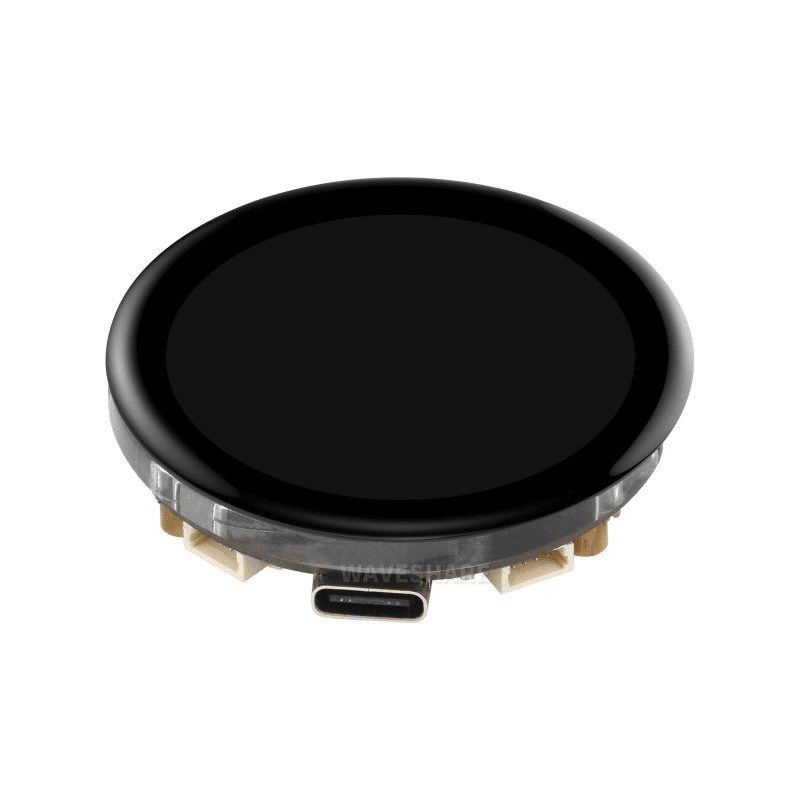
Waveshare ESP32-S3 1.43inch AMOLED Display Development Board, 466×466
ESP32-S3 with a stunning 466×466 AMOLED round display — showcases the S3’s AI and graphics processing power in one compact board.
4. USB Features: OTG and USB Serial/JTAG
Both the ESP32-S2 and ESP32-S3 include a built-in Full-Speed USB 1.1 OTG controller — a feature the original ESP32 lacked entirely. This opens up exciting possibilities:
USB Device Mode (most common)
- CDC (Communication Device Class): Appear as a USB serial port — no CP2102 or CH340 bridge chip needed!
- HID (Human Interface Device): Emulate a keyboard, mouse, or gamepad.
- MSC (Mass Storage Class): Appear as a USB flash drive.
- WebUSB: Communicate directly with a browser via the WebUSB API.
- MIDI: USB MIDI instrument controller.
USB Host Mode (ESP32-S3 advantage)
The ESP32-S3 can also operate in USB Host mode, which allows it to control USB devices connected to it — a USB keyboard, barcode scanner, RFID reader, or even a USB thumb drive (with TinyUSB’s MSC host driver). The ESP32-S2 has more limited host support in practice.
USB Serial/JTAG
Both chips include a built-in USB Serial/JTAG controller (separate from the OTG). This means you can flash firmware and debug over a single USB cable without any external USB-to-serial converter. This significantly simplifies PCB design and reduces component count for production products.
USB summary: For pure USB device applications (HID, CDC, MIDI), both chips are equivalent. For USB host functionality, the ESP32-S3 with its mature TinyUSB host stack is the better choice.
5. Wireless Connectivity
Here is perhaps the most dramatic difference: the ESP32-S2 has Wi-Fi only, with absolutely no Bluetooth support. The ESP32-S3 adds Bluetooth 5.0 + Bluetooth Low Energy.
This might seem like a minor point, but it has major implications:
- ESP32-S2: Cannot connect to Bluetooth devices, cannot act as a BLE beacon, cannot be configured via a smartphone Bluetooth app. Wi-Fi provisioning must be done over the network.
- ESP32-S3: Full BT 5.0 + BLE. Can use ESP-IDF’s Bluedroid or NimBLE stack. Supports BLE advertising, scanning, GATT server/client, Bluetooth Classic audio (A2DP), and ESP-BLE-MESH. Works with Espressif’s ESP BLE Provisioning for easy Wi-Fi setup via a smartphone app.
If your project needs to communicate with a smartphone, fitness band, BLE sensor, or any Bluetooth peripheral, the ESP32-S2 is a non-starter. Go with the ESP32-S3.
6. GPIO Count and Peripherals
The ESP32-S3 has 45 GPIO pins vs 43 on the ESP32-S2. Both support capacitive touch sensing on 14 pins. Both have the same complement of standard peripherals: SPI, I2C, I2S, UART, CAN (TWAI), RMT, LEDC PWM, ADC (12-bit), DAC, and a pulse counter.
Key peripheral differences:
- LCD interface: ESP32-S3 adds support for RGB565 parallel display interface, enabling it to drive larger colour LCDs directly without an external driver chip.
- I2S: ESP32-S3 has enhanced I2S with better support for TDM audio.
- SPI: Both have 4 SPI controllers; ESP32-S3 SPI in slave mode supports GP-SPI DMA transfers up to 80 MHz.
7. Memory: RAM and Flash
The ESP32-S3 wins on memory too:
- SRAM: 512 KB vs 320 KB on the S2. Extra 192 KB matters for TensorFlow Lite model buffers and large image frame buffers.
- ROM: 384 KB vs 128 KB. More ROM means more functionality available without consuming flash.
- PSRAM: Both chips support external Octal PSRAM (up to 8 MB). The ESP32-S3 supports faster Octal-SPI PSRAM at 80 MHz vs 40 MHz on the S2 in some configurations — this is critical for rendering images and running AI models that don’t fit in internal SRAM.
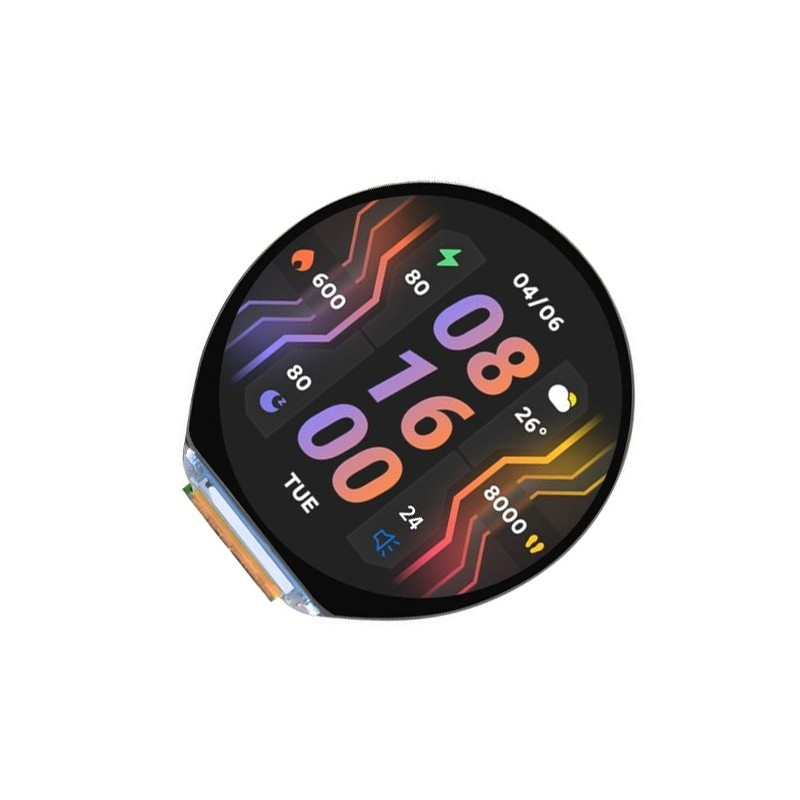
Waveshare ESP32-S3 1.46inch Round Display Development Board, 412×412
Compact wearable-style board with ESP32-S3, round 412×412 display, accelerometer, gyroscope, speaker and microphone — ideal for AI voice projects.
8. Power Consumption
Both chips are low-power variants of the ESP32 family, with no Ethernet MAC and reduced peripheral set compared to the original ESP32. Typical power figures:
| Mode | ESP32-S2 | ESP32-S3 |
|---|---|---|
| Active (CPU + Wi-Fi TX) | ~300 mA | ~340 mA |
| Modem Sleep | ~3–12 mA | ~4–14 mA |
| Light Sleep | ~240 µA | ~270 µA |
| Deep Sleep | ~22 µA | ~7 µA |
Interestingly, the ESP32-S3 achieves lower deep sleep current (7 µA vs 22 µA) despite having more features. This is a result of architectural improvements in the power management unit. For battery-powered IoT sensors that spend most of their time sleeping, the ESP32-S3 may actually last longer on a battery.
9. Display and Camera Support
Both chips support a parallel DVP camera interface for connecting OV2640 or similar camera modules. However, the ESP32-S3 handles camera + AI pipelines much better due to its dual core and AI acceleration — it can capture a frame, run face detection, and still maintain a Wi-Fi connection simultaneously.
For displays, the ESP32-S3’s enhanced LCD controller supports RGB565 interface, making it compatible with a broader range of affordable colour TFT panels without needing an SPI-to-parallel bridge. This is what enables products like the Waveshare ESP32-S3 AMOLED boards.
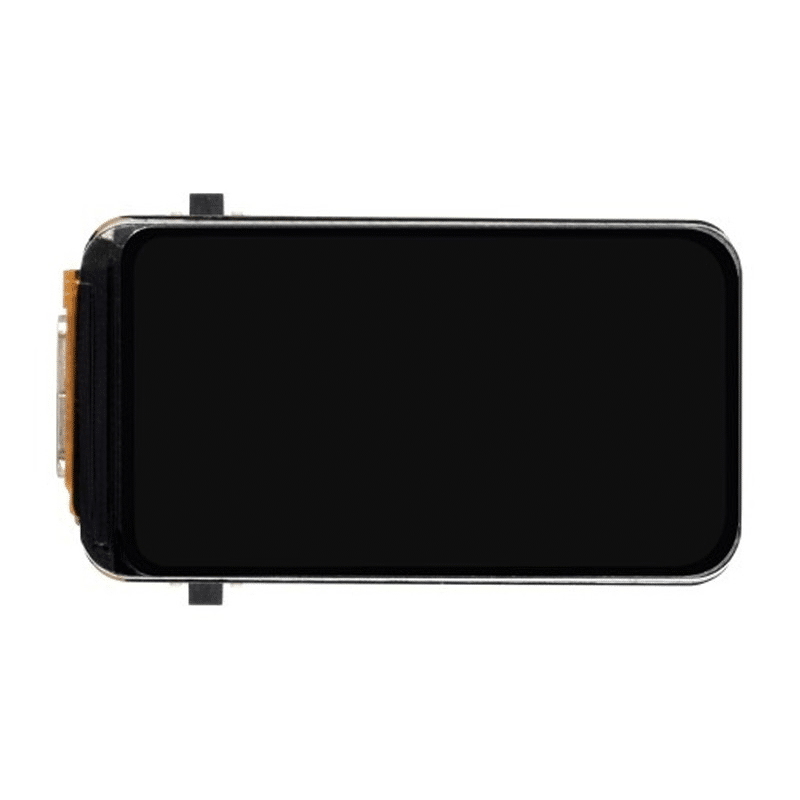
Waveshare ESP32-S3 1.47inch 172×320 LCD Display Development Board
Slim ESP32-S3 board with a 262K-colour LCD — great for learning display programming with the S3’s enhanced graphics capabilities.
10. Which Chip Should You Choose?
Choose ESP32-S2 if:
- You need USB HID/CDC/MSC device functionality and don’t need Bluetooth.
- Your application is single-threaded and doesn’t require parallel processing.
- You want the absolute lowest cost in the Espressif USB-capable lineup.
- You are building a simple Wi-Fi sensor node, USB gadget, or web server device.
- Power consumption in deep sleep is not critical (though actually S3 wins here too).
Choose ESP32-S3 if:
- You need Bluetooth or BLE — period. The S2 cannot do this.
- Your project involves AI inference — face recognition, keyword spotting, gesture detection.
- You need dual-core performance for multitasking (networking + AI + UI simultaneously).
- You are building a camera-based project (ESP-WHO, face recognition, QR code scanner).
- You need more RAM for complex applications, large frame buffers, or machine learning models.
- You want USB host mode to connect USB peripherals to your project.
In most new designs, we recommend the ESP32-S3 as the default choice — the extra cost is marginal, and you get Bluetooth, dual-core, AI acceleration, and more RAM. The ESP32-S2 remains valuable for cost-sensitive, USB-only applications where Bluetooth is not needed.
11. Development Boards Available in India
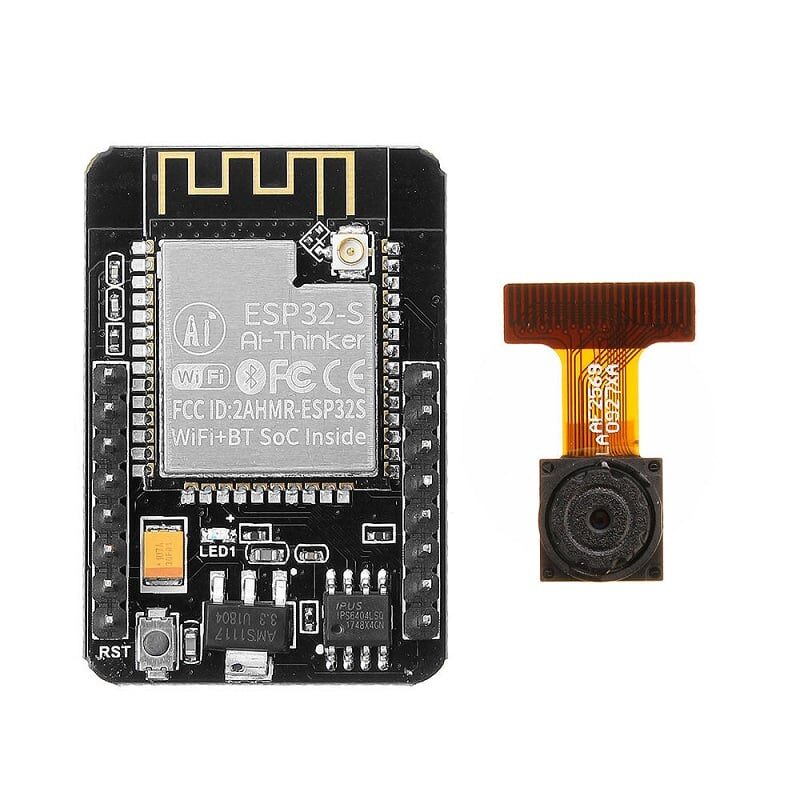
Ai Thinker ESP32 CAM Development Board WiFi+Bluetooth with AF2569 Camera Module
Complete ESP32 camera board — perfect for learning face recognition and AI vision before upgrading to the ESP32-S3 platform.
Frequently Asked Questions
Can I use the same Arduino sketches on both ESP32-S2 and ESP32-S3?
Mostly yes, with minor modifications. The Arduino core for ESP32 supports both chips. However, code using Bluetooth APIs will not compile for the S2. Pin numbers may differ depending on your specific board.
Is the ESP32-S3 compatible with the original ESP32 pinout?
No, the ESP32-S3 has a different pinout from the original ESP32. However, boards like the ESP32-S3-DevKitC follow a similar form factor. Always check the pinout diagram for your specific board before wiring.
Which has better Wi-Fi range — S2 or S3?
Both use the same 2.4 GHz 802.11 b/g/n Wi-Fi stack and are rated for similar ranges. In practice, performance depends more on antenna design, PCB layout, and the specific module than on which chip is inside. Both achieve similar RSSI levels in equivalent conditions.
Can ESP32-S3 run ChatGPT or large language models locally?
No, large language models require gigabytes of RAM and powerful processors. The ESP32-S3 is designed for small TensorFlow Lite Micro models (typically under 1 MB). For edge AI with larger models, look at Raspberry Pi 4/5 or dedicated AI accelerator modules.
Is there an ESP32-S4 or next generation chip coming?
Espressif continues to expand its portfolio. The ESP32-P4 (announced 2023) is a high-performance chip with dual-core RISC-V at 400 MHz, hardware H.264 encoder, MIPI-DSI/CSI support, and no built-in wireless (intended for gateway applications paired with a wireless-capable chip). Watch Espressif’s announcements for future product releases.
Conclusion
The ESP32-S3 vs ESP32-S2 debate has a clear answer for most projects: unless you specifically need a low-cost USB-only solution without Bluetooth, the ESP32-S3 is the better choice. Its dual-core LX7, AI vector instructions, Bluetooth 5.0, larger memory, and lower deep sleep power make it a genuine upgrade worth the modest extra cost.
The ESP32-S2 still has its place in USB HID gadgets, low-cost Wi-Fi sensors, and any application where Bluetooth is genuinely not needed. But for AI-powered projects, camera applications, and anything involving a smartphone connection, the ESP32-S3 is the chip you want.
Shop ESP32-S3 Development Boards in India
Get the latest Waveshare ESP32-S3 display boards and camera modules at Zbotic — genuine products, fast India delivery.


Add comment