
The Wien bridge oscillator circuit is the most elegant way to generate a pure, low-distortion sine wave using nothing more than an op-amp and a handful of resistors and capacitors. Named after Max Wien who described the bridge circuit in 1891, and later perfected by William Hewlett (co-founder of HP) as his Stanford graduate thesis project, this oscillator remains the gold standard for audio-frequency sine wave generation. From function generators and audio test equipment to precision reference oscillators, the Wien bridge is a circuit every serious hobbyist and engineering student in India should understand and build.
How the Wien Bridge Oscillator Works
To understand the Wien bridge oscillator, you need to understand two things: the Wien bridge network and the Barkhausen stability criterion.
The Wien Bridge Frequency-Selective Network
The Wien bridge network is a two-element phase-shift network made of resistors and capacitors arranged in a specific way. In its oscillator form, it consists of:
- A series RC combination (R1 and C1) from the output back to the non-inverting input (+)
- A parallel RC combination (R2 and C2) from the non-inverting input to ground
Together, these form a frequency-selective voltage divider. At most frequencies, the network shifts the phase and reduces the amplitude of the signal fed back. But at one specific frequency — the resonant frequency — the network produces exactly 0° phase shift and an attenuation of exactly 1/3 (i.e., the output is one-third of the input, in phase).
The Barkhausen Criterion for Oscillation
An oscillator requires two conditions (Barkhausen criterion):
- Total loop gain ≥ 1: The amplifier must compensate for losses in the feedback network. If the feedback network attenuates by 1/3, the amplifier must have a gain of at least 3.
- Total loop phase shift = 0° (or 360°): At the oscillation frequency, the signal must return to the input in phase with itself.
The Wien bridge network provides 0° phase shift at the resonant frequency. The op-amp non-inverting amplifier (gain = 1 + Rf/Rg) provides 0° phase shift. Total loop phase = 0° + 0° = 0° — perfect for oscillation. The amplifier gain is set to exactly 3 to compensate for the 1/3 attenuation of the bridge network.
Frequency Formula and Component Selection
When R1 = R2 = R and C1 = C2 = C (the standard simplified form), the oscillation frequency is:
f = 1 / (2π × R × C)
This is exactly the same formula as the time constant of an RC filter. The elegance of the Wien bridge is that two simple RC sections work together to produce pure oscillation at this frequency.
Component Selection Table
| Frequency | R (R1=R2) | C (C1=C2) | Application |
|---|---|---|---|
| 1 Hz | 1.59 MΩ | 0.1 µF | Ultra-low frequency |
| 100 Hz | 15.9 kΩ (use 16 kΩ) | 0.1 µF | Low-frequency audio |
| 1 kHz | 15.9 kΩ (use 16 kΩ) | 10 nF | Audio mid-range |
| 10 kHz | 15.9 kΩ (use 16 kΩ) | 1 nF | Audio high-frequency |
| 100 kHz | 15.9 kΩ (use 16 kΩ) | 100 pF | RF low end |
For audio work, the most useful range is 20 Hz to 20 kHz. By keeping R fixed and switching capacitor values (in decades), or by using a dual-gang potentiometer for R1 = R2 simultaneously, you can tune the frequency continuously.
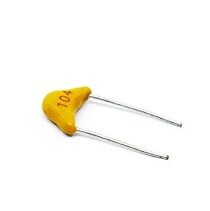
0.1/100nF TH-Multilayer Ceramic Capacitor (Pack of 50)
The 100nF capacitor is the starting point for building Wien bridge oscillators in the audio frequency range. Pair with 15.9 kΩ resistors for a clean 100 Hz sine wave generator.
Amplitude Stabilisation
This is the critical challenge in Wien bridge oscillator design. The Barkhausen criterion requires loop gain of exactly 1. In practice:
- If gain < 3× (loop gain < 1): oscillations die out (the circuit is damped)
- If gain > 3× (loop gain > 1): oscillations grow until the op-amp clips against the supply rails — producing a distorted, clipped “square-ish” wave, not a sine wave
- If gain = exactly 3×: sustained, undistorted sine wave — but this exact condition cannot be maintained without some form of automatic gain control
Method 1: Incandescent Lamp (Hewlett’s Original Method)
William Hewlett’s original HP200A oscillator used a small incandescent lamp (torch bulb) as Rg in the gain network. The lamp’s resistance increases as it heats up (positive temperature coefficient). If the oscillation amplitude increases, the lamp heats slightly, its resistance increases, reducing the gain below 3 — the amplitude falls back. This elegant self-regulating mechanism was the key innovation of the HP200A. The lamp must be the right power rating to operate at the right temperature in the circuit — too bright and it responds too slowly; too dim and it overheats and burns out. A standard 12V/40mA or 6V/50mA small signal lamp works well.
Method 2: JFET Automatic Gain Control (AGC)
A JFET (2N3819, J2N3819) can be used as a voltage-controlled resistor. Its drain-source resistance in the ohmic region varies with the gate-source voltage Vgs. Connect the JFET as a variable resistor in the gain network (Rg). A half-wave rectifier and integrator monitor the output amplitude and generate a control voltage for the JFET gate. As amplitude rises, the control voltage makes the JFET resistance increase (reducing gain below 3) — and the loop stabilises the amplitude at the design point. This gives much lower distortion than the lamp method for a well-designed AGC circuit.
Method 3: Back-to-Back Diodes (Softclip)
The simplest (but highest distortion) method: place two silicon diodes (1N4148) back-to-back in parallel with Rf. When the output amplitude exceeds the diode forward voltage (~0.65V), the diodes conduct and reduce the effective Rf, clamping the gain to less than 3. The output amplitude is clamped to approximately 1.3–1.5V peak. The diodes only conduct at the peaks of the sine wave, adding harmonic distortion. THD (total harmonic distortion) is typically 1–5% — acceptable for many applications but not for precision audio measurements. Use silicon diodes for standard designs; BAT43 Schottky diodes for lower clamp voltage (~0.3V).
Practical Op-Amp Wien Bridge Circuit
Here is a complete, practical Wien bridge oscillator design for a 1 kHz sine wave using an LM358 or TL071 op-amp:
Component List
- Op-amp: TL071 or TL072 (recommended for lower noise) — or LM741 for a classic build
- R1 = R2 = 15.9 kΩ (use 15 kΩ standard + 1 kΩ trim pot for fine adjustment)
- C1 = C2 = 10 nF (use 10 nF polyester film capacitors — better stability than ceramics)
- Rf = 20 kΩ (gain network feedback)
- Rg = 10 kΩ fixed + 5 kΩ potentiometer (to fine-tune gain to exactly 3×)
- Amplitude stabilisation: 2× 1N4148 back-to-back across Rf (for simplicity)
- Decoupling: 100 nF ceramic on each supply pin, 10 µF electrolytic at power entry
- Supply: ±12V or ±9V dual supply
Assembly and Test
- Wire the Wien bridge network: series RC (R1 + C1) from op-amp output pin 6 to non-inverting pin 3; parallel RC (R2 in parallel with C2) from pin 3 to GND.
- Connect gain network: Rf from output (pin 6) to inverting input (pin 2); Rg from pin 2 to GND.
- Power up and monitor output on an oscilloscope. If there is no oscillation, increase Rf slightly (increase gain above 3) — oscillations should start.
- Adjust the gain trim pot so oscillations are clean — not clipped. With the diode softclip, the amplitude self-regulates to ~1.3V peak.
- Verify frequency: should be close to 1/(2π × 15.9k × 10n) = 1000 Hz. Adjust R1/R2 trim pots for exact 1 kHz if needed.
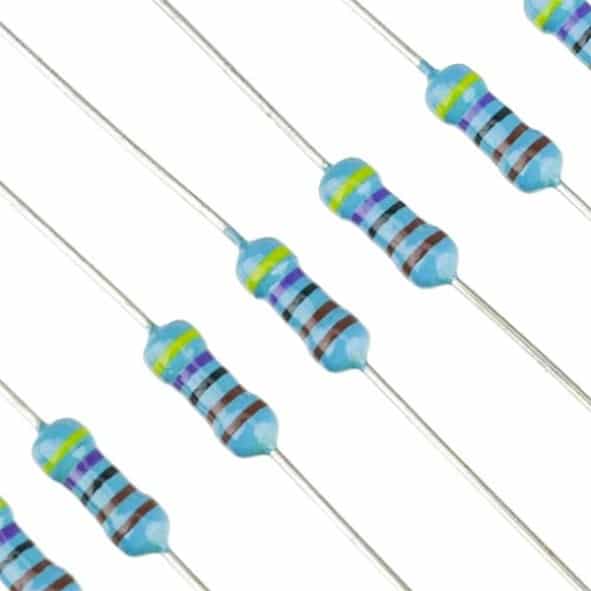
1/4W Metal Film Resistor MFR (Pack of 100)
Use metal film resistors for your Wien bridge oscillator — their 1% tolerance and low temperature coefficient keep your oscillation frequency stable across ambient temperature changes.
Frequency Tuning and Adjustment
The Wien bridge oscillator frequency is determined by R and C. To make a variable-frequency oscillator:
Dual-Gang Potentiometer
Replace R1 and R2 with a dual-gang potentiometer (both sections track together on the same shaft). Rotating the pot changes both R1 and R2 simultaneously, maintaining the R1 = R2 condition needed for equal-component design. A 10 kΩ dual-gang pot with a 1 kΩ fixed resistor in series (minimum resistance) gives a frequency range of approximately 3:1 per capacitor range.
Switched Capacitor Ranges
Use a rotary switch to select capacitor pairs (C1 and C2) in decades:
- Range 1: 100 nF — covers 100 Hz to ~1 kHz
- Range 2: 10 nF — covers 1 kHz to ~10 kHz
- Range 3: 1 nF — covers 10 kHz to ~100 kHz
This is exactly how classic HP audio oscillators (HP200, HP650A) were designed. Use polypropylene or polyester film capacitors (not ceramic) for the frequency-determining capacitors — ceramics have significant voltage coefficients and temperature coefficients that shift the frequency.
Minimising Distortion
For low-distortion sine wave generation (THD < 0.1%), follow these design practices:
Use the JFET AGC Method
The JFET automatic gain control method achieves THD below 0.05% when well-designed. The key is choosing a JFET with appropriate pinch-off voltage and ensuring the AGC loop time constant is much longer than the oscillation period (so the AGC corrects slowly and does not modulate the sine wave amplitude within each cycle).
High-Quality Op-Amp Selection
Choose op-amps with low open-loop distortion. The TL071/TL072 are good starting points (available and inexpensive). For low-distortion audio work, the NE5534, OPA627, or AD797 give excellent THD performance. The op-amp’s gain-bandwidth product must be far above the oscillation frequency — at 1 kHz, even an LM741 (GBP = 1 MHz) is marginal with 1000× surplus gain. Use a TL071 (GBP = 3 MHz) for more comfortable margins.
Symmetric Supply and Output Amplitude
Keep the output amplitude well below the supply rails — clipping even a tiny fraction of the sine wave peak adds enormous distortion. With ±12V supply and diode softclip at ±1.3V, there is plenty of headroom. If you need a higher output amplitude, add a post-amplifier stage rather than increasing the oscillator amplitude.
Applications of Wien Bridge Oscillators
Audio Function Generators
The Wien bridge is the go-to circuit for audio frequency sine wave generation. Commercial audio oscillators (from the HP200A in 1939 to modern Rigol and Siglent generators) use Wien bridge or derived topologies for their low-distortion sine outputs in the 20 Hz to 100 kHz range.
Audio Equipment Testing
Testing amplifiers, speakers, and acoustic systems requires low-distortion sine wave sources. A Wien bridge oscillator generating 1 kHz at <0.01% THD lets you measure the distortion introduced by the device under test — any distortion you measure is from the DUT, not the source.
Lock-In Amplifier Reference
Lock-in amplifiers use a reference sine wave to recover signals buried below the noise floor. The Wien bridge oscillator provides the phase-stable reference needed for coherent detection. This technique is used in scientific instruments, precision impedance measurements, and solar cell characterisation.
Crystal Calibration Reference
When frequency accuracy matters, a Wien bridge can be frequency-locked to a crystal oscillator using a phase-locked loop (PLL) or temperature-compensated adjustment. The Wien bridge output provides a low-distortion sine with crystal-accurate frequency — combined, you get the best of both worlds.
Educational Lab Experiments
Wien bridge oscillators are a classic topic in undergraduate electronics labs across IITs, NITs, and engineering colleges throughout India. Building one from scratch teaches Barkhausen criterion, feedback theory, amplitude stabilisation, and frequency-selective networks — all fundamental concepts.
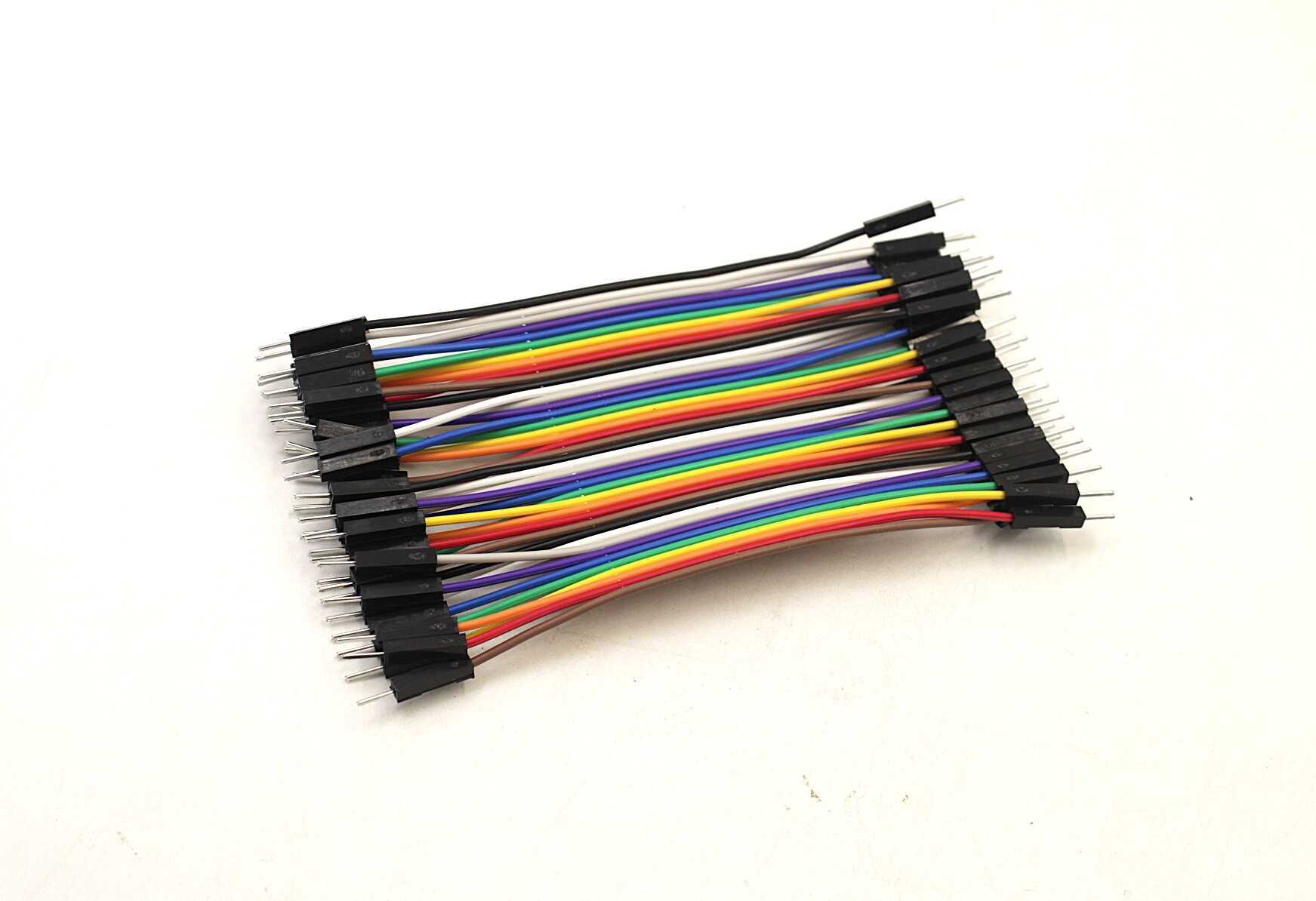
10CM Male To Male Breadboard Jumper Wires 2.54MM – 40Pcs
Prototype your Wien bridge oscillator cleanly on a breadboard with these quality jumper wires. Good breadboard connections are critical for oscillator circuits — loose connections kill oscillations.
Frequently Asked Questions
Why does the Wien bridge oscillator use two RC stages instead of one?
A single RC stage produces a maximum phase shift of 90° — but the Barkhausen criterion for oscillation requires exactly 0° total phase shift. Two RC stages in the Wien bridge configuration produce 0° phase shift at the resonant frequency (each section contributes +45° and −45° respectively in a specific way that cancels at f0). This is mathematically elegant and is the key insight behind the Wien bridge design.
What is the minimum supply voltage for a Wien bridge oscillator?
The circuit needs headroom above the oscillation amplitude. For a 1.3V peak output using diode softclip, a ±5V supply works fine. For a 3V peak output, use ±9V or ±12V. Single-supply operation is possible with an LM358 — bias the non-inverting reference to VCC/2 and use a coupling capacitor on the output. Single-supply designs are slightly more complex but fully functional.
How accurate is the Wien bridge oscillator frequency?
Frequency accuracy depends entirely on the R and C component tolerances. With 1% resistors and 5% capacitors, expect ±6% frequency accuracy. With 1% components for both R and C (use 1% film capacitors), accuracy improves to ±2%. For the absolute best frequency accuracy without a crystal, use a trimmer potentiometer to fine-adjust R and calibrate against a frequency reference (a calibrated oscilloscope, GPS-disciplined oscillator, or a 1 kHz reference from an online tone generator on a mobile phone).
Can I build a Wien bridge oscillator on a breadboard?
Yes — a breadboard Wien bridge oscillator works well for learning purposes. However, breadboard parasitic capacitance (approximately 1–2 pF per contact) and resistance (tens of milliohms per contact) affect performance at higher frequencies (above 100 kHz). For audio frequencies (20 Hz to 20 kHz), breadboard prototyping is perfectly adequate. Use good-quality jumper wires with firm contacts to avoid intermittent connections that disrupt oscillation.
What is the difference between a Wien bridge oscillator and a phase shift oscillator?
Both are RC sine wave oscillators. The Wien bridge uses two RC sections in a bridge configuration and requires a non-inverting amplifier with gain of 3. The phase shift oscillator uses three RC sections (each contributing 60° of phase shift at the oscillation frequency for a total of 180°) and requires an inverting amplifier with gain of −29. The Wien bridge generally achieves lower distortion and is easier to tune. The phase shift oscillator uses fewer components but has higher distortion and is less amenable to tuning.
All the components for your Wien bridge oscillator — resistors, capacitors, prototyping boards, and jumper wires — are available at Zbotic with fast delivery across India. Explore our Electronics Basics collection and bring your analog circuit projects to life.





Add comment