
Voltage Multiplier Circuit: Cockcroft-Walton Ladder Design Tutorial
A voltage multiplier circuit is one of the most elegant inventions in power electronics — using nothing but diodes and capacitors to multiply an AC input voltage to many times its original value without a transformer. The most well-known design is the Cockcroft-Walton (CW) multiplier, named after John Cockcroft and Ernest Walton who used it in 1932 to accelerate protons and split the atom — earning them the Nobel Prize. Today, Indian hobbyists and makers use CW multipliers in Geiger counters, electrostatic experiments, ion fans, and high-voltage power supplies for nixie tube clocks. This tutorial walks you through the theory, design, and construction from first principles.
Starting Simple: The Half-Wave Voltage Doubler
Before tackling the full Cockcroft-Walton ladder, understanding the simple half-wave voltage doubler is essential. It is the building block from which the CW multiplier is extended.
A half-wave voltage doubler uses two diodes and two capacitors:
- On the negative half-cycle: Diode D1 conducts, charging capacitor C1 to the peak input voltage V_peak.
- On the positive half-cycle: D1 blocks. The input voltage and C1 (now acting as a series battery) combine, forward-biasing D2 and charging C2 to 2×V_peak.
- Output: C2 holds the 2×V_peak charge, available as DC output.
For a 12V AC RMS input (from a standard transformer), V_peak = 12 × √2 = 16.97V. A voltage doubler outputs approximately 33.9V DC (under no load). This is how many simple inverter circuits and electrolytic capacitor reformers work.

0.1µF Ceramic Capacitor (Pack of 50)
Ceramic capacitors for voltage multiplier prototyping and coupling stages. Ideal for low-current high-frequency CW multiplier designs.
The Cockcroft-Walton Ladder Explained
The Cockcroft-Walton multiplier extends the doubler concept into a cascade of stages — creating a “ladder” of diodes and capacitors. Each additional stage adds another 2×V_peak to the output voltage.
The circuit structure for an N-stage CW multiplier:
- Column 1 (left, “pump” column): Capacitors C1, C3, C5… connected between the AC source and the column 2 nodes
- Column 2 (right, “output” column): Capacitors C2, C4, C6… connected from the output nodes to ground
- Diodes: Form a chain connecting the nodes, allowing charge to “pump” upward through the ladder on alternating half-cycles
On each half-cycle, charge pumps up one stage of the ladder. Over multiple cycles, charge accumulates across all the output column capacitors, each holding 2×V_peak. The total output is the sum of all capacitor voltages in the output column.
Think of it as a water pump analogy: each stage is like a check valve that allows water to flow upward but not back down. As the AC source pumps, water (charge) climbs the ladder and accumulates at the top (output).
Design Equations and Output Voltage
Ideal Output Voltage (No Load)
V_out(ideal) = 2 × N × V_peak
Where N is the number of stages and V_peak is the peak AC input voltage.
For a 5-stage CW multiplier with a 12V RMS (16.97V peak) input:
V_out = 2 × 5 × 16.97 = 169.7V DC (no load)
Output Voltage Under Load
When current I_load is drawn, each capacitor partially discharges between pump cycles, causing voltage droop. The output voltage under load is:
V_out = 2N × V_peak – (I_load / (f × C)) × ((2N³/3) + N²/4)
Where f is the AC frequency and C is the capacitance value (assuming all equal). The N³ term shows that output droop increases dramatically with more stages — a fundamental limitation of CW multipliers for high-current applications.
Output Ripple Voltage
ΔV_ripple = I_load × N × (N+1) / (2 × f × C)
To minimise ripple: increase C, increase f, reduce N, or reduce load current. This is why CW multipliers work best at low output current — they are not suitable for high-current power supplies without significant derating.
Practical Example: 3-Stage CW Multiplier
| Parameter | Value |
|---|---|
| Input AC | 9V RMS (12.73V peak) at 50 Hz |
| N (stages) | 3 |
| C (all equal) | 10 µF |
| No-load output | 2 × 3 × 12.73 = 76.4V |
| Output at 1mA load | ≈ 70.5V (8% droop) |
| Ripple at 1mA load | ≈ 1.2V peak-to-peak |
| Max diode PIV needed | 2 × V_peak = 25.5V |
Choosing Diodes and Capacitors
Diode Selection
Each diode in a CW multiplier must withstand a peak inverse voltage (PIV) of at least 2×V_peak. For a 12V RMS input, that is 2 × 16.97 = 33.94V minimum PIV.
For a small-signal CW multiplier (milliamp output):
- 1N4007: 1000V PIV, 1A — overkill for voltage but reliable. Available everywhere in India at under ₹2 each.
- 1N4148: 75V PIV, 300mA — good for low-voltage stages and high-frequency (above 1 kHz) applications
- HER108: 1000V PIV, fast recovery — better than 1N4007 for frequencies above 5 kHz
Always use diodes with PIV rating at least 2× your calculated requirement for safety margin.
Capacitor Selection
Capacitors must be rated for at least 2×V_peak voltage in each stage. For a 12V input (17V peak), each capacitor should be rated for at least 35V. Use 50V or 100V rated capacitors for adequate margin.
- Electrolytic capacitors (10-100 µF): Good for low-frequency (50 Hz mains) CW multipliers. Ensure correct polarity.
- Film capacitors (0.1-1 µF): Better for high-frequency CW multipliers (above 1 kHz) — lower ESR, no polarity concern
- Ceramic capacitors (0.01-0.1 µF): Excellent for very high-frequency (100 kHz+) CW multipliers used in Geiger counter HV supplies
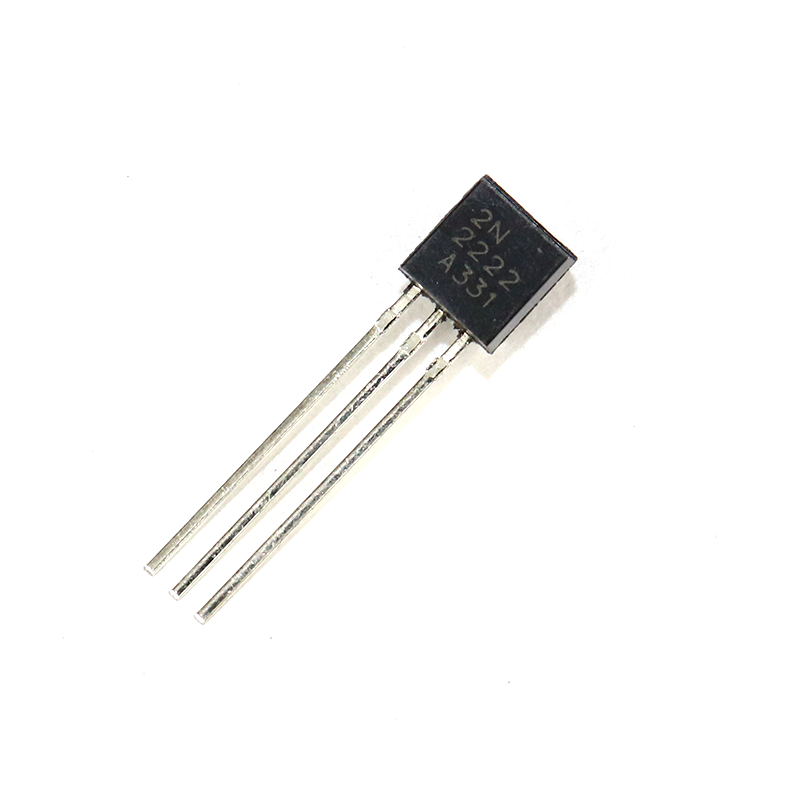
2N2222 NPN Transistor (Pack of 20)
Use 2N2222 transistors to build a high-frequency oscillator (1-100 kHz) to drive your CW multiplier — higher frequency means smaller capacitors and less ripple.
Practical Build Guide
Materials for a 4-Stage CW Multiplier (Output ~150-180V)
- AC input: 12V RMS from a wall adapter or transformer
- 8× 1N4007 diodes (arranged as the ladder)
- 8× 100µF 50V electrolytic capacitors (for low-frequency 50 Hz input)
- Universal PCB board or breadboard (for initial testing)
- High-voltage wire for connections above 100V
- Bleeder resistor: 1MΩ 1/4W across output (safety discharge)
Circuit Layout Tips
- Layout the capacitor columns clearly: Column 1 (pump) and Column 2 (output) should be physically distinct. Poor layout causes parasitic capacitance that reduces efficiency.
- Keep diode orientation consistent: All diodes in the odd-numbered positions point the same way; even-numbered positions point opposite. Double-check before powering on.
- Test each stage incrementally: Build one stage, measure output. Add the next stage, measure again. This catches polarity errors before high voltages are involved.
- Install bleeder resistor first: Always connect a high-value resistor (1MΩ–10MΩ) across the output before testing. This safely discharges capacitors when power is removed.
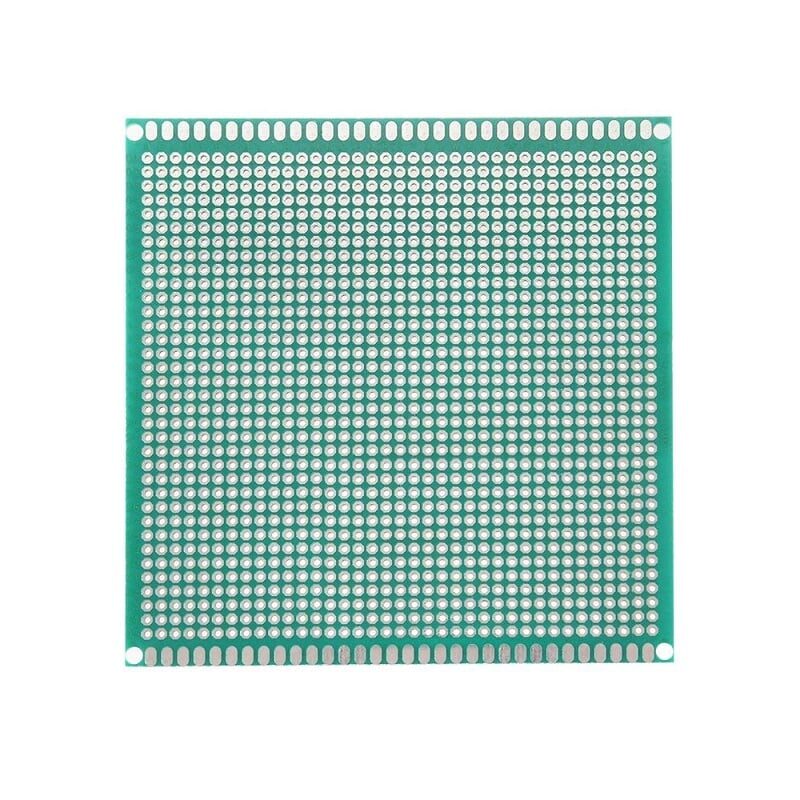
10 x 10 cm Universal PCB Prototype Board Single-Sided
Perfect single-sided PCB for laying out your Cockcroft-Walton ladder — roomy 10×10cm gives space to clearly separate the pump and output capacitor columns.
Real-World Applications for Indian Makers
1. Nixie Tube Clock Power Supply
Nixie tubes (available from hobbyist stores in India for ₹200–500 each) require 170–180V DC at very low current (2–5mA per tube). A 5-stage CW multiplier driven from a 12V adapter is perfect — no bulky transformer needed.
2. Geiger Counter High Voltage
Geiger-Müller tubes (GM tubes) typically require 300–500V at sub-milliamp current to detect radiation. A 12-stage CW multiplier running from a small high-frequency oscillator (powered by a 9V battery) generates the required HV efficiently.
3. Van de Graaff Generator Trigger
Small electrostatic experiments, plasma globes, and ion wind fans use voltage multipliers in the kilovolt range. Multiple cascaded CW stages with high-voltage capacitors achieve this.
4. Electrostatic Precipitator
Air purifiers using electrostatic precipitation need 5–15kV at very low current. A CW multiplier is the standard power supply for DIY electrostatic precipitator projects that can filter fine dust from workshop air.
High Voltage Safety — Non-Negotiable
WARNING: Voltages above 50V DC can cause ventricular fibrillation and death. Even after switching off, the capacitors in a CW multiplier can hold lethal charge for hours. ALWAYS discharge the output through a high-resistance bleeder (1MΩ+) before touching anything in the circuit. Never work alone. Never work on live high-voltage circuits.
Essential safety practices:
- Install a bleeder resistor permanently across the output — never remove it
- Use one-hand rule: keep one hand behind your back when probing near high voltage
- Enclose the completed multiplier in a non-conductive plastic box
- Label all high-voltage points clearly: “DANGER — HIGH VOLTAGE”
- Use a voltmeter to verify discharge before any physical contact with the circuit
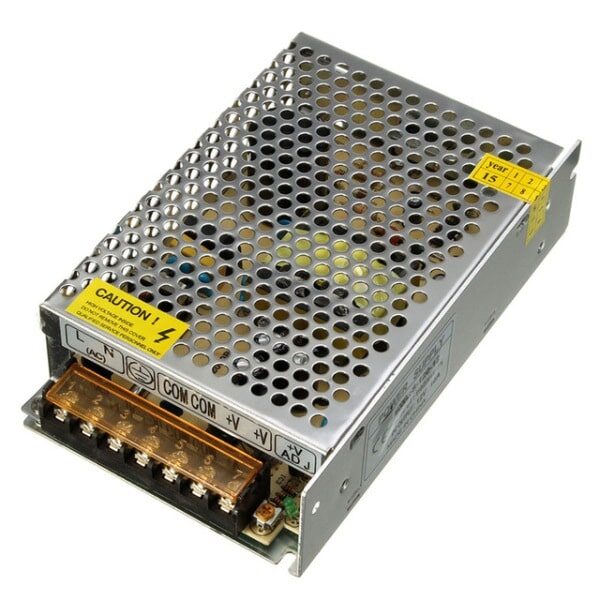
12V 10A SMPS – 120W DC Metal Power Supply
Stable 12V DC input for driving a high-frequency oscillator that feeds your Cockcroft-Walton multiplier — provides clean, regulated input for stable HV output.
Frequently Asked Questions
Q: What is the maximum voltage a CW multiplier can produce?
Theoretically unlimited — just add more stages. Practically, parasitic capacitances, leakage currents, and diode losses limit efficiency. Practical CW multipliers rarely exceed 50 stages. Commercial CW multipliers for particle accelerators operate at megavolts using sophisticated stage designs and SF6 insulation gas.
Q: Why does output voltage drop under load in a CW multiplier?
The capacitors act as charge reservoirs. When load current drains charge between pump cycles, capacitors do not fully recharge before the next cycle. Higher stages are most affected because they have fewer charge transfers per cycle to replenish. The N³ term in the voltage droop equation shows this degradation is severe for many stages at high current.
Q: Can I use a CW multiplier to boost 5V to 50V?
Yes — a 3-stage CW multiplier driven from a 5V AC source (or 5V driven through a small oscillator) can theoretically output about 42V (under no load). Practically, with component losses and some load, expect 35–40V. This is a common technique for generating higher voltages from a microcontroller project’s 5V supply.
Q: How does increasing frequency improve CW multiplier performance?
Higher frequency means more charge pumping cycles per second, which reduces voltage droop (more replenishment per second) and reduces ripple. It also allows smaller capacitors for the same performance. SMPS-based CW multipliers running at 100 kHz can use 10nF capacitors where a 50 Hz design would need 100µF — a 10,000× size reduction.
Q: Are there safety regulations for high voltage projects in India?
For personal/educational use, there are no specific regulations for low-power high-voltage hobby circuits. However, any device connected to the mains (230V AC) must comply with the Indian Electricity Rules and BIS standards. For mains-connected HV projects, all work should be done by licensed electricians or under proper supervision.
Zbotic has all the capacitors, resistors, transistors, and PCB boards you need for power electronics projects. Shop online with delivery across India.





Add comment