
India’s power grid is notorious for voltage spikes, surges, and transients — caused by lightning strikes, capacitor bank switching, motor start/stop cycles, and the frequent switching of heavy industrial loads on shared transformers. These events can destroy expensive electronics in milliseconds. The Metal Oxide Varistor (MOV) — commonly called a varistor — is the most cost-effective first line of defence against such electrical surges, and understanding how to select and apply it correctly is an essential skill for any electronics designer or maker in India.
What Is a Varistor (MOV)?
A varistor is a voltage-dependent resistor — its resistance is not constant but changes dramatically with applied voltage. The term MOV stands for Metal Oxide Varistor, referring to the zinc oxide (ZnO) ceramic material that gives it its nonlinear electrical properties. Unlike ordinary resistors, a varistor has very high resistance at normal operating voltages but rapidly transitions to very low resistance (and high current conduction) when voltage exceeds a threshold called the clamping voltage.
This nonlinear behaviour makes varistors ideal surge absorbers. Under normal operation, almost no current flows through the MOV and it is invisible to the circuit. During a surge, the MOV clamps the voltage to a safe level by shunting the excess energy to ground (or across the supply lines), protecting all connected equipment.
Varistors are available from 3.3V DC (for signal line protection) up to 1000V AC (for high-voltage industrial equipment). The most common types in Indian electronics are the disc varistors for 230V AC protection (07D431K, 10D471K, 14D431K, 20D471K) and the smaller radial lead types for PCB mounting.
How a Metal Oxide Varistor Works
The internal structure of a MOV is a compressed disc of zinc oxide (ZnO) granules with small amounts of other metal oxides (bismuth oxide, manganese oxide, cobalt oxide) sintered at high temperature. At the grain boundaries, microscopic p-n junctions form — billions of them in parallel and series throughout the disc. This creates the varistor’s characteristic nonlinear I-V curve described by:
I = k × V^α
Where α (the nonlinearity exponent) is typically 25–80 for good varistors (versus α=1 for a resistor). The higher α is, the sharper the voltage clamping action.
Under normal voltage, all these grain-boundary junctions are reverse-biased and only leakage current (microamps) flows. When voltage exceeds the clamping threshold, the junctions avalanche and the MOV’s resistance drops from megaohms to just a few ohms, conducting hundreds or thousands of amperes for the microsecond duration of the surge. The surge energy is absorbed and converted to heat within the zinc oxide ceramic body.
Once the surge passes and voltage returns to normal, the junctions recover and the MOV returns to its high-resistance state — ready for the next event. This self-resetting behaviour is a key advantage over fuses, which are single-use devices.
Key MOV Parameters You Must Understand
Varistor Voltage (V_N or V_1mA)
The voltage across the varistor when 1 mA DC flows through it. This is the nominal clamping voltage reference. For 230V AC circuits (peak voltage = 325V), you need V_N to be above 325V. Standard choices: 430V, 470V, 560V (for 230V mains). The part number often encodes this: 14D431K = 14mm disc, 430V varistor voltage, ±10% tolerance.
Maximum Continuous Voltage (V_AC or V_DC)
The maximum steady-state voltage the MOV can withstand continuously without degradation. For 230V AC mains: choose V_AC(max) ≥ 275V. For 120V AC: V_AC(max) ≥ 150V. For 12V DC: V_DC(max) ≥ 18V.
Clamping Voltage (V_C)
The voltage across the MOV during a standardised surge current pulse (typically measured at 100A or 1000A peak). This is the voltage your protected circuit actually sees during a surge event. Lower clamping voltage = better protection. For 230V AC equipment, V_C at 100A should be ≤ 710–775V to stay below equipment breakdown voltages.
Peak Surge Current (I_P)
The maximum instantaneous current the MOV can handle without damage, specified for a standard 8/20 µs waveform (8 µs rise, 20 µs decay — the standard lightning surge waveform). Common ratings: 2500A, 4500A, 6500A. Larger disc diameter = higher surge current capability. For mains protection, choose ≥ 2500A; for high-risk areas (rooftop equipment, direct lightning exposure), use ≥ 6500A.
Energy Rating (Joules)
The total energy the MOV can absorb in a single surge pulse without destruction. Calculated as: W = ½ × C_equivalent × V² (from the surge source model). Typical mains protection MOVs: 25–100 joules. For power strips and UPS bypass protection, choose ≥ 40 joules. Remember: each surge event partially degrades the MOV, even if it survives.
Response Time
The time from surge onset to clamping action: typically less than 25 nanoseconds for standard MOVs, and sub-nanosecond when properly mounted. This is fast enough to clamp lightning-induced surges (which have microsecond rise times) but may not be fast enough for ESD (electrostatic discharge, sub-nanosecond rise) — for ESD, TVS diodes are preferred.
Varistor vs TVS Diode vs Gas Discharge Tube
| Parameter | MOV Varistor | TVS Diode | Gas Discharge Tube |
|---|---|---|---|
| Response time | <25 ns | <1 ps | ~1 µs |
| Energy absorption | High (joules) | Low-Medium | Very High |
| Peak surge current | Up to 70 kA | Up to 100A | Up to 20 kA |
| Bidirectional | Yes (symmetric) | Yes (bidirectional types) | Yes |
| Clamping precision | Moderate (±10–20%) | High (±5%) | Low (varies widely) |
| Cost | Low (₹5–₹30) | Moderate (₹10–₹100) | Moderate |
| Best for | Mains surge protection | ESD, signal line protection | Telecom, heavy industrial |
For comprehensive protection, use a coordinated three-stage approach: GDT (coarse clamp, high energy) → MOV (medium clamp) → TVS diode (fine clamp, fast response). This is standard practice in telecom equipment, industrial control panels, and high-reliability designs.
How to Select the Right Varistor
Step 1: Determine the Maximum Continuous Voltage
For 230V AC circuits: V_peak = 230 × √2 = 325V. Allow for ±10% mains variation: V_max_continuous = 253V RMS. Choose V_AC(max) ≥ 275V. Standard selection: 430V varistor (V1mA = 430V).
Step 2: Choose Disc Size Based on Energy and Current
- 07D series (7mm): 20–25J, 1200–1500A — for PCB-level protection, signal supplies
- 10D series (10mm): 25–40J, 2500A — for small appliances, adapter circuits
- 14D series (14mm): 40–60J, 4500A — for power strips, consumer electronics
- 20D series (20mm): 60–100J, 6500A — for industrial equipment, motor drives
- 34D series (34mm): 150–250J, 10kA — for main distribution boards
Step 3: Verify Clamping Voltage
The clamping voltage at the expected surge current must be below the withstand voltage of the equipment being protected. For electronics rated to 1000V, a clamping voltage of 710–775V at 1kA is generally acceptable. For 600V-rated equipment, choose a smaller V_N varistor (e.g., 390V) to achieve lower clamping.
Step 4: Derate for Reliability
Always apply 20% derating on the continuous voltage rating. For 230V/50Hz nominal (with ±10% tolerance and possible over-voltage events), a 275V AC rated MOV is the minimum — but 300V or 320V AC rated MOVs provide a larger safety margin in areas with frequent over-voltage (common in many Indian rural and peri-urban areas).
Protecting Indian 230V Mains Equipment
India’s 230V/50Hz mains supply has several characteristics that make surge protection particularly important:
- Monsoon lightning: Direct and indirect lightning strikes are common from June–September. A nearby lightning strike (even 1 km away) can couple kilovolt surges onto power lines.
- Rural supply quality: Voltage fluctuations of ±20% are common; distribution transformer tap changes create switching transients.
- Heavy industrial loads: Motor starts and welding machines on shared feeders create repetitive microsurges.
- Earthing issues: Poor earthing (high earth resistance, missing earth connections) means surge currents flow through equipment rather than safely to ground.
Recommended MOV for 230V Indian mains protection:
- V_AC(max) = 275–320V, V_N = 430–470V
- Disc size: 14D or 20D (for ≥4500A surge capability)
- Always pair with a proper earth connection — MOVs shunt surge current to ground; without earth, they provide no protection
- Add an upstream fuse (1–6A depending on circuit) — if MOV is hit repeatedly, it degrades and can fail short-circuit; the fuse prevents fire
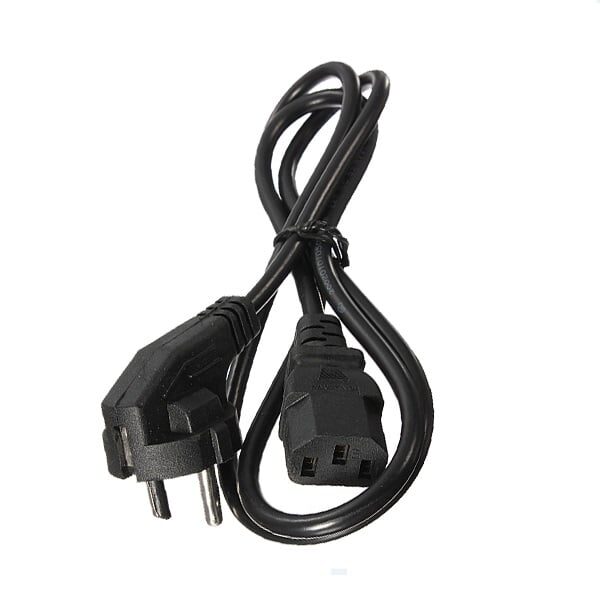
1.2M AC 10A 250V Power Supply Adapter Cord Cable EU Plug
A quality rated AC power cord for your mains-connected projects and power supply builds — always use properly rated cables in AC circuits with surge protection components.
Varistors in DC Circuits
Varistors are equally useful for DC power rail protection. In automotive electronics (12V/24V battery systems), industrial DC buses (24V, 48V), and solar panel installations, voltage transients from load switching, regenerative braking, and battery disconnection events can easily exceed 2× the nominal voltage.
For DC circuits, choose a varistor with V_DC(max) ≥ 1.5 × V_DC_nominal:
- 12V DC automotive: Choose V_DC(max) ≥ 18V (e.g., 18V varistor, V_N ≈ 22V)
- 24V DC industrial: Choose V_DC(max) ≥ 36V (e.g., 36V varistor)
- 48V telecom: Choose V_DC(max) ≥ 72V (e.g., 75V varistor)
For automotive applications, the standard load dump transient (when battery is disconnected with alternator running) is typically +100V for 400 ms — a 33V varistor won’t survive this. Use 40V AC varistors (V_DC = ~56V) for 12V automotive circuits to handle load dump.
Relay and Solenoid Coil Protection
Every relay and solenoid coil stores magnetic energy that must be dissipated when power is removed. The inductive kickback spike can easily reach 5–10× the supply voltage and will destroy transistors and MOSFETs without protection. A varistor placed directly across the coil is an excellent suppressant:
- 12V relay coil: Place a 24–27V varistor across the coil terminals
- 24V relay coil: Place a 36–47V varistor across the coil
- 230V AC contactor coil: Place a 430V varistor across the coil
Compared to a traditional flyback diode, a varistor across an inductive coil allows faster coil de-energisation (important for fast-acting valves and relays) because it clamps at a higher voltage, which drives current out of the inductor more quickly. The tradeoff is more energy dissipated in the varistor, but for relay applications the spike energy is small and poses no problem.
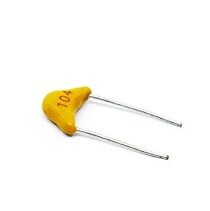
0.1/100nF TH Multilayer Ceramic Capacitor (Pack of 50)
Use 100nF ceramic capacitors alongside MOV varistors for comprehensive transient filtering — capacitors handle high-frequency noise while MOVs absorb energy surges.
Complete Surge Protector Design
Here is a practical surge protection circuit for Indian 230V equipment (e.g., protecting an SMPS from mains transients):
COMPLETE 230V SURGE PROTECTION STAGE:

  LIVE ─────┬──── Fuse (2A) ──────────────────── To SMPS Input (L)
             │
         MOV1 (14D471K, 470V, 4500A)
             │
  NEUTRAL ──┴──────────────────────────────────── To SMPS Input (N)
             │
             └── MOV2 (line-to-earth, same type)
             │
  EARTH ────────────────────────────────────────── Earth

ADDITIONAL COMPONENTS:
  - X2 class 0.1µF capacitor in parallel with MOV1 (filters HF noise)
  - Y2 class 4.7nF capacitors from L→Earth and N→Earth (common mode filter)
  - Common mode choke (150µH) after MOV stage for differential and common mode noise
This three-element MOV arrangement (L-N, L-E, N-E) is the standard configuration recommended by IEC 61000-4-5 for differential and common mode surge protection. The line-to-neutral MOV handles differential surges; line-to-earth and neutral-to-earth MOVs handle common mode surges from lightning. The fuse upstream of the MOV protects against thermal runaway if the MOV ages to a leaky state.
MOV Failure Modes and Limitations
Understanding MOV failure modes helps you design more reliable systems:
Gradual Degradation
Each surge event causes slight degradation of the zinc oxide granular structure. After many surges (or a few very large ones), the MOV’s leakage current at normal voltage increases. This causes thermal runaway: more current → more heat → more leakage → eventually the MOV fails short-circuit. Signs of a degraded MOV: warm to the touch at normal operating voltage, slight smell of burning, discolouration.
Catastrophic Failure
A single massive surge (beyond the MOV’s rated peak current) causes immediate destruction: the MOV typically cracks, burns, or explodes if not fused. This is why fuse coordination is mandatory — the fuse must blow before the MOV body can rupture and cause a fire.
Thermal Runaway
In regions with frequent overvoltage (V_AC sustained above V_AC(max) rating), the MOV runs warm continuously and can self-heat to destruction. This is why selecting an adequately rated MOV (with margin above the maximum expected mains voltage) is critical in Indian installations with unreliable supply.
Limitations
- MOVs are NOT fuses — they absorb energy but don’t interrupt the circuit
- They degrade over time and need periodic replacement in high-surge environments
- Lead inductance limits very fast (nanosecond) surge clamping — keep leads short on PCB
- Cannot handle sustained overvoltage — they are for transient protection only
Frequently Asked Questions
Q1: Do I need to replace a MOV after a lightning surge?
If the MOV survived (no visible damage, no burning smell), it may still function but has reduced surge capacity. For critical equipment in lightning-prone areas (rooftop solar installations, outdoor meters), replace MOVs annually as preventive maintenance. In normal installations, replace if the equipment takes a direct lightning event or if you notice the MOV is warm during normal operation.
Q2: Can I use multiple MOVs in parallel for more protection?
Yes. Paralleling two identical MOVs roughly doubles the surge current capability and energy rating. Due to manufacturing tolerances, MOVs don’t share current perfectly, but close-tolerance matched pairs (same manufacturer, same batch) share reasonably well. This is done in high-end SPDs (Surge Protective Devices) for main distribution boards.
Q3: My MOV gets warm during normal operation. Is this normal?
No. A properly selected MOV should be essentially cold at its rated continuous voltage. Warmth indicates either: (1) mains voltage is exceeding the MOV’s V_AC(max) rating, requiring an upgrade to higher voltage MOV; (2) the MOV has degraded from previous surges and needs replacement; or (3) the wrong MOV was selected. Measure your actual mains voltage (it should be below the MOV’s V_AC rating) and replace the component.
Q4: What is the difference between a varistor and a Zener diode?
Both are voltage-clamping devices, but with important differences. A Zener diode clamps precisely (±2–5% tolerance) but can only handle milliwatts to a few watts. A MOV varistor has wider tolerance (±10–20%) but handles joules of energy and kiloamperes of peak current. Use Zeners for precision voltage regulation; use MOVs for high-energy transient protection. TVS (Transient Voltage Suppressor) diodes are high-power Zeners optimised for transient protection — faster than MOVs but lower energy handling.
Q5: How do I test if a varistor is working?
Use a multimeter in resistance mode: a healthy varistor should measure very high resistance (megaohms) at normal voltages. If it reads a low resistance (kΩ or less), the MOV has failed short. In diode test mode, a healthy MOV will read OL (overrange) in both directions. A failed (shorted) MOV reads near-zero in both directions. Never test by applying high voltage to measure clamping action unless you have a proper high-voltage surge tester.
Q6: Should I use a MOV in an inverter/UPS output circuit?
Yes, but with care. UPS and inverter output voltages are nominally 230V AC. Use a 275V AC rated MOV (same as mains-side). However, some UPS outputs have modified sine waves with high-voltage peaks — measure the peak voltage with an oscilloscope before selecting the MOV. Ensure the MOV’s V_AC(max) is above the actual peak voltage, not just the RMS nominal.
Don’t let the next lightning storm or voltage spike destroy your hard work. Build surge protection into every mains-connected project. Zbotic stocks MOVs, fuses, capacitors, and all the components you need — with fast shipping across India.





Add comment