
If you are setting up a solar power system in India — whether for a small off-grid cabin, a rooftop home system, or a DIY solar-powered electronics bench — the solar charge controller PWM vs MPPT decision is one of the most important choices you will make. The wrong controller can mean wasted solar energy, shortened battery life, and money lost every single day the sun shines. This guide breaks down both technologies clearly, with real-world performance numbers relevant to Indian conditions.
Table of Contents
- What is a Solar Charge Controller?
- PWM Charge Controllers Explained
- MPPT Charge Controllers Explained
- PWM vs MPPT: Detailed Comparison
- Efficiency in Indian Conditions
- Which Controller Should You Choose?
- How to Size Your Solar Charge Controller
- Frequently Asked Questions
What is a Solar Charge Controller?
A solar charge controller sits between your solar panels and battery bank. Its primary job is to regulate the voltage and current flowing from the panels to the batteries — preventing overcharging, which can damage or destroy lead-acid, lithium, or LiFePO4 batteries. It also prevents reverse current from flowing from batteries back to the solar panels at night.
Modern charge controllers do much more: they implement multi-stage charging profiles (bulk, absorption, float), provide load control outputs, display real-time power data, and protect the system from faults. In India, where grid power can be unreliable and electricity costs are rising, a properly sized charge controller can significantly improve system performance and ROI.
The two dominant technologies are PWM (Pulse Width Modulation) and MPPT (Maximum Power Point Tracking). They work on fundamentally different principles and have very different efficiency profiles.
PWM Charge Controllers Explained
PWM (Pulse Width Modulation) controllers work by directly connecting the solar panel to the battery and regulating the charging current by switching the connection on and off at high frequency. As the battery charges and approaches full charge, the pulse width (on-time) decreases, reducing current flow.
The key characteristic of PWM controllers is that they force the solar panel to operate at the battery voltage. A 12V battery at 13.5V charging will pull the panel’s operating voltage down from its optimal point (typically 17–18V for a 12V-rated panel) to 13.5V. This means the panel is operating below its maximum power point, and efficiency suffers.
Advantages of PWM:
- Low cost — PWM controllers are significantly cheaper, starting from ₹300–500 for basic units in India
- Simple, robust design with few components — highly reliable in dusty environments
- Suitable for small systems where panel voltage closely matches battery voltage
- Lower heat generation in many scenarios
- Wide availability across India, including in Tier 2 and 3 cities
Disadvantages of PWM:
- 15–25% less efficient than MPPT in most real-world conditions
- Panel must be matched to battery voltage (12V panels for 12V battery, 24V panels for 24V battery)
- Cannot accept higher-voltage panels or multiple panels in series
- Performance degrades significantly in cold mornings or partial shading
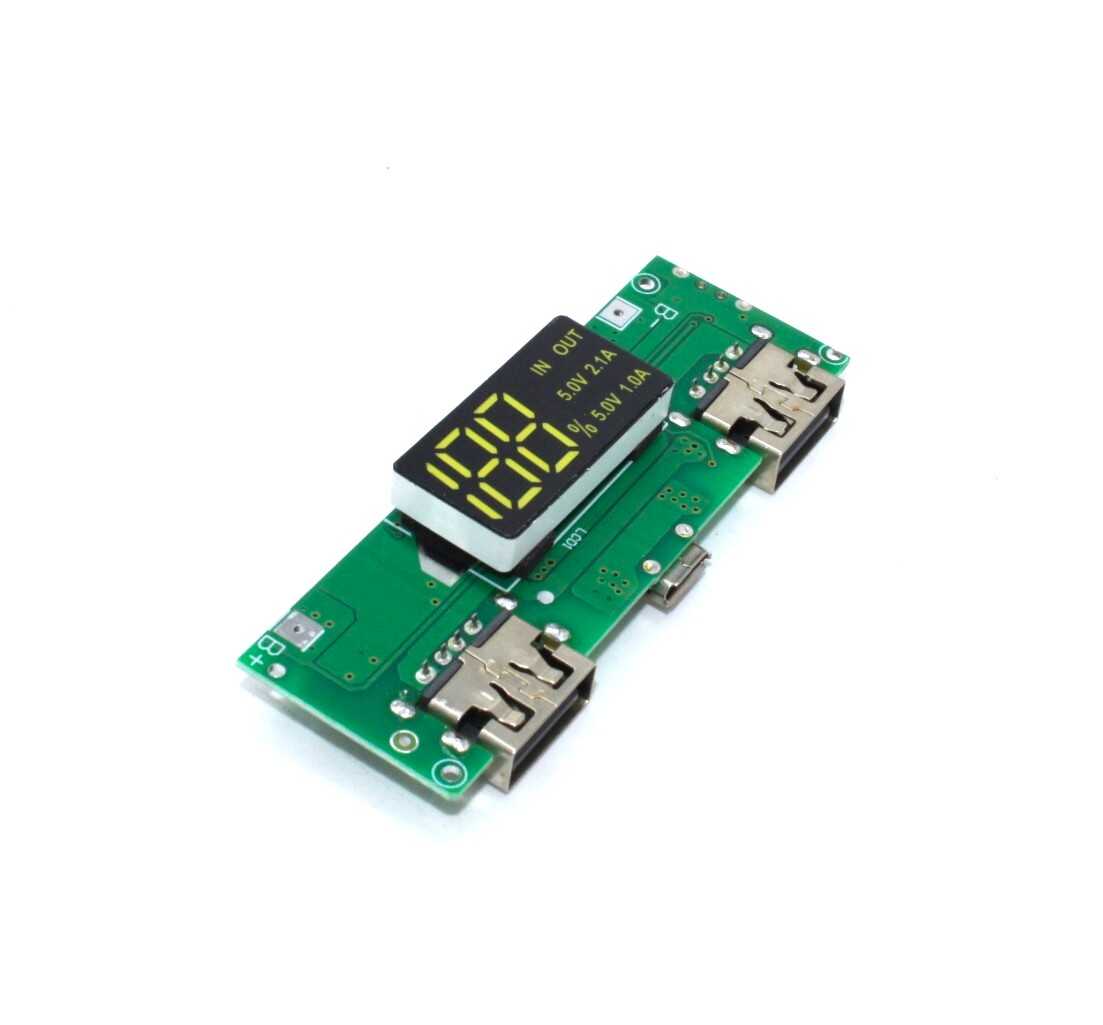
18650 5V 1A/2A Lithium Battery Charging Module with Dual USB Output & Display
Build a compact solar-charged USB power bank with this dual-output 18650 charging module featuring a real-time display for voltage and capacity.
MPPT Charge Controllers Explained
MPPT (Maximum Power Point Tracking) controllers are fundamentally different in architecture. Rather than directly connecting the panel to the battery, an MPPT controller uses a DC-DC converter circuit to efficiently step down higher panel voltages to the battery charging voltage — similar in principle to how a switching buck converter works.
The “maximum power point” is the voltage at which a solar panel produces maximum power under given conditions of temperature and irradiance. An MPPT controller continuously sweeps the panel’s I-V curve and adjusts its operating point to always extract maximum available power. It then converts this power at high efficiency (typically 93–98%) down to the battery voltage.
This means you can use a 36V panel with a 12V battery system, or connect two 12V panels in series to a 12V battery — the MPPT controller handles the conversion. The practical benefit: you can run longer panel strings with thinner (cheaper) wire, reducing installation costs.
Advantages of MPPT:
- 10–30% more energy harvest from the same panels compared to PWM
- Performance advantage is largest in cold temperatures, partial shade, and early morning/late evening (when panel voltage is high but not at rated current)
- Accepts panels with higher voltage than battery — enables flexible system design
- Multiple panels can be wired in series for lower wiring losses
- Advanced models support 24V, 48V battery systems from a single controller
Disadvantages of MPPT:
- Higher cost — quality MPPT controllers start from ₹1,500–3,000 and can reach ₹15,000+ for large systems
- More complex electronics — more components that could fail
- Overkill for very small systems (under 200W) where cost savings don’t justify the premium
PWM vs MPPT: Detailed Comparison
| Parameter | PWM | MPPT |
|---|---|---|
| Efficiency | 70–80% | 93–98% |
| Cost (India) | ₹300–1,500 | ₹1,500–15,000+ |
| Panel Voltage Match | Must match battery voltage | Flexible (higher V panels OK) |
| Best System Size | <200W (small) | 200W–10kW+ |
| Cold Weather Gain | None | Up to 25% more |
| Reliability | Very high (simple design) | High (quality models) |
| Wiring Cost | Higher (parallel wiring needed) | Lower (series panels, thinner wire) |
| Payback Period | Immediate (low upfront) | 1–3 years via energy savings |
Efficiency in Indian Conditions
India’s climate adds some interesting nuances to the PWM vs MPPT debate:
High Temperature Impact
Solar panels lose efficiency as temperature rises — typically 0.4–0.5% per degree Celsius above 25°C. On a 45°C summer day in Rajasthan or Telangana, your panel operates 20°C above the rating temperature, reducing output by 8–10%. MPPT controllers partially compensate by tracking the shifted maximum power point, while PWM simply accepts the degraded output passively.
Morning and Evening Harvest
During the first and last hours of sunlight, panel voltage is near open-circuit voltage while current is low. MPPT controllers excel in these conditions — they can harvest significant energy during these “shoulder” hours that PWM controllers largely miss due to the direct panel-to-battery connection. In tropical India with year-round solar availability, this adds up to meaningful extra energy daily.
Monsoon and Cloudy Days
During monsoon season across much of India (June–September), diffuse light conditions are common. Under cloud cover, panel voltage remains relatively high while current drops. MPPT controllers again outperform PWM in these conditions, maintaining better tracking of available power.
Rooftop Heat
Many Indian solar installations have panels mounted directly on hot concrete rooftops. Panels can reach 70–75°C in peak summer. The resulting low Vmp means the MPPT advantage is reduced somewhat (less margin between Vmp and battery voltage), but MPPT still outperforms PWM overall.

1S 18650 Li-Ion Lithium Battery BMS Charger Protection Board for 3.7V Battery
Essential protection board for single-cell Li-Ion storage in solar DIY projects. Prevents overcharge, over-discharge, and short circuits.
Which Controller Should You Choose?
Choose PWM if:
- Your system is under 200W and uses a single 12V or 24V panel matched to the battery
- Budget is the primary concern and maximum efficiency is not critical
- You are building a simple, low-maintenance solar lighting or water pump system in a rural area
- You already have 12V-rated panels and a 12V battery bank
- The installation environment is very hot and dusty (PWM’s simpler design is more robust)
Choose MPPT if:
- Your system is 300W or larger
- You are using modern 36V or 60V-cell panels (most new 72-cell panels are NOT compatible with PWM on 12V systems)
- You want to expand your system in the future by adding panels in series
- You are in North India where winter mornings are cold (MPPT gains are largest)
- You have a LiFePO4 battery bank (requires precise charging profiles that quality MPPT controllers provide)
- Long-term ROI and maximum energy harvest matter more than upfront cost
How to Size Your Solar Charge Controller
Sizing a charge controller correctly is critical for both safety and performance.
Step 1: Calculate Panel Current
Divide total panel wattage by battery voltage. Example: 400W of panels ÷ 24V battery = 16.67A. Add a 25% safety margin: 16.67 × 1.25 = 20.8A. Choose a 30A controller minimum.
Step 2: Check Input Voltage (for MPPT)
If wiring two 12V panels in series, open-circuit voltage (Voc) of each panel might be 21V, so series Voc = 42V. Ensure the MPPT controller’s maximum input voltage (typically 50V, 100V, or 150V) exceeds this safely. Cold weather raises Voc, so check specifications at low temperatures.
Step 3: Match Battery Chemistry
Ensure the controller supports your battery chemistry. Lead-acid, GEL, AGM, and LiFePO4 all require different voltage profiles. Many modern controllers allow custom charging profiles via Bluetooth or physical DIP switches.

ISDT A4 Air Smart Charger – Li-Ion, LiFePO4, NiMH with Bluetooth Monitoring
Smart multi-chemistry charger with Bluetooth app monitoring. Ideal for maintaining and conditioning the battery banks in your solar setup.
Frequently Asked Questions
Can I use an MPPT controller with my old 12V solar panel?
Yes. An MPPT controller works with 12V-rated panels (Voc typically 21–22V). You will get some benefit, but the maximum gain comes when using higher-voltage panels (36V+ Voc) that are above the battery voltage. For a single 12V panel on a 12V battery, the efficiency difference over PWM is smaller but still present.
How much more power does MPPT produce compared to PWM in India?
Under Indian summer conditions (high temperature, moderate irradiance), expect 10–15% more energy harvest from MPPT. In winter mornings in North India (low temperature, high insolation), MPPT can yield 20–30% more. Over a full year, a 15–20% average improvement is realistic for well-designed systems.
What is the best brand for solar charge controllers in India?
Popular and reliable brands available in India include Victron Energy (premium, excellent reliability), EPever/Tracer (good mid-range MPPT), Renogy (widely available), and Luminous (local brand, wide service network). For DIY and small systems, EPever 10A–40A MPPT controllers offer excellent value.
Can I use an MPPT controller without a battery?
Most traditional charge controllers require a battery in the circuit to operate. However, some advanced MPPT controllers and grid-tie inverters can operate in battery-less mode. For standard off-grid DIY setups in India, always use a battery bank.
What happens if I oversize the solar panel array on a PWM controller?
With PWM, excess panel capacity is simply wasted — the controller throttles down charging. With MPPT, over-paneling is often intentional (“clipping”) to improve performance during early morning, evening, and cloudy conditions, maximising annual energy harvest without oversizing the inverter or controller.
Conclusion: Make Your Solar Investment Work Harder
For most Indian solar projects above 200W, MPPT controllers deliver better returns despite higher upfront costs. The combination of better efficiency, flexible panel wiring, and support for modern high-voltage panels makes MPPT the forward-looking choice. For small, simple, budget-constrained setups under 200W with matched voltage panels, PWM remains a practical and reliable option.
Whatever you choose, pair your controller with quality batteries and proper protection circuitry. A well-designed solar system can deliver clean, free power for decades — particularly valuable in India’s energy landscape.
Upgrade your solar setup today. Explore batteries, charging modules, and power components at Zbotic — delivered across India.







Add comment