
When a robot arm lifts a payload, a mobile robot climbs a ramp, or an automated door opens smoothly and quietly, there is almost always a planetary gear motor at work. This elegant combination of a DC motor and a planetary gearbox is one of the most important building blocks in modern robotics and automation. In this guide, we cover everything from the physics of how planetary gears produce torque to the practical decisions you need to make when selecting one for your project.
What Is a Planetary Gear Motor?
A planetary gear motor is an integrated unit that combines an electric motor — usually a brushed or brushless DC motor — with a planetary gearbox mounted on its output shaft. The gearbox reduces the motor’s high rotational speed to a lower, more usable speed while multiplying torque proportionally. A motor spinning at 10,000 RPM with a 100:1 gearbox delivers 100 RPM at the output shaft, with approximately 100 times the torque (minus friction losses, typically 85–95% efficiency).
The planetary arrangement specifically refers to the internal gear geometry: a central sun gear, multiple planet gears that orbit it, and a fixed outer ring gear (also called the annulus). This three-element structure is what gives planetary gearboxes their remarkable properties of compactness, load sharing, and efficiency.
How Planetary Gears Work
To understand why planetary gears are so special, visualize the arrangement from the front:
- The sun gear sits at the centre and is driven directly by the motor shaft.
- Three or four planet gears mesh with the sun gear and also mesh with the inner teeth of the ring gear. They are held in position by a planet carrier.
- The ring gear is fixed (it does not rotate) inside the gearbox housing.
- As the sun gear rotates, the planet gears are forced to roll around the inside of the ring gear, causing the planet carrier to rotate.
- The output shaft is attached to the planet carrier, so it rotates at a reduced speed.
The gear ratio of a single planetary stage is determined by the formula: Ratio = 1 + (Ring Teeth / Sun Teeth). For example, if the ring has 72 teeth and the sun has 24 teeth, the ratio is 1 + (72/24) = 4:1. Multi-stage gearboxes stack multiple planetary stages to achieve higher ratios: two 4:1 stages give 16:1, three stages give 64:1, and so on.
A critical feature is load sharing: because three or four planet gears carry the torque simultaneously, each individual gear tooth bears only a fraction of the total load. This is why planetary gearboxes can transmit much higher torque than a simple spur gearbox of the same size.
Why Planetary Over Spur Gears?
Spur gear motors (like the common yellow TT motor in hobby robots) are simple and cheap, but they have fundamental limitations compared to planetary designs:
| Property | Spur Gear Motor | Planetary Gear Motor |
|---|---|---|
| Torque density | Low | High |
| Efficiency | 85–90% | 88–95% |
| Backlash | Higher | Lower (precision versions) |
| Noise | Higher | Lower |
| Axial length | Longer for same ratio | Compact |
| Coaxial input/output | No (offset shafts) | Yes |
| Cost | Very low | Moderate |
The coaxial design is particularly valuable in robotics: the input and output shafts share the same axis, simplifying mechanical integration into robot joints, wheels, and actuators without needing offset gearing or belt drives.
Key Specifications Explained
When reading a planetary gear motor datasheet, you will encounter these key parameters:
- No-load speed (RPM): Output shaft speed with no mechanical load. Real operating speed under load will be lower.
- Rated torque (kg-cm or N-m): The torque the motor can sustain continuously without overheating. Brief peaks can exceed this.
- Stall torque: Maximum torque at zero speed — the rotor is stopped and the motor is pulling maximum current. Operating at stall continuously will burn the motor.
- Rated voltage: The design operating voltage. Running at higher voltage increases speed and torque temporarily but shortens motor life.
- No-load current: Current draw when running free. Useful for calculating battery life.
- Stall current: Maximum current draw. Your motor driver must handle this without latching off.
- Gear ratio: Input speed / output speed. A 100:1 motor at 10,000 RPM free-spin gives 100 RPM output.
- Gearbox efficiency: Typically 85–95%. Actual output torque = (motor torque × gear ratio × efficiency).
Gear Ratio and Torque Calculation
Selecting the right gear ratio requires knowing the load you need to move. Here is a practical example for a wheeled robot:
Scenario: 2 kg robot, 6 cm diameter wheels, target speed 0.5 m/s on flat ground, 15° incline capability.
- Wheel circumference = π × 0.06 = 0.188 m. At 0.5 m/s, wheel speed = 0.5 / 0.188 = 2.66 rev/s = 159 RPM.
- Force on incline = 2 kg × 9.81 m/s² × sin(15°) = 5.08 N. Wheel torque = 5.08 × 0.03 m = 0.152 N-m = 15.5 kg-cm per wheel (with 2 wheels: 7.75 kg-cm each).
- Add 50% safety margin: target torque = ~12 kg-cm per motor.
- If the DC motor produces 0.1 kg-cm, required ratio = 12 / 0.1 = 120:1.
This calculation guides you toward a 100:1 or 150:1 planetary gear motor rated at 12+ kg-cm output torque. Always verify the motor’s rated torque against your worst-case scenario, and choose a motor driver that handles the stall current comfortably.
Robotics Applications
Planetary gear motors appear in virtually every category of robot. Here are the most common use cases:
Mobile Robot Drive Wheels
Differential-drive robots and omnidirectional platforms need motors that produce enough torque to move the robot’s mass while maintaining precise speed control for straight-line tracking. Planetary gear motors with quadrature encoders are the standard choice because the encoder attached to the high-speed motor shaft (before gearing) provides higher resolution than one on the slow output shaft. A typical setup uses two 12 V, 100 RPM planetary gear motors on a 1 kg robot.
Robot Arm Joints
Each joint of a robot arm must hold a position against gravity and dynamic loads. The gear ratio must be high enough that the back-driven torque from gravity cannot turn the joint when power is off (self-locking), or at least that the holding torque matches the load. Planetary gearboxes with ratios of 50:1 to 300:1 are common in arm joints from miniature desktop arms to 6-axis industrial manipulators.
Pan-Tilt Camera Systems
Surveillance cameras, telescope mounts, and drone gimbals use planetary gear motors for slow, smooth pan and tilt motion. Low backlash is critical here — any slop in the gears shows up as image jitter. Precision planetary gearboxes with anti-backlash stages (or zero-backlash strain-wave gearing) are used in high-end gimbal systems.
Conveyors and Linear Actuators
Many linear actuators use a planetary gear motor driving a lead screw or rack-and-pinion. The motor’s rotational output is converted to linear force. The gear ratio determines the balance between speed and force, same as in rotary applications.
Industrial Automation Uses
Outside of robotics, planetary gear motors are ubiquitous in automation. Conveyor belt drives, packaging machines, gate openers, agricultural equipment, and electric vehicle axle drives all rely on planetary gearboxes. The key advantages — compact size, high efficiency, and coaxial geometry — make them the preferred solution when spur or worm gearboxes cannot meet torque density requirements.
In industrial settings, planetary gearboxes are rated by their input power, maximum output torque, and radial and axial load capacity on the output shaft bearing. Overloading the output shaft bearing (by mounting a heavy wheel directly on an undersized bearing) is the most common cause of premature failure in DIY planetary gear motor applications.
Choosing the Right Planetary Gear Motor
Follow this decision checklist when selecting a planetary gear motor:
- Calculate required output torque under your worst-case load condition (incline, maximum payload, starting from rest).
- Calculate required output speed for your target performance (linear speed, arm movement rate).
- Determine operating voltage from your power supply (5 V, 6 V, 12 V, 24 V).
- Check gear ratio needed: ratio = motor free-spin RPM / required output RPM.
- Verify stall current against your motor driver capability.
- Decide on encoder: do you need closed-loop position or speed control? If yes, choose a variant with a quadrature encoder on the motor shaft.
- Check output shaft diameter and shaft type (D-shaft, round, keyed) for compatibility with your mechanical design.
- Size matters: Common planetary gear motor body diameters include 16 mm, 20 mm, 25 mm, 37 mm, and 50+ mm. Choose the smallest that meets torque requirements to save space and weight.
Encoders and Position Feedback
A planetary gear motor with an encoder becomes a powerful closed-loop actuator. The encoder is almost always mounted on the motor shaft (before the gearbox) because the higher shaft speed gives better encoder resolution after gearing. For example, a 500 CPR encoder on a 100:1 gearbox provides 50,000 effective counts per output revolution — more than enough for smooth, precise position control.
Common encoder types for gear motors include:
- Magnetic encoders: Compact, robust, no optical path to contaminate. Most DC gear motors under 50 mm diameter use these.
- Optical encoders: Higher resolution potential, but sensitive to dust and oil.
- Hall effect sensors: Two or three hall sensors provide commutation feedback for brushless motors and basic speed feedback for brushed motors. Lower resolution but very robust.
For a PID position controller on an Arduino or Raspberry Pi, a 12–48 CPR magnetic encoder on a 50:1 gearbox gives 600–2400 effective counts per output revolution — adequate for smooth servo-like motion with a good control loop.
Product Recommendations
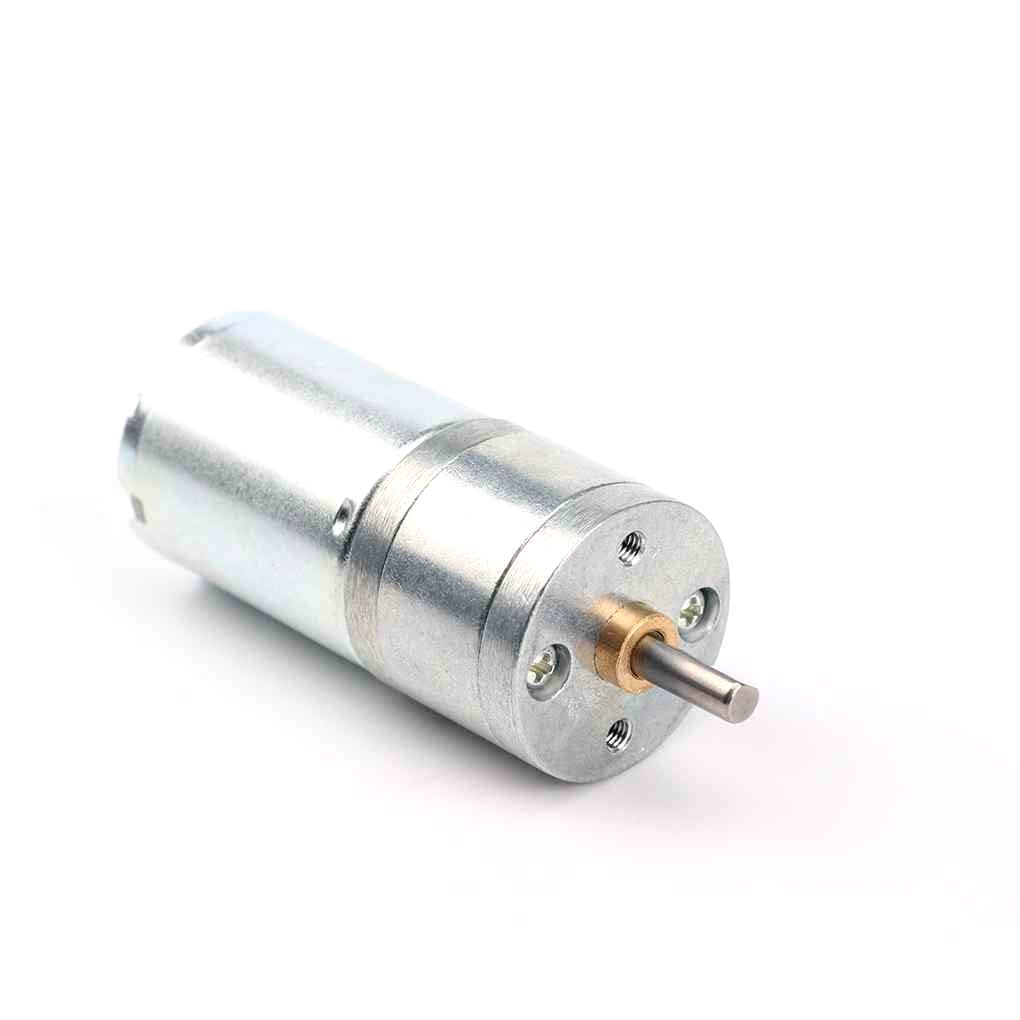
25GA-370 12V 12RPM DC Reducer Gear Motor
A compact 25 mm body gear motor delivering 12 RPM at 12 V — ideal for slow, high-torque robot applications like arm joints and camera pan mechanisms. The GA-370 motor series is widely used in DIY robotics across India.
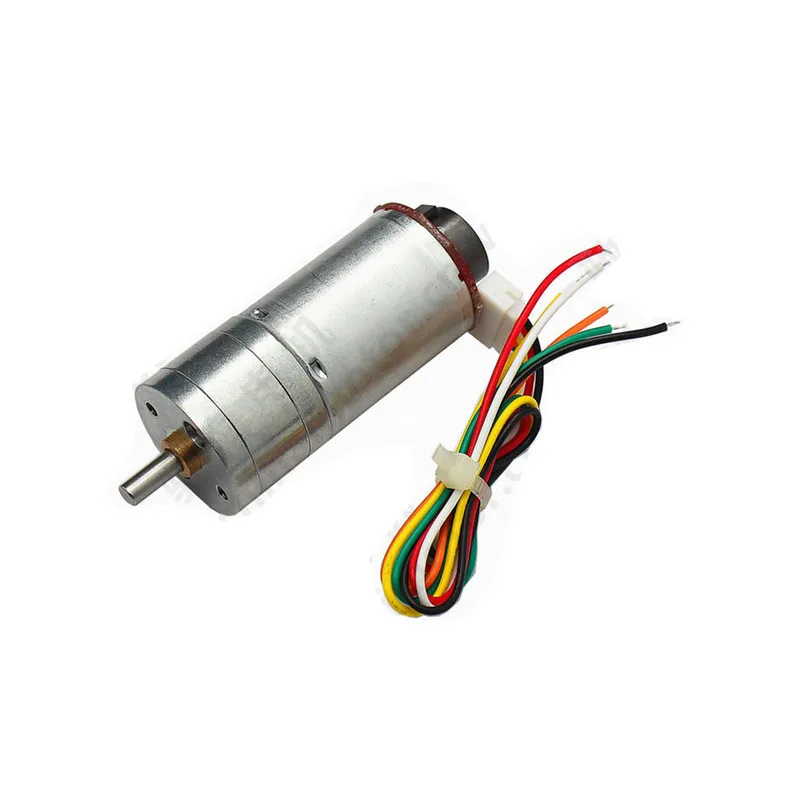
25GA-370 12V 12RPM DC Reducer Gear Motor with Encoder
The same proven 25GA-370 motor but with a quadrature encoder for closed-loop PID control. Essential for any robot that needs precise speed regulation or position tracking.
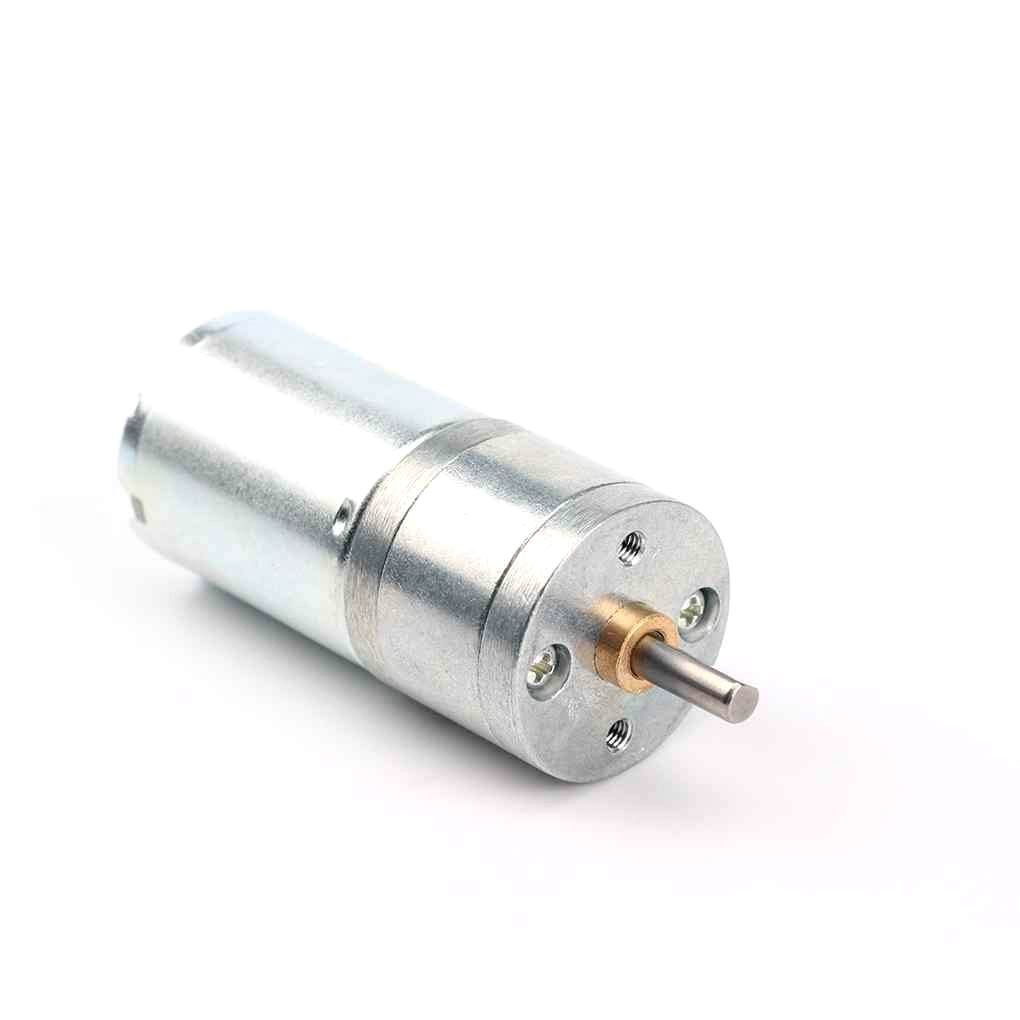
25GA-370 12V 1360RPM DC Reducer Gear Motor
A higher-speed variant of the GA-370 series for applications needing faster wheel rotation — perfect for line-following robots, conveyor models, and fast mobile platforms.
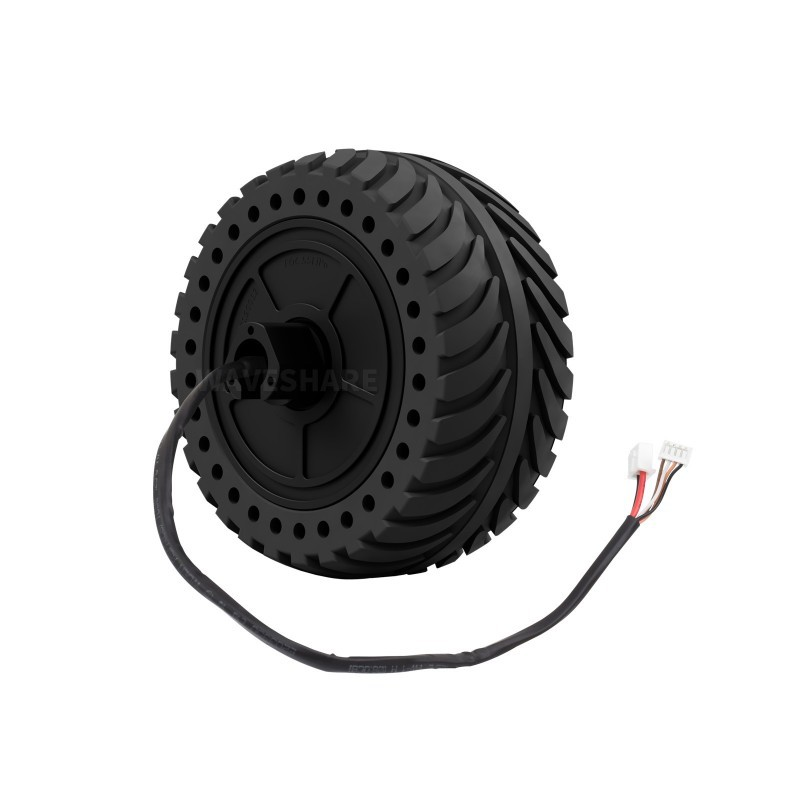
Waveshare DDSM115 Direct Drive Servo Motor — Hub Motor
A premium direct-drive hub motor for advanced UGV and robotics platforms. Low noise, high torque, and integrated servo control make it ideal when planetary gearing reaches its limits.
Frequently Asked Questions
What is the difference between a planetary gear motor and a worm gear motor?
A worm gear motor uses a worm screw meshing with a worm wheel — it provides very high gear ratios in a compact package and is naturally self-locking (the load cannot back-drive the motor). However, efficiency is low (30–60%). A planetary gear motor is more efficient (88–95%) but requires active braking or a high gear ratio for self-locking. Choose worm gears when self-locking is mandatory and efficiency is secondary; choose planetary when efficiency, torque density, and speed matter more.
Can I run a planetary gear motor with an Arduino?
Not directly — the Arduino’s GPIO pins can only source 40 mA, far below what a gear motor needs. You need a motor driver such as the L298N, L9110S, or BTS7960 between the Arduino and the motor. The Arduino controls the driver with PWM signals; the driver handles motor current from your power supply.
How do I reverse a planetary gear motor?
Swap the polarity of the supply voltage on the motor terminals (M+ and M-). In practice, your motor driver does this automatically when you set direction. The planetary gearbox itself works identically in both directions.
What gear ratio should I use for a robot arm?
This depends on the load and the motor’s torque. For a lightweight desktop arm lifting up to 500 g at 30 cm reach, torque = 0.5 × 9.81 × 0.3 = 1.47 N-m = 150 kg-cm at the base joint. A typical 12 V DC motor produces 0.1–0.5 kg-cm, so you need a 300:1 to 1500:1 reduction. Multi-stage planetary gearboxes or a planetary stage driving a worm stage are common solutions for arm joints.
Why does my planetary gear motor make a whining noise?
A constant whine at a frequency proportional to motor speed is normal gear meshing noise. If the whine changes character or becomes grinding, check for: inadequate lubrication (gearbox grease dried out), bearing wear, or an oversized load causing gear tooth stress. Most sealed planetary gear motors are pre-lubricated for life and should run quietly for thousands of hours under rated load.
Zbotic stocks DC gear motors, encoders, servo motors, and motor drivers — all the components you need for a complete drive system. Shop online with fast delivery anywhere in India.






Add comment