
Open Collector Output: What It Is and How to Use It
If you have ever looked at a datasheet and seen the notation "open collector output" and wondered what it means — or struggled with pull-up resistors, wired-AND connections, or driving different voltage peripherals from a microcontroller — this guide is for you. The open collector output is one of the most practical and versatile output types in digital electronics, used everywhere from I2C buses to relay drivers. Understanding it deeply will make you a significantly better circuit designer.
What Is an Open Collector Output?
In a standard digital output, the output pin is actively driven HIGH or LOW by the circuit inside the IC. An open collector output works differently: the output stage consists of only a single NPN transistor whose collector is left unconnected (open) inside the IC package. The emitter is tied to ground.
The circuit behaves like this:
- When the output is "asserted" (logic LOW): The transistor is turned on. The collector (output pin) is pulled to ground through the transistor’s collector-emitter channel. Current flows from the external circuit, through the pull-up resistor, into the output pin, and to ground.
- When the output is "de-asserted" (logic HIGH): The transistor is turned off. The collector is disconnected from ground. The output pin floats high — but only if an external pull-up resistor connects the pin to the supply voltage.
The key insight: an open collector output can only actively pull the line LOW. It cannot actively drive the line HIGH. The line goes high passively through the external pull-up resistor when the transistor is off.
This is why the pull-up resistor is not optional with an open collector output — without it, the "high" state is floating (undefined), and your circuit will behave erratically or not at all.
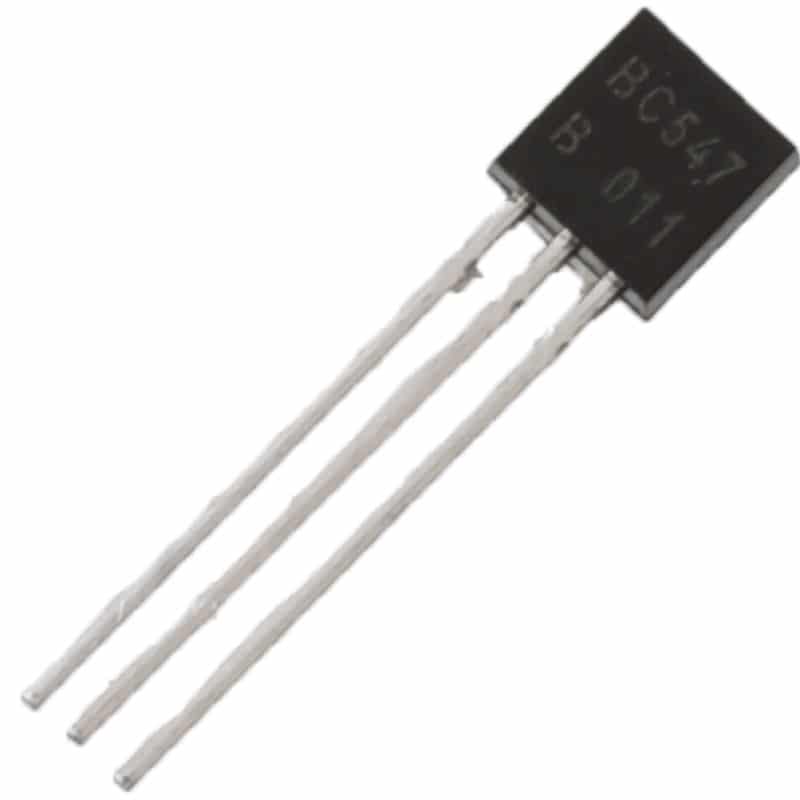
BC547 NPN 100mA Transistor TO-92 (Pack of 10)
The BC547 NPN transistor is the discrete component version of an open collector output. Understanding how the BC547 works in switching mode (saturated on, or cut-off) gives you a direct model of what happens inside an open collector IC.
Totem-Pole vs Open Collector
To appreciate open collector outputs, you need to contrast them with the standard totem-pole output used in most TTL and CMOS logic gates.
Totem-Pole Output (standard push-pull):
- Has two active transistors: one that pulls the output HIGH (source current), one that pulls it LOW (sink current).
- Both pull up and pull down are active — fast transitions in both directions.
- Cannot be wire-connected: if two totem-pole outputs are connected together and one drives HIGH while the other drives LOW, you get a low-impedance short circuit — possible IC damage and definitely incorrect logic.
- Cannot easily drive a different voltage: the high level is determined by the IC’s own supply.
Open Collector Output:
- Only actively pulls LOW. HIGH is passive (through pull-up resistor).
- Multiple open collector outputs can be safely wired together — when any one pulls LOW, the line goes LOW.
- The pull-up resistor can connect to a different supply voltage, enabling voltage level shifting.
- Slower than totem-pole for the rising edge (limited by R × C time constant of pull-up resistor and line capacitance).
The open drain equivalent in MOSFET technology works the same way — the drain is left open (unconnected to the drain supply rail inside the IC). MOSFET-based logic like CMOS uses "open drain" for the same function. I2C, for example, uses open-drain outputs — but the terminology and principle are identical to open collector.
The Pull-Up Resistor: Calculation and Selection
Choosing the right pull-up resistor value is a trade-off between speed and power consumption:
- Smaller resistor value: More current flows, faster rise time (lower R × C), but more static power dissipated when the line is pulled low.
- Larger resistor value: Less current, lower power, but slower rise time — may not meet timing requirements at high frequencies.
The rise time of an open collector line is governed by:
τ = R_pullup × C_line
tRise (10%→90%) ≈ 2.2 × τ
Example calculation for I2C:
I2C at 100 kHz standard mode, bus capacitance = 100 pF (typical for a short PCB trace with a few devices).
- Rise time requirement: less than 1 µs (tRise max for standard mode = 1 µs)
- R_max = tRise / (2.2 × C) = 1µs / (2.2 × 100pF) = 4.5 kΩ
- R_min: limited by sink current — most I2C devices can sink 3 mA. With 3.3V supply: R_min = 3.3V / 3mA = 1.1 kΩ
- Practical choice: 4.7 kΩ for standard-mode I2C at 3.3V. (For 400 kHz fast mode, use 2.2 kΩ or lower.)
For general-purpose open collector outputs where speed is not critical (relay control, interrupt lines, etc.), values between 4.7 kΩ and 10 kΩ are standard. Use 1 kΩ when you need faster transitions or are driving an LED through the pull-up (though a dedicated current-limiting resistor is better for LEDs).
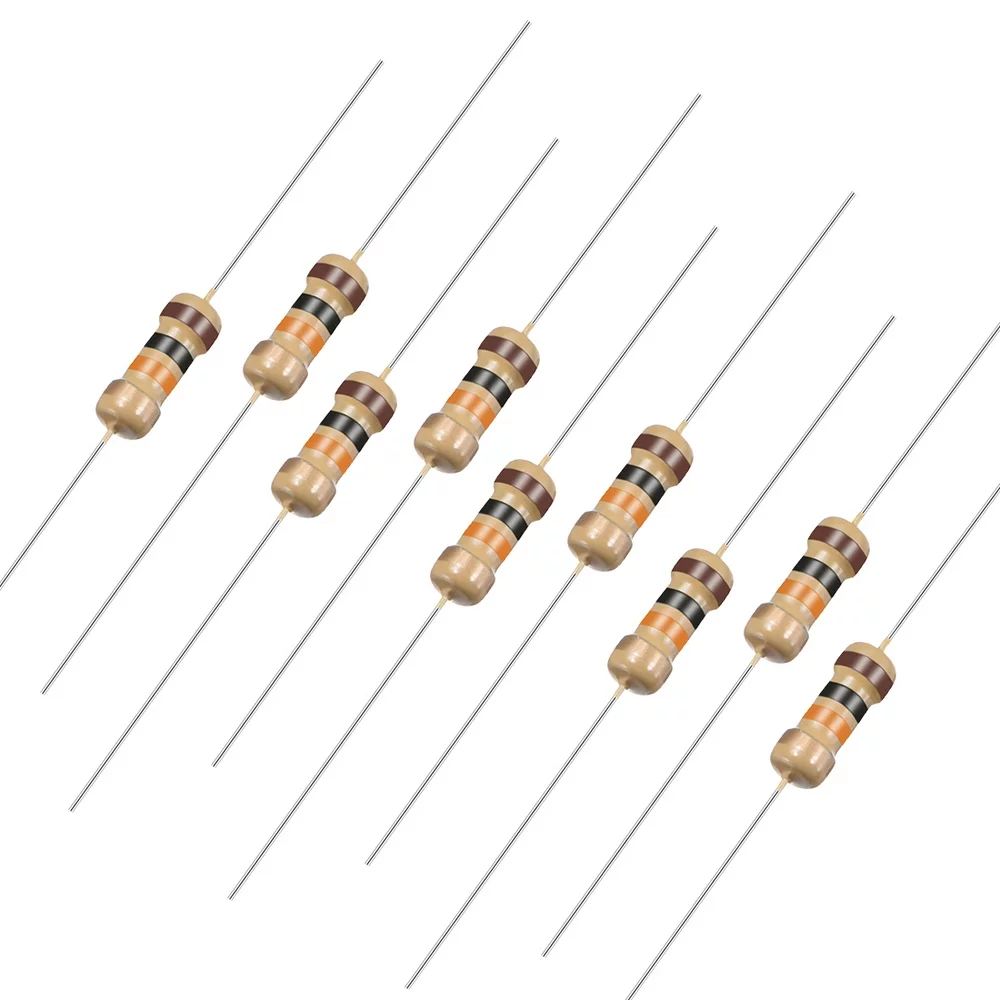
10 Ohm 0.25W Carbon Film Resistor (Pack of 50)
Stock up on carbon film resistors for pull-up applications in open collector circuits. For I2C and open collector designs you will go through many resistors — having a pack handy is essential for any electronics lab.
Wired-AND: Multiple Outputs on One Line
One of the most powerful features of open collector outputs is the ability to connect multiple outputs together on a single wire — a configuration called wired-AND (or in some contexts, wired-OR, depending on polarity convention).
Here is how it works:
- All output pins are connected together to a single node.
- A single pull-up resistor connects this node to the supply.
- If ANY output transistor is turned on (pulling LOW), the entire bus is pulled LOW.
- Only when ALL output transistors are turned off (HIGH) does the bus float HIGH through the pull-up.
This is an AND function: Line = HIGH only when Output1 = HIGH AND Output2 = HIGH AND Output3 = HIGH. In terms of active-low signals: the bus asserts (goes LOW) when any device wants to assert. This is exactly how I2C arbitration works — multiple masters can drive the SDA line, and whichever one pulls low first wins.
Common uses of wired-AND:
- I2C and SMBus communication (open-drain standard)
- Interrupt lines from multiple peripherals to a single microcontroller pin (active-low interrupt — any device can assert)
- Early computer address decoding (multiple decoders with open-collector NAND gates)
- Fan-out signal distribution where multiple controllers share control of one line
Warning: You cannot do wired-AND with standard push-pull (totem-pole) outputs. Connecting two push-pull outputs together where one drives HIGH and the other drives LOW creates a short circuit between the supply and ground — potentially damaging both ICs. Open collector is the solution that allows safe bus sharing.
Level Shifting with Open Collector
Open collector outputs provide an elegant solution for interfacing circuits running at different voltages — one of the most common challenges in modern maker projects where 3.3V microcontrollers (ESP32, STM32, Arduino Due) must talk to 5V peripherals.
The trick: the pull-up resistor can connect to any supply voltage, not necessarily the same supply as the driving IC. As long as the pull-up voltage does not exceed the maximum rated voltage for the open-collector transistor, you can use the pull-up to define a different high-level voltage.
Example: 3.3V MCU driving a 5V open collector input
- Connect open collector output to a 5V pull-up resistor (e.g., 4.7 kΩ to 5V)
- MCU pulls the line LOW → output = 0V (LOW, logic 0 in both 3.3V and 5V domains)
- MCU releases → line rises to 5V through pull-up → output = 5V (HIGH in 5V domain)
- Result: 3.3V logic drives a signal that swings to 5V — perfect level shift
This is how the widely-used BSS138-based bidirectional level shifter modules work — they use the BSS138 N-channel MOSFET as an open-drain switch with pull-ups on both the 3.3V and 5V sides, enabling bidirectional level conversion on I2C and other open-drain buses.
I2C Bus: Why It Uses Open Drain
I2C (Inter-Integrated Circuit), invented by Philips, uses open-drain outputs on both SDA (data) and SCL (clock) lines — and this is not an accident. It is central to how the protocol works.
Reasons I2C uses open drain:
- Multiple masters: Multiple I2C master devices can share the same bus. If two masters try to transmit simultaneously, the first to see a LOW when it drove HIGH detects the conflict (arbitration lost) and backs off.
- Clock stretching: Slave devices can hold SCL LOW to tell the master "wait, I’m not ready yet." A push-pull master driving SCL HIGH would fight the slave pulling it LOW — with open drain, the slave safely wins (the line stays LOW).
- Voltage compatibility: Different devices on the bus can operate at different internal voltages as long as their open-drain outputs are all connected to common pull-ups at the bus voltage.
Standard I2C pull-up values by mode and bus capacitance (3.3V bus):
- Standard mode (100 kHz), <200 pF: 4.7 kΩ
- Fast mode (400 kHz), <200 pF: 2.2 kΩ
- Fast mode (400 kHz), <400 pF: 1.5 kΩ
- Fast-Plus mode (1 MHz): 1 kΩ or lower
1.3 Inch I2C/IIC 128×64 WHITE OLED Display Module 4pin
This OLED module uses the I2C (open-drain) bus — a perfect real-world example of open collector outputs in action. The SDA and SCL lines both use open-drain, with pull-up resistors required for proper operation.
Practical Applications and Real Examples
1. Interrupt Sharing
Many embedded systems have multiple sensor ICs that need to signal interrupts to a microcontroller. If each IC has an open-drain active-low interrupt output, connect all interrupt pins together with a single 10 kΩ pull-up to VCC, then to one MCU interrupt pin. Any device pulling the line LOW triggers the interrupt. The MCU then polls each device to find out which one generated it.
2. LED Driving
Open collector outputs are ideal for driving LEDs. Connect the anode through a current-limiting resistor to VCC, and the cathode to the open collector pin. When the transistor turns on, current flows through the LED to ground — it lights up. This "active-low" LED drive is common and reliable.
R_LED = (VCC - V_LED - V_CE_sat) / I_LED
      = (5V - 2V - 0.3V) / 20mA
      = 135Ω → use 150Ω standard value
3. Relay and Transistor Driving
Open collector outputs are frequently used to drive relay coils via a transistor buffer, or directly if the output transistor can handle the relay coil current. The open collector transistor switches ground to the coil, with the other end of the coil connected to VCC through a freewheeling diode.
4. Multiple Logic Inputs Combined
In older TTL designs, open collector NAND gates (e.g., 7401, 7403) were used to create wired-AND logic without additional gate ICs. Several outputs were tied together with a pull-up to implement complex logic functions economically.

10CM Male To Female Breadboard Jumper Wires 2.54MM – 40Pcs
Essential for prototyping open collector and I2C circuits on a breadboard. Male-to-female wires let you connect modules directly to your breadboard for quick experimentation.
Frequently Asked Questions
What happens if I forget the pull-up resistor on an open collector output?
Without a pull-up resistor, the output line has no path to a defined high voltage when the transistor is off. The line floats — it picks up stray capacitance and noise from nearby signals. The input reading will be undefined (could be high or low depending on the board layout and nearby signals). Your circuit will behave erratically. Always add a pull-up resistor to any open collector or open drain output.
Can I connect an open collector output directly to a CMOS input without a pull-up?
No. CMOS inputs have extremely high impedance — they draw negligible current. Without a pull-up, the line floats when the transistor is off, and a floating CMOS input is undefined. The pull-up is mandatory. For I2C OLED modules and sensor breakout boards, the pull-up resistors are often already included on the module PCB — check the schematic before adding external ones, or you will have resistors in parallel (too low a total resistance).
What is the difference between open collector and open drain?
Functionally identical. "Open collector" refers to BJT (bipolar transistor) output stages — the collector terminal is left unconnected internally. "Open drain" refers to MOSFET output stages — the drain terminal is left unconnected. Modern CMOS ICs always use open-drain terminology, while older TTL ICs use open-collector. The circuit behaviour, pull-up requirements, and wired-AND properties are the same.
How much current can a typical open collector output sink?
Standard TTL open-collector (74LS series): 8 mA to 40 mA depending on the part. High-current open-collector drivers (like ULN2003): 500 mA per channel. Microcontroller open-drain GPIO: typically 4–25 mA (check your datasheet — ESP32 GPIO is 40 mA max, Arduino Uno is 40 mA per pin). For driving relays or high-current loads, always use a dedicated driver IC rather than relying on a logic gate’s open-collector output.
Why is the wired-AND also called wired-OR?
The name depends on the polarity convention. If you think of the active state as HIGH (positive logic): multiple open-collector outputs sharing a pull-up → the line goes LOW when ANY output asserts → this is a wired-OR of the LOW signals. If you think in active-low signals: the effective function at the positive-logic level is AND (the result is HIGH only when all outputs are HIGH). Both names describe the same circuit — the confusion is just a positive/negative logic perspective difference.
Build Your Next Digital Logic Project with Zbotic
Get transistors, resistors, capacitors, and display modules delivered fast across India. Zbotic has everything you need for open collector circuits, I2C projects, and all your electronics experiments — at prices that make sense for Indian makers and students.






Add comment