
If you have spent any time building robots, drones, wearables, or motion-sensing projects with Arduino, you have almost certainly encountered the MPU6050 — the workhorse 6-DOF inertial measurement unit that dominated the maker world for years. Its successor, the MPU9250, adds a 3-axis magnetometer to deliver a full 9 degrees of freedom, enabling true compass heading and absolute orientation. But is the MPU9250 always the better choice? Understanding the real differences in hardware, software support, calibration complexity, and power consumption will help you pick the right IMU for every project. This guide gives you a thorough technical comparison with working Arduino code for both.
1. Specs Comparison: MPU6050 vs MPU9250
| Specification | MPU6050 | MPU9250 |
|---|---|---|
| Gyroscope axes | 3-axis | 3-axis |
| Accelerometer axes | 3-axis | 3-axis |
| Magnetometer | No (external only via I2C passthrough) | Yes (AK8963, 3-axis) |
| Total DOF | 6-DOF | 9-DOF |
| Gyro full-scale range | ±250/500/1000/2000 °/s | ±250/500/1000/2000 °/s |
| Accel full-scale range | ±2/4/8/16 g | ±2/4/8/16 g |
| ADC resolution | 16-bit (accel + gyro) | 16-bit (accel + gyro), 16-bit (mag) |
| Gyro noise density | 0.005 °/s/√Hz | 0.01 °/s/√Hz |
| Accel noise density | 400 µg/√Hz | 300 µg/√Hz |
| Supply voltage | 2.375–3.46 V | 2.4–3.6 V |
| Gyro + accel current | 3.8 mA | 3.5 mA |
| Interface | I2C (up to 400 kHz) | I2C + SPI |
| DMP (motion processor) | Yes (quaternion output) | Yes |
| I2C addresses | 0x68 / 0x69 | 0x68 / 0x69 |
| Typical price (India) | ₹80–120 | ₹200–350 |
2. What Are Degrees of Freedom (DOF)?
In inertial navigation, Degrees of Freedom refers to the number of independent physical axes measured. Each axis of measurement provides data about a different aspect of motion or orientation:
- 3-DOF accelerometer: Measures linear acceleration (and gravity) along X, Y, Z. Gives tilt (roll and pitch) relative to gravity. Cannot measure yaw.
- 3-DOF gyroscope: Measures angular rate (rotational velocity) around X, Y, Z. Integrates to give orientation change. Drifts over time (gyro drift).
- 3-DOF magnetometer: Measures the Earth’s magnetic field vector. Provides absolute heading (yaw) relative to magnetic north. Affected by local magnetic interference.
A 6-DOF IMU (MPU6050) fuses accelerometer and gyroscope data to give orientation in pitch, roll, and relative yaw (yaw drifts slowly without a magnetometer reference). A 9-DOF IMU (MPU9250) adds the magnetometer, enabling absolute yaw (compass heading) and drift correction for long-duration navigation.
3. MPU6050 Deep Dive
The MPU6050 from TDK InvenSense (originally InvenSense) was released in 2011 and quickly became the go-to IMU for Arduino robotics projects, largely because of the MotionApps DMP (Digital Motion Processor) — a dedicated hardware block on the chip that computes quaternions without taxing the host MCU. Jeff Rowberg’s i2cdevlib MPU6050 library (one of the most starred Arduino libraries ever) wraps the DMP nicely for quaternion and Euler angle output.
Key strengths of the MPU6050:
- Massive community support and libraries — virtually every Arduino question has been answered.
- Built-in I2C master port to connect an external magnetometer (HMC5883L) and make it appear as a slave device, somewhat extending to 9-DOF.
- Lower noise gyroscope than the MPU9250 on paper (though in practice the difference is minimal).
- Very low cost — GY-521 modules sell for under ₹100.
- Only I2C (no SPI), which is fine for single-sensor setups.
Limitations:
- No built-in magnetometer means yaw drifts over time — typically 1–3°/minute.
- I2C only limits maximum data rate to ~400 Hz.
- Product is in mature/legacy status; MPU9250 is the current recommended successor.
4. MPU9250 Deep Dive
The MPU9250 packages the same gyroscope and accelerometer core as the MPU6050 (with modest noise improvements) alongside the AK8963 magnetometer from Asahi Kasei in a single 3×3×1 mm package. Crucially, it also adds SPI support for higher data rates.
Key strengths of the MPU9250:
- True 9-DOF with built-in magnetometer — enables absolute heading (yaw) without external sensor or I2C master passthrough complexity.
- SPI interface enables data rates exceeding 1 kHz — essential for high-speed drone flight controllers.
- Slightly better accelerometer noise density than MPU6050.
- Same pinout as MPU6050 GY-521 module family — many GY-91 breakout boards use the MPU9250.
Limitations:
- More complex to fully calibrate — the magnetometer requires its own 9-point hard-iron and soft-iron calibration.
- Some cloned MPU9250 modules ship with fake or inferior magnetometer ICs — always verify by reading the WIA register (should return 0x71 for AK8963).
- Library ecosystem, while good, has more fragmentation than MPU6050.
- TDK has discontinued the MPU9250 (legacy product); ICM-42688 or ICM-20948 are its successors.
5. The AK8963 Magnetometer in MPU9250
The AK8963 inside the MPU9250 is accessible in two ways: through the MPU9250’s I2C slave bus (the MPU9250 acts as master to the AK8963 internally) or by bypassing the MPU9250’s I2C master and accessing the AK8963 directly from the Arduino when bypass mode is enabled.
AK8963 key specs:
- Measurement range: ±4800 µT
- Resolution: 16-bit (14-bit in low-power mode)
- Sensitivity: 0.15 µT/LSB (16-bit mode)
- Output data rate: up to 100 Hz (continuous) or single-shot
- Interface: I2C address 0x0C (accessed via MPU9250 bypass or internal slave bus)
Magnetometer calibration is critical. Nearby ferromagnetic materials (PCB copper, motors, batteries) cause hard-iron distortion, shifting the baseline reading. Soft-iron distortion from anisotropic materials stretches the theoretical sphere of magnetic field measurements into an ellipsoid. To calibrate, slowly rotate the sensor in all orientations while logging data, find the bounding ellipsoid, and apply offset and scaling corrections.
6. Arduino Code: MPU6050 Setup and Reading
Install the MPU6050 by Electronic Cats or i2cdevlib MPU6050 library. Here is a basic setup with DMP quaternion output:
#include <Wire.h>
#include <MPU6050_6Axis_MotionApps20.h>

MPU6050 mpu;
uint8_t fifoBuffer[64];
Quaternion q;
VectorFloat gravity;
float ypr[3]; // yaw, pitch, roll

void setup() {
  Wire.begin();
  Wire.setClock(400000);
  Serial.begin(115200);
  mpu.initialize();
  uint8_t devStatus = mpu.dmpInitialize();
  // Apply your own calibration offsets:
  mpu.setXGyroOffset(220);
  mpu.setYGyroOffset(76);
  mpu.setZGyroOffset(-85);
  mpu.setZAccelOffset(1788);
  if (devStatus == 0) {
    mpu.CalibrateAccel(6);
    mpu.CalibrateGyro(6);
    mpu.setDMPEnabled(true);
    Serial.println("DMP ready.");
  }
}

void loop() {
  if (mpu.dmpGetCurrentFIFOPacket(fifoBuffer)) {
    mpu.dmpGetQuaternion(&q, fifoBuffer);
    mpu.dmpGetGravity(&gravity, &q);
    mpu.dmpGetYawPitchRoll(ypr, &q, &gravity);
    Serial.print("Yaw: ");   Serial.print(ypr[0] * 180/M_PI, 1);
    Serial.print(" Pitch: "); Serial.print(ypr[1] * 180/M_PI, 1);
    Serial.print(" Roll: ");  Serial.println(ypr[2] * 180/M_PI, 1);
  }
}
Important: The yaw angle from the MPU6050 DMP is relative (it starts at 0 on boot and drifts). It does NOT give you compass heading without a magnetometer.
7. Arduino Code: MPU9250 with Magnetometer
The MPU9250 by Hideaki Tai library is one of the cleanest options:
#include <MPU9250.h>

MPU9250 mpu;

void setup() {
  Serial.begin(115200);
  Wire.begin();
  mpu.setup(0x68); // I2C address
  Serial.println("Calibrating... move sensor in figure-8 pattern.");
  mpu.calibrateAccelGyro();
  mpu.calibrateMag();
  Serial.println("Done.");
}

void loop() {
  if (mpu.update()) {
    float roll    = mpu.getRoll();
    float pitch   = mpu.getPitch();
    float yaw     = mpu.getYaw();    // Absolute heading!
    Serial.print("Roll: ");  Serial.print(roll, 1);
    Serial.print(" Pitch: "); Serial.print(pitch, 1);
    Serial.print(" Yaw: ");  Serial.println(yaw, 1);
  }
  delay(10);
}
The key advantage is on full display: getYaw() returns the absolute compass heading (0–360°, referenced to magnetic north) because the Madgwick filter inside the library fuses all nine DOF.
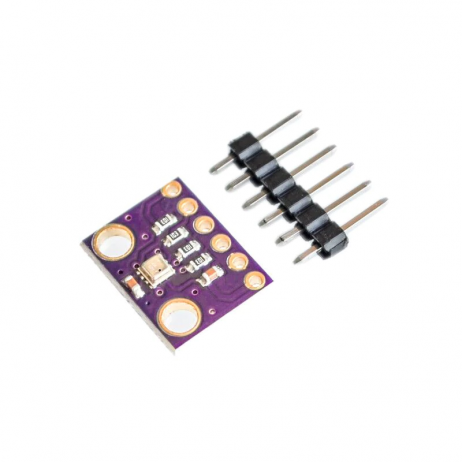
GY-BME280 Precision Altimeter Sensor Module
Add pressure-based altitude to your IMU data for complete 3D navigation. BME280 shares the I2C bus with MPU6050/MPU9250 easily.
8. Sensor Fusion: Mahony, Madgwick, and Kalman
Raw IMU data alone does not give you orientation — you need a sensor fusion algorithm to combine the noisy, complementary data streams:
Mahony Filter
A lightweight filter that uses accelerometer and magnetometer data as reference vectors to correct gyroscope drift via PI feedback. Very computationally efficient — runs at 1 kHz on a 16 MHz Arduino. Ideal for 9-DOF systems.
Madgwick Filter
A gradient-descent based algorithm that minimises the orientation error with respect to the reference vectors. Slightly more accurate than Mahony at lower computational cost than Kalman. Works in both 6-DOF and 9-DOF configurations. Sebastian Madgwick’s original implementation is freely available and widely used.
Extended Kalman Filter (EKF)
The most accurate approach, but also the most computationally demanding. Models the sensor noise covariance matrices explicitly, providing optimal state estimates when the noise statistics are known. Typically requires a 32-bit MCU (STM32, ESP32) to run at useful rates.
Practical recommendation: Use the Madgwick filter for MPU9250 9-DOF projects. Use the MPU6050 DMP (which implements a modified Mahony variant) for 6-DOF projects where absolute heading is not needed.
9. Calibration Differences
Calibration complexity is perhaps the most overlooked difference between the two sensors:
MPU6050 Calibration
- Gyroscope offset: Record average gyro reading while stationary. Subtract from all future readings. Simple, one-time, stored in offset registers.
- Accelerometer offset: Orient sensor in 6 positions (±X, ±Y, ±Z facing down). Record gravity vector. Average offsets to find centre. Alternatively use the DMP’s CalibrateAccel() function.
- Total calibration time: ~2 minutes on a flat surface.
MPU9250 Calibration
All of the above, plus:
- Magnetometer hard-iron calibration: Rotate sensor slowly in all orientations while logging mag data. Find the ellipsoid centre offset. Takes 1–2 minutes of smooth rotation.
- Magnetometer soft-iron calibration: Compute the stretching matrix to correct the ellipsoid to a sphere. More complex mathematics, but most libraries (including the MPU9250 library above) do this automatically.
- Must repeat magnetometer calibration whenever the sensor is installed in a new mechanical assembly, as hard-iron offsets change with local magnetic environment.
10. Which IMU Should You Choose?
| Application | Recommended IMU | Why |
|---|---|---|
| Self-balancing robot | MPU6050 | Only needs pitch, DMP available, low cost |
| Gesture controller | MPU6050 | Roll/pitch sufficient for most gestures |
| GPS-aided navigation | MPU9250 | Absolute heading needed for dead reckoning |
| Quadcopter / drone | MPU9250 | Heading hold, auto-levelling, SPI speed |
| Fitness tracker / wearable | MPU6050 | Step counting + gesture; mag not needed |
| Compass application | MPU9250 | Magnetometer is the entire point |
| Learning IMUs / first project | MPU6050 | Huge community, cheapest, easiest libraries |
| High-speed data logging | MPU9250 | SPI enables >1 kHz logging |
Bottom line: If your project needs to know where it is pointing relative to the real world (compass direction), or needs SPI, choose the MPU9250. If your project only needs to know how much it has tilted or rotated since startup, the MPU6050 is cheaper, simpler, and has better community support.
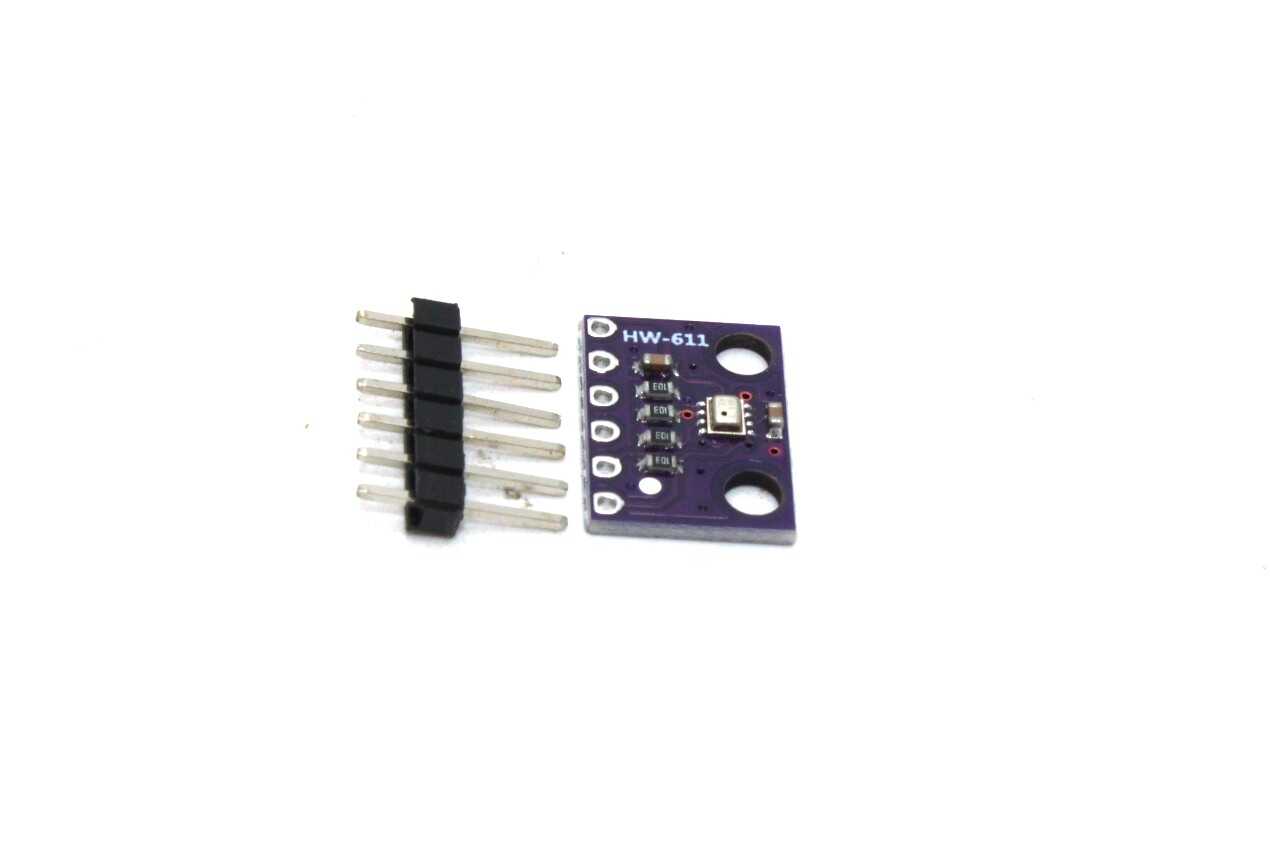
BMP280 Barometric Pressure and Altitude Sensor
Essential companion for drone and navigation projects alongside the MPU9250. Provides barometric altitude data to complete your 3D navigation stack.
FAQ
Is the MPU9250 backwards compatible with MPU6050?
Partially. Both share the same I2C addresses (0x68/0x69) and most gyro/accelerometer registers are identically mapped. Code that reads raw accelerometer and gyroscope data from the MPU6050 will generally work on an MPU9250 with minor tweaks. However, the DMP firmware binary differs, so MPU6050 DMP libraries will not function on an MPU9250 — you need an MPU9250-specific library for full 9-DOF sensor fusion.
Why does my MPU9250 gyroscope drift?
All MEMS gyroscopes drift — the gyroscope measures angular rate, and integrating rate over time accumulates numerical error. The MPU9250 magnetometer provides a long-term drift correction through the sensor fusion algorithm. Ensure your magnetometer is calibrated (especially hard-iron correction) and that the Madgwick/Mahony beta parameter is tuned appropriately (higher beta = faster magnetometer correction but more noisy).
Can I run both MPU6050 and MPU9250 on the same I2C bus?
Yes. Set one to address 0x68 (AD0 pin low) and the other to 0x69 (AD0 pin high). In code, initialise each with its respective address. They will coexist on the same SDA/SCL bus without conflict.
The MPU9250 is discontinued — should I still use it?
For new designs being produced in quantities, consider TDK’s ICM-20948 (the official MPU9250 replacement — also 9-DOF with AK09916 magnetometer). For hobbyist and prototype use, MPU9250 modules remain widely available in India and are perfectly suitable. The ICM-42688-P is TDK’s current flagship 6-DOF IMU if you do not need a magnetometer.
What is the DMP and do I need it?
The DMP (Digital Motion Processor) is an on-chip processor that runs sensor fusion algorithms in hardware, outputting quaternions and Euler angles without consuming Arduino cycles. If you use the i2cdevlib DMP library with MPU6050, this is what powers it. The DMP is optional — you can run Madgwick or Mahony filters in software instead, which is actually more flexible and gives you full control over the fusion parameters.
Find the Right IMU for Your Project
Zbotic stocks a wide range of IMU modules, sensor breakout boards, and all the components you need to build motion-aware electronics projects. Browse our collection and get fast delivery anywhere in India.




Add comment