
Table of Contents
- The Distance Sensing Dilemma in Robotics
- How Ultrasonic Sensors Work
- How LIDAR Works
- Head-to-Head Specifications
- Accuracy and Resolution Compared
- Range and Coverage
- Environmental Factors
- Cost Analysis
- Use Case Recommendations
- Using Ultrasonic Sensors with Arduino
- Frequently Asked Questions
- Verdict: Which Should You Choose?
If you are building a robot, one of the first decisions you face is: how will it sense the world around it? Two technologies dominate affordable robotics for distance measurement and obstacle avoidance: LIDAR (Light Detection and Ranging) and ultrasonic sensors. Both measure distance. Both can detect obstacles. But they work on completely different physical principles, have radically different cost profiles, and excel in very different scenarios. Choosing the wrong one can mean a robot that constantly crashes into glass walls or a project blown 10x over budget. This comprehensive comparison will help you make the right choice for your specific robotics application.
How Ultrasonic Sensors Work
Ultrasonic distance sensors work on the same principle as a bat’s echolocation. The sensor emits a brief burst of ultrasonic sound waves (typically 40 kHz — far above human hearing) from a piezoelectric transducer. These sound waves travel through air, hit an object, and reflect back. The sensor measures the time elapsed between the emission and the reception of the echo. Since the speed of sound in air is approximately 343 m/s at 20°C, the distance is calculated as:
Distance = (Time × Speed of Sound) / 2
The division by 2 accounts for the round trip. The most common ultrasonic sensor in hobbyist robotics is the HC-SR04, which can measure distances from 2 cm to 400 cm with approximately 3 mm precision. The JSN-SR04T is a waterproof variant for outdoor and wet environments.
Ultrasonic sensors work on one axis at a time — they give you a single distance reading in the direction the sensor is pointed. To get a 360-degree picture, you need to rotate the sensor (with a servo) or mount multiple sensors around the robot.
How LIDAR Works
LIDAR uses laser pulses instead of sound. A laser diode fires an extremely brief pulse of near-infrared light, and a photodetector measures the time-of-flight (ToF) of the reflected pulse — the same Time = Distance/Speed principle, but using the speed of light (299,792 km/s) instead of sound.
Because light travels so much faster than sound, LIDAR can take hundreds of thousands of measurements per second. This enables two capabilities that transform robotics:
- Scanning LIDAR: A spinning mirror or rotating assembly sweeps the laser beam in a plane, producing a complete 2D map of the surroundings (360° or partial arc) thousands of times per second. This produces a point cloud — a detailed 2D (or 3D) map of the environment.
- Solid-state LIDAR: Uses MEMS mirrors or phased arrays to scan without moving parts, offering higher reliability but typically narrower field of view.
Consumer-grade scanning LIDARs like the RPLiDAR A1 and YDLIDAR X4 have made 360° laser scanning affordable for robotics hobbyists and researchers. Automotive-grade LIDARs like the Benewake AD2-S-X3 take this to the next level with multiple beams, centimeter accuracy, and hardened packaging for autonomous vehicle applications.

Benewake AD2-S-X3 Automotive-Grade LiDAR
High-performance multi-beam LiDAR designed for autonomous driving applications — exceptional range, accuracy, and weather resistance for professional robotics projects.
Head-to-Head Specifications
| Specification | HC-SR04 (Ultrasonic) | JSN-SR04T (Waterproof Ultrasonic) | RPLiDAR A1 (Entry LIDAR) | Benewake AD2-S-X3 (Auto LIDAR) |
|---|---|---|---|---|
| Range | 2–400 cm | 20–450 cm | 15–1200 cm | 0.5–200 m |
| Resolution | ~3 mm | ~3 mm | ~1 mm | <2 cm |
| Field of View | 15° cone | 15° cone | 360° scan | 120° × 25° |
| Sample Rate | 40 Hz max | 40 Hz max | 8000 samples/s | Up to 320K pts/s |
| Interface | Digital (Trigger/Echo) | Digital (UART opt.) | UART/USB | Ethernet/CAN |
| Works in Dark? | Yes | Yes | Yes | Yes |
| Works in Bright Sun? | Yes | Yes | Limited | Yes (hardened) |
| Glass Detection | Poor | Poor | Poor | Poor |
| Approx. Price | ₹50–100 | ₹300–500 | ₹8,000–12,000 | On request |
Accuracy and Resolution Compared
Ultrasonic Accuracy
The HC-SR04 achieves approximately 3 mm resolution and ±3 mm accuracy under ideal conditions. However, accuracy degrades in several scenarios:
- Angled surfaces: Sound waves reflect off angled surfaces like a billiard ball — if the surface is tilted more than ~10°, the echo misses the receiver entirely, giving no reading or a false reading
- Temperature changes: Speed of sound varies with temperature (0.6 m/s per °C). At 0°C, the sensor reads 0.6% too close; at 40°C, it reads 0.6% too far. For most robotics, this is acceptable, but dataloggers should apply a temperature correction.
- Soft/absorptive materials: Foam, carpets, and fabric absorb ultrasonic waves and give very weak or no echoes — a significant limitation for household robots
- Multiple reflections: In echo-prone environments (concrete rooms, metal pipes), multiple reflections can create false distance readings
LIDAR Accuracy
Consumer LIDAR typically achieves 1–2 cm accuracy at moderate range, with some high-end units reaching sub-millimeter accuracy at close range. Because LIDAR uses light, it is immune to temperature-induced speed-of-medium variations. However:
- Black surfaces: Dark matte surfaces absorb laser light and return very weak reflections — LIDAR may fail to detect black objects reliably at maximum range
- Rain and fog: Water droplets scatter laser light; outdoor LIDAR performance degrades in rain and heavy fog (automotive-grade LIDARs include compensation algorithms)
- Specular surfaces: Mirrors and highly polished metal can reflect the laser beam away from the detector — mirrors are invisible to LIDAR (same issue as ultrasonic)
Range and Coverage
The most significant practical difference is coverage, not just range. A single HC-SR04 gives you one distance measurement in a narrow 15° cone. To scan even a 180° arc, you need either a servo (slow, adds weight and complexity) or 12+ sensors around the robot (expensive, complex wiring).
A single RPLiDAR A1 gives you 8,000 distance measurements per second distributed across a full 360° — effectively a real-time 2D map of the entire environment around the robot. This fundamentally enables capabilities that ultrasonic simply cannot match:
- Simultaneous Localization and Mapping (SLAM)
- ROS Navigation Stack (move_base) with AMCL localization
- Dynamic obstacle avoidance in multi-direction scenarios
- Room mapping and autonomous exploration
- Precise docking and positioning relative to landmarks
Environmental Factors
Lighting Conditions
Ultrasonic sensors are completely immune to ambient light. They work identically in pitch-black darkness and in direct sunlight. Consumer LIDAR, which typically uses 785 nm or 905 nm laser wavelengths, can be affected by intense direct sunlight, which adds noise to the photodetector. High-end automotive LIDARs use narrowband optical filters and signal processing to overcome this. For indoor robots, consumer LIDAR works without issue.
Temperature and Humidity
Ultrasonic is more sensitive to temperature (affecting sound speed). Both technologies can be used from -10°C to 50°C for consumer variants. The waterproof JSN-SR04T handles wet environments; the HC-SR04 is for dry indoor use only.
Surface Materials
Ultrasonic excels at detecting reflective surfaces at angles — the wide 15° beam cone means it can detect partially angled surfaces. LIDAR struggles with dark, absorptive materials at range. For household robots navigating dark furniture legs or matte-black obstacles, this is an important consideration.
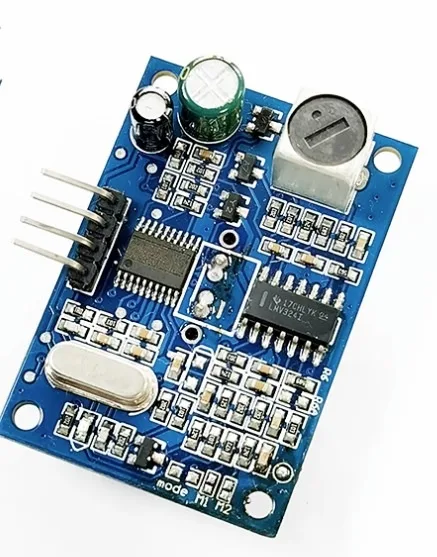
JSN-SR04T Waterproof Ultrasonic Rangefinder Module
The best ultrasonic sensor for outdoor robot applications — waterproof, accurate to 3 mm, and works over a 20–450 cm range with simple Arduino-compatible UART or trigger/echo interface.
Cost Analysis
The cost difference between ultrasonic and LIDAR is dramatic — but so is the capability difference. Here is a real-world cost breakdown for equipping a robot:
| Approach | Component Cost | Coverage | Capability |
|---|---|---|---|
| 1× HC-SR04 | ₹60 | 15° forward cone | Basic obstacle stop |
| 3× HC-SR04 + servo | ₹500 | ~180° swept slowly | Obstacle avoidance |
| 12× HC-SR04 ring | ₹720 | 360° with 30° gaps | 360° proximity |
| RPLiDAR A1 | ₹10,000 | 360° continuous | SLAM, mapping, navigation |
| Benewake AD2-S-X3 | Professional tier | 120°×25° 3D | Autonomous driving |
Use Case Recommendations
Choose Ultrasonic Sensors When:
- Budget is under ₹500 for distance sensing
- Your robot just needs basic forward obstacle detection and stop/avoid behavior
- You are building an Arduino-based beginner robot (wheeled car, line follower with obstacle avoidance)
- The application is a liquid level sensor, parking sensor, or single-axis distance measurement
- Operating in wet environments where the JSN-SR04T’s waterproofing is needed
- Detecting soft obstacles (foam, cardboard) that might not reflect laser well
Choose LIDAR When:
- You need 360° spatial awareness without mechanical complexity
- Building a ROS-based robot with SLAM navigation (e.g., TurtleBot-style)
- Precise localization and autonomous navigation in complex environments
- Mapping rooms, corridors, or warehouses for robot navigation
- High-speed robots where update rate matters (8,000+ measurements/s vs 40 Hz for ultrasonic)
- The robot operates in environments with many angled surfaces that confuse ultrasonic sensors
Hybrid Approach (Best of Both Worlds):
Professional robots often combine LIDAR for navigation and mapping with ultrasonic sensors as cliff detectors and short-range ground-level sensors for objects too low for the LIDAR beam plane. For example, a Roomba-style home robot might use LIDAR at 15 cm height for wall mapping and three HC-SR04 sensors pointing downward for stair/drop detection. This gives excellent coverage without relying on any single sensor technology.
Using Ultrasonic Sensors with Arduino
Here is a complete, clean Arduino sketch for the HC-SR04 with distance averaging for stable readings:
#define TRIG_PIN 9
#define ECHO_PIN 10
#define SPEED_OF_SOUND 0.0343 // cm/microsecond at 20°C

void setup() {
  Serial.begin(9600);
  pinMode(TRIG_PIN, OUTPUT);
  pinMode(ECHO_PIN, INPUT);
}

float measureDistance() {
  // Clear trigger
  digitalWrite(TRIG_PIN, LOW);
  delayMicroseconds(2);

  // Send 10µs pulse
  digitalWrite(TRIG_PIN, HIGH);
  delayMicroseconds(10);
  digitalWrite(TRIG_PIN, LOW);

  // Measure echo duration
  long duration = pulseIn(ECHO_PIN, HIGH, 30000); // 30ms timeout

  if (duration == 0) return -1; // No echo received

  return (duration * SPEED_OF_SOUND) / 2.0;
}

float averageDistance(int samples) {
  float total = 0;
  int valid = 0;
  for (int i = 0; i  0 && d  0 ? total / valid : -1;
}

void loop() {
  float dist = averageDistance(5); // Average of 5 readings

  if (dist < 0) {
    Serial.println("No object detected (out of range)");
  } else {
    Serial.print("Distance: ");
    Serial.print(dist, 1);
    Serial.println(" cm");

    // Simple obstacle logic
    if (dist < 20) {
      Serial.println("OBSTACLE DETECTED - Stop!");
    } else if (dist < 50) {
      Serial.println("Object nearby - Slow down");
    }
  }

  delay(200);
}
25kHz Ultrasonic Sensor Transmitter T25 16mm
Industrial-grade 25kHz ultrasonic transducer for custom rangefinder designs with higher range and penetration than standard 40kHz modules.
Frequently Asked Questions
Can I use multiple HC-SR04 sensors without interference?
Yes, but carefully. Sensors firing simultaneously can hear each other’s echoes, causing cross-talk errors. Fire sensors one at a time with at least 50 ms between readings, or use sensors pointed in sufficiently different directions (more than 30° apart) to minimize cross-talk. The NewPing library handles this elegantly.
Can an Arduino handle a LIDAR sensor?
Entry-level spinning LIDARs like the RPLiDAR A1 output data over UART at 115200 baud — an Arduino Mega can receive the data, but processing 8,000 points per second for SLAM requires a more powerful platform like Raspberry Pi or Jetson Nano running ROS. Arduino is better suited as a motor controller receiving navigation commands from the Pi.
What is a ToF (Time of Flight) sensor — is it LIDAR?
VL53L0X and VL53L1X are ToF sensors that use laser pulses like LIDAR but in a single fixed direction with a very small beam. They are essentially compact, single-axis LIDAR modules. They are more accurate than ultrasonic at short range (up to 2 m) with millimeter resolution, but have no scanning capability. They are a middle ground between ultrasonic and scanning LIDAR.
Does LIDAR work outdoors in Indian summers?
Consumer LIDARs (RPLiDAR, YDLIDAR) may struggle in direct tropical sunlight due to solar interference in the 785–905 nm wavelength range. For outdoor use in India, automotive-grade LIDARs with optical filters and temperature compensation are necessary. Indoors, consumer LIDARs work perfectly year-round.
Which sensor should I use for an autonomous lawn mower?
A combination: LIDAR for obstacle mapping and navigation, ultrasonic (JSN-SR04T waterproof) facing downward for drop detection and terrain following, and a GPS module for boundary confinement. No single technology handles all aspects of an outdoor autonomous robot well.
Is LIDAR safe for eyes?
Consumer LIDARs are Class 1 laser devices — eye-safe under normal conditions. Automotive-grade LIDARs may be higher class. Never stare directly into the laser emitter of any LIDAR at close range, and keep away from children’s eyes as a precaution.
Verdict: Which Should You Choose?
There is no single winner — the right sensor depends entirely on your project:
- Beginner robot / tight budget / simple obstacle avoidance: HC-SR04 ultrasonic. At ₹60–100, it is impossible to beat for the use case.
- Outdoor robot / water exposure: JSN-SR04T waterproof ultrasonic for reliable outdoor sensing.
- ROS robot / SLAM navigation / autonomous indoor robot: Consumer LIDAR (RPLiDAR A1 or YDLIDAR X4). The 360° map is transformative for navigation capability.
- Autonomous vehicle / industrial robot / outdoor navigation: Automotive-grade LIDAR like the Benewake AD2-S-X3 for uncompromising performance in real-world conditions.
- Best of both worlds (intermediate): ToF sensor (VL53L1X) for short-range precision + ultrasonic for medium range obstacle detection. Affordable and effective for many indoor robots without the cost of LIDAR.
Start with ultrasonic for your first robot. When you outgrow its single-axis limitation and need real spatial awareness, upgrade to LIDAR. The jump in robot autonomy and navigation quality will immediately justify the cost difference.
From entry-level ultrasonic modules to professional-grade LiDAR systems, Zbotic has the sensors to build your next generation robot. Explore all sensors at Zbotic →


Add comment