
Servo motors are everywhere — from the robotic arm on a factory floor to the tiny mechanism that flips the landing gear of a model aircraft. But not all servos are built alike. The gap between an industrial servo and a hobby servo is enormous in terms of engineering, performance, and price. Understanding that gap helps you spend smartly and avoid costly over- or under-engineering your project.
In this guide, we break down every meaningful difference between industrial and hobby servos, examine real-world applications, and help you decide which one belongs in your next build.
What Is a Servo Motor?
A servo motor is a rotary or linear actuator that allows precise control of angular or linear position, velocity, and acceleration. Unlike a plain DC motor that just spins continuously, a servo operates in a closed-loop system: a sensor (encoder or potentiometer) monitors the output shaft’s actual position and feeds that data back to the controller, which corrects any deviation in real time.
The word servo comes from the Latin servus (servant) — the motor faithfully follows the command it receives. This closed-loop principle is identical between hobby and industrial servos; what differs radically is how well they implement it.
Hobby Servos: Overview & Specs
Hobby servos were designed in the 1960s for RC aircraft and have evolved into a standard form factor used across hobbyist electronics, school robotics, and maker projects. They are self-contained units: motor, gearbox, potentiometer, and basic control electronics all in one plastic (or sometimes metal) case.
Key Specifications of Popular Hobby Servos
- SG90: 9g, 1.8 kg·cm torque, 180° rotation, 4.8–6V, PWM control, ~₹80–120
- MG90S: 13.4g, 2.2 kg·cm, metal gears, 4.8–6V, ~₹150–200
- MG996R / MG995: 55g, 13 kg·cm, metal gears, 4.8–7.2V, ~₹200–350
- DS3218: 60g, 18 kg·cm, digital, ~₹500–700
How Hobby Servos Work
Hobby servos respond to a PWM (Pulse Width Modulation) signal — typically a 50 Hz signal where pulse width between 1 ms (0°) and 2 ms (180°) sets the target angle. The internal potentiometer senses the actual shaft position, and the built-in IC drives the motor until the position matches the command. Position resolution is limited by the 8–10 bit ADC reading the pot — typically ±1° accuracy under no-load conditions.
Limitations of Hobby Servos
- No velocity feedback — you cannot command a specific speed
- Potentiometer wears out over time (especially under vibration)
- Typically limited to 180° rotation (some continuous rotation variants exist)
- Current draw can spike to 1–2 A under stall — damaging if sustained
- No fieldbus communication (no CAN, EtherCAT, Modbus)
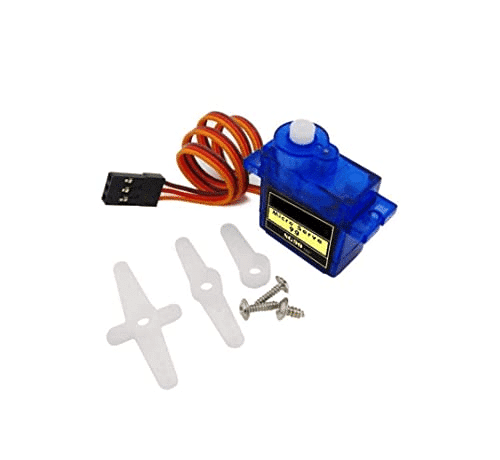
TowerPro SG90 180° Rotation Servo Motor
The classic 9g hobby servo — ideal for lightweight robotics, RC aircraft control surfaces, and student projects. Affordable entry point with reliable PWM interface.
Industrial Servos: Overview & Specs
Industrial servo systems are engineered for continuous, high-duty-cycle operation in demanding environments. They consist of a servo motor paired with a dedicated servo drive (amplifier) and are programmed via a PLC or motion controller. Industrial servos use high-resolution encoders rather than potentiometers — many modern units offer 17–23 bit absolute encoders providing over 8 million counts per revolution.
Key Characteristics of Industrial Servos
- Power range: 50W to hundreds of kilowatts
- Encoder resolution: 17–23 bit (131,072 to 8,388,608 counts/rev)
- Speed range: 0–6000 RPM with smooth control at any point
- Communication: EtherCAT, CANopen, Modbus RTU, PROFIBUS, ±10V analog
- Torque accuracy: ±0.1% or better
- Duty cycle: S1 (100% continuous) rated
- Protection: IP65–IP67, temperature monitoring, regenerative braking
- Cost: ₹15,000–₹5,00,000+ per axis (motor + drive)
Examples of Industrial Servo Brands
Mitsubishi MELSERVO, Yaskawa Sigma, Panasonic MINAS, Delta ASDA, Beckhoff AM series, Kollmorgen AKM, and Siemens SIMOTICS are the major players. Most of these are available in India through authorized distributors.
Side-by-Side Comparison
| Parameter | Hobby Servo | Industrial Servo |
|---|---|---|
| Price (single axis) | ₹80 – ₹2,000 | ₹15,000 – ₹5,00,000+ |
| Position feedback | Potentiometer (10-bit) | Encoder (17–23 bit) |
| Position accuracy | ±1–2° | ±0.001° or better |
| Velocity control | None (position only) | Full (position + velocity + torque) |
| Control interface | PWM (50Hz) | EtherCAT, CANopen, ±10V, step/dir |
| Continuous torque | 0.5–18 kg·cm | 0.1–5000 N·m |
| Duty cycle | Intermittent (overheats) | S1 continuous rated |
| Ingress protection | None (open PCB) | IP65–IP67 |
| Lifespan | Hundreds of hours | 10,000–30,000+ hours |
| Controller needed | Any microcontroller | PLC / motion controller / servo drive |
Torque, Precision & Feedback
This is where the two worlds diverge most dramatically. A hobby MG996R claims 13 kg·cm but that rating assumes fresh gears, 6V supply, and ambient temperature. Under sustained load or heat, the plastic housing deforms and actual torque delivery drops. Industrial servos, by contrast, are rated for continuous stall torque at rated supply voltage — the number on the datasheet is what you reliably get.
Position precision tells an even starker story. A 10-bit ADC on the potentiometer gives 1024 steps over 180° — roughly 0.18° per step under ideal conditions. An industrial servo with a 23-bit encoder offers 8,388,608 steps per revolution, or about 0.000043° per step. That is 4,000x more resolution, which matters enormously for coordinated multi-axis motion, thread cutting on CNC lathes, or semiconductor wafer handling.
Velocity & Torque Loops
Industrial servo drives run three nested PID loops simultaneously: current (torque) → velocity → position. The torque loop runs at 10–40 kHz, velocity at 1–4 kHz, position at 250–1000 Hz. This cascaded structure gives buttery smooth motion profiles with precise S-curve acceleration. Hobby servos have only the single position loop (implemented in an 8-bit MCU) with no tunable parameters.
Control Interface & Drivers
Connecting a hobby servo to an Arduino takes three wires and two lines of code. Industrial servo integration is a project in itself:
- Step/Direction: Simplest digital interface — a pulse train from a CNC controller drives position. Used with most stepper-replacement servo systems.
- ±10V Analog: Voltage sets velocity or torque reference. Legacy standard still used in spindle drives.
- CANopen / Modbus RTU: Serial fieldbus — suitable for multi-axis systems over RS485.
- EtherCAT: Synchronised Ethernet fieldbus running at 1 kHz update rate. State of the art for high-speed coordinated motion (packaging machines, pick-and-place).
- PROFIBUS / PROFINET: Siemens ecosystem standard.
The servo drive itself handles current amplification, regenerative energy management, motor protection, and safety functions (STO — Safe Torque Off). This drives up the bill of materials but is essential for CE-marked machinery.
Cost Analysis
Let us put real numbers to it for an Indian buyer in 2024:
Hobby Servo (SG90 build)
- SG90 servo: ₹90
- Arduino Uno: ₹400
- Servo horn + mount: ₹60
- Total per axis: ₹550
Mid-range Industrial Servo (100W axis)
- Servo motor (Delta ECMA-C20602): ~₹18,000
- Servo drive (Delta ASD-B2): ~₹22,000
- Encoder cable: ~₹1,500
- Power cable: ~₹800
- Breakout terminal: ~₹600
- Total per axis: ~₹43,000
The 80x price difference is justified only when precision, duty cycle, torque accuracy, or lifespan demands it. For a school robotics arm that moves twice a day, an SG90 at ₹90 is the right call. For a CNC router that runs 8 hours daily, an industrial servo at ₹43,000 pays for itself in avoided downtime and scrap material.
Real-World Applications
Hobby Servo Use Cases
- RC aircraft/boats/cars: Control surfaces, throttle valves, steering — the original application
- School robotics: Robot arms, gripper mechanisms, simple humanoid joints
- Maker projects: Pan-tilt camera mounts, automated plant waterers, door openers
- 3D printer extruder pivot: Low-duty-cycle, minimal load
- Educational kits: Demonstrating closed-loop control concepts
Industrial Servo Use Cases
- CNC machining centers: X/Y/Z axis drives requiring micron-level repeatability
- Injection moulding: Clamp, injection, and ejection axes on electric IMMs
- Collaborative robots (cobots): Each joint of a Fanuc or UR robot uses an industrial servo
- Textile machinery: Rapier drives, take-up rolls requiring synchronised multi-axis control
- PCB pick-and-place: High-speed gantry systems placing 10,000+ components per hour
- Semiconductor wafer handling: Sub-micron positioning in vacuum environments
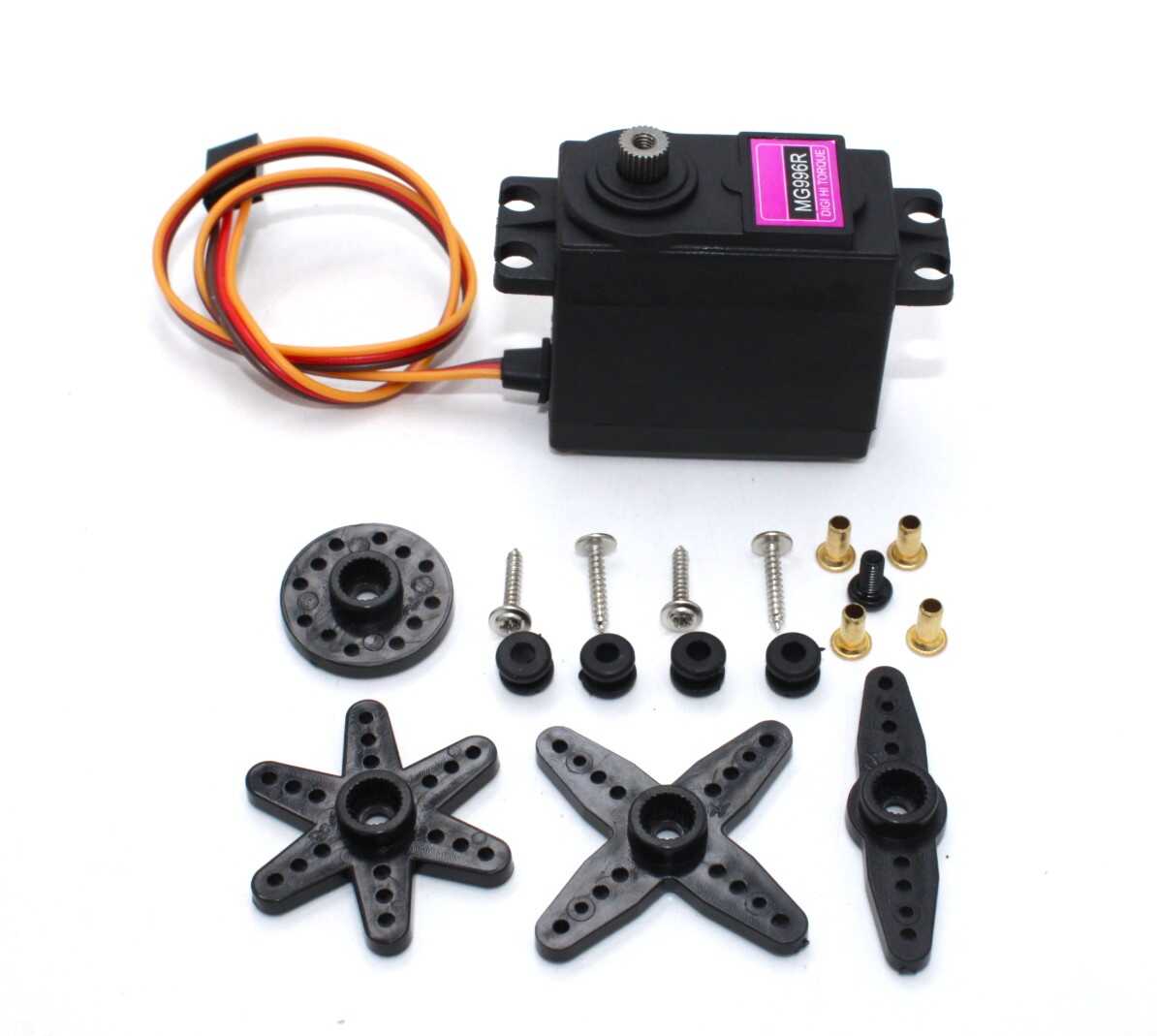
Servo MG996 13KG 180° High Quality
Top-end hobby servo with metal gears and 13 kg·cm torque — suitable for heavier hobby robot arms, RC car steering, and pan-tilt mechanisms needing more grunt.
Which Should You Choose?
Use this decision framework:
Choose a Hobby Servo When:
- Budget is under ₹2,000 per axis
- Duty cycle is light (less than 20% on-time)
- Position accuracy of ±1–2° is acceptable
- Control comes from an Arduino, Raspberry Pi, or similar microcontroller
- The project is a prototype, demo, or educational build
- Weight and size constraints favour a compact unit
Choose an Industrial Servo When:
- Continuous or near-continuous operation is required
- Positioning accuracy below ±0.1° is mandatory
- Velocity profiling (trapezoidal or S-curve moves) is needed
- The machine must comply with safety standards (CE, ISO 13849)
- Multiple axes must be electronically geared or interpolated
- The application involves cutting, grinding, moulding, or assembly at production speed
The Grey Zone: Smart Servos
Products like the Dynamixel XL430 (₹4,000–6,000) or Feetech STS3215 occupy the middle ground — they use magnetic encoders (12-bit), TTL/RS485 bus communication, support continuous rotation, and report position/temperature/load in real time. They are not industrial servo replacements, but they are light-years ahead of SG90 for serious robotics prototyping.
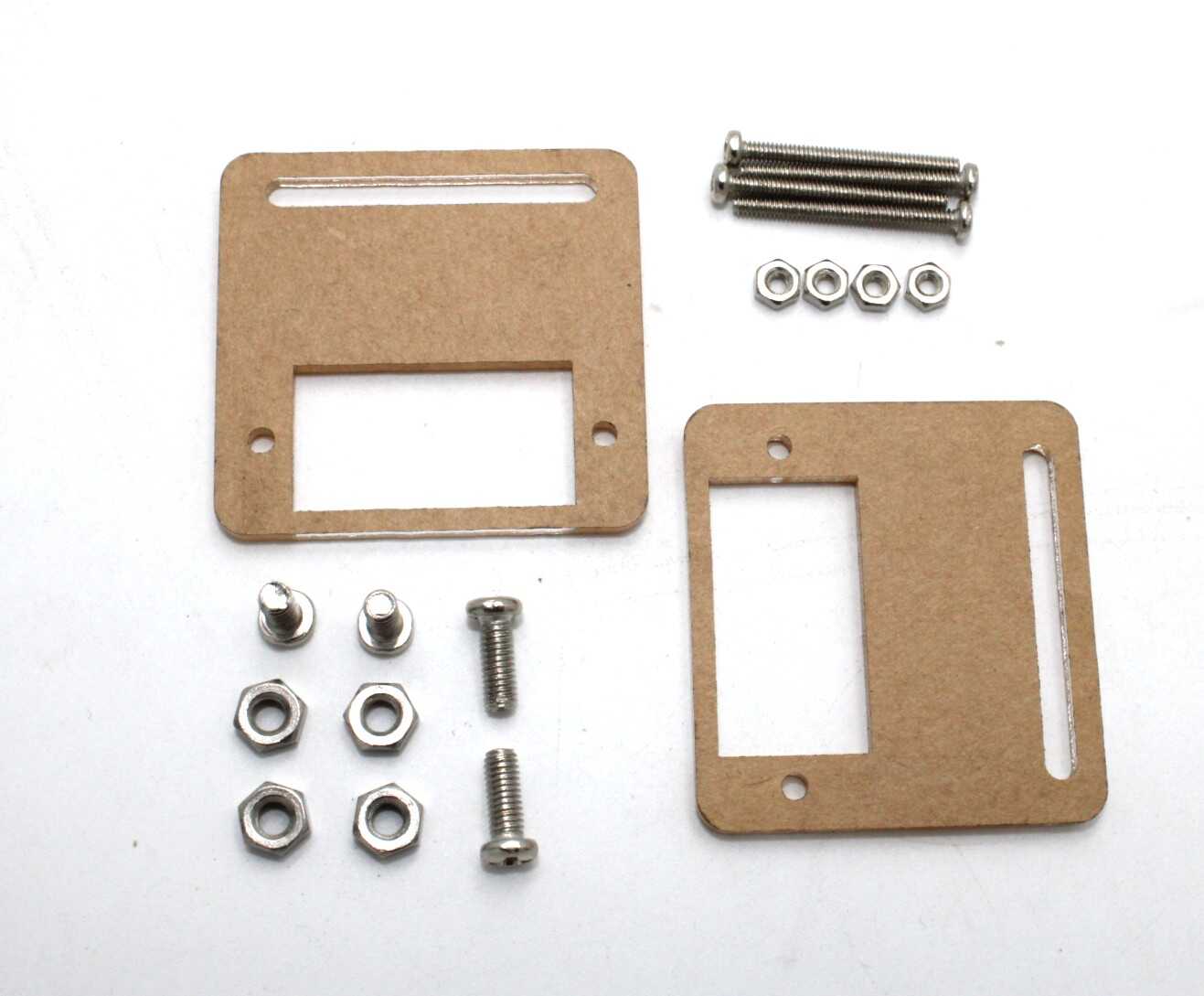
Servo Mount Holder Bracket for SG90/MG90 (Pack of 2)
Aluminium brackets for clean servo mounting — saves fabrication time and keeps your servo mechanically stable in pan-tilt rigs and robot arms.
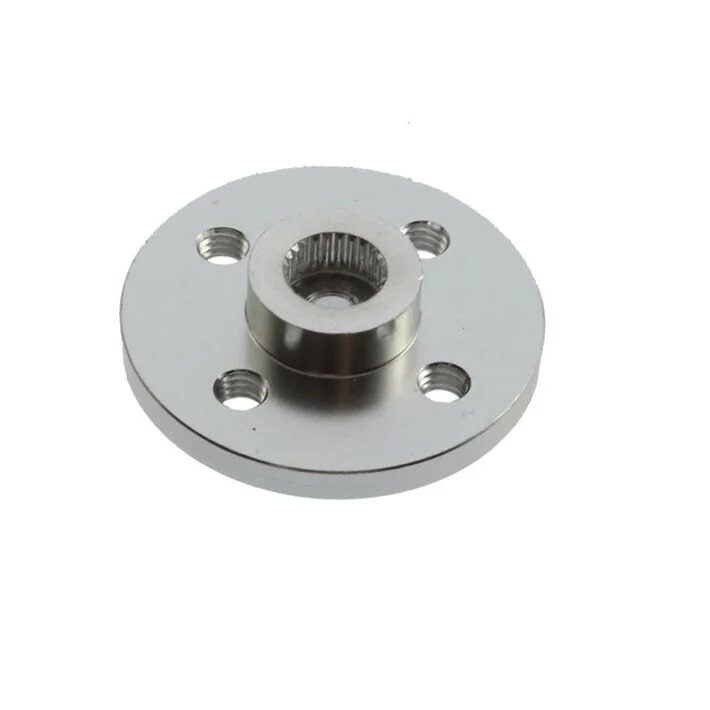
Aluminum Servo Horn/Arm 25T Round Type Disc MG995/MG996
Durable aluminium servo horn for MG995/MG996 servos — prevents horn stripping under high torque that destroys plastic horns on demanding builds.
Frequently Asked Questions
Can I use a hobby servo in a CNC machine?
You can use a hobby servo for very light proof-of-concept CNC builds, but not for production use. The limited position resolution (±1–2°), lack of velocity control, and intermittent duty cycle rating make hobby servos unsuitable for reliable CNC operation. Use stepper motors or industrial servos for any serious CNC build.
What is the maximum torque I can get from a hobby servo?
High-torque hobby servos like the DS3218 reach 20 kg·cm (1.96 N·m) at 7.4V. Beyond that, you enter brushless hobby servo territory (~30 kg·cm) or DC gear motors. For reference, a small industrial servo (100W) delivers 0.32 N·m continuous — but at much higher speed (3000 RPM) giving far more power output.
Can hobby servos run continuously (360°)?
Standard hobby servos are limited to ~180° (or 270° on some models). Continuous rotation servos (modified or purpose-built) spin indefinitely but lose position feedback entirely — they become basic speed controllers. For continuous rotation with position feedback, use brushless gimbal motors with an encoder, or an industrial servo.
Do industrial servos work with Arduino?
Some industrial servo drives support step/direction input — this is the closest interface to what an Arduino can produce using a pulse library. However, the drive still requires 220V AC power, a proper ground reference, and safety wiring. It is possible but not practical or safe without proper electrical knowledge.
What is a gimbal motor and how does it differ from both servo types?
A gimbal motor is a low-KV brushless motor designed for camera stabilisation — it runs under precise FOC (Field Oriented Control) and behaves like a torque motor. It is neither a hobby servo nor an industrial servo, but pairs with dedicated gimbal controllers (BaseCam, Alexmos) for smooth camera-holding applications.
Zbotic stocks a complete range of hobby servos (SG90, MG90, MG996R), servo horns, and extension cables — everything you need to go from idea to working prototype today. Browse all servo motors and actuators at Zbotic →






Add comment