
Every electronics project, power supply, and electrical installation needs protection against overcurrent and short circuits. A fuse is the simplest and most reliable protection device — when current exceeds its rating, the fuse element melts and interrupts the circuit before damage occurs. However, not all fuses are equal. The difference between a glass fuse, a ceramic fuse, and a polyfuse can mean the difference between a safely interrupted fault and a fire, or between a permanently protected circuit and one that needs manual reset after every bump. This guide explains all the common fuse types used in electronics, how to select the right fuse for your application, and the practical details Indian makers need to know.
How Fuses Work: The Fundamentals
A fuse is a deliberate weak link in a circuit — a thin wire or strip of metal calibrated to melt and open the circuit when current exceeds a specified value. The fuse element is typically made of tin-coated copper, silver, or a tin-lead alloy and is enclosed in a body (glass, ceramic, or polymer) that contains the melting arc and prevents the fuse from becoming a fire hazard.
The physics are straightforward: electrical energy dissipated in the element is I² × R × t. When this exceeds the thermal capacity of the element, it reaches its melting point and opens. Higher fault current = faster blow time. The fuse I²t (ampere-squared-seconds) rating defines how much energy the element can absorb before blowing — this is critical for matching the fuse to both the circuit’s normal operating profile and the fault currents it must interrupt.
A critical distinction: a fuse protects the wiring and power supply, NOT necessarily the load. If you put a 5A fuse on a circuit powering a 100mA Arduino, a fault in the Arduino will cause it to draw 5A — destroying the Arduino — before the fuse blows. Size fuses for the wiring/source capability, and use additional component-level protection (polyfuses, current-limit ICs) for sensitive loads.
Key Fuse Parameters You Must Know
Rated Current (I_N)
The maximum current the fuse carries continuously without blowing. Fuses are rated at a specific ambient temperature (typically 25°C for electronics fuses). At higher temperatures, the element is already pre-heated and blows at lower currents. Always derate: use a fuse rated at 125–150% of your circuit’s maximum continuous current. For a circuit drawing 2A, use a 2.5A or 3A fuse.
Rated Voltage
The maximum voltage the fuse can safely interrupt. When a fuse blows, an arc forms across the gap. The fuse body must quench this arc before it restarts. A fuse rated for 32V DC cannot safely interrupt a 230V AC circuit — the arc will sustain and the fuse becomes a fire hazard. Always match or exceed the circuit voltage in your fuse selection.
Breaking Capacity (Interrupting Rating)
The maximum fault current the fuse can safely interrupt without rupturing or creating a hazard. Low-quality glass fuses may be rated only 35A or 100A breaking capacity — inadequate for mains circuits where fault current can reach kiloamperes. High-quality ceramic HBC (High Breaking Capacity) fuses are rated 1500A or higher. For mains-connected circuits in India, always use HBC-rated fuses.
Blow Time Characteristic
How quickly the fuse blows at various overcurrent levels. This is expressed as a time-current curve. Key classifications:
- F (Fast-acting): Blows within milliseconds at 200% rated current
- M (Medium-acting): Blows within seconds at 200% rated current
- T (Slow-blow/Time-lag): Withstands 200% current for several seconds; blows only on sustained overloads
I²t Rating
The let-through energy before blowing, expressed in A²s. Important for coordinating fuse protection with semiconductor devices. If your MOSFET can survive 50 A²s of fault energy, your fuse must blow with an I²t less than 50 A²s to protect it. Check both the fuse’s pre-arcing I²t (energy to start melting) and total I²t (energy through arc extinction).
Glass Tube Fuses (5×20mm and 6.3×32mm)
Glass tube fuses are the most common fuse type in hobbyist electronics and consumer appliances. The element is visible through the glass body, making it easy to visually inspect — a blown fuse shows a broken or vaporised element, often with blackening inside the glass.
5×20mm (IEC Standard)
The international standard size used in most European and Indian consumer electronics: 5mm diameter, 20mm long. This is the size you’ll find in test equipment, power supplies, audio amplifiers, and most PCB-mounted fuse holders. Available in currents from 100mA to 20A, both fast-blow and slow-blow versions.
6.3×32mm (North American / Legacy)
The older American standard size. Less common in India but still found in older equipment, imported electronics, and some industrial panel-mount applications. Higher physical size allows higher breaking capacity ratings.
Advantages of Glass Fuses
- Visually inspectable — easy to tell if blown
- Widely available in India (every electronics shop stocks them)
- Low cost (₹2–₹10 each)
- Easy to replace — just pull out and insert new
Disadvantages of Glass Fuses
- Low breaking capacity (typically 35–200A) — NOT suitable for mains circuits with high fault current
- Glass body can shatter in extreme fault events
- Element characteristics not as tightly controlled as ceramic types
- Single-use — must be replaced after every blow
Recommended use: Low-voltage DC circuits (batteries, 12V adapters), test equipment, audio equipment, and secondary protection downstream of a higher-rated main fuse. Do NOT use glass fuses as the primary protection on directly mains-connected circuits.
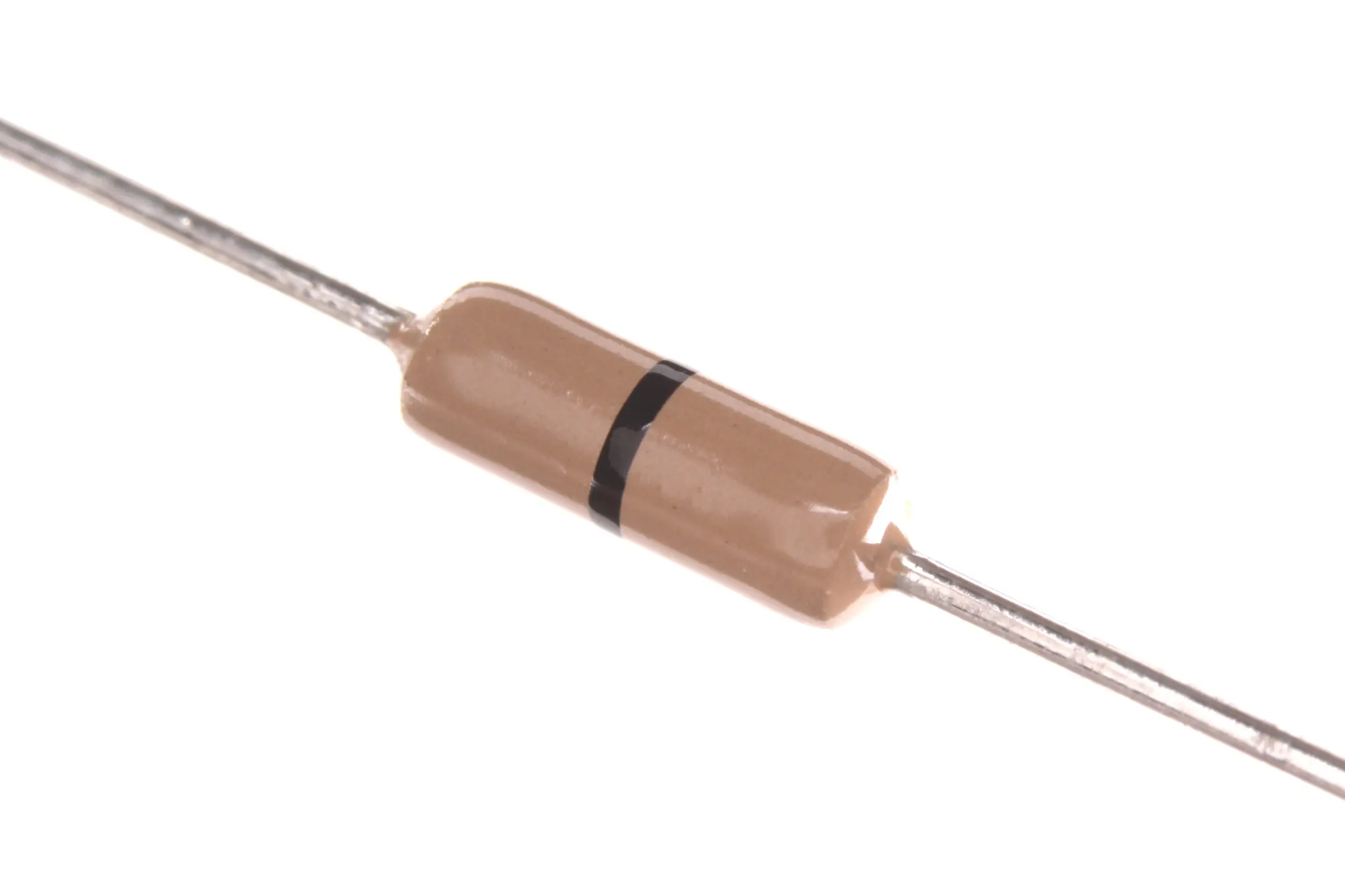
0 Ohm 0.25W Carbon Film Resistor (Pack of 100)
Zero-ohm resistors are sometimes used as PCB-level jumpers or placeholders for fuses in test circuits — a useful component to have alongside your fuse selection for flexible board design.
Ceramic Fuses: High Breaking Capacity
Ceramic fuses look similar to glass fuses (same 5×20mm dimensions are common) but the body is opaque white or grey ceramic and the internal filling is sand (silica) quartz filler. The ceramic body and sand filling together serve a critical purpose: they absorb and quench the arc that forms when the fuse element blows, enabling interruption of much higher fault currents without rupturing.
HBC (High Breaking Capacity) Ceramic Fuses
Standard HBC ceramic fuses are rated 1500A breaking capacity — more than adequate for mains circuits in homes and light commercial buildings. They are the correct choice for any AC mains application in India. Available in the same range of current ratings (100mA to 32A+) and blow characteristics (fast, medium, slow) as glass fuses.
Ultra-HBC Ceramic Fuses
For industrial and distribution-level applications, ultra-HBC ceramic fuses in larger body sizes (10×38mm, 14×51mm NH/DIN fuses) are rated 100kA interrupting capacity. These are the fuses inside Indian switchboards and MCB panels.
Advantages of Ceramic Fuses
- High breaking capacity — safe for mains fault interruption
- Tight tolerances on blow characteristics
- Sand filling prevents arc flash and contains the blow safely
- Available in voltage ratings up to 690V AC
- Better performance at elevated temperatures compared to glass
Disadvantages
- Cannot visually inspect the element (opaque body)
- Slightly higher cost than glass (₹10–₹50 depending on current rating)
- Single-use — must be replaced after blowing
Recommended use: ALL mains-connected equipment. Power strips, adapters, SMPS, UPS circuits, motor controllers, heaters, and any circuit operating at 230V AC must use ceramic HBC fuses. This is also a BIS (Bureau of Indian Standards) requirement for products sold in India.
Polyfuse (Resettable PTC Fuses)
A polyfuse — also called a resettable fuse or PPTC (Polymeric Positive Temperature Coefficient) thermistor — is a fundamentally different protection device. Instead of melting and opening the circuit, a polyfuse is a polymer-based device whose resistance increases dramatically when temperature (and thus current) exceeds a threshold, effectively limiting current to a safe level. When the fault is removed and the device cools, resistance drops back to near-normal and the circuit automatically resets.
How Polyfuses Work
The polyfuse body contains a crystalline polymer matrix loaded with conductive carbon particles. At normal temperature, the crystalline structure holds the carbon particles in contact, giving low resistance (0.05–2 Ω). When overcurrent heats the polymer to its transition temperature (~125°C), the polymer expands to an amorphous state — the carbon particles lose contact, resistance spikes to thousands of ohms, and current drops to a safe trickle. This happens in milliseconds.
Key Polyfuse Parameters
- Hold current (I_H): Maximum current the device carries indefinitely without tripping
- Trip current (I_T): Current at which the device trips (typically 2× I_H)
- Maximum voltage (V_max): Typically 6V, 12V, 24V, 60V, or 250V depending on type
- Resistance (R_initial): Normal state resistance — adds a small voltage drop in series
- I²t rating: Energy to trip — important for coordination with other protection devices
Polyfuse Product Examples
- Littelfuse 30R series: Through-hole, 1.1A hold, 2.2A trip, for USB port protection
- Bourns MF-R series: Radial, various currents, common in PCB-level protection
- TE Connectivity RXEF series: SMD polyfuses for compact PCB designs
Advantages of Polyfuses
- Self-resetting — no need to replace after a fault clears
- Ideal for applications where access for fuse replacement is difficult (sealed enclosures, remote equipment)
- Available in SMD and through-hole packages
- Excellent for USB port protection (devices that users frequently short-circuit by accident)
- Protects against repeated transient faults without user intervention
Disadvantages of Polyfuses
- Higher resistance than glass/ceramic fuses — adds voltage drop in current-sensitive circuits
- Response time slower than fast-blow glass fuses (tens of milliseconds vs milliseconds)
- Resistance increases with temperature — derate in hot environments
- Trip point drifts with age and repeated cycling
- NOT suitable for mains AC protection (low breaking capacity and voltage ratings)
- Hold current is temperature-dependent — at 40°C ambient, hold current may be 70–80% of rated value
Recommended use: USB port protection, laptop battery packs, motor driver boards where motors stall occasionally, sensor circuits in sealed enclosures, Arduino power input protection (prevents repeated fuse replacement during development).
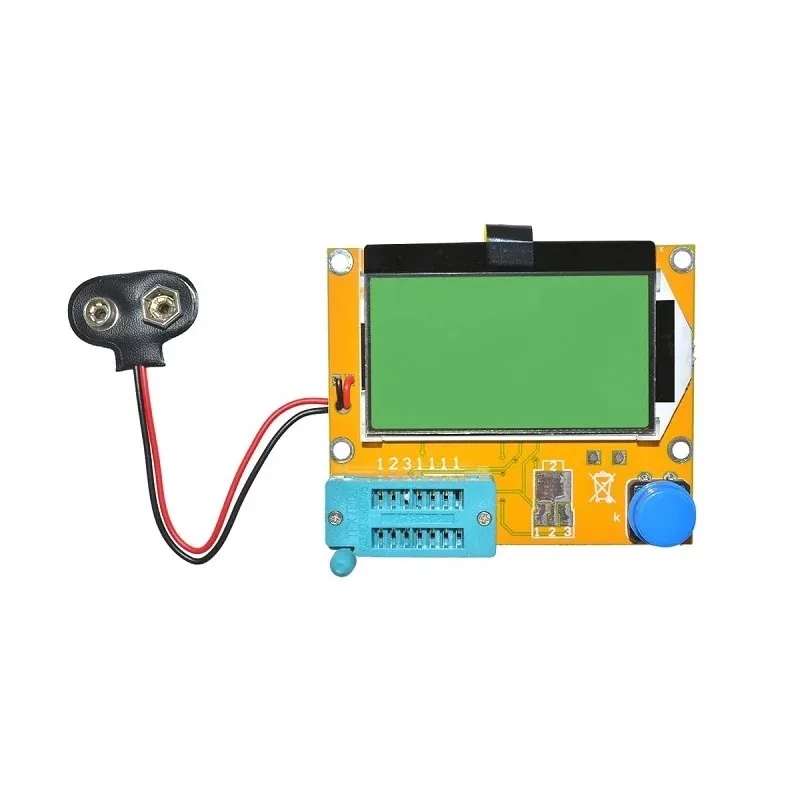
9V LCR-T4 12864 LCD Graphical Component Tester
Test fuses, varistors, capacitors, and all passive components with this versatile LCR tester — automatically identifies component type, value, and parameters in seconds.
SMD and Blade Fuses
SMD Fuses
Surface-mount fuses are essential in compact PCB designs where board space is at a premium. They are available in standard SMD package sizes:
- 0402, 0603, 0805, 1206: Standard SMD resistor-sized packages, rated typically 0.5–5A, 32V–125V
- 2410, 2920: Larger SMD packages for higher current ratings (up to 20A+)
SMD fuses come in fast-blow and slow-blow versions and can be ceramic or polymer filled. Major manufacturers: Littelfuse (451 series), Bourns (SF-0603 series), Schurter (PFMF series). For BIS-compliant products, source SMD fuses from reputable manufacturers with proper markings (current rating, voltage rating, interrupting rating).
Automotive Blade Fuses
The familiar coloured plastic fuses used in car fuse boxes are blade fuses (also called spade fuses or ATO/ATC fuses). They are NOT designed for electronics circuits but are useful in 12V automotive and solar projects:
- Mini blade (APS): Compact version used in modern vehicles
- Standard blade (ATO/ATC): Standard size, colour-coded (5A tan, 7.5A brown, 10A red, 15A blue, 20A yellow, 25A clear, 30A green)
- Maxi blade: For high-current applications (40A, 50A, 60A+)
Blade fuses are fast-blow types with breaking capacities up to 1000A — adequate for automotive 12V systems. They are convenient for Indian solar installers and EV enthusiasts building 12V–48V battery-powered systems.
Slow-Blow vs Fast-Blow: When to Use Which
The blow speed is perhaps the most misunderstood fuse parameter. Using the wrong type is a very common mistake that either results in nuisance blowing (fast fuse in a motor circuit) or inadequate protection (slow fuse in a sensitive circuit).
Fast-Blow (F) Fuses
Fast-blow fuses have no deliberate time delay — they blow within milliseconds once current significantly exceeds the rating. Use for:
- Power supply input protection (blows quickly on transformer or rectifier faults)
- Semiconductor protection (diodes, transistors have very low I²t tolerance)
- Signal circuit protection
- Any circuit with no inrush current or capacitive loading
Slow-Blow (T) Fuses
Slow-blow fuses incorporate a thermal element (coil spring, thermal mass, or solder blob) that stores heat — allowing brief overcurrents to pass without blowing while still protecting against sustained faults. Use for:
- Motor circuits (high inrush on start: 5–10× full-load current for 0.1–2 seconds)
- Transformer primaries (magnetising inrush: up to 10× rated current at switch-on)
- Circuits with large electrolytic capacitors (capacitor charging inrush)
- LED driver inputs with SMPS (switchmode supplies have high inrush)
- Pump and compressor circuits
A simple rule: if your circuit draws a clean, steady current with no surges → fast-blow. If it has any startup current higher than normal operating current → slow-blow. Size the slow-blow fuse to the steady-state current (with 150% margin), not the startup peak.
How to Select the Right Fuse
Step 1: Determine Maximum Continuous Current
Measure or calculate the maximum current your circuit draws during normal operation at full load and highest ambient temperature.
Step 2: Choose Fuse Rating
Fuse rating = Maximum continuous current × 1.25 to 1.5 (derating factor). Example: circuit draws 2A maximum → fuse = 2.5A or 3A.
Step 3: Choose Blow Speed
Fast-blow for resistive/electronic loads; slow-blow for motors, transformers, capacitive loads.
Step 4: Choose Voltage Rating
Fuse voltage ≥ circuit voltage. For 230V mains: use 250V AC rated (minimum) or 500V AC rated for margin. Never use a 32V rated glass fuse in a 230V circuit.
Step 5: Choose Breaking Capacity
For mains circuits in India: use ceramic HBC fuses with ≥1500A breaking capacity. For 12V DC circuits: glass fuses with 35A+ breaking capacity are adequate (fault currents are limited by wire resistance).
Step 6: Choose Package
PCB mount: PCB fuse clips with 5×20mm ceramic fuse (through-hole design) or SMD fuse packages. Panel/appliance: inline fuse holders with 5×20mm fuses. Automotive/solar 12V: blade fuse holder with ATO fuse.
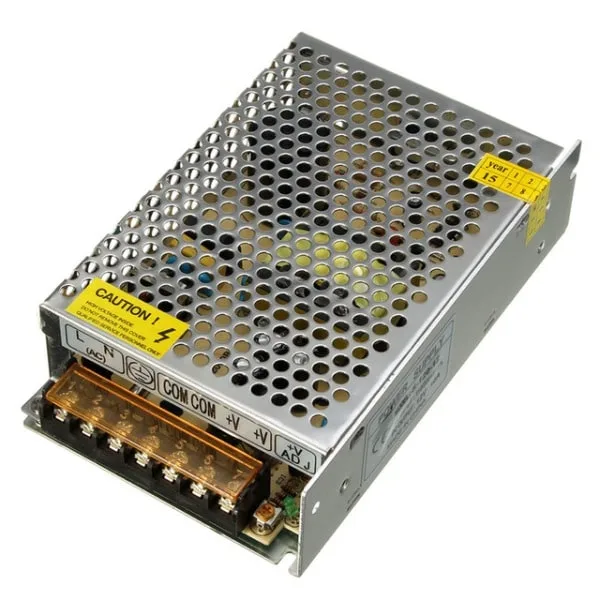
12V 10A SMPS – 120W DC Metal Power Supply
Quality SMPS modules like this already include internal mains protection and fusing — but always add an external fuse on the DC output lines for complete system protection.
Correct Fuse Placement in Circuits
Fuse placement is as important as fuse selection. Rules for correct placement:
- Always fuse the positive rail in DC circuits (or Live in AC circuits). Never put a fuse on the negative/neutral — a short from positive to chassis still results in full fault current flowing unfused.
- Place fuses as close to the supply source as possible — at the output of the battery, adapter, or transformer, not deep in the circuit. The fuse protects the wiring between the source and the load; if fuse is placed at the load end, the full length of unfused wire becomes a fire hazard.
- Use a fuse holder, not a direct PCB solder connection (for replaceable fuses). PCB-mounted SMD fuses are an exception — they are replaced by re-soldering.
- Do not rely on a single fuse to protect multiple parallel loads — each branch should be individually fused to its load’s current rating.
Fuse and MOV Coordination
In surge protection circuits (as discussed in the MOV guide), the fuse and varistor must be coordinated correctly. The fuse must:
- NOT blow during normal MOV clamping events (the MOV conducts brief high-current surges; the fuse must withstand the surge I²t without blowing)
- MUST blow if the MOV degrades and draws continuous excess current (e.g., a leaky MOV conducting 500mA continuously at normal voltage)
This is achieved by choosing a fuse whose time-current curve allows the brief surge (microseconds) through, but interrupts continuous overcurrent (seconds). A slow-blow fuse ahead of the MOV typically satisfies both requirements. For a 230V mains circuit with a 10D MOV, a 2A T-type (slow-blow) ceramic fuse upstream is a common design choice.
Frequently Asked Questions
Q1: Can I replace a blown fuse with a higher-rated one?
Never replace a fuse with a higher-rated one without understanding why the original fuse blew. The fuse rating is chosen to protect specific wiring and components. A 2A fuse protects wiring rated for 2A — replacing it with a 10A fuse means the wiring can now heat to dangerous levels before the fuse blows. Always find the root cause of the fuse failure (overloaded circuit, shorted component) and fix it before replacing with the same-rated fuse.
Q2: Why does my fuse keep blowing even though my load is within the rating?
Several possibilities: (1) Switch-on inrush current exceeds the fuse’s I²t — use a slow-blow fuse instead; (2) The fuse is derated at high ambient temperature — use a higher-rated fuse with derating applied; (3) The circuit has a partial short causing slightly elevated current — investigate with a clamp meter; (4) The replacement fuse is counterfeit or incorrectly rated — source from reputable suppliers.
Q3: What is the difference between T and TT fuse markings?
T means Time-lag (slow-blow) — typically 10 seconds minimum at 200% rated current. TT means Super Time-lag (also called Very Slow or FF for very fast at the other extreme) — TT fuses have even longer time delays for very high inrush applications like large motor starters. F = Fast, M = Medium, T = Time-lag (slow), TT = Super time-lag. The marking is standardised by IEC 60127.
Q4: Can I use a polyfuse for mains AC protection?
No. Polyfuses (PPTC devices) have low breaking capacity and low maximum voltage ratings (typically 30–60V for most types, up to 250V for special types but with very low current). They are not rated for 230V AC mains interruption and should never be used as primary protection on mains circuits. Use HBC ceramic fuses for all mains-connected applications.
Q5: How do I know if a ceramic fuse is blown?
You cannot visually inspect a ceramic fuse. Use a multimeter in continuity or resistance mode: a good fuse reads near 0 Ω (a beep in continuity mode); a blown fuse reads OL (open circuit). Always test before assuming a fuse is good — vibration or thermal stress can cause intermittent contact inside the fuse holder even without blowing the element.
Q6: What are the BIS standards for fuses in India?
Fuses for Indian mains applications should comply with IS 9224 (LV HRC fuse-links) which is equivalent to IEC 60269. For consumer electronics, IS 9000 part tests include fuse testing. Products bearing the ISI mark (BIS certification) are required to use compliant protection devices. When building products for commercial sale in India, use fuses from manufacturers with BIS-recognised test reports and proper component markings.
From glass and ceramic fuses to polyfuses, MOVs, and capacitors — Zbotic stocks everything you need to build safe, protected electronics. Browse our components collection and get fast delivery anywhere in India.


Add comment