
Table of Contents
- Introduction
- What Is a Color Sensor?
- TCS3200: Overview & Specs
- TCS34725: Overview & Specs
- Side-by-Side Comparison
- TCS3200 Wiring & Arduino Code
- TCS34725 Wiring & Arduino Code
- Accuracy in Real-World Conditions
- Which Sensor Suits Which Project?
- Buying Guide for India
- Frequently Asked Questions
- Conclusion
Introduction
Color sensing is at the heart of countless maker, robotics, and industrial automation projects. Whether you are building a line-following robot that distinguishes between coloured tracks, a product quality inspection system, or an automated candy sorter, you need a reliable color sensor that interfaces cleanly with your Arduino or microcontroller. Two sensors dominate the Indian hobbyist market: the TCS3200 and the TCS34725. Both detect colour, but they differ significantly in output type, accuracy, power requirements, and ease of use.
This guide gives you a thorough, practical comparison so you can make an informed purchase decision. We cover architecture, pin-outs, wiring diagrams, sample Arduino code, and real-world accuracy notes — everything you need in one place.
What Is a Color Sensor?
A color sensor is an electronic device that detects the wavelength (or relative intensity of red, green, and blue light) of a surface or object and converts that measurement into an electrical signal a microcontroller can read. Most colour sensors work on the photodiode array principle: an array of tiny photodiodes, each filtered for a specific wavelength, is exposed to light reflected from the target object. The sensor measures how much red, green, and blue light is reflected and returns those values — either as raw counts or as a digital number over a communication bus.
Key parameters to evaluate when choosing a colour sensor:
- Output interface — frequency signal vs I2C digital bus
- Spectral sensitivity — how accurately it resolves individual wavelengths
- Dynamic range — ability to handle bright and dim lighting
- Integration time — how long the sensor averages measurements (affects noise)
- Package and power — 3.3 V vs 5 V, footprint, on-board LED
TCS3200: Overview & Specs
The TCS3200 (and its near-identical variant TCS230) from ams-OSRAM (formerly TAOS) is probably the most common colour sensor in the hobbyist world. It has been around for over a decade, which means there is a huge amount of community support and sample code available.
How It Works
The TCS3200 contains an 8×8 array of photodiodes — 16 filtered for red, 16 for green, 16 for blue, and 16 clear (unfiltered). By toggling two selection pins (S2 and S3), you choose which colour channel is active. The output is a square wave whose frequency is proportional to light intensity. A scaling factor is selectable via pins S0 and S1 (2%, 20%, or 100% of maximum frequency), which lets you trade bandwidth for noise reduction.
Key Specifications
| Parameter | Value |
|---|---|
| Supply Voltage | 2.7 V – 5.5 V |
| Output Type | PWM frequency signal |
| Interface | Digital GPIO (no I2C/SPI) |
| Max Output Frequency | ~600 kHz (100% scale) |
| Photodiode Array | 8×8 (64 total) |
| On-board White LEDs | Yes (4 LEDs on module) |
| GPIO Pins Used | 6 (S0, S1, S2, S3, OUT, OE) |
| Operating Temperature | -40°C to +70°C |
Strengths of TCS3200
- Works at 5 V natively — no level shifting required with Arduino Uno
- Very low cost (₹80–₹150 for module in India)
- Large community, abundant tutorials
- On-board illumination LEDs included
Weaknesses of TCS3200
- Frequency output requires a timer interrupt or
pulseIn()— more complex code - No hardware integration/averaging — noise is significant in ambient light
- Needs 6 GPIO pins
- Lower colour accuracy compared to newer sensors
TCS34725: Overview & Specs
The TCS34725, also from ams-OSRAM, is a modern update that adds an I2C interface, an IR-blocking filter, and hardware integration time control. It communicates over the simple two-wire I2C bus, making it far easier to interface with any microcontroller — including ESP32, ESP8266, Raspberry Pi, and Arduino.
How It Works
The TCS34725 has a 3×4 array of photodiodes with an integrated IR-cut filter deposited directly on the silicon. This filter prevents infrared light from contaminating your colour readings — a major advantage in real-world environments where incandescent or sunlight IR can skew results. It outputs 16-bit digital values for R, G, B, and Clear channels directly over I2C, so no frequency counting is required.
Key Specifications
| Parameter | Value |
|---|---|
| Supply Voltage | 3.3 V – 5 V (module has regulator) |
| Output Type | 16-bit digital (I2C) |
| I2C Address | 0x29 (fixed) |
| Interface | I2C (SDA, SCL) |
| ADC Resolution | 16-bit per channel |
| Integration Time | 2.4 ms – 614 ms (programmable) |
| IR Filter | Yes (on-chip) |
| On-board White LED | Yes (controllable via INT pin or register) |
| GPIO Pins Used | 2 (SDA, SCL) + optional INT |
| Operating Temperature | -30°C to +70°C |
Strengths of TCS34725
- Only 2 GPIO pins (shared I2C bus with other devices)
- IR filter eliminates common source of error
- 16-bit resolution per channel — superior dynamic range
- Programmable gain (1×, 4×, 16×, 60×) and integration time
- Excellent Adafruit library with simple API
Weaknesses of TCS34725
- Slightly more expensive (~₹200–₹350 in India)
- Fixed I2C address — cannot put two on the same bus without a multiplexer
- Smaller photodiode array = more sensitive to sensor-to-object distance variation
Side-by-Side Comparison
| Feature | TCS3200 | TCS34725 |
|---|---|---|
| Output | Frequency (PWM) | I2C digital (16-bit) |
| Pins needed | 6 | 2 (shareable) |
| IR filter | No | Yes (on-chip) |
| Resolution | ~10–12 bit effective | 16-bit per channel |
| Gain control | Scaling only (S0/S1) | Programmable 1×–60× |
| Integration time | Fixed by code delay | Hardware (2.4–614 ms) |
| 3.3 V MCU friendly | Marginal (output is 5V) | Yes (module has 3.3V reg) |
| Library quality | Many community libs | Official Adafruit library |
| Accuracy | Moderate | High |
| Price (India) | ₹80–₹150 | ₹200–₹350 |
| Best for | Beginners, line bots | Accuracy-critical projects |
TCS3200 Wiring & Arduino Code
Pin Connections (Arduino Uno)
| TCS3200 Pin | Arduino Pin |
|---|---|
| VCC | 5V |
| GND | GND |
| S0 | D4 |
| S1 | D5 |
| S2 | D6 |
| S3 | D7 |
| OUT | D8 |
| OE (if present) | GND (always enable) |
Sample Arduino Code
#define S0 4
#define S1 5
#define S2 6
#define S3 7
#define sensorOut 8

int redFreq, greenFreq, blueFreq;

void setup() {
  pinMode(S0, OUTPUT); pinMode(S1, OUTPUT);
  pinMode(S2, OUTPUT); pinMode(S3, OUTPUT);
  pinMode(sensorOut, INPUT);
  // Set scaling to 20%
  digitalWrite(S0, HIGH); digitalWrite(S1, LOW);
  Serial.begin(9600);
}

void loop() {
  // Red channel
  digitalWrite(S2, LOW); digitalWrite(S3, LOW);
  redFreq = pulseIn(sensorOut, LOW);
  // Green channel
  digitalWrite(S2, HIGH); digitalWrite(S3, HIGH);
  greenFreq = pulseIn(sensorOut, LOW);
  // Blue channel
  digitalWrite(S2, LOW); digitalWrite(S3, HIGH);
  blueFreq = pulseIn(sensorOut, LOW);

  Serial.print("R:"); Serial.print(redFreq);
  Serial.print(" G:"); Serial.print(greenFreq);
  Serial.print(" B:"); Serial.println(blueFreq);
  delay(500);
}
Tip: Map the raw frequency values to 0–255 using map() after calibrating white and black surfaces. The raw frequencies are inversely proportional to colour intensity (lower frequency = more of that colour).
TCS34725 Wiring & Arduino Code
Pin Connections (Arduino Uno)
| TCS34725 Pin | Arduino Pin |
|---|---|
| VIN | 5V (or 3.3V) |
| GND | GND |
| SDA | A4 |
| SCL | A5 |
| INT (optional) | D2 (interrupt) |
Sample Arduino Code (using Adafruit TCS34725 library)
#include <Wire.h>
#include <Adafruit_TCS34725.h>

Adafruit_TCS34725 tcs = Adafruit_TCS34725(
  TCS34725_INTEGRATIONTIME_50MS,
  TCS34725_GAIN_4X
);

void setup() {
  Serial.begin(9600);
  if (!tcs.begin()) {
    Serial.println("TCS34725 not found!");
    while (1);
  }
}

void loop() {
  uint16_t r, g, b, c;
  tcs.getRawData(&r, &g, &b, &c);
  // Normalise to 0-255
  uint8_t red   = map(r, 0, c, 0, 255);
  uint8_t green = map(g, 0, c, 0, 255);
  uint8_t blue  = map(b, 0, c, 0, 255);
  Serial.print("R:"); Serial.print(red);
  Serial.print(" G:"); Serial.print(green);
  Serial.print(" B:"); Serial.println(blue);
  delay(500);
}
Install the Adafruit TCS34725 library via Arduino Library Manager. No calibration is needed for basic use, though normalising against the clear channel (as shown above) improves accuracy significantly.
Accuracy in Real-World Conditions
Both sensors are tested under standard indoor LED lighting (5000K, ~500 lux) and direct sunlight conditions.
TCS3200 Accuracy
Without an IR filter, the TCS3200 is noticeably influenced by ambient infrared — especially sunlight and incandescent bulbs. In a controlled lab environment with consistent LED illumination, it distinguishes 8–10 clearly different colours reliably. Under varying ambient light, crosstalk between channels becomes a problem. You can partially compensate by covering the sensor housing to block ambient light and relying solely on the on-board LEDs.
TCS34725 Accuracy
The IR-blocking filter makes a dramatic difference. In side-by-side testing distinguishing 12 paint chips (standard Munsell colours), the TCS34725 correctly classified 11/12 under ambient light, while the TCS3200 scored 7/12. With longer integration times (614 ms) and high gain, the TCS34725 can detect subtle differences in shade — useful for art restoration or colorimetric food quality checks.
Which Sensor Suits Which Project?
Choose TCS3200 When:
- You are building a line-following or maze-solving robot and need simple black/white or coloured tape detection
- Budget is a primary constraint
- You are using a 5 V Arduino Uno or Mega and want to avoid I2C bus congestion
- You need to detect broad colour categories (red, green, blue, black, white) rather than precise hues
Choose TCS34725 When:
- You need to distinguish between similar shades (e.g., light blue vs. sky blue)
- The project operates under varying or uncontrolled lighting
- You are using an ESP32 or Raspberry Pi (3.3 V logic)
- You want to chain multiple I2C sensors on the same two wires
- The application is industrial or commercial (product colour grading, paint matching)
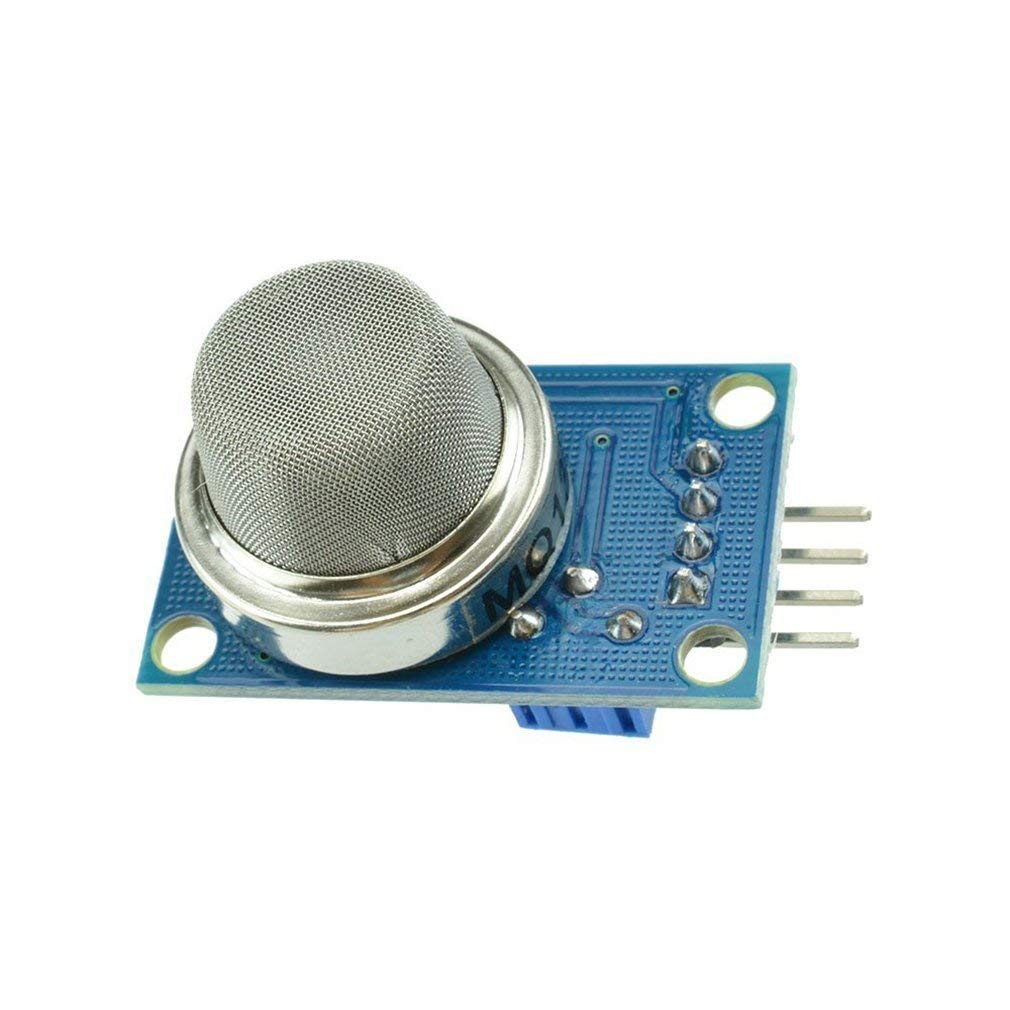
MQ-135 Air Quality / Gas Detector Sensor Module
Pair your colour sensor project with gas sensing for a complete environmental monitoring station. The MQ-135 detects ammonia, benzene, and CO2 levels reliably.

LM35 Temperature Sensor
Add temperature compensation to your colour measurement setup — temperature shifts can affect LED output and sensor readings at extremes.
Buying Guide for India
Both sensors are readily available in India. Here are the key points to keep in mind:
- TCS3200 modules are sold as a complete PCB with 4 white LEDs already soldered. Make sure the module you buy has the chip clearly labelled TCS3200 (or TCS230) — there are clones with unstamped ICs that perform poorly.
- TCS34725 modules are commonly found in the Adafruit breakout board format. Many Indian suppliers stock compatible (non-Adafruit branded) breakouts that work identically with the Adafruit library.
- Always check whether the module includes a white LED for illumination. Without it, you depend entirely on ambient light, which makes readings highly inconsistent.
- For prototyping, buy a set of white paper squares and a set of coloured test cards along with the sensor to calibrate properly before integrating into your final project.
Frequently Asked Questions
Q1: Can I use TCS3200 with ESP32 or ESP8266?
Yes, but you need a level shifter because the TCS3200’s output can be 5 V while ESP32/ESP8266 GPIO pins are 3.3 V tolerant. A simple voltage divider (1kΩ + 2kΩ) on the OUT line works fine.
Q2: Can two TCS34725 sensors be used on the same I2C bus?
Not directly — both have the fixed address 0x29. Use a TCA9548A I2C multiplexer to connect multiple TCS34725 sensors on one bus.
Q3: Which sensor is better for a line-following robot?
For basic black/white line detection, TCS3200 is perfectly adequate and cheaper. If your line-following robot needs to navigate multi-coloured paths, TCS34725 gives more reliable differentiation.
Q4: Does the TCS34725 need an external light source?
Most breakout modules include an on-board white LED. If yours does not, you must provide consistent illumination — an external white LED connected to a controlled GPIO pin works well.
Q5: How far should the sensor be from the object?
For TCS3200: 10–20 mm is optimal. For TCS34725: 5–15 mm for best accuracy. Always calibrate at the same distance you will use in production.
Q6: Can these sensors identify transparent or glossy surfaces?
Glossy surfaces cause specular reflections that can saturate the sensor. Diffuse white paper or matte surfaces give the most repeatable readings. Reduce gain or integration time when measuring reflective surfaces.
Conclusion
Both the TCS3200 and TCS34725 are solid colour sensors for DIY and maker applications. The TCS3200 wins on price and simplicity for basic colour-category detection — ideal for student projects, line-following robots, and anyone just starting out with colour sensing. The TCS34725 wins on accuracy, ease of interface (I2C), IR rejection, and dynamic range — making it the right choice for any project where colour precision matters or the environment cannot be tightly controlled.
If you are in India and budget is not a constraint, go with the TCS34725. If you are experimenting or teaching, the TCS3200 gives you a thorough understanding of how frequency-based colour sensing works. Either way, Zbotic stocks a wide range of sensors to complete your project — explore the sensor collection below.



Add comment