
Charging Profile Stages: CC CV Float for Lead Acid Battery Explained
Whether you are building a solar charge controller, an uninterruptible power supply (UPS), or simply maintaining the battery in your inverter at home, understanding the charging profile CC CV float lead acid battery stages is essential knowledge. Charging a lead-acid battery with the wrong profile is one of the most common causes of premature battery failure in India, where inverter batteries often die within 2–3 years instead of their designed 5–7 year lifespan. In this comprehensive guide, we explain every stage of the three-phase charging process — bulk, absorption, and float — and show you how to configure chargers and battery management circuits to maximise the life of your lead-acid batteries.
Why Charging Profile Matters
Lead-acid batteries are electrochemical devices with specific chemical reactions happening during charge and discharge. The active materials — lead dioxide (PbO₂) at the positive plate and sponge lead (Pb) at the negative plate, immersed in sulphuric acid electrolyte — undergo reversible reactions that depend critically on the voltage applied and the current flowing.
If you charge too fast (too high a current), the battery cannot absorb charge fast enough, and the excess energy goes into electrolysing the water in the electrolyte — producing hydrogen and oxygen gas. This is called gassing. Mild gassing is normal at the end of charge; excessive gassing causes electrolyte loss, plate corrosion, and in sealed batteries (VRLA, AGM, Gel), venting or rupture.
If you charge too slowly or at too low a voltage, the battery never reaches full charge and sulphation occurs — lead sulphate crystals form on the plates and harden over time, permanently reducing capacity. This is the most common failure mode in improperly maintained inverter batteries across India.
The three-stage CC-CV-Float profile addresses both problems elegantly: charge fast at first, then switch to a controlled finishing charge, then maintain indefinitely without overcharging.
Stage 1: Bulk Charge (Constant Current — CC)
The bulk stage is the first and fastest phase of charging. The charger delivers a constant current (typically C/5 to C/10 of the battery’s capacity) until the battery voltage rises to the absorption voltage threshold.
What Happens Chemically
During bulk charge, the lead sulphate (PbSO₄) that formed on both plates during discharge is converted back into lead dioxide (positive plate) and sponge lead (negative plate), releasing sulphuric acid back into the electrolyte. The electrolyte specific gravity rises, and battery voltage climbs steadily.
Key Parameters
- Current: 10–25% of rated Ah capacity (a 100Ah battery charges at 10–25A)
- Voltage: Rises freely from the depleted battery voltage (~11.7V for a 12V battery) up to the absorption voltage
- Duration: Typically 70–80% of total charge time; restores 80–90% of capacity
- Termination: When voltage reaches the absorption setpoint (see table below)
Higher bulk current charges faster but increases heat and gassing. For standby applications (UPS, inverters), C/10 is ideal — a 100Ah battery charges in about 10 hours on one complete cycle. For cyclic applications (golf carts, forklifts, solar), C/5 is acceptable.
Important for Indian conditions: Battery temperature significantly affects optimal charging voltage. Standard charger setpoints are calibrated for 25°C. In summer months when ambient temperatures reach 40–45°C in many Indian cities, the battery temperature during charging can exceed 50°C. At higher temperatures, the gassing voltage drops, so using fixed setpoints calibrated for 25°C will overcharge the battery. Temperature-compensated charging (−3mV/°C/cell for flooded, −4mV/°C/cell for AGM) is strongly recommended.
Stage 2: Absorption Charge (Constant Voltage — CV)
Once the battery reaches the absorption voltage, the charger transitions to constant-voltage mode. It holds the voltage at the absorption setpoint while the current naturally decreases as the battery fills up.
What Happens Chemically
At the absorption voltage, the bulk conversion reaction (lead sulphate to active material) is nearly complete. The remaining sulphate is in harder-to-reach locations within the plate structure. The lower current at constant voltage gently completes this conversion without overheating or gassing excessively. The electrolyte continues to rise in specific gravity towards its fully charged value (~1.265 for a flooded battery at 25°C).
Key Parameters
- Voltage: Held constant at the absorption setpoint (see table below)
- Current: Starts at the bulk current and tapers exponentially towards zero
- Duration: 1–4 hours depending on battery type and depth of discharge; ends when current drops below ~2–3% of capacity (2–3A for a 100Ah battery)
- Purpose: Completes the charge, ensures sulphation is fully reversed, conditions plates
Skipping or shortening the absorption stage is one of the most damaging things you can do to a lead-acid battery. It is the equivalent of taking medicine for two days instead of the prescribed seven — the superficial problem improves but the underlying issue persists and worsens over time.
Gel batteries require a lower absorption voltage than flooded batteries and are more sensitive to overcharging. Never use a flooded battery charger on a gel battery without verifying the voltage setpoints are compatible.
Stage 3: Float Charge
After absorption, the battery is fully charged. If you simply disconnect the charger, the battery will self-discharge gradually (1–3% per month for sealed batteries, up to 5–10% per month for flooded batteries in hot weather). For standby applications — UPS, inverter backup, emergency lights — you need the battery to remain at full charge indefinitely.
Float charge solves this: the charger drops to a lower constant voltage that just compensates for self-discharge and the small current needed to maintain electrolyte in VRLA batteries. At float voltage, the chemical reactions are in equilibrium — no net charging, no net discharging, no significant gassing.
Key Parameters
- Voltage: Float setpoint, lower than absorption (see table below)
- Current: Very small — typically 1–10mA per Ah of capacity
- Duration: Indefinite — the battery can stay on float for years
- Purpose: Maintains full charge without damage; ideal for standby applications
Float vs trickle charge: These terms are sometimes used interchangeably but have an important distinction. Float is a constant-voltage circuit that adjusts current automatically; trickle is a constant-low-current approach (typically C/300). Float is safer for long-term maintenance because it cannot overcharge — the voltage ceiling limits electrolysis regardless of how long the charger runs.
Optional Stage 4: Equalization Charge
Flooded (wet cell) lead-acid batteries benefit from a periodic equalization charge — a controlled overcharge at a higher voltage (typically 2.4–2.5V/cell = 14.4–15V for a 12V battery) for 1–3 hours. This deliberately causes gentle gassing, which stirs the electrolyte (which can stratify with denser acid settling to the bottom), reverses minor sulphation, and ensures all cells reach the same state of charge.
Equalization should be done:
- Every 1–3 months for batteries in standby use
- When specific gravity readings between cells differ by more than 0.010 points
- After deep discharge events
- Never on sealed batteries (VRLA, AGM, Gel) — they cannot vent gas safely
Voltage Reference Table by Battery Type
All voltages are for a 12V nominal (6-cell) battery at 25°C. For 24V systems, double all values.
| Battery Type | Bulk End / Absorption | Float | Equalization |
|---|---|---|---|
| Flooded (Wet Cell) | 14.4–14.8V | 13.2–13.5V | 14.4–15.5V |
| AGM (Absorbent Glass Mat) | 14.4–14.6V | 13.5–13.8V | N/A |
| Gel | 14.0–14.2V | 13.5–13.8V | N/A |
| LiFePO4 (for comparison) | 14.4–14.6V | No float needed | N/A |
Temperature compensation formula: Adjust the setpoints by −3mV per cell per °C above 25°C and +3mV per cell per °C below 25°C. For a 12V (6-cell) battery at 40°C: reduce absorption setpoint by 6 cells × 3mV × 15°C = 270mV (i.e. from 14.4V to 14.13V).
Common Charging Mistakes and How to Avoid Them
1. Using a Car Battery Charger on a Deep-Cycle Battery
Automotive chargers are designed for starting batteries — high cold-cranking amps, shallow discharge. They often charge at too high a current and lack proper absorption/float stages. Using them on deep-cycle inverter batteries causes premature plate degradation. Use a charger rated for deep-cycle use.
2. Leaving Battery Connected to a Non-Float Charger Indefinitely
Simple constant-voltage chargers or chargers that stay in absorption mode permanently will slowly gas away the electrolyte over weeks. Always use a smart charger that transitions to float mode, or disconnect after absorption completes.
3. Charging Immediately After Deep Discharge
Deeply discharged batteries (below 10.5V for a 12V battery) have heavy sulphation. Applying full charge current immediately can cause high temperatures and buckling of plates. Use a charger with a recovery/desulphation mode that applies a lower voltage (12–12.6V) for 1–2 hours first to reconstitute the plate chemistry before switching to bulk mode.
4. Ignoring Temperature in Indian Summer
As discussed, standard setpoints overcharge batteries at 40°C+. If your charger lacks temperature compensation, manually reduce the absorption setpoint by about 0.3V during peak summer months as an approximation.
DIY Charge Controller with Arduino
You can build a simple three-stage lead-acid charger using an Arduino, a voltage sensor (resistor divider or INA219), a current sensor (INA219 or ACS712), and a PWM-controlled power MOSFET or SMPS module. Here is the high-level state machine logic:
- State: BULK — Set MOSFET PWM to maximum current. Monitor voltage. When voltage ≥ absorption_setpoint, transition to ABSORPTION.
- State: ABSORPTION — Use a PID loop on the PWM duty cycle to hold voltage at absorption_setpoint. Monitor current. When current < 0.03 × capacity_Ah, start a timer. After timer_duration (e.g. 30 minutes of stable low current), transition to FLOAT.
- State: FLOAT — Adjust PWM duty cycle to hold voltage at float_setpoint. Remain in this state indefinitely. Monitor for low-voltage event (load connected). If voltage drops below 12.8V, transition back to BULK.
Display the current state, voltage, current, and Ah counter on an OLED screen (as described in our battery monitor article) for a complete, informative charger dashboard.
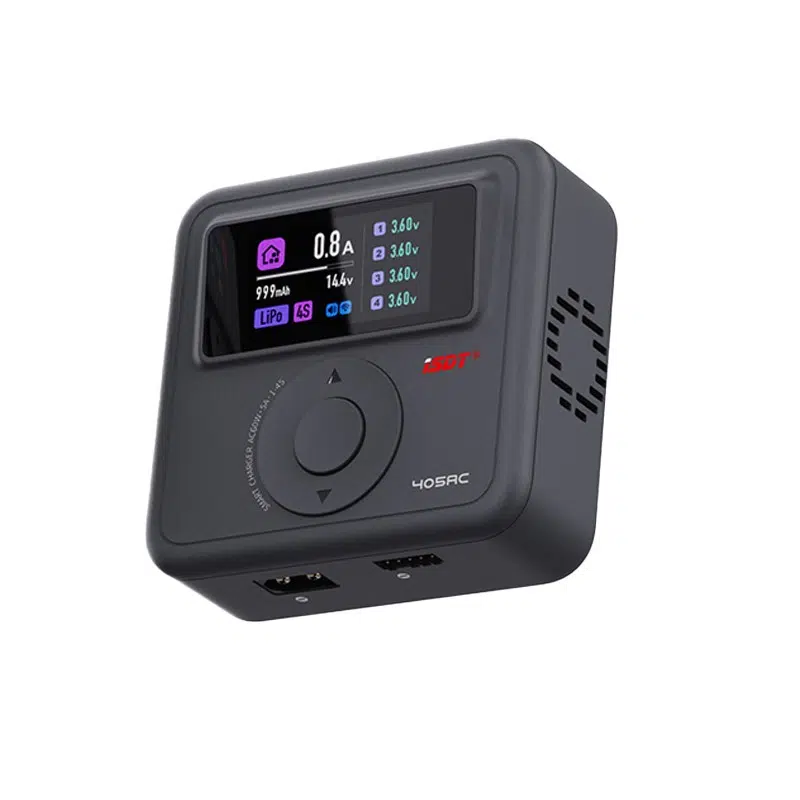
ISDT 405AC 60W AC GaN Smart Charger – 1–4S LiPo/LiHv/LiFe (XT60)
Precision GaN smart charger that implements proper CC-CV termination for LiPo, LiHv, and LiFe packs. Compact, efficient, and programmable — ideal for understanding how professional charge profiles work.

ISDT 608 AC LiPo Charger – AC 50W / DC 200W Dual Mode RC Charger/Discharger
Dual-mode professional charger and discharger for multiple battery chemistries. Study its CC-CV charge curves on the display to build intuition about real-world three-stage charging behaviour.
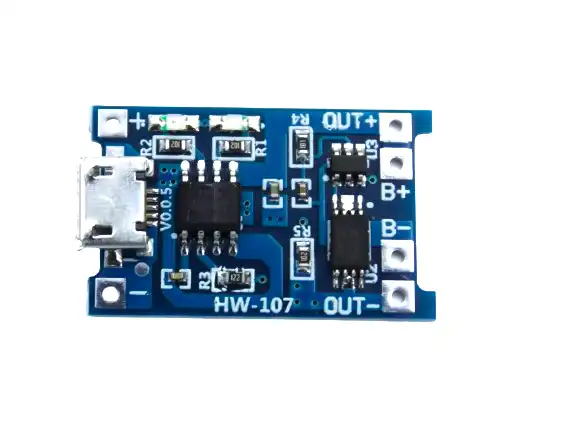
TP4056 1A Li-Ion Battery Charging Board Micro USB with Current Protection
The TP4056 IC implements a textbook CC-CV profile for 4.2V Li-ion cells. Its internal state machine is a miniature version of the three-stage process explained in this article — a great reference design to study.

18650 Polymer Li-ion Charger Type C to 3S 12.6V 2A Booster Module
USB Type-C to 3S 12.6V charger and boost module — perfect for powering 12V systems from a Li-ion pack with proper CC-CV charging built in. Great for portable projects and solar backup builds.
Frequently Asked Questions
Can I use the same CC-CV-Float profile for Li-ion batteries?
The three-stage concept applies to Li-ion as well — bulk (CC) followed by absorption (CV) — but the voltage setpoints are completely different and there is no float stage for lithium chemistry. A 3.7V Li-ion cell charges to 4.2V CV and terminates when current drops to C/20 or C/30. There is no float voltage because lithium chemistry does not need topping-up current; it is fine to simply disconnect after CV termination. Charger ICs like the TP4056 implement this automatically.
What is the difference between AGM and Gel batteries for charging?
Both are VRLA (valve-regulated lead-acid) sealed batteries, but they differ in electrolyte immobilisation. AGM uses fibreglass mat; Gel uses silica to solidify the electrolyte. Gel is more sensitive to overcharge — it requires a lower absorption voltage (14.0–14.2V vs 14.4–14.6V for AGM). Using an AGM charger on a Gel battery causes dry-out and permanent capacity loss. Always use the correct charger type or a multi-mode charger with selectable battery type.
How long should the absorption stage last?
Typically 1–3 hours for a partially discharged battery, up to 6–8 hours for a deeply discharged or sulphated battery. Most smart chargers terminate absorption when current drops to 2–3% of battery capacity (i.e. 2–3A for a 100Ah battery). Using time-based termination alone is less accurate because a cold battery takes longer to reach termination current than a warm one.
Is it safe to leave a battery on float charge permanently?
Yes, for sealed VRLA batteries (AGM and Gel), permanent float is the designed operating mode. They are made for standby service. For flooded batteries, permanent float is acceptable but the electrolyte level should be checked every 3–6 months, as even at float voltage there is a small ongoing gassing reaction that consumes water over time. Top up with distilled water (not tap water) to the maximum fill line.
My inverter battery feels warm during charging. Is that normal?
Mild warmth during the bulk charge phase is normal — it is caused by the electrochemical reactions and internal resistance. The battery should feel warm to the touch but not hot. If the battery becomes too hot to hold comfortably (above 45–50°C), reduce the charge current or check for a shorted cell (which would cause excessive current draw). In Indian summers, improve ventilation around the battery to prevent heat build-up.
From professional smart chargers to TP4056 modules and battery protection boards, Zbotic.in stocks everything you need to implement correct charging profiles in your projects. Order today with fast shipping across India and keep your batteries healthy for years to come.






Add comment