
Combat robotics is one of the most exciting — and brutally competitive — branches of DIY robotics. Whether you’re preparing for a college fest event, the Indian Robotic League, or simply want to understand what it takes to build a robot that can take a hit and dish one out, this guide to battle robot design weight weapon drive systems will give you a solid engineering foundation. From choosing the right weight class to picking a weapon that can win fights, we cover everything here.
Understanding Weight Classes
Combat robot events use weight classes to ensure fair competition. Each class has strict rules about maximum total robot weight including all onboard electronics, weapons, and batteries. The most common classes you’ll encounter at Indian college events and national competitions are:
- 150g (Fairyweight): Ultra-compact, fits in your palm. Usually limited to shufflebot or wheeled designs. Great for beginners due to low cost of failure — parts are cheaper and arena damage is minimal.
- 454g (Antweight): The most popular beginner class internationally. Allows spinning weapons. Components must be extremely lightweight — titanium and carbon fibre are common even at this weight.
- 1 kg (Beetleweight): The dominant class in India’s college robotics scene. Balances complexity and cost well. You can run a meaningful horizontal spinner or flipper at this weight.
- 3 kg (Featherweight): Full-featured combat robots with real destructive potential. Requires more investment in machined aluminium or HDPE frames.
- 13.6 kg (Lightweight): Regional and national championship class. Serious engineering challenges. Motors alone can cost ₹5,000–₹20,000.
- 120 kg (Heavyweight): TV-level combat robotics (BattleBots, Robot Wars). Out of reach for most student teams in India.
For most Indian college teams, the 1 kg beetleweight class offers the best balance of affordability, skill development, and competition availability.
Chassis Design and Materials
The chassis must perform two contradictory jobs simultaneously: be as light as possible (to leave weight budget for weapons) while being strong enough to survive impacts. Here’s how experienced builders approach this:
Low-Profile vs. High-Profile
Low-profile robots (under 30 mm tall) are harder to flip and present less surface area to spinning weapons. However, they constrain battery placement and make maintenance difficult. High-profile robots are easier to work on but more vulnerable to horizontal spinners.
Material Choices
- HDPE (High-Density Polyethylene): Cheap, machineable with a drill press or Dremel, absorbs impacts without shattering. The go-to material for beginner beetleweight chassis. 10 mm HDPE sheets cost ₹200–₹400 per sheet from hardware suppliers.
- Aluminium 6061: Stronger than HDPE, much lighter than steel. Requires a milling machine or CNC for accurate cuts. Good for brackets and weapon mounting plates.
- 3D Printed PLA/PETG: Accessible and fast to iterate, but shatters on hard impacts. Best used for non-structural parts (battery mounts, sensor brackets, lid panels).
- S7 Tool Steel / Hardox: Used for weapon spinners and wear-resistant armour. Extremely hard to machine at home — requires waterjet or laser cutting services.
Frame Topology
Two-wheel drive robots typically use a simple rectangular or wedge-shaped frame. Four-wheel drive adds stability but adds weight. For spinner weapons, the frame must be designed to absorb the gyroscopic forces from a spinning disc or drum without cracking.
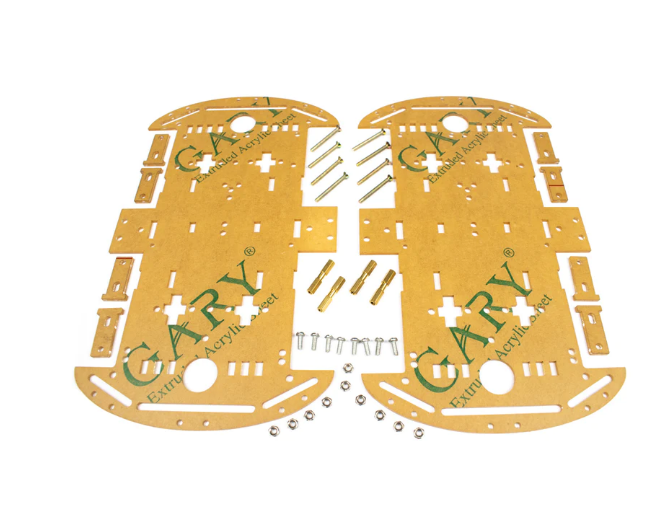
4 Wheels Car Chassis Acrylic Frame
Solid 4WD acrylic frame chassis — a great base for a non-weapon beetleweight or rambot. All four wheels powered for maximum pushing force in the arena.
Drive System Options
Your drive system determines your robot’s speed, turning agility, and pushing power. These are the main choices:
Differential Drive (Tank Steering)
Two independently controlled drive wheels (one on each side). Turning is achieved by running wheels at different speeds. Simple, reliable, and leaves maximum weight budget for weapons. The vast majority of combat robots use this configuration. Suitable for beetleweights through heavyweights.
4WD with Skid Steering
Four wheels, paired on each side. Adds stability and pushing traction but costs extra weight and motor complexity. Good for wedge-style rambots where pushing power is the weapon.
Omni / Mecanum Drive
Allows strafing movement — the robot can move sideways without rotating. Rarely used in combat robots because mecanum wheels are fragile and the rollers are easily destroyed by arena debris. More novelty than practical in combat.
Motor Selection for Combat Drive
For a 1 kg beetleweight, N20 micro gear motors (1000–3000 RPM, 3V–6V) are the standard choice. For a 3 kg featherweight, 25mm or 37mm DC gear motors with metal gearboxes are needed. Motor stall torque must be high enough to resist being pushed without the gears stripping.
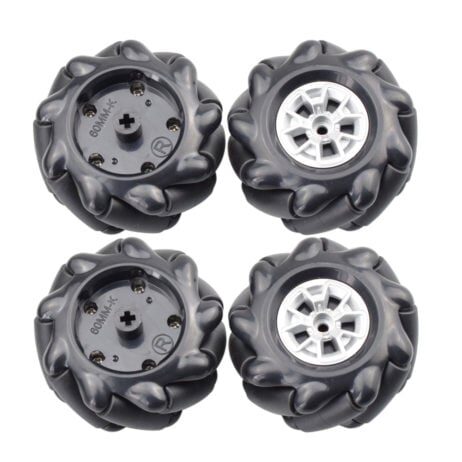
60MM-K Mecanum Wheel (Pack of 4) – Black
Holonomic drive wheels for experimental combat designs. 60mm diameter suits smaller featherweight-class robots needing omnidirectional agility.
Weapon Types and Their Trade-offs
The weapon is what makes combat robotics exciting. Each type has distinct engineering requirements, failure modes, and strategies:
Horizontal Spinner
A heavy spinning bar or disc rotating in the horizontal plane. Delivers massive kinetic energy to opponents, sending them flying across the arena. Requires a powerful brushless motor and ESC, precision balancing to avoid destructive vibration, and robust weapon mounts. One of the most effective weapons in the sport but punishing if it hits a hard wall — the robot itself recoils violently.
Vertical Spinner / Full-Body Spinner
Disc or drum spinning vertically. Tends to launch opponents upward. Vertical spinners are generally safer on arena walls. Full-body spinners (the entire robot shell spins) are the most dangerous to opponents but complex to build.
Drum Spinner
A drum-shaped spinning weapon at the front of the robot. High hit frequency (many teeth strike per second), lower energy per hit than a single-tooth spinner. More robust mechanically since the drum distributes stress. Great choice for beginner builders who want a reliable spinner weapon.
Flipper / Lifter
A pneumatic or servo-driven arm that gets under the opponent and flips them over. Many robots cannot self-right once inverted, making flippers very effective. Pneumatic flippers (CO2) are powerful but regulated in many Indian events — check rules before building. Servo-powered lifters are simpler and event-legal almost everywhere.
Crusher / Axe
A pneumatic or servo-driven arm that drives a hardened spike into the opponent. Requires piercing through armour, which is difficult against modern HDPE and aluminium bots. More popular as a secondary weapon combined with a spinning drum.
Wedge / Rambot (No Active Weapon)
A robot with a low wedge front and powerful drive. Gets under spinners before they reach full speed, then pushes opponents into arena hazards. Surprisingly effective against glass-cannon spinners. Easiest weapon type to build reliably.
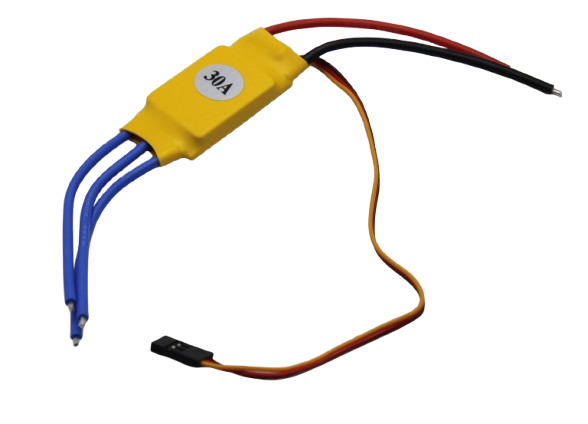
30A BLDC ESC Brushless Electronic Speed Controller
30A brushless ESC suitable for driving spinner weapon motors up to featherweight class. Handles regenerative braking for faster weapon spin-down between hits.
Electronics, ESCs and Radio Control
Combat robot electronics must survive vibration, magnetic fields from motors, and occasional short circuits when wires get shredded. Key components:
Radio System
A minimum of 2-channel RC is needed (left drive, right drive). 4+ channels allow separate weapon control. For Indian events, 2.4 GHz spread-spectrum systems (FlySky, Futaba) are required — older 27/40 MHz systems are banned due to interference. The FlySky FS-GT2 and FS-G7P are popular choices for combat bots due to their reliability and affordability.
Drive ESCs
Most beetleweights use dual-channel ESC boards (e.g., Repeat Robotics or DualSky combat ESCs). For higher weight classes, two single-channel RC car ESCs wired in mixed mode work well and are easily replaced after battle damage.
Weapon ESC
Brushless spinners need a dedicated ESC. Match the ESC amperage to the motor’s rated stall current with 20% headroom. A 30A brushless ESC is appropriate for most featherweight spinners. Add a capacitor bank across the power leads to absorb voltage spikes when the weapon hits something.
Battery
LiPo batteries are universal in combat robotics. 3S (11.1V) for most drive and weapon systems. 4S (14.8V) for higher-power builds. Ensure the battery is protected in the most shielded part of the chassis — a punctured LiPo is a fire hazard in the arena.
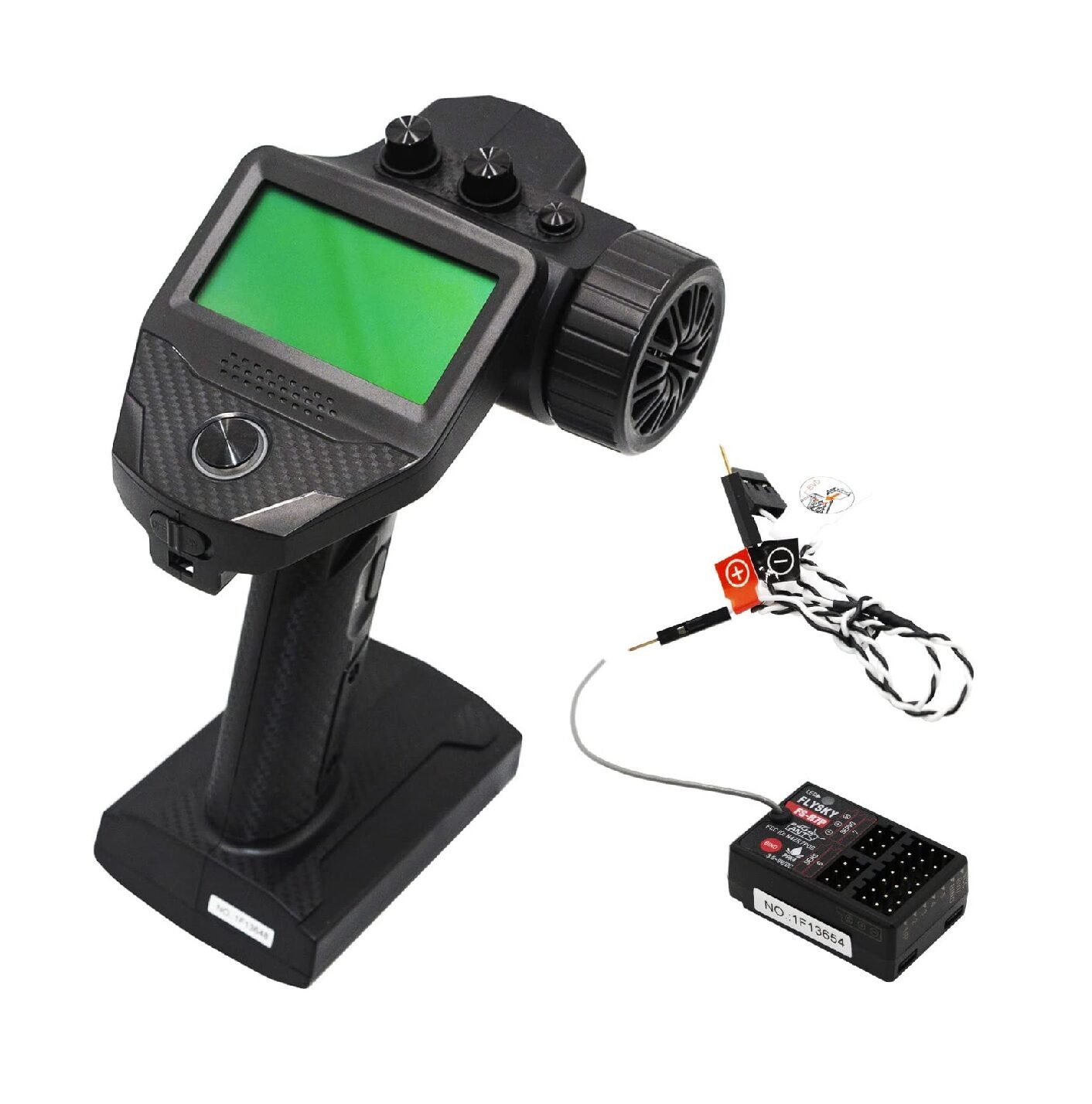
Flysky FS-G7P 2.4 GHz Transmitter with FS-R7P Receiver
Upgraded 7-channel 2.4 GHz radio set for combat robots. Multiple channels for drive + weapon control. Failsafe feature cuts weapon spin if signal is lost — mandatory at most events.
Armour and Defensive Design
A robot that can’t survive to the end of the match can’t win. Armour strategy depends on your weapon type and expected opponents:
- Against horizontal spinners: Angled or wedge-shaped front armour deflects the spinner’s disc over the top rather than absorbing the hit directly. Stainless steel or Hardox 450 front wedges are popular for this.
- Against vertical spinners: Low-profile design reduces the target surface. Thick HDPE top armour can absorb the upward energy without shattering like acrylic would.
- Against flippers: Design a low centre of gravity and self-righting mechanism (SRM). An SRM can be as simple as a curved shell that lets the robot roll back upright, or an active arm.
- General armour: 6–10 mm HDPE on sides, 3 mm aluminium on top, minimal mass at the rear (motors and batteries create their own armour by being heavy).
Practical Building Tips for India
Building a combat robot in India comes with specific logistical challenges that international guides often overlook:
- Machining access: Most cities have small machine shops (lathe + drill press) that will cut aluminium and HDPE for ₹200–₹500 per part. Build a relationship with your local machinist early.
- Waterjet cutting: Available in industrial areas of major cities (Mumbai, Pune, Hyderabad, Delhi NCR). Ideal for weapon spinner blades in hardened steel. Expect ₹500–₹2,000 per part depending on material and complexity.
- Fasteners: Use only metric M3 and M4 nylon-insert locknuts (Nylock). Vibration will back out standard nuts within minutes of combat. Available at hardware stores across India for under ₹2/piece.
- Regulations: Always download and read the specific event rulebook. Indian college events often have lower weight limits and stricter weapon rules than international events. Pneumatic weapons and certain spinner configurations may be outright banned.
- Practice arena: Build a basic arena from 12mm plywood sheets before attending your first event. Running your robot on a carpeted floor is not representative of arena conditions.
Frequently Asked Questions
What is the easiest battle robot type for a first-time builder?
A wedge-style rambot with differential drive and no active weapon. It teaches you all the fundamentals of chassis design, electronics integration, and driving without the added complexity of a spinning weapon system.
How much does it cost to build a 1 kg beetleweight in India?
A basic wedge or drum-spinner beetleweight can be built for ₹3,000–₹8,000 including chassis materials, motors, ESCs, radio receiver, and battery. Machining costs vary widely. A competition-grade build with quality electronics and machined parts runs ₹12,000–₹25,000.
Is FlySky radio reliable enough for combat use?
Yes. FlySky 2.4 GHz systems use AFHDS-2A frequency hopping which is resistant to interference. The key requirement is configuring the failsafe to cut weapon motor power if signal is lost — most event rules mandate this for safety.
Can I use a 3D-printed chassis for a beetleweight?
A fully 3D-printed chassis will not survive spinner impacts. However, 3D printing is excellent for rapid prototyping of geometry before final fabrication in HDPE or aluminium, and for internal mounting brackets and battery holders.
Which events in India accept beetleweight combat robots?
Major Indian robotics competitions that include combat events: Techfest (IIT Bombay), Shaastra (IIT Madras), Cognizance (IIT Roorkee), Kshitij (IIT Kharagpur), BITS Open Sports Meet (BOSM), and numerous state-level college tech fests. Check each event’s current rulebook for weight class acceptance.
From chassis kits and motor drivers to RC receivers and brushless ESCs, Zbotic stocks everything you need to build a competition-ready battle robot. Shop Robotics & Automation and get fast delivery anywhere in India.






Add comment