
India’s agriculture sector is rapidly embracing automation, and one of the most impactful DIY projects you can build is an agricultural robot for weed detection and spraying. This guide walks you through designing a field-ready robot that identifies weeds using a camera and machine-vision model, then activates a precision spray nozzle only over the weed — cutting herbicide use by up to 90% compared to blanket spraying.
Why Agricultural Robots for Weed Control?
Manual weeding costs Indian farmers 25–40% of total crop labour expenses. Chemical herbicides used indiscriminately harm soil health, contaminate groundwater, and leave residues on produce. Precision agricultural robots solve both problems simultaneously: they move row by row, spray only on detected weeds, and skip healthy crop plants entirely.
Early commercial systems (like Blue River Technology’s See & Spray, now owned by John Deere) cost crore-scale investments. But the underlying technology — camera + image classifier + solenoid valve — is buildable for under ₹15,000 using off-the-shelf components and open-source machine learning. Indian agricultural universities are already deploying student-built versions in test plots.
Beyond weeding, the same robot platform supports soil moisture sensing, crop health imaging (NDVI with a modified camera), and pest counting — making it a versatile agricultural IoT node.
System Overview and Architecture
The robot combines three subsystems:
- Mobility: A rugged 4WD chassis navigates along crop rows using row-following sensors (IR or ultrasonic) or GPS waypoints.
- Perception: A Raspberry Pi with camera runs a TensorFlow Lite or YOLO-Nano model trained to distinguish crop species from common weeds.
- Actuation: When a weed is detected within a defined region-of-interest, Arduino triggers a 12 V solenoid valve that opens a nozzle for a calibrated burst (typically 50–200 ms).
The Raspberry Pi handles vision (CPU-heavy) and sends simple serial commands to the Arduino (e.g. SPRAY_ON / SPRAY_OFF, MOVE_FWD). The Arduino manages real-time motor control and solenoid timing — tasks that require deterministic microsecond-level timing beyond the Pi’s Linux scheduler capabilities.
Hardware Components and Selection
Core bill of materials:
- Raspberry Pi 4 (4 GB RAM) — vision processing
- Raspberry Pi Camera Module v2 or v3
- Arduino Uno/Mega — real-time motor + solenoid control
- 4WD robot chassis with high-torque DC motors (200–300 RPM, metal gearbox)
- L298N dual H-bridge motor driver (×2 for 4 motors)
- 12 V mini diaphragm pump (agricultural grade, 8–10 L/hr)
- 12 V solenoid valve (normally closed, 3/4″ NPT)
- Flat fan spray nozzle (110° coverage, stainless)
- 2S or 3S LiPo battery pack (5000 mAh minimum)
- IR line sensors for row tracking (×2)
- Waterproof enclosure for electronics (IP54 minimum)
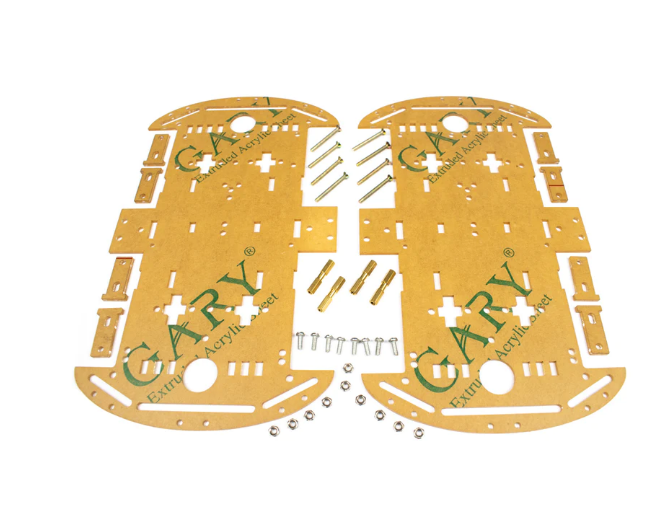
4 Wheels Car Chassis Acrylic Frame
Robust 4-wheel acrylic chassis with mounting holes for agricultural robot builds — handles uneven terrain better than 2WD.
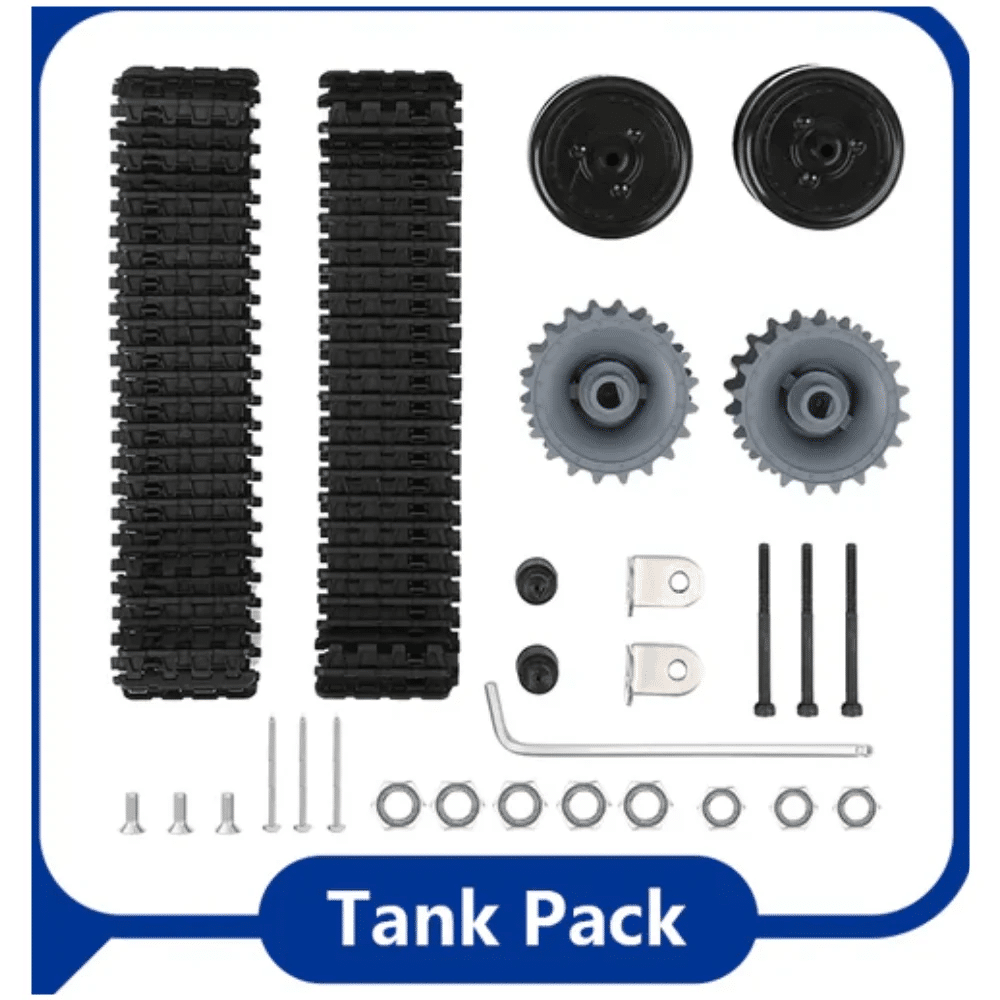
ACEBOTT ESP32 Tank Robot Car Expansion Pack
Tank-track expansion for ESP32 robot kits — superior traction on loose soil and uneven agricultural ground.
Outdoor Chassis and Drive System
Outdoor terrain demands more from a chassis than a flat lab floor. Key considerations for agricultural environments:
- Ground clearance: Minimum 5 cm to clear soil ridges and irrigation furrows. Raise the chassis body on 40 mm standoffs if needed.
- Wheel type: Pneumatic or rubber-spiked wheels give far better traction than smooth plastic wheels on wet soil. Mecanum wheels are useless in mud — stick to standard rubber tyres.
- Motor torque: A fully loaded robot (electronics + tank + 1 L herbicide) weighs 3–5 kg. Use motors rated for at least 3 kg-cm torque. Metal-geared motors at 150–200 RPM are ideal — fast enough to cover rows, slow enough for accurate spray placement.
- Waterproofing: Spray mist and dew will destroy unprotected electronics within days. Use conformal coating on PCBs, silicone sealant on enclosure joints, and rubber grommets on cable entries.
Row-following can be achieved with two downward-facing IR sensors detecting the dark/light contrast between soil and vegetation. Adjust motor speed differentially to keep the robot centred between crop rows. A PID controller works well: error = (left_sensor – right_sensor), correct with differential motor PWM.
Camera Vision and Weed Detection
Training a custom weed vs. crop classifier is the most technically demanding part of the project, but accessible tools have made it achievable for intermediate makers:
- Dataset collection: Photograph 300–500 images each of your target crop (e.g. wheat, rice, tomato) and common weeds (parthenium, wild grass, pigweed) under various lighting conditions. Use a phone camera for collection; relabel with LabelImg.
- Training: Use Google Teachable Machine (browser-based, zero-code) or Roboflow + YOLOv8 for bounding-box detection. Export as TensorFlow Lite (
.tflite) for Raspberry Pi inference. - Inference: Run the model on each camera frame using Python + TensorFlow Lite Interpreter. For 320×320 input, a Pi 4 achieves ~8–12 FPS — sufficient at low robot speeds (0.1–0.3 m/s).
- Trigger logic: If a weed bounding box appears in the bottom third of the frame (meaning the robot is directly over it), send the spray command via PySerial to Arduino.
Real-world accuracy tip: train your model in the actual field with real lighting, not from Google Image Search. Field-specific models trained on 200 local images often outperform generic models trained on 10,000 internet images.
Precision Spraying Mechanism
The spraying system has three components: reservoir, pump, and nozzle/valve assembly.
Reservoir: A 1–2 litre HDPE bottle with a secure cap is adequate for a test build. Commercial versions use stainless steel tanks. Position it low and centred for good weight distribution.
Pump: A 12 V diaphragm pump (similar to those used in windshield washers) provides adequate pressure (1–3 bar) for spray nozzles. Run it continuously while the robot is active; control herbicide delivery via the downstream solenoid valve only.
Solenoid valve: A normally-closed 12 V valve (opens when energised) gives fail-safe behaviour — if power cuts, spraying stops automatically. The Arduino controls a MOSFET or relay module to switch the valve. Pulse width controls spray dose: 100 ms burst sprays about 0.5 mL with a flat fan nozzle at 2 bar.
Nozzle selection: A flat fan nozzle (110°, 03 or 04 orifice) covers a 30–40 cm wide swath at 30 cm height — ideal for row crop spacing. Use stainless steel or ceramic nozzles; brass corrodes with many herbicide formulations.
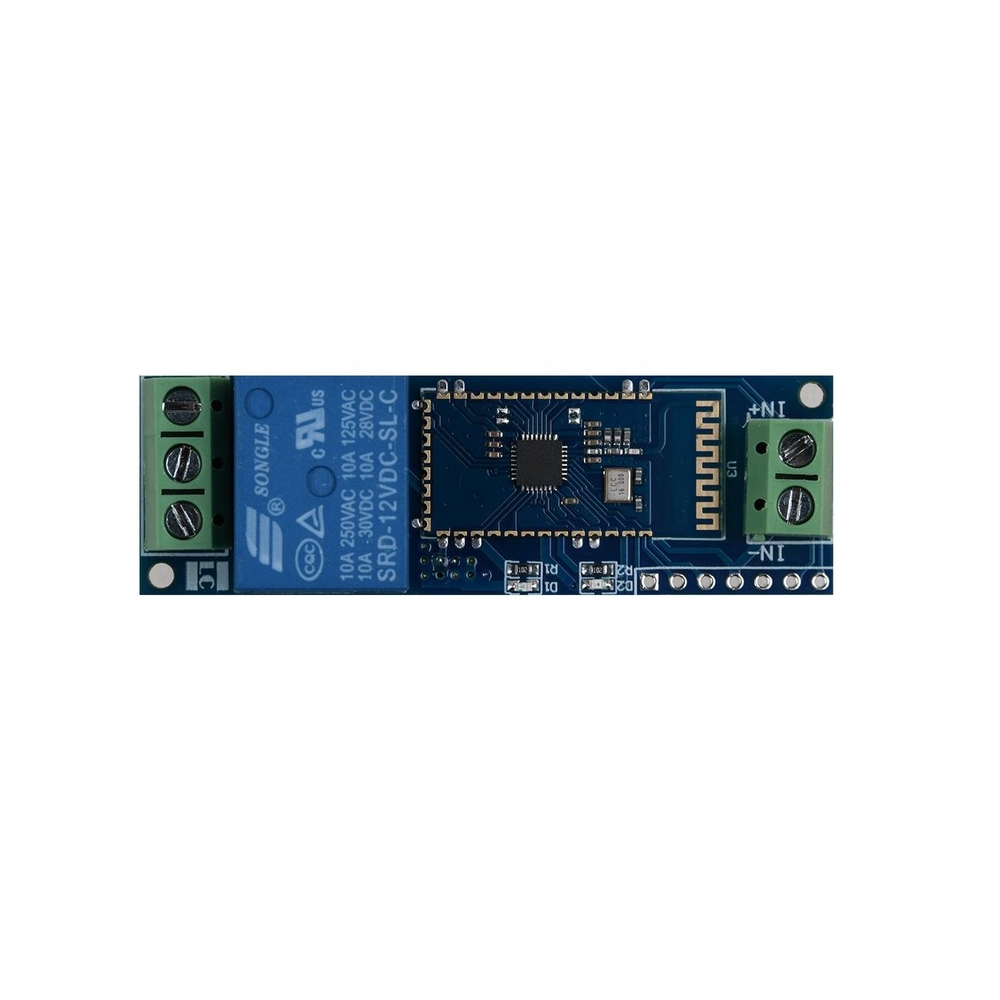
12V 1 Channel Bluetooth Relay Module
12V relay module for switching solenoid valves and pumps in your agricultural spraying robot.
Integrating Everything with Arduino and Raspberry Pi
Communication between Pi and Arduino uses UART serial at 115200 baud via a USB cable or GPIO UART pins. Define a simple protocol:
F— move forwardS— stopL/R— steer left/right (PID correction)P{ms}— spray pulse for {ms} milliseconds (e.g.P150)
The Pi sends motor corrections at ~10 Hz based on IR sensor readings (read via I2C expander or direct GPIO). Spray commands fire asynchronously when the vision model triggers. The Arduino executes spray pulses with delayMicroseconds() for precise timing without blocking motor control (use a state machine, not blocking delay).
Power architecture: A single 3S LiPo (11.1 V, 5000 mAh) powers everything. Step-down converters provide 5 V for Pi, 3.3 V for sensors, and 12 V for motors/solenoid. Separate the motor power ground from logic ground with a common point to prevent motor noise corrupting sensor readings.
Field Testing and Calibration Tips
- Start with water: Test spraying with plain water before loading herbicide. Verify nozzle pattern, valve timing, and pump pressure.
- Calibrate spray dose: Measure spray volume per pulse with a measuring cup. Adjust pulse width to hit your target dose (typically 20–50 mL/m² for contact herbicides).
- Test vision in field conditions: Morning dew, noon glare, and overcast shadows drastically change image appearance. Retrain or augment your dataset with field photos at different times of day.
- Check false positive rate: Spraying herbicide on crop plants is worse than missing a weed. Set the confidence threshold high (0.85+) so uncertain detections are skipped.
- Battery life: Expect 45–90 minutes per charge with motors, Pi, and pump all running. Carry spare batteries or a solar trickle-charge panel for all-day operation.
Frequently Asked Questions
- Which crops is this robot most suitable for?
- Row crops with distinct weed species work best — wheat, maize, cotton, vegetable rows. Dense canopy crops (rice paddy) are more challenging as weeds may be hidden under leaves.
- How much does it cost to build?
- A working prototype costs roughly ₹12,000–₹18,000 including chassis, Raspberry Pi, camera, pump, and sensors. Excluding the Pi (if you already own one), under ₹8,000.
- Can this robot work without GPS?
- Yes. Row-following with IR sensors works entirely without GPS. GPS becomes useful for large field navigation, returning to base, and logging spray maps.
- Is machine learning required for weed detection?
- Not necessarily. Simple colour-based detection (weeds are often a different shade of green than crops after calibration) works for some crop/weed pairs and requires only OpenCV — no ML model needed.
- What safety precautions are needed?
- Always test in an enclosed area first. Ensure all herbicide connections are leak-free. Mark the robot’s operating area clearly and keep children and pets away. Follow all pesticide handling regulations under India’s Insecticides Act.







Add comment