
Table of Contents
- What is Dropout Voltage?
- Standard Linear Regulators: The Classic 78xx Series
- LDO Regulators: Low Dropout Explained
- LDO vs Standard: Head-to-Head Comparison
- When to Use LDO vs Standard Regulators
- Recommended Products from Zbotic
- Design Tips and Common Mistakes
- Frequently Asked Questions
Choosing between a voltage regulator LDO dropout standard comparison is one of the most fundamental decisions in power supply design. Whether you are building an Arduino project powered by a 9V battery, an ESP32 IoT node on a LiPo cell, or a precision analog circuit that demands ultra-clean power, the right voltage regulator choice makes or breaks your design. This guide explains exactly what dropout voltage means, how LDO and standard regulators differ, and when to reach for each type — written for the practical Indian electronics maker.
What is Dropout Voltage?
Before diving into the comparison, you need to understand the single most important parameter that separates LDO from standard regulators: dropout voltage.
A linear voltage regulator works by dissipating excess voltage as heat. To regulate 5V output, the input must be higher than 5V — but by how much? That minimum difference between input and output voltages at which the regulator can still maintain regulation is called the dropout voltage (V_DO).
Expressed as an equation:
V_IN(min) = V_OUT + V_DO
If the input voltage falls below V_IN(min), the output drops out of regulation — it can no longer maintain the set output voltage.
Why does this matter in practice?
- A LiPo cell discharges from 4.2V down to 3.0V. If your regulator needs 5V input to output 3.3V, you need a boost converter or special low-dropout design.
- A 9V alkaline battery sags to 7V under load. If your regulator needs 2.5V headroom for a 5V output, you are fine — but if it needs 3.5V, you drop out early and waste capacity.
- Battery-powered products lose usable capacity if the regulator drops out early.
Standard Linear Regulators: The Classic 78xx Series
The LM7805, LM7812, LM7833 family — the 78xx series — are the workhorses of hobbyist and industrial electronics since the 1970s. These are NPN darlington pass transistor designs with a typical dropout voltage of 2.0V to 3.0V.
How They Work
Inside a 78xx regulator, a NPN (or NPN darlington) pass transistor sits between input and output. The base-emitter voltage of an NPN transistor is always a positive offset — meaning the collector (input) must be higher than the emitter (output) by at least V_BE plus the regulation headroom. This is why NPN-based regulators have inherently high dropout voltages.
Typical Specifications (LM7805)
- Output voltage: 5V fixed
- Dropout voltage: 2.0V typical (input must be at least 7V for 5V output)
- Maximum input voltage: 35V
- Maximum output current: 1A (TO-220 package)
- Operating temperature: 0°C to 125°C
- Price: Very cheap (Rs 5–15 per piece in India)
Advantages
- Extremely cheap and universally available
- Robust and tolerant of high input voltage spikes
- Excellent for dropping from wall adapter (12V, 9V) to 5V
- Adjustable versions (LM317) are highly versatile
- Very stable, low noise output
Disadvantages
- High dropout voltage (2–3V) makes them unsuitable for battery-powered designs
- Inefficient: all excess voltage is wasted as heat. 12V in, 5V out at 1A = 7W of heat!
- Requires a heatsink at higher currents
- Cannot function when input is only slightly above output
LDO Regulators: Low Dropout Explained
LDO (Low Dropout) regulators solve the dropout problem by using a PMOS (P-channel MOSFET) or PNP pass transistor instead of an NPN darlington. This architecture fundamentally changes the minimum headroom requirement.
Why PMOS Gives Lower Dropout
A PMOS transistor passes current when its gate is pulled low relative to its source. The source is connected to the input rail, the drain to the output. The voltage drop across the MOSFET depends only on R_DS(on) × I_load — which can be as low as 0.1V or even less at low currents. No base-emitter voltage stacking required.
Popular LDO ICs
- AMS1117-3.3: V_DO = 1.1V typical, 800mA, extremely popular in hobbyist projects
- MCP1700-3302: V_DO = 178mV typical, 250mA, ultra-low quiescent current (1.6µA)
- LP2985: V_DO = 280mV typical, 150mA, very low noise
- TPS73633: V_DO = 260mV typical, 400mA, for precision analog
- AP2112K-3.3: V_DO = 250mV typical, 600mA, common on breakout boards
Advantages
- Very low dropout (as low as 100–300mV) — ideal for battery-powered designs
- Better efficiency than standard regulators when input/output differential is small
- Low quiescent current (some ultralow IQ models draw less than 2µA — critical for sleep modes)
- Small packages (SOT-23, SOT-223) for compact PCBs
- Excellent noise performance for analog and RF circuits
Disadvantages
- More expensive than 78xx series
- Lower maximum input voltage (typically 6V–20V)
- PMOS pass element means output capacitor choice is critical for stability
- Lower tolerance to input voltage spikes compared to 78xx
- At high input-output differentials, LDOs are just as inefficient as standard regulators (heat = (V_IN – V_OUT) × I_load)
LDO vs Standard: Head-to-Head Comparison
| Parameter | Standard (78xx/LM317) | LDO (AMS1117/MCP1700) |
|---|---|---|
| Typical dropout | 2.0–3.0V | 0.1–1.2V |
| Pass element | NPN Darlington | PMOS or PNP |
| Cost | Very low (Rs 5–15) | Low to moderate (Rs 10–60) |
| Max input voltage | 35–40V (very tolerant) | 5.5–20V (varies by model) |
| Quiescent current | 5–8mA typical | 1µA–5mA (model dependent) |
| Battery suitability | Poor (wastes battery capacity) | Excellent |
| Noise/ripple | Very low | Very low (some models ultra-low) |
| Stability | Easy (any output cap) | Cap-dependent (check datasheet) |
| Best application | Wall adapter powered projects | Battery/low-headroom designs |
When to Use LDO vs Standard Regulators
Use a Standard Regulator (78xx/LM317) When:
- Your input is from a mains adapter (9V, 12V, 15V) and you are regulating down to 5V or 3.3V — the 4–9V headroom is plenty
- You need to handle high input voltage spikes (automotive, industrial environments)
- Cost is critical and you are producing in volume
- You need an adjustable output and do not want to bother with trim resistors on an LDO
- Input voltage is guaranteed to be at least 2–3V above output at all times
Use an LDO When:
- Powering from batteries (LiPo, NiMH, alkaline) where the input sags near the output voltage
- Generating 3.3V from a 3.7V LiPo (impossible with a standard regulator — not enough headroom!)
- Your microcontroller uses deep sleep and quiescent current matters
- PCB space is limited and you need a tiny package
- Input and output are close together (e.g., 5V in to 3.3V out from a regulated USB supply)
When Neither Is Ideal — Use a Switching Regulator (Buck/Boost)
- When efficiency matters most (battery-powered products above 100mA load)
- When you need to step UP voltage (e.g., 3.7V LiPo to 5V for USB devices) — linear regulators cannot do this
- When the input-output differential is large and heat dissipation is a concern
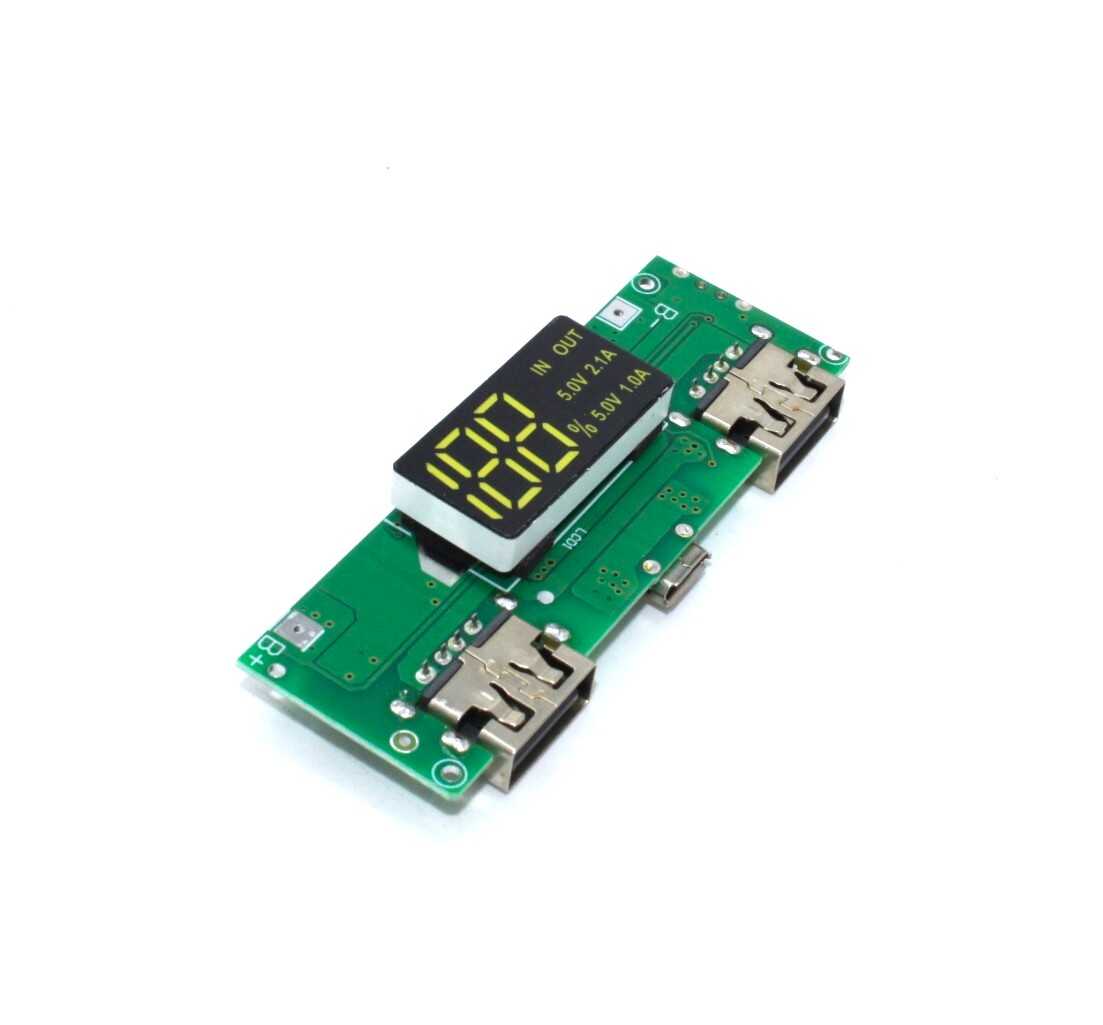
18650 5V 1A/2A Lithium Battery Digital Display Charging Module, Dual USB Output
An integrated boost module that steps up 18650 LiPo voltage to 5V — perfect when you need a voltage step-up that a linear LDO cannot provide.
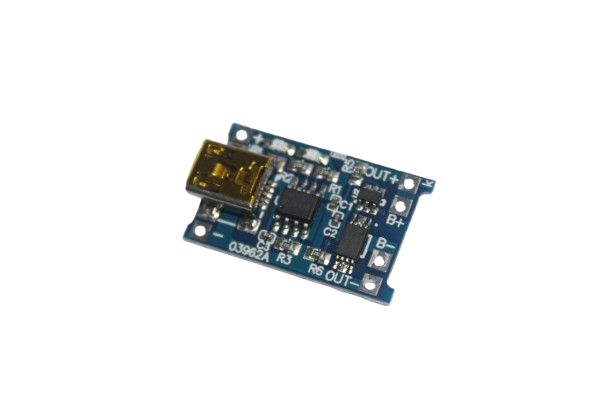
TP4056 1A Li-Ion Lithium Battery Charging Module With Current Protection – Mini USB
Pair this TP4056 charging module with an LDO regulator for a complete Li-Ion powered 3.3V MCU supply with charging and regulation in one compact design.
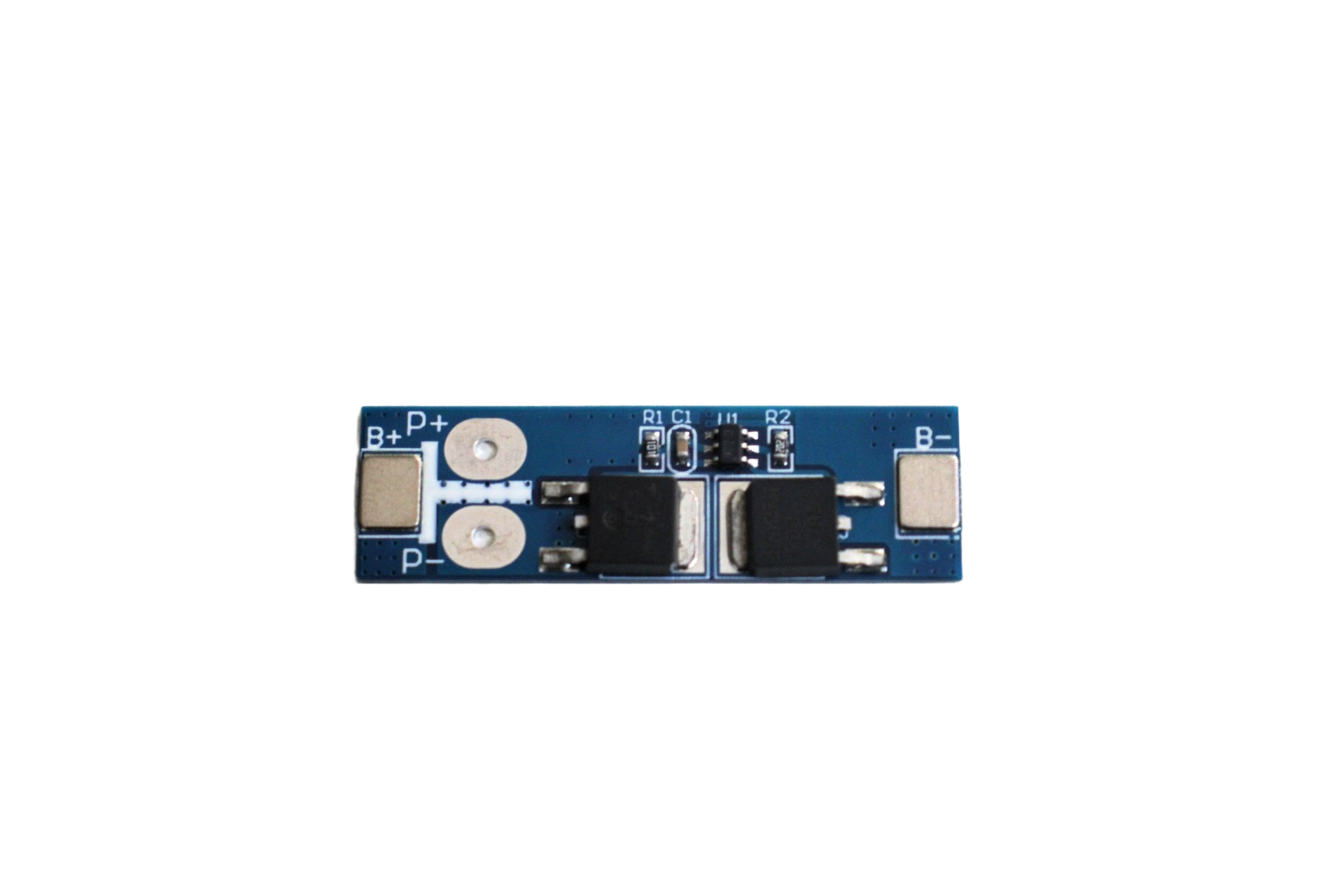
1S 12A 3.6V BMS Battery Protection Board for Li-Ion Cell
Use this BMS with an LDO regulator in Li-Ion battery-powered projects. Protects against over-discharge, over-charge, and short circuits.
Design Tips and Common Mistakes
Tip 1: Always Add Bypass Capacitors
Both standard and LDO regulators need input and output bypass capacitors. For standard regulators, 0.1µF ceramic on both input and output is sufficient. For LDOs, the output capacitor also affects stability — check the datasheet for the recommended capacitor type and value. Many LDOs require a minimum ESR range — too low (pure ceramic) or too high (old tantalum) can cause oscillations.
Tip 2: Thermal Management for High Current
Power dissipated = (V_IN – V_OUT) × I_LOAD. A 7805 running at 1A from 12V dissipates 7W — it will get burning hot without a heatsink. Always calculate thermal requirements. Use the TO-220 package with a heatsink for currents above 500mA with high differentials.
Tip 3: Do Not Use AMS1117 on a Coin Cell
The AMS1117 has a quiescent current of around 5–10mA — a coin cell (CR2032, 220mAh) would be drained in about 20 hours even with no load! For coin-cell powered circuits, use ultra-low IQ LDOs like MCP1700 (1.6µA Iq) or TPS7A10 (sub 0.5µA Iq).
Tip 4: Reverse Polarity Protection
Standard 78xx regulators are somewhat tolerant of reverse polarity (no internal damage at short durations). LDOs with PMOS pass elements can be damaged by reverse polarity — always include a series Schottky diode or a PMOS reverse-polarity protection circuit.
Tip 5: Paralleling Regulators
Never parallel multiple regulators of the same type expecting double current — they will fight each other due to slight output voltage differences. Use a single higher-current regulator or a switching regulator for high current needs.
Common Mistake: Choosing an LDO for a Wall Adapter Circuit
A very common mistake: using an AMS1117 LDO directly after a 12V wall adapter to get 3.3V. The AMS1117 will dissipate (12 – 3.3) × I = 8.7W at just 1A — it will fail. Use a 78xx series or ideally a buck converter in this scenario.
Frequently Asked Questions
Q: Can I use an LDO directly from a 4.2V LiPo to get 3.3V?
A: Yes — this is one of the most common LDO use cases. A fully charged LiPo at 4.2V provides 0.9V headroom for a 3.3V LDO. Most LDOs with sub-0.5V dropout will regulate fine. As the battery discharges to 3.0V, you will have 0.3V headroom — you need an LDO with dropout under 0.3V (like MCP1700, rated at 178mV dropout).
Q: My 7805 gets very hot. What should I do?
A: This is normal for high input-output differential and current. Options: add a heatsink to the TO-220 package, reduce the input voltage (add a dropping resistor for small loads), or replace with a buck converter (LM2596, MP1584) for much better efficiency.
Q: What is the difference between LDO and ultra-LDO?
A: There is no strict industry definition, but ultra-LDO typically refers to devices with dropout below 100mV at rated current. Devices like the LP5907 (75mV dropout) or TPS7A05 (85mV dropout) fall in this category. They are used in precision analog and RF circuits where minimum headroom is critical.
Q: Can a standard 7805 regulate 6V input to 5V output?
A: No — the 7805 needs at least 7V input (2V dropout minimum). At 6V input, the output will drop out of regulation and fall below 5V. You need an LDO like AMS1117-5.0 (1.1V dropout, needs 6.1V minimum) or an ultra-LDO for a 6V input.
Q: Is the AMS1117 the best LDO for Arduino/ESP32 projects?
A: It is the most common (it is on almost every Arduino clone and ESP32 breakout), but not the best for battery-powered designs due to its 5–10mA quiescent current. It is fine for USB-powered projects. For battery-powered IoT nodes in deep sleep, MCP1700 or XC6206 are better choices.
Choose the Right Regulator for Your Next Build
The takeaway is simple: standard regulators for wall-powered projects, LDOs for battery-powered designs. Understanding dropout voltage — and choosing a regulator whose dropout is well below your available headroom — is the key to reliable, efficient power supply design.
As your projects get more sophisticated, you will likely end up using both types: a robust 78xx or LM317 for the main 5V rail from a wall adapter, and a low-IQ LDO to generate a clean 3.3V for your MCU and precision sensors. This combination gives you the best of both worlds.
Browse power management components and battery modules at Zbotic’s Batteries & Power section to find the right components for your power supply design.


Add comment