
If you have ever stared at a tiny resistor wondering what those coloured bands actually mean, you are not alone. The resistor color code is one of the first things every electronics hobbyist and engineering student must master. Once you understand the system, you can read resistance values in seconds — no multimeter required.
In this comprehensive guide we cover the complete resistor color code chart for both 4-band and 5-band resistors, explain how the system works, and give you practical shortcuts to decode values quickly. Whether you are building your first Arduino project or prototyping a custom PCB, this guide will become your go-to reference.
What Is the Resistor Color Code?
Resistors are so small that printing numbers on them is impractical. Instead, manufacturers paint coloured bands around the body of the resistor. Each colour corresponds to a digit (0–9), and the position of each band carries a specific meaning: significant digits, multiplier, and tolerance.
The system was standardised by the Electronic Industries Alliance (EIA) and is universally used worldwide. Carbon film resistors, metal film resistors, and wirewound resistors all use the same colour-coding convention.
There are two main types you will encounter in Indian electronics markets:
- 4-band resistors — two significant digits + multiplier + tolerance. The most common type for general-purpose carbon film resistors.
- 5-band resistors — three significant digits + multiplier + tolerance. Used for precision (1%) metal film resistors.
Complete Resistor Color Code Chart
The table below covers all 12 colours used in the resistor colour code system:
| Colour | Digit Value | Multiplier | Tolerance |
|---|---|---|---|
| ■ Black | 0 | ×1 (1 Ω) | — |
| ■ Brown | 1 | ×10 (10 Ω) | ±1% |
| ■ Red | 2 | ×100 (100 Ω) | ±2% |
| ■ Orange | 3 | ×1K (1 kΩ) | — |
| ■ Yellow | 4 | ×10K (10 kΩ) | — |
| ■ Green | 5 | ×100K (100 kΩ) | ±0.5% |
| ■ Blue | 6 | ×1M (1 MΩ) | ±0.25% |
| ■ Violet | 7 | ×10M (10 MΩ) | ±0.1% |
| ■ Grey | 8 | ×100M | ±0.05% |
| ■ White | 9 | ×1G | — |
| ■ Gold | — | ×0.1 | ±5% |
| ■ Silver | — | ×0.01 | ±10% |
How to Read 4-Band Resistors
The 4-band system is the most widely used and is what you will find on the vast majority of 5% and 10% tolerance carbon film resistors available in India.
Band layout (left to right):
- Band 1 — First significant digit
- Band 2 — Second significant digit
- Band 3 — Multiplier (power of 10)
- Band 4 — Tolerance (Gold = ±5%, Silver = ±10%)
How to identify the starting band: The tolerance band (gold or silver) is always on the right side. Hold the resistor so the gold/silver band is on your right, then read left to right.
4-Band Worked Examples
Example 1: Yellow – Violet – Red – Gold
- Yellow = 4
- Violet = 7
- Red = ×100
- Gold = ±5%
- Result: 47 × 100 = 4,700 Ω (4.7 kΩ) ±5%
Example 2: Brown – Black – Orange – Gold
- Brown = 1
- Black = 0
- Orange = ×1,000
- Gold = ±5%
- Result: 10 × 1,000 = 10,000 Ω (10 kΩ) ±5%
Example 3: Red – Red – Brown – Gold
- Red = 2, Red = 2, Brown = ×10, Gold = ±5%
- Result: 220 Ω ±5%
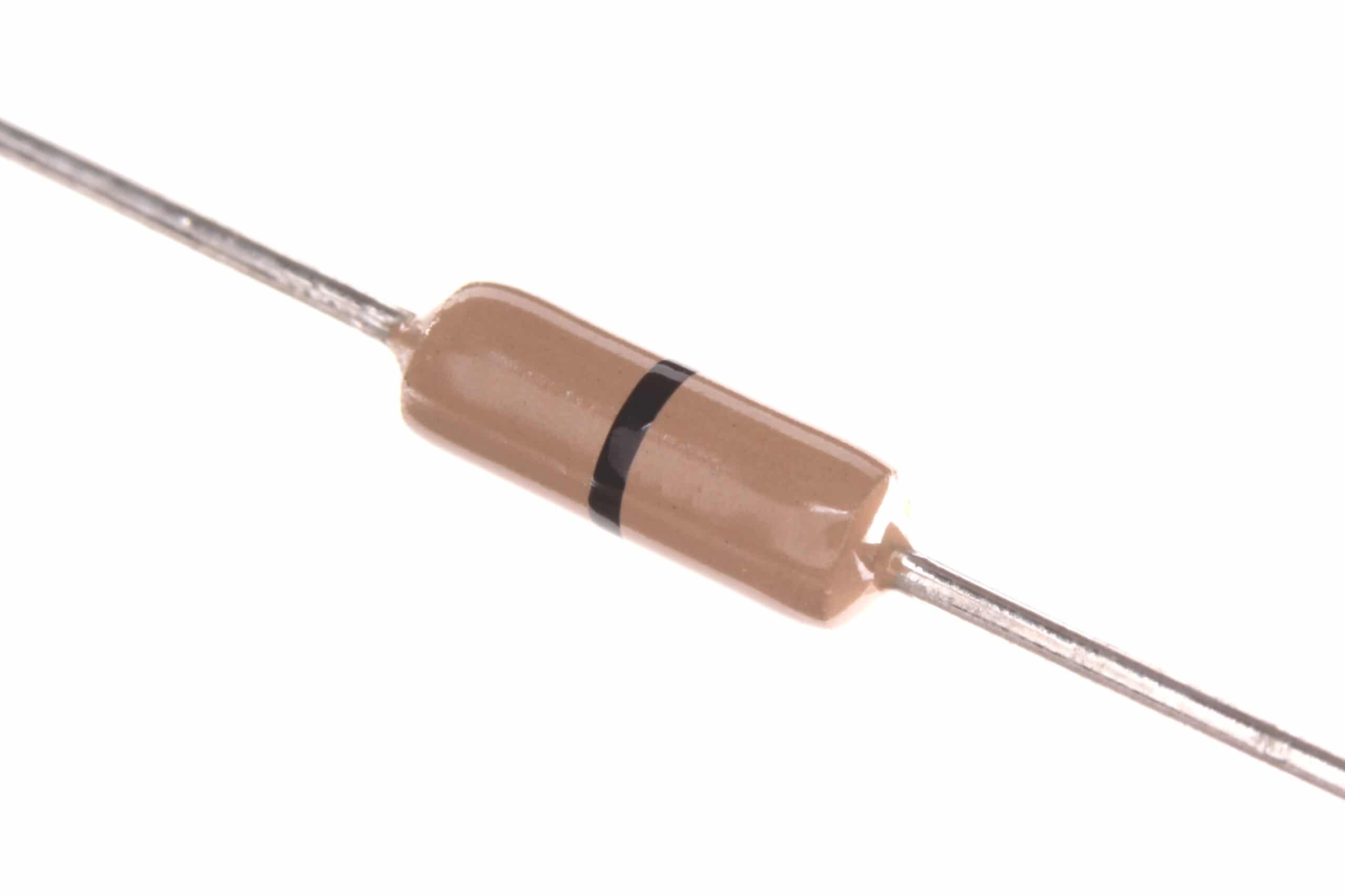
0 Ohm 0.25W Carbon Film Resistor (Pack of 100)
Perfect for practising colour code reading. Carbon film resistors with clear colour bands — great for beginners learning band identification on real components.
How to Read 5-Band Resistors
Five-band resistors provide greater precision and are typically 1% metal film resistors. They are physically similar to 4-band resistors but carry an extra significant digit band.
Band layout (left to right):
- Band 1 — First significant digit
- Band 2 — Second significant digit
- Band 3 — Third significant digit
- Band 4 — Multiplier
- Band 5 — Tolerance (Brown = ±1%)
Identifying orientation: On 5-band resistors, the tolerance band (usually brown, red, or green) may be slightly wider or set apart with a larger gap. Always orient so the wider-spaced band is on the right.
5-Band Worked Examples
Example 1: Red – Black – Black – Red – Brown
- Red = 2, Black = 0, Black = 0, Red = ×100, Brown = ±1%
- Result: 200 × 100 = 20,000 Ω (20 kΩ) ±1%
Example 2: Brown – Green – Black – Brown – Brown
- Brown = 1, Green = 5, Black = 0, Brown = ×10, Brown = ±1%
- Result: 150 × 10 = 1,500 Ω (1.5 kΩ) ±1%
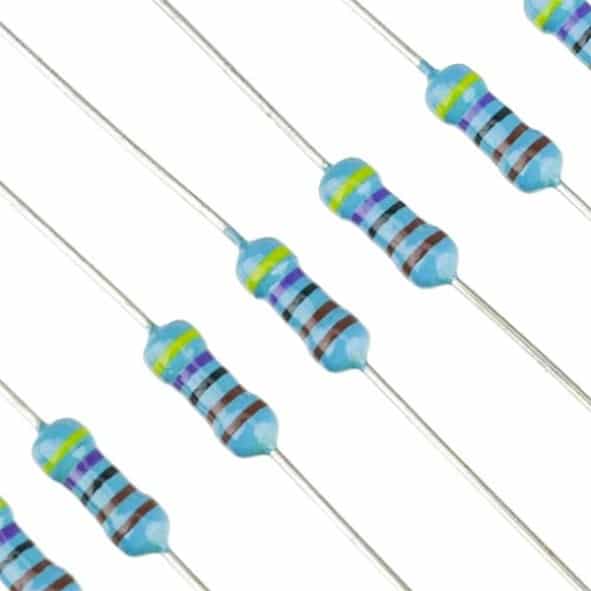
1.5 Ohm 0.25W Metal Film Resistor MFR (Pack of 100)
A 5-band metal film resistor with ±1% tolerance — ideal for precision circuits. Use it as a hands-on example to practise reading 5-band colour codes.
Understanding Tolerance Bands
The tolerance band tells you how much the actual resistance can deviate from the stated value. This matters for circuits where precision is important.
| Colour | Tolerance | Resistor Series |
|---|---|---|
| Gold | ±5% | E24 (carbon film) |
| Silver | ±10% | E12 |
| Brown | ±1% | E96 (metal film) |
| Red | ±2% | E48 |
| Green | ±0.5% | E192 |
| Blue | ±0.25% | E192 |
| Violet | ±0.1% | E192 |
Practical tip: For most Arduino and hobbyist projects, ±5% (gold band) resistors are perfectly adequate. Only switch to ±1% metal film resistors when your circuit is sensitive to resistance variation — such as precision voltage dividers, bridge circuits, or audio applications.
Memory Tricks and Mnemonics
The colours follow the order: Black, Brown, Red, Orange, Yellow, Green, Blue, Violet, Grey, White (0 to 9). Here are popular mnemonics:
- “BB ROY Great Britain Very Good Wife” — B(lack) B(rown) R(ed) O(range) Y(ellow) G(reen) B(lue) V(iolet) G(rey) W(hite)
- “Bad Boys Race Our Young Girls But Violet Generally Wins”
- “Better Be Right Or Your Great Big Venture Goes Wrong”
Pick whichever mnemonic sticks best, and you will never forget the colour sequence again.
Common Resistor Values and Their Colour Codes
Here are the resistor values most commonly used in Indian electronics projects along with their 4-band codes:
| Value | Band 1 | Band 2 | Band 3 (Mult) | Band 4 |
|---|---|---|---|---|
| 100 Ω | Brown | Black | Brown (×10) | Gold |
| 220 Ω | Red | Red | Brown (×10) | Gold |
| 470 Ω | Yellow | Violet | Brown (×10) | Gold |
| 1 kΩ | Brown | Black | Red (×100) | Gold |
| 4.7 kΩ | Yellow | Violet | Red (×100) | Gold |
| 10 kΩ | Brown | Black | Orange (×1K) | Gold |
| 47 kΩ | Yellow | Violet | Orange (×1K) | Gold |
| 100 kΩ | Brown | Black | Yellow (×10K) | Gold |
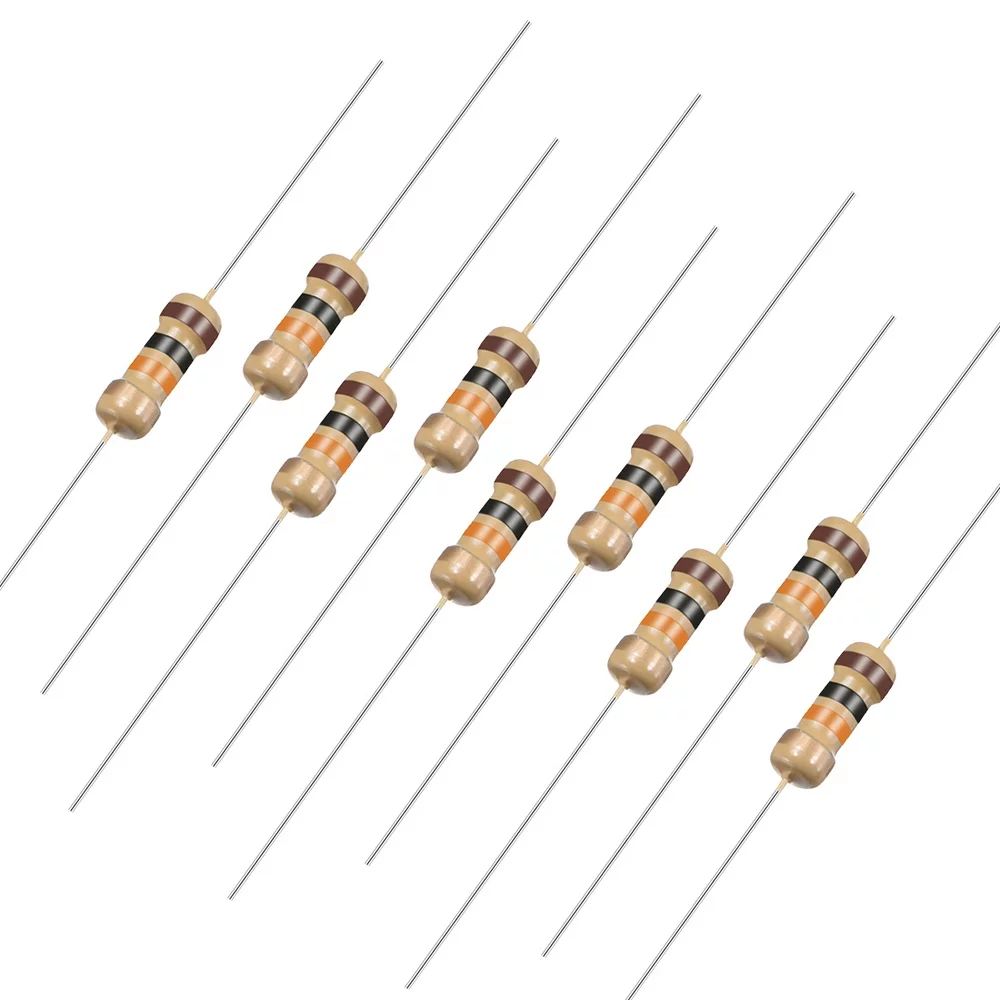
10 Ohm 0.25W Carbon Film Resistor (Pack of 50)
A staple value for LED current-limiting and signal circuits. 4-band carbon film with gold tolerance band — a great value pack for workshops and projects.
SMD Resistor Codes
Surface Mount Device (SMD) resistors are too small for colour bands. Instead, they use a printed numerical code.
- 3-digit code (5% tolerance): First two digits are significant figures; third is the number of zeros. For example, 472 = 47 followed by 2 zeros = 4,700 Ω = 4.7 kΩ.
- 4-digit code (1% tolerance): First three digits are significant figures; fourth is zeros. For example, 4702 = 470 followed by 2 zeros = 47,000 Ω = 47 kΩ.
- EIA-96 code: A two-digit number and a letter. The number is an index into the E96 table; the letter indicates the multiplier. For example, 01C = 100 × 100 = 10 kΩ.
Buying Guide for Resistors in India
When buying resistors for your projects, keep these factors in mind:
1. Power Rating
The most common hobbyist resistors are 0.25W (1/4 W). For higher-current applications, opt for 0.5W or 1W. The formula is: P = I² × R. Always leave at least 50% headroom — if your calculation shows 0.2W, use a 0.5W resistor.
2. Tolerance
Gold band (±5%) is sufficient for most digital and hobbyist work. Use brown band (±1%) metal film when building precision analogue circuits, reference voltage dividers, or audio equipment.
3. Resistor Type
- Carbon film — cheap, general purpose, ±5%, slight noise
- Metal film — lower noise, ±1%, better temperature stability, costs slightly more
- Wirewound — high power, very precise, but has inductance (not suitable for RF)
4. Buying in Bulk
For students and project builders, buying resistor assortment kits or packs of 50–100 pieces is far more economical than buying single resistors. Zbotic offers resistors in packs starting from just a few rupees per piece.
10×10 cm Universal PCB Prototype Board
Solder your resistors and build permanent circuits on this sturdy single-sided PCB. The standard 2.54mm hole pitch fits all through-hole resistors perfectly.
Frequently Asked Questions
Q: How do I know which end of the resistor to start reading from?
A: The tolerance band (gold or silver) is always closest to one end. Hold the resistor so the gold/silver band is on the right, then read left to right. On 5-band resistors, there is often a slightly larger gap before the last (tolerance) band.
Q: What if I cannot see the colours clearly?
A: Resistors can look similar under certain lighting. Always use a multimeter to confirm the value. Set the multimeter to resistance mode (Ω) and touch the probes to both ends of the resistor.
Q: Are colour codes the same worldwide?
A: Yes. The IEC 60062 standard is universal, so a resistor bought in Germany reads the same as one from India or the USA.
Q: What does a resistor with no fourth band mean?
A: A resistor with only 3 coloured bands (no tolerance band) is a 20% tolerance resistor — very old and rarely sold today. Assume ±20% if you encounter one.
Q: What is the difference between carbon film and metal film resistors?
A: Carbon film resistors (usually gold band, ±5%) are cheaper and adequate for most circuits. Metal film resistors (usually brown band, ±1%) have lower noise, better temperature coefficient, and tighter tolerance — preferred for audio and precision analogue designs.
Q: Can I use a resistor with a higher power rating than needed?
A: Yes, absolutely. A higher wattage resistor with the correct resistance value will work perfectly. It will simply run cooler. The resistance value matters; the power rating is just the maximum safe limit.
Zbotic offers carbon film and metal film resistors in convenient packs — perfect for students, makers, and engineers across India. Browse all resistors →







Add comment