
Resin 3D Printer Curing Station: UV Light Setup and Tips
Resin 3D printing produces parts with incredible detail — layer lines measured in microns, smooth surfaces straight off the build plate, and the ability to reproduce fine features impossible on FDM machines. But the workflow does not end when the print finishes. Post-curing is an essential step that transforms a fragile, partially-polymerised print into a fully hard, chemically stable part. This guide covers everything Indian resin printing enthusiasts need to know about UV curing stations — from DIY setups to commercial units, wavelengths, timing, and best practices for Indian conditions.
1. Why Post-Curing Is Non-Negotiable
When a resin printer finishes a job, the part looks complete — but it is not. The print is a green part: partially polymerised photopolymer that is still chemically reactive. At this stage, the part:
- Is significantly weaker than fully cured resin — green tensile strength can be 40–60% of final strength
- Has residual uncured monomer on the surface, which is a skin sensitiser
- Is sticky or tacky, especially standard and water-washable resins
- Has poor chemical resistance until fully crosslinked
- Will continue to deform or warp under gravity or heat if left uncured
Post-curing under UV light completes the polymerisation reaction, driving remaining monomers to fully crosslink. A properly cured part achieves rated tensile strength, hardness, and chemical resistance. Skipping post-curing is the single most common mistake beginners make.
2. UV Wavelengths: 365nm vs 405nm
UV light spans 10–400nm. Most MSLA (masked SLA) resin printers use 405nm near-UV light — technically at the boundary of UV-A and violet visible light. This wavelength was chosen for consumer printers because 405nm LEDs are affordable, efficient, and safer than deep UV.
405nm (Near-UV / Violet)
- Standard for all consumer LCD/MSLA printers (Elegoo, Anycubic, Phrozen)
- Most consumer resins are formulated to cure at 405nm
- LED sources are inexpensive and widely available
- Less eye hazard than shorter wavelengths (but never stare at UV sources directly)
365nm (UV-A)
- Used by some professional DLP and SLA systems
- Penetrates resin more deeply — good for thick sections
- Some engineering resins (castable, dental, flexible) require 365nm for optimal cure
- LED sources more expensive; not ideal as sole cure source for 405nm-formulated resins
Rule of thumb: Match your curing light to your printer’s light source wavelength. For 99% of Indian makers using Elegoo Saturn, Anycubic Photon, or similar MSLA printers — a 405nm UV curing station is correct.
3. Commercial Curing Stations
Several dedicated commercial curing stations are available. The most popular in India:
Elegoo Mercury Plus
A combined wash and cure station. Uses a 405nm UV light array with a rotating turntable for even exposure. The wash bucket uses IPA or Elegoo Wash solution. Suitable for up to Mars 3 / Saturn 2 build sizes. Compact and reliable.
Anycubic Wash & Cure Plus
Similar concept to Mercury Plus. Handles Anycubic Photon M3 Max parts. LED array rated at 36W, rotating platform ensures even cure from all angles. Some users report uneven curing on tall thin parts — rotate manually halfway.
Phrozen Cure
A standalone curing station (no wash function) from the Taiwanese maker of the Sonic Mighty lineup. 405nm, 36W, with a timer.
Commercial stations are convenient and priced ₹4,000–₹12,000 in India. The main limitation: they are sized for their corresponding printer’s build plate. If you upsize your printer later, you may need a larger curing station.
4. DIY UV Curing Station Build
For Indian makers who love building their own tools (or want a cost-effective solution for larger prints), a DIY curing station works excellently. Here is what you need:
Components
- UV LED strip (405nm): 2 metres of 405nm UV LED strip — available on Amazon/Flipkart for ₹300–₹600. Look for 60 LEDs/metre density.
- Container: A large plastic tub, cardboard box lined with aluminium foil (reflective interior boosts intensity), or a purpose-built wooden enclosure.
- Turntable: A lazy-Susan bearing (₹80–₹150) driven by a 5V DC motor for even exposure. A battery-powered kitchen turntable (₹200–₹400) works perfectly.
- Power supply: 12V DC adapter rated for your LED strip wattage.
- Timer: A mechanical or digital outlet timer for automatic shutoff.
Build Notes
Line all interior surfaces with aluminium foil, shiny side in. Mount LED strips in a spiral pattern on the ceiling and sides of the enclosure for omnidirectional exposure. Seal the enclosure to prevent UV exposure to hands and eyes. A total DIY build with these parts costs ₹1,500–₹2,500 and can handle any print size.

3D Printer Pen with Filament and USB Cable
Great for touching up resin print supports or filling gaps post-cure. Also useful for adding PLA reinforcement to resin parts for mixed-material applications.
5. Using Indian Sunlight as a Curing Source
India has a significant advantage for resin printing: abundant UV-rich sunlight for most of the year. Sunlight contains the full UV spectrum including 365nm and 405nm bands — and it is free.
How to Cure in Sunlight
- Wash your print thoroughly in IPA and air-dry for 5 minutes before sun curing.
- Place the print on a rotating surface (kitchen turntable) in direct sunlight.
- Cure for 2–5 minutes in strong noon sunlight (10am–2pm, summer). UV index of 8+ in Indian cities during summer is sufficient.
- Winter or cloudy days require 10–20 minutes of sun exposure.
- Check for tackiness — surface should be completely dry and hard.
Caution: Do not cure in sunlight before washing. Uncured resin on the surface will harden onto the part unevenly and be impossible to remove. Always wash first.
Limitation: Sunlight curing is unreliable during monsoon season and on cloudy days. A UV station is essential for consistent year-round production.
6. Washing Before Curing
The wash step removes uncured liquid resin from the part surface before UV curing locks it in place. Using the wrong sequence or poor wash technique leads to tacky spots, frosted surfaces, or trapped uncured resin.
Washing Solvents
- IPA (Isopropyl Alcohol) 99%: The most common wash solvent. Widely available in India (pharmacies, electronics stores). Slightly slower than alternatives but safe and effective. Do not use 70% IPA — the water content prevents proper cleaning.
- Resin wash solutions (Elegoo, Anycubic): Purpose-formulated, less aggressive on skin, can be recycled via UV exposure to harden spent resin for disposal. Available via import.
- Tripropylene glycol monomethyl ether (TPGME): Preferred for ABS-like and flexible resins — IPA can cause some flexible resins to whiten (IPA whitening effect).
Wash Time
2–3 minutes in fresh IPA with agitation is sufficient. Overwashing (10+ minutes) causes the print to absorb IPA, leading to micro-cracking and brittleness, especially in thin sections. Use two-stage washing: dirty IPA first (removes bulk resin), clean IPA second (final rinse).
7. Curing Times by Resin Type
| Resin Type | Commercial Station (36W) | Indian Sunlight | Notes |
|---|---|---|---|
| Standard PLA-like | 2–4 min | 3–6 min | Most common |
| ABS-like / Tough | 3–5 min | 5–8 min | Thicker sections need more time |
| Flexible / TPU-like | 4–6 min | 6–10 min | Overcuring reduces flexibility |
| Water-washable | 2–3 min | 3–5 min | Cure ASAP after washing |
| Castable / Dental | 5–8 min | Not recommended | May need 365nm station |
These are guidelines — always follow the resin manufacturer’s specification sheet. Thicker parts may require longer cure times or flip-curing (cure one side, flip, cure other side).
8. Temperature Effects on Curing
Temperature plays a significant role in resin post-curing — a factor particularly relevant in India’s extreme climate range.
Warm Curing (Indian Summer Advantage)
Resin polymerisation is a thermally activated process. At 30–40°C (typical Indian summer indoor temperatures), resins cure faster and achieve slightly higher crosslink density than at 20°C. Cure times in Indian summer are often 20–30% faster than the manufacturer’s stated values (measured in 20°C labs).
Cold Curing Issues
At temperatures below 15°C (Himachal Pradesh winters, air-conditioned labs in summer), resin viscosity increases and curing slows. Parts may feel fully cured on the surface but remain soft inside. Warm the curing station slightly or extend cure time by 30–50% in cold conditions.
Heat-Curing Hybrid
Some advanced workflows combine UV curing with a warm water bath (50–60°C) after initial UV exposure. The heat drives further crosslinking beyond what UV alone achieves, particularly for engineering resins. This is common in dental laboratories and is worth trying for ABS-like resin functional parts.
9. Overcuring: When More Is Not Better
More curing is not always better. Common overcuring problems:
- Brittleness: Excessively crosslinked standard resin becomes very stiff and brittle — drops or impacts that would normally flex without breaking instead shatter the part.
- Yellowing: Standard (clear) resins yellow with excessive UV exposure. Particularly visible in transparent parts.
- Loss of flexibility: Flexible/rubber resins that are overcured lose their elasticity and crack under strain.
- Warping in thin sections: The heat generated by extended UV exposure can warp very thin (<1mm) features.
The target is fully cured, not maximally cured. When in doubt, use a durometer shore hardness comparison — standard resins should read around 75–85D when properly cured.
10. Safety in Indian Workshop Conditions
Resin printing involves chemicals that require respect. Indian workshops often lack dedicated ventilation — take these steps seriously:
Chemical Safety
- Nitrile gloves (not latex): Always wear nitrile gloves when handling uncured resin. Resin monomers are skin sensitisers — repeated skin contact leads to irreversible allergy.
- N95/FFP2 mask: Resin vapours accumulate in enclosed spaces. Print in a ventilated room or use an exhaust fan directed outdoors.
- Eye protection: UV light at 365–405nm is harmful to eyes — wear UV-blocking safety glasses when operating open UV curing setups.
Waste Disposal
Never pour liquid resin or IPA-resin mixture down drains. In India, the correct approach: cure spent IPA under sunlight or UV lamp until all resin hardens, then dispose of the hardened mass in solid waste. Check local municipal solid waste guidelines for your city.
11. Common Post-Curing Problems and Fixes
Tacky Surface After Curing
Cause: Oxygen inhibition — the outer surface layer is inhibited from curing by atmospheric oxygen, leaving a thin tacky film.
Fix: Cure under water (submerse in a clear water tray and expose to UV — water blocks oxygen). This is a professional technique that eliminates oxygen inhibition entirely.
White Frosted Appearance
Cause: IPA whitening — the resin absorbed IPA during the wash step, causing micro-clouding.
Fix: Reduce wash time to 2 minutes maximum. Use TPGME wash solution instead of IPA for sensitive resins. For already-frosted parts: light sanding followed by UV resin coating can restore clarity.
Warped Part After Curing
Cause: Printing support strategy was inadequate; the green part warped before curing completed.
Fix: Cure flat parts on a flat glass surface. For already-warped parts — gentle heat (50°C water bath) can make them pliable for reshaping before UV re-curing.
Cracked or Shattered Part
Cause: Overcuring, thermal shock, or the wrong resin formulation for the application.
Fix: Reduce cure time, use a tougher resin (ABS-like rather than standard), check that part is fully washed before curing.
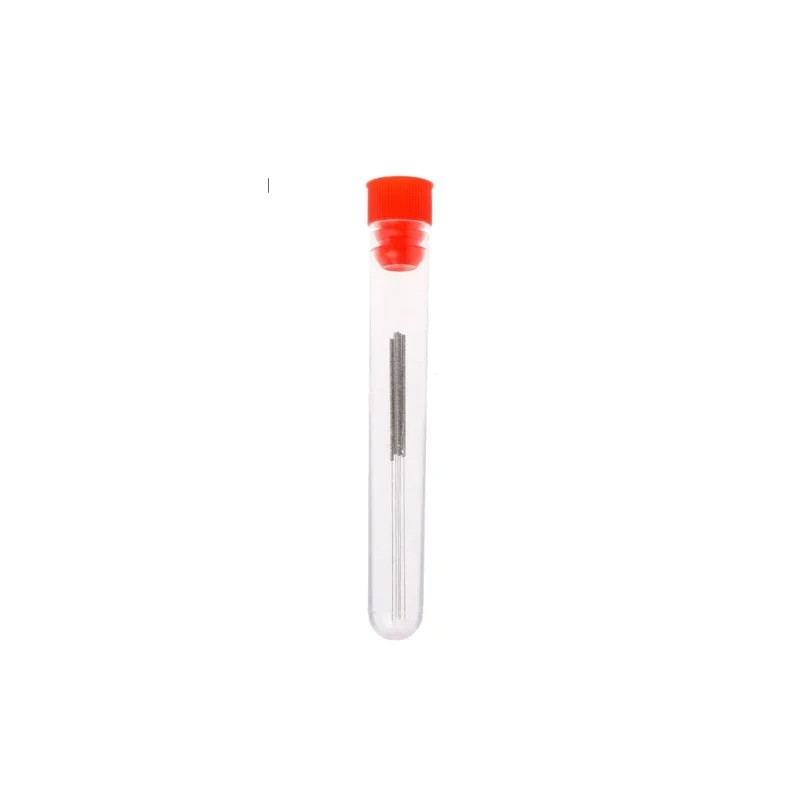
0.4mm Stainless Steel Nozzle Cleaning Needle for 3D Printer (Pack of 10)
Precision needles for cleaning FDM nozzle passages. Useful in mixed FDM+resin workshops for maintaining FDM machines alongside resin setups.
Frequently Asked Questions
Can I cure resin without a UV station — just using sunlight?
Yes, Indian sunlight is a perfectly adequate UV source for standard 405nm resins, especially from 10am–2pm when UV index is highest. It is less consistent than a station (cloudy days, monsoon), but completely functional for hobbyist use. Cure time is typically 3–8 minutes in direct summer sun.
Do I need a wash station or can I use a bowl of IPA?
A bowl of IPA works fine — use two bowls (dirty rinse + clean rinse). A dedicated wash station with an agitator (magnetic stirrer or ultrasonic) cleans more thoroughly and reduces IPA consumption. For occasional printing, a bowl is sufficient.
Is 99% IPA necessary, or can I use 91%?
91% works, but 99% is better. The 9% water in 91% IPA is not detrimental for most resins, but it slows drying after washing. 70% IPA (pharmacy grade) should be avoided as the water content significantly reduces cleaning efficacy and extends drying time.
Can I cure resin in a microwave?
No. Microwaves do not produce UV light — they produce microwaves (2.4GHz radio frequency). A microwave will not cure photopolymer resin and may cause irregular heating or fire with some resin chemistries.
How long does a cured resin print last?
Properly post-cured standard resin parts last 1–3 years in indoor conditions before UV degradation becomes noticeable (yellowing, brittleness). ABS-like resins perform better. For outdoor use, UV-resistant resin formulations extend life to 3–5 years. Painting with UV-blocking primer dramatically extends outdoor longevity.
Is resin printing safe in a small Indian apartment?
It is manageable with precautions: print near an open window or with an exhaust fan, always wear nitrile gloves, never pour liquid resin down the drain, and keep the printer covered when not in use. Activated carbon air purifiers help with vapour control in small spaces.
Set Up Your Complete Resin Printing Workflow
From filament filters to nozzle kits and build accessories, Zbotic.in supports your entire 3D printing journey — whether you are printing with resin or FDM. Explore our growing range of 3D printer supplies with fast delivery across India.







Add comment