
Table of Contents
- Introduction to the OPT3001
- Why OPT3001 Over LDR or BH1750?
- Key Specifications
- Hardware Wiring to Arduino
- I2C Register Overview
- Arduino Library and Setup
- Continuous Mode: Reading Lux Values
- Interrupt Mode: Threshold Alerts
- Understanding Automatic Full-Scale Range
- IoT Applications and Projects
- Frequently Asked Questions
- Conclusion
Introduction to the OPT3001
The OPT3001 is a single-chip ambient light sensor from Texas Instruments that measures illuminance (lux) across the visible light spectrum with extraordinary precision and dynamic range. Unlike simple photodiodes or LDR (light-dependent resistor) modules that give you a relative analog reading, the OPT3001 outputs calibrated lux values directly over I2C — no conversion tables, no ADC linearity concerns, no reference resistor needed.
The sensor covers an enormous dynamic range of 0.01 to 83,865 lux across 23 automatic full-scale ranges — from a moonlit night (0.01–1 lux) to direct sunlight (100,000 lux). This is not achieved by switching sensitivity modes manually; the sensor automatically selects the best range on every measurement cycle, which is what makes the OPT3001 uniquely suited for IoT applications where ambient light can vary from pitch darkness to bright outdoor sunlight within the same deployment.
In this guide, you will learn why the OPT3001 stands apart from competing sensors, how to wire it to Arduino and ESP32, how to configure its I2C registers for continuous and single-shot measurement, how to use the interrupt pins for threshold-based smart lighting control, and how to apply it in real IoT projects.
Why OPT3001 Over LDR or BH1750?
There are many ambient light sensors available for hobbyists. Here is how the OPT3001 compares to the most common alternatives:
| Feature | LDR + ADC | BH1750 | OPT3001 |
|---|---|---|---|
| Output type | Analog (relative) | Digital lux (I2C) | Digital lux (I2C) |
| Dynamic range | ~3 decades | 1–65,535 lux | 0.01–83,865 lux |
| Automatic ranging | No | 2 manual modes | Yes (23 ranges, automatic) |
| Human eye spectral match | Poor | Good | Excellent |
| IR rejection | None | Good | Excellent (rejects >700nm) |
| Interrupt output | No | No | Yes (programmable threshold) |
| Power-down mode | Partial (switch off LDR) | Yes | Yes (400nA in shutdown) |
| Supply voltage | 3.3V–5V | 3V–5V | 1.6V–3.6V |
The OPT3001’s strongest advantage is its human-eye spectral response match. It uses a specific optical filter that matches the photopic response curve (CIE 1931) of the human eye, rejecting infrared light that would otherwise cause false-high readings under incandescent bulbs and sunlight. This means the OPT3001 tells you how bright a scene looks to a person, not just how much electromagnetic radiation is hitting the sensor — a critical distinction for lighting control applications.
Key Specifications
| Parameter | Value |
|---|---|
| Measurement range | 0.01 – 83,865 lux |
| Number of automatic ranges | 23 ranges (auto-selected) |
| Accuracy | ±20% (0°C to 85°C, across all ranges) |
| Integration time options | 100ms or 800ms |
| Interface | I2C (up to 2.6MHz) |
| I2C addresses | 0x44, 0x45, 0x46, 0x47 (ADDR pin) |
| Supply voltage | 1.6V – 3.6V |
| Operating current | 1.8µA (continuous), 400nA (shutdown) |
| Package | WSON-6 (2mm × 2mm) — use breakout board |
| Operating temperature | −40°C to +85°C |
Hardware Wiring to Arduino
The OPT3001 runs at 3.3V and comes in a tiny WSON-6 SMD package. Use a breakout board (available from SparkFun or compatible vendors) which includes a 3.3V regulator and I2C level shifter for 5V Arduino compatibility.
Arduino Uno Wiring
| OPT3001 Breakout Pin | Arduino Uno Pin | Notes |
|---|---|---|
| VCC | 3.3V | Do not use 5V directly on the IC |
| GND | GND | |
| SDA | A4 (SDA) | With 4.7kΩ pull-up to 3.3V |
| SCL | A5 (SCL) | With 4.7kΩ pull-up to 3.3V |
| INT | D2 (optional) | Interrupt output (active low, open-drain) |
| ADDR | GND | Sets I2C address to 0x44 |
ADDR pin address selection: GND → 0x44, VCC → 0x45, SDA → 0x46, SCL → 0x47. This allows up to four OPT3001 sensors on the same I2C bus — useful for measuring light in multiple rooms or zones simultaneously.
I2C Register Overview
The OPT3001 has four 16-bit registers:
- Result Register (0x00): Contains the lux reading as a 12-bit mantissa and 4-bit exponent in an exponential format (similar to floating-point).
- Configuration Register (0x01): Controls operating mode (shutdown/single-shot/continuous), integration time (100ms/800ms), interrupt configuration, and alert polarity.
- Low Limit Register (0x02): Threshold for interrupt — same format as Result Register.
- High Limit Register (0x03): High threshold for interrupt.
Result Register Format
The result is encoded as: Lux = 0.01 × 2^(exponent) × mantissa
Bits [15:12] = 4-bit exponent, Bits [11:0] = 12-bit mantissa. The library handles this conversion automatically.
Arduino Library and Setup
Use the SparkFun OPT3001 library or the ClosedCube OPT3001 library, both available through the Arduino Library Manager.
#include <Wire.h>
#include <ClosedCube_OPT3001.h>

ClosedCube_OPT3001 opt3001;

#define OPT3001_ADDRESS 0x44

void configureSensor() {
  OPT3001_Config config;

  // Automatic full-scale range (recommended)
  config.RangeNumber = B1100; // Auto-range

  // 800ms integration time (best accuracy, 1.25 readings/sec)
  // Use B0000 for 100ms (10 readings/sec, lower accuracy)
  config.ConvertionTime = B1;

  // Continuous conversion mode
  config.ModeOfConversionOperation = B11;

  // Latched window-style interrupt
  config.Latch = B1;

  OPT3001_ErrorCode errorConfig = opt3001.writeConfig(config);
  if (errorConfig != NO_ERROR) {
    Serial.println("OPT3001 config error!");
  }
}

void setup() {
  Serial.begin(115200);
  Wire.begin();

  OPT3001_ErrorCode errorBegin = opt3001.begin(OPT3001_ADDRESS);
  if (errorBegin != NO_ERROR) {
    Serial.println("OPT3001 not found! Check wiring.");
    while (1);
  }

  configureSensor();
  Serial.println("OPT3001 Ambient Light Sensor Ready");
}

void loop() {
  OPT3001 result = opt3001.readResult();

  if (result.error == NO_ERROR) {
    Serial.print("Lux: ");
    Serial.print(result.lux, 2);
    Serial.println(" lux");

    // Print descriptive label
    if (result.lux  Very dark (moonlight / pitch black)");
    } else if (result.lux  Dim indoor lighting");
    } else if (result.lux  Normal indoor lighting");
    } else if (result.lux  Bright office / overcast outdoor");
    } else {
      Serial.println("  -> Direct sunlight");
    }
  } else {
    Serial.print("Read error: ");
    Serial.println(result.error);
  }

  delay(1000);
}
Continuous Mode: Reading Lux Values
In continuous mode (Mode = 0b11 in the configuration register), the OPT3001 continuously performs measurements at the configured integration time (100ms or 800ms). After each conversion, the result register is updated and the conversion-ready flag is set. You can either poll this flag or use the INT pin for interrupt-driven reading.
For most IoT logging applications, polling every 1–5 seconds is sufficient. The sensor uses only 1.8µA during continuous conversion — negligible even on battery-powered devices running continuously.
Single-Shot Mode for Ultra-Low Power
For battery-powered sensor nodes that wake from deep sleep, use single-shot mode (Mode = 0b01). The sensor performs one measurement, sets the conversion-ready flag, then automatically returns to shutdown mode (400nA current). This allows you to measure ambient light while consuming less than 1µA average current across a 5-minute measurement interval.
Interrupt Mode: Threshold Alerts
The OPT3001’s INT pin is an open-drain output (requires pull-up to 3.3V) that asserts when the measured lux value crosses a programmed threshold. This is extremely useful for smart lighting systems where you want to turn lights on when ambient light drops below a threshold, without constantly polling the sensor.
// Set interrupt thresholds for automatic lighting control
// Turn light ON below 50 lux, OFF above 200 lux (hysteresis)

void setThresholds(float lowLux, float highLux) {
  OPT3001_Config lowLimit;
  OPT3001_Config highLimit;

  // Encode lux values in OPT3001 exponential format
  // For simplicity, use the library's built-in threshold functions if available
  // Here we manually configure the limits

  // Low limit: 50 lux
  // Result format: mantissa = lux / (0.01 * 2^exp)
  // For 50 lux: exponent 5 (2^5=32), mantissa = 50/(0.01*32) = 156.25 → 156
  lowLimit.RangeNumber = B0101;     // Exponent 5
  // Write mantissa to bits [11:0] with exponent in [15:12]
  uint16_t lowRaw  = (5 << 12) | 156;
  uint16_t highRaw = (8 <> 8);
  Wire.write(lowRaw & 0xFF);
  Wire.endTransmission();

  Wire.beginTransmission(OPT3001_ADDRESS);
  Wire.write(0x03); // High Limit register
  Wire.write(highRaw >> 8);
  Wire.write(highRaw & 0xFF);
  Wire.endTransmission();
}

// In setup(), attach interrupt:
// pinMode(2, INPUT_PULLUP);
// attachInterrupt(digitalPinToInterrupt(2), lightThresholdISR, FALLING);

void lightThresholdISR() {
  // Read current lux to determine which threshold was crossed
  // Then turn light relay on/off accordingly
  // Note: keep ISR short; set a flag and handle in loop()
}
Understanding Automatic Full-Scale Range
The OPT3001’s automatic ranging is one of its most valuable features. When configured in auto-range mode (RangeNumber = 0b1100), the sensor selects the best of its 23 available ranges on every measurement cycle. The 23 ranges cover 0.01 lux to 83,865 lux in logarithmically spaced steps. Each range has a full-scale value 2× the previous range, and the 12-bit ADC within each range gives 4096 steps.
This means the sensor always operates near full-scale on its ADC, maintaining approximately constant relative resolution (~0.025% of the current range’s full-scale) regardless of the absolute lux level. Compare this to a fixed-range sensor like the BH1750, which loses resolution at low light levels when its single range covers 0–65,535 lux but you are measuring 0.5 lux.
The result: the OPT3001 resolves 0.01 lux at low light and 20 lux at outdoor daylight — all without any manual mode switching.
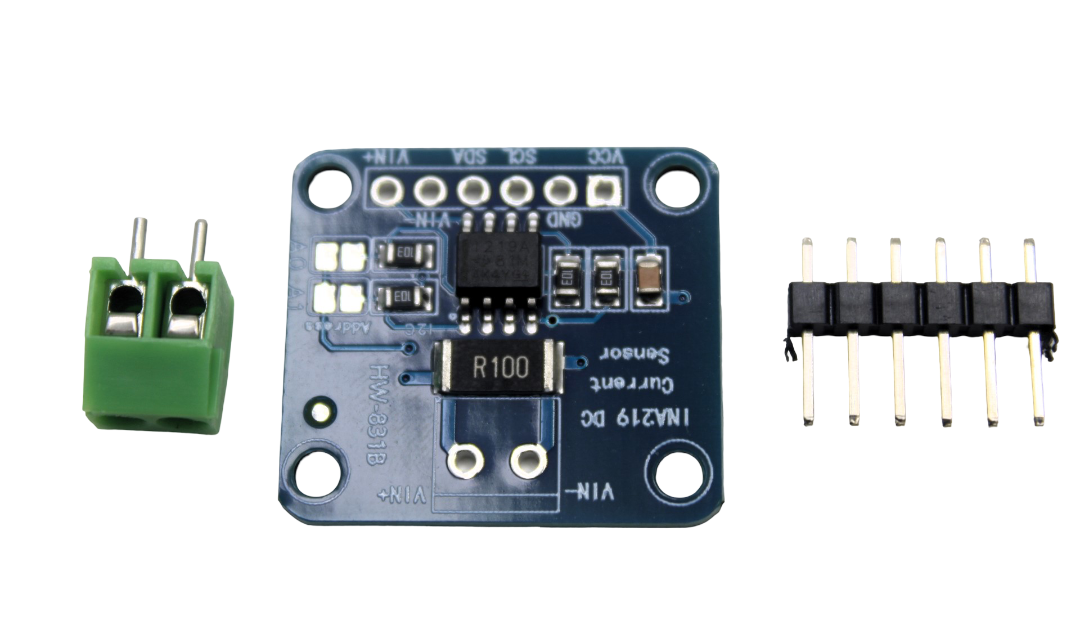
INA219 I2C Current/Power Monitoring Module
Pair with OPT3001 to build an energy-aware smart lighting system — measure both lux and LED power consumption over I2C simultaneously.
IoT Applications and Projects
Automatic Outdoor LED Street Light Controller
Mount an OPT3001 inside a white diffuser on a street light pole. Configure the low threshold to 20 lux (dusk/dawn) and the high threshold to 100 lux (daylight). The INT pin drives a relay directly (via a transistor and optocoupler) to switch the street light on at dusk and off at dawn — no microcontroller required for the switching logic, just the OPT3001’s hardware interrupt.
Agricultural Daylight Logger
For greenhouse or field crop monitoring, lux logging every 15 minutes for months provides data to calculate DLI (Daily Light Integral — the total amount of photosynthetically active radiation a plant receives per day). The OPT3001’s wide range handles both pre-dawn darkness and full midday sun without range switching artifacts.
Display Auto-Brightness
In an ESP32 IoT dashboard or smart clock, use the OPT3001 to automatically adjust the backlight brightness of a TFT display. Map the lux reading logarithmically to a PWM duty cycle — the display is dim in a dark bedroom at night and bright in a sunlit office during the day. The logarithmic mapping matches how human eyes perceive brightness.
Solar Panel Efficiency Monitor
Measure incident solar irradiance (lux) alongside panel voltage and current (using INA219). Calculate expected vs actual power output to detect panel soiling, shading, or degradation. Log data to an MQTT broker and visualize on Grafana.
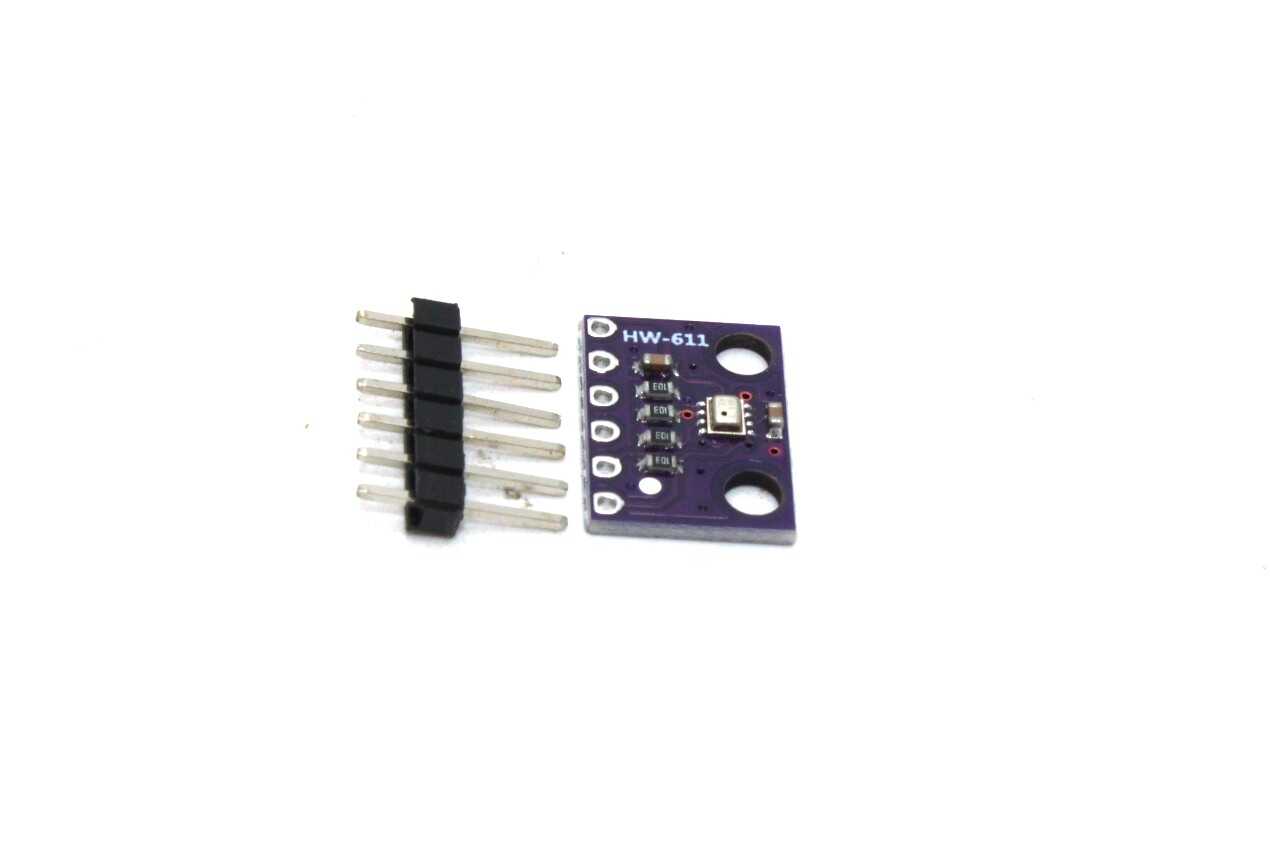
BMP280 Barometric Pressure & Altitude Sensor
Add a BMP280 to your OPT3001 weather station for a complete environmental monitor tracking light, pressure, and altitude over I2C.
Frequently Asked Questions
Q: What is the difference between lux and lumens?
A: Lumens measure the total light output of a source (e.g., a bulb emits 800 lumens). Lux measures illuminance — the luminous flux per unit area (1 lux = 1 lumen/m²). The OPT3001 measures lux — how much light is falling on the sensor surface, which is what matters for deciding whether a room is adequately lit or whether a plant is receiving enough light.
Q: Can I use the OPT3001 with a 5V Arduino without level shifting?
A: The OPT3001 IC operates at 1.6V–3.6V and its I2C pins are not 5V tolerant. You must use a level shifter or connect it to the Arduino’s 3.3V I2C pins (using Wire with SDA/SCL at 3.3V logic). On a 5V Arduino Uno, the I2C pins run at 5V by default — use a bidirectional I2C level shifter module. Breakout boards from SparkFun include this level shifter.
Q: How does the OPT3001 compare to the VEML7700?
A: Both are excellent I2C ambient light sensors with wide dynamic range and human-eye spectral matching. The VEML7700 offers a similar dynamic range with auto-gain (not true auto-range) and is slightly cheaper. The OPT3001 has better linearity across its full range, a true logarithmic auto-range system, and more flexible interrupt configuration. For most projects, either works well; the OPT3001 is preferred for applications requiring calibrated absolute lux values.
Q: Why is my OPT3001 reading consistently lower than a commercial lux meter?
A: The OPT3001 measures from the top surface of its package. If the sensor is inside an enclosure with a window, the window material attenuates the light. Glass transmits ~90% of visible light; acrylic ~85–92%; polycarbonate ~80–88%. Apply the appropriate correction factor, or calibrate against a reference meter in your specific enclosure.
Q: Can I use multiple OPT3001 sensors in the same project?
A: Yes, up to 4 sensors on the same I2C bus using the ADDR pin to set unique addresses (0x44–0x47). For more sensors, use a TCA9548A I2C multiplexer, which provides 8 independent I2C buses on a single ESP32 or Arduino.
Conclusion
The OPT3001 is the ambient light sensor of choice for demanding IoT applications where measurement accuracy, dynamic range, and power efficiency all matter. Its automatic 23-range system eliminates the manual range management required by simpler sensors, its human-eye spectral matching delivers lux readings that correspond to perceptual brightness, and its 400nA shutdown current makes it suitable for even the most power-constrained battery-operated nodes.
Whether you are building a smart street light controller, an agricultural daylight logger, an auto-dimming display, or a solar efficiency monitor, the OPT3001 provides the calibrated lux data you need across the full 0.01 to 83,865 lux range without ever needing to touch a range-select register.
Pair it with a BMP280 for environmental monitoring, an INA219 for power measurement, or a DS18B20 for temperature, all on the same I2C bus — the OPT3001 fits naturally into any I2C sensor stack and requires only two wires beyond power and ground.



Add comment