
Choosing the right GSM SIM card for IoT in India is one of the most important decisions you’ll make for any connected project. Whether you’re building a GPS tracker, a smart agriculture monitor, or a remote sensor node, the operator and plan you pick determines reliability, cost, and coverage. In this guide, we break down the best Indian telecom operators, their IoT-friendly plans, key technical considerations, and the hardware you need to get started.
Why GSM Still Dominates IoT in India
Despite the buzz around NB-IoT and LoRa, 2G GSM (and its data cousin GPRS) remains the backbone of most hobbyist and small-scale commercial IoT deployments in India. Here’s why:
- Ubiquitous coverage: Airtel and Jio together cover over 700,000 villages. In remote areas where NB-IoT towers are absent, GSM 900 MHz still works reliably.
- Cheap, proven hardware: Modules like the SIM800L, SIM900A, and M590E cost under ₹400 and are well-documented in the hobbyist community.
- Low data requirements: Most IoT payloads — temperature readings, GPS coordinates, alarm notifications — are tiny. GPRS at 10–50 kbps is more than enough.
- AT command interface: Every maker who has used Arduino can get started with AT commands in an afternoon. No custom protocol stack needed.
That said, 2G networks are being sunset by some operators in urban areas. This guide covers both 2G and 4G LTE options so you can future-proof your projects.
Best Operators for IoT SIM Cards in India
1. Airtel
Airtel is the top choice for IoT projects requiring wide geographic coverage. Their M2M SIM cards are available through Airtel Business, but individual makers often use regular prepaid SIMs (Airtel 179 plan gives 2GB/day) with GPRS/4G modules. Airtel also offers dedicated IoT plans starting at ₹29/month for M2M applications with 1MB data — ideal for low-frequency telemetry.
Pros: Best-in-class 2G coverage in rural India, excellent roaming, stable GPRS connectivity even on congested networks.
Cons: M2M plans require business registration; individual IoT tinkerers usually rely on consumer prepaid plans.
2. Jio
Jio is 4G-only — there is no 2G fallback. This means older modules like SIM800L will NOT work on Jio. You need a 4G-capable module (like the SIM7600 or A7670) or an external 4G dongle. Jio’s cheapest plan is ₹15 for 1 day with 1GB data, making it cost-effective for short-duration tests. Their NB-IoT service (via JioThings) is available in select cities.
Pros: Cheapest data rates in India, excellent 4G coverage in urban areas, NB-IoT for future-proofing.
Cons: No 2G support, SIM800-family modules will not register on Jio network.
3. BSNL
BSNL is often overlooked but is a strong contender for rural IoT deployments. Their 2G network still operates in many areas where private operators have moved to 4G-only. BSNL offers specific M2M SIM cards (STV 56 plan) at very low cost for registered businesses. For individual makers, their Bhaarat SIM prepaid works fine with SIM800-series modules.
Pros: Strong 2G coverage in tier-2/tier-3 cities and rural areas, government reliability, low-cost M2M plans.
Cons: Data speeds can be slow, customer service is inconsistent.
4. Vi (Vodafone Idea)
Vi’s M2M division offers competitive bulk IoT SIM plans for commercial deployments. For individual projects, their prepaid plans work with GPRS modules. Network stability has improved post-merger, though their rural coverage still lags behind Airtel.
Pros: Good urban coverage, dedicated M2M division for bulk orders.
Cons: Financial uncertainty of the company, inconsistent rural coverage.
Plan Comparison: Data-Only vs Voice+Data
For most IoT applications, you have two main SIM options:
| Type | Use Case | Estimated Cost | Recommended Operator |
|---|---|---|---|
| Consumer Prepaid (2G/4G) | Prototyping, small projects | ₹15–179/month | Airtel / BSNL |
| M2M SIM (2G GPRS) | Deployed sensors, GPS trackers | ₹29–99/month | Airtel M2M / BSNL |
| NB-IoT SIM | Low-power deployed sensors | ₹50–200/month | Airtel / JioThings |
| Data-only 4G | Camera streams, large payloads | ₹15–49/month | Jio |
Practical tip for Indian makers: For a prototyping budget, buy a ₹15 Jio SIM for testing (if using a 4G module) or a BSNL prepaid for SIM800-series modules. Once your project is validated, explore Airtel M2M plans for long-term deployment.
Technical Considerations for GSM IoT Devices
Frequency Bands
India uses 900 MHz and 1800 MHz for 2G GSM. Make sure your module supports both. The SIM800L supports 850/900/1800/1900 MHz (quad-band), so it works everywhere. The cheaper SIM900A is dual-band (900/1800 MHz) and works well in India.
Power Supply Requirements
This is the most common reason GSM modules fail. The SIM800L can draw up to 2A peak current during transmission bursts. A weak 3.3V regulator from an Arduino will cause the module to reset or fail to register. Always use a dedicated 4.1V supply (3× 1.5V AA batteries work well) or a quality LDO regulator rated for 2A+. Add a 1000µF capacitor close to the module’s power pins.
Antenna Matters
Many beginner failures are caused by poor antenna connections. The small helical antenna shipped with SIM800L breakouts is adequate for bench testing but marginal in the field. For deployed projects, use a proper external GSM antenna with an IPEX (U.FL) connector. A 3dBi PCB antenna on a 15cm cable significantly improves signal in weak-coverage areas.
SIM Registration Issues
Newly purchased SIMs sometimes need to be activated in a regular phone before they’ll register in a module. Always activate the SIM in your smartphone first, then move it to the IoT module. Also note: some operators require KYC for M2M SIMs.
Hardware: GSM Modules & Antennas
Here are the recommended components from Zbotic for your GSM IoT projects:
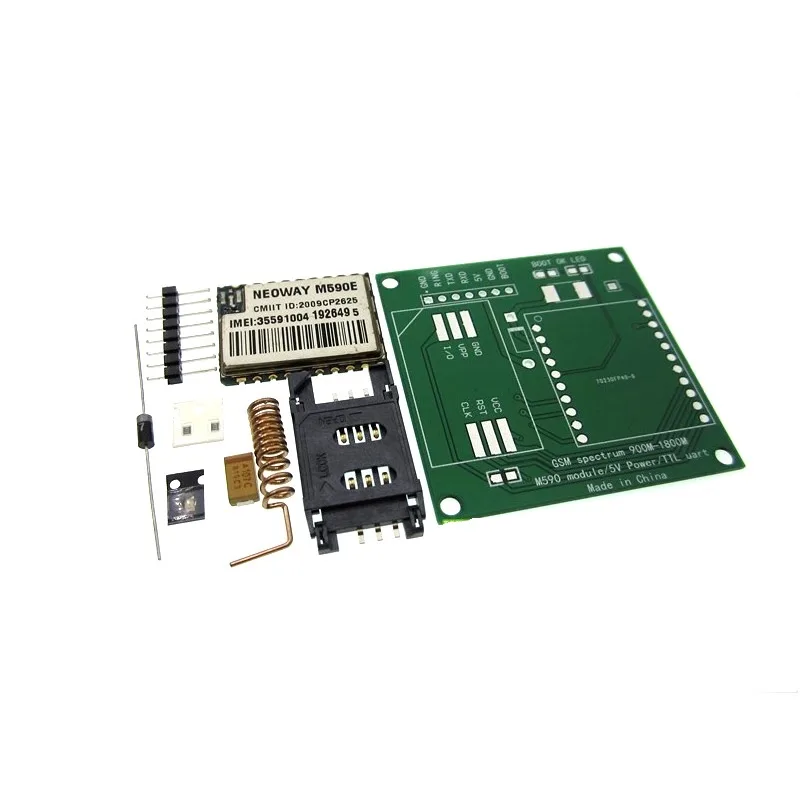
DIY GSM/GPRS M590E Module Kit
A budget-friendly GSM/GPRS module based on the M590E chipset. Supports 2G GPRS on Indian networks (900/1800 MHz). Great for SMS alerts, GPRS data, and basic IoT connectivity with AT command interface.

Adafruit FONA 808 – Mini Cellular GSM + GPS Breakout
Combines GSM/GPRS and GPS in a single compact breakout board. Perfect for vehicle trackers, asset monitoring, and any IoT project requiring both location and cellular data. Uses a standard nano-SIM.

15cm 3dBi GSM/GPRS/3G PCB Antenna with IPEX Connector
A compact 3dBi PCB antenna with IPEX/U.FL connector for GSM, GPRS, and 3G modules. Improves signal quality in enclosures and weak-coverage areas. Essential for reliable field deployments.

GPS NEO-6M Satellite Positioning Module
Pair this NEO-6M GPS module with your GSM module to build a complete GPS tracker. Outputs NMEA data over UART, compatible with Arduino, STM32, and ESP32. Reliable lock time under 60 seconds outdoors.
Getting Started: Setting Up Your First IoT SIM
Here’s a quick setup guide for connecting an M590E or SIM800-series module to Arduino:
- Activate SIM first: Insert the SIM in a phone, make a call, ensure it’s KYC-verified and active.
- Wire up power: Connect VCC to a 4.1V/2A supply. Connect GND to common ground with Arduino. Add a 1000µF cap across VCC-GND at the module pins.
- UART connection: Module TX → Arduino RX (pin 10 if using SoftwareSerial). Module RX → Arduino TX via a 1K resistor (level shifting for 3.3V modules).
- Test with AT commands: Open Serial Monitor at 9600 baud. Send
AT→ should replyOK. SendAT+CSQto check signal quality (value >10 is usable, >15 is good). - Send an SMS:
AT+CMGF=1sets text mode.AT+CMGS="+91XXXXXXXXXX"followed by your message and Ctrl+Z (byte 26) sends it. - Enable GPRS: Use
AT+SAPBRcommands to configure APN. For Airtel: APN isairtelgprs.com. For BSNL:bsnlnet. For Vi:portalnmms.
Common Mistakes to Avoid
- Using Jio with SIM800/SIM900: Jio is 4G VoLTE only. These 2G modules will never register. Use Airtel or BSNL for 2G modules.
- Powering from Arduino’s 3.3V pin: Maximum 150–300mA from Arduino — far less than the 2A peak a GSM module needs. Always use a separate power supply.
- Ignoring APN settings: Without the correct APN, GPRS will never connect even if voice/SMS works fine.
- No antenna connected: Never power up a GSM module without an antenna. It can damage the RF front-end and will definitely fail to register.
- Using a SIM with active data packs only: Some cheap recharge packs only give data on 4G; the 2G GPRS may not be provisioned. Test with a voice-capable plan first.
Frequently Asked Questions
Does SIM800L work with Jio in India?
No. The SIM800L is a 2G GSM module, and Jio operates exclusively on 4G LTE. The SIM800L will fail to register on Jio’s network. Use Airtel, BSNL, or Vi prepaid SIMs, which still maintain active 2G networks in India.
What is the best APN for GPRS on Airtel India?
The standard Airtel GPRS APN is airtelgprs.com with no username or password required. Configure using: AT+CSTT="airtelgprs.com","","" followed by AT+CIICR and AT+CIFSR to get an IP address.
Can I use a regular prepaid SIM in a GSM IoT module?
Yes, for prototyping and small deployments a regular prepaid SIM works perfectly. For commercial-scale deployments (100+ devices), look into Airtel M2M or BSNL M2M SIM cards which offer lower per-device costs and are designed for always-on machine use.
How much data does a typical IoT sensor use per month?
A sensor sending readings every 5 minutes (temperature, humidity, GPS) typically uses 5–50MB per month depending on payload size and protocol overhead. HTTP POST requests are heavier; lightweight MQTT packets over TCP can reduce this to under 5MB/month for simple telemetry.
Is 2G being shut down in India?
2G shutdown is not imminent across India. While Jio never had 2G, Airtel and Vi have indicated gradual 2G sunsetting in urban metro areas starting around 2025–2026. Rural 2G coverage will continue for several more years. BSNL has committed to maintaining 2G for rural service. Always check current network availability for your target deployment area before finalising hardware.
Ready to Build Your IoT Project?
Zbotic stocks a wide range of GSM modules, GPS boards, and antennas for Indian makers. From beginner GPRS kits to advanced LTE modules — all available with fast shipping across India.



Add comment