
Choosing the right sensor is the most important decision in any robot build. The three dominant technologies for robot sensors on Arduino — IR (infrared), ultrasonic, and LIDAR — each have dramatically different performance profiles, costs, and ideal use cases. Use the wrong sensor for your application and your robot will fail in ways that are maddening to debug. This comprehensive comparison covers the physics, specs, wiring, code, and real-world performance of all three sensor families so you can make the right choice from the start.
Table of Contents
- IR Sensors: Types and How They Work
- Ultrasonic Sensors: HC-SR04 and Beyond
- LIDAR Sensors: Overview and Arduino Options
- Side-by-Side Specifications Comparison
- Wiring and Arduino Code for Each Sensor
- Obstacle Avoidance: Which Sensor Wins?
- Cost vs Performance Analysis
- How to Choose the Right Sensor
- Frequently Asked Questions
IR Sensors: Types and How They Work
Infrared sensors for robot navigation come in two distinct families: IR proximity sensors (reflectance-based, short range) and IR distance sensors (triangulation-based, medium range). Both use infrared light as the sensing medium, but their operating principles and performance characteristics differ significantly.
IR Proximity Sensors (TCRT5000, FC-51)
These modules emit IR light and measure the reflected intensity. They give a simple digital output: object detected or not detected, within a fixed range (typically 2–30 cm). The detection range is adjusted via an onboard potentiometer. They are inexpensive (under ₹50 each), easy to use with a single digital pin, and consume very little power. Their main limitations: they give no distance measurement, only presence/absence; they are badly affected by ambient IR light (sunlight causes false positives); and they cannot detect dark objects reliably (black surfaces absorb IR and appear “invisible”).
Use IR proximity sensors for: line follower arrays, close-range edge detection (table-edge-avoiding robots), object counting on conveyor belts, and any application where you only need to know “is something there?” within a fixed range.
IR Distance Sensors (Sharp GP2Y0A21, GP2Y0A02)
Sharp’s triangulation-based sensors measure actual distance by calculating the angle of the reflected IR beam using a linear CCD array. The GP2Y0A21YK measures 10–80 cm with analogue output (typically 3.1V at 10 cm, 0.4V at 80 cm). The GP2Y0A02YK extends range to 20–150 cm. These are more useful than simple proximity sensors because they give a continuous distance reading rather than just a threshold crossing.
Limitations: the analogue output is non-linear (inverse relationship between voltage and distance), requiring a look-up table or mathematical inverse for accurate distance calculation. They are sensitive to target surface reflectivity — a matte black surface gives shorter apparent distance than a white surface. Update rate is 25–39 Hz, which limits fast robot applications.
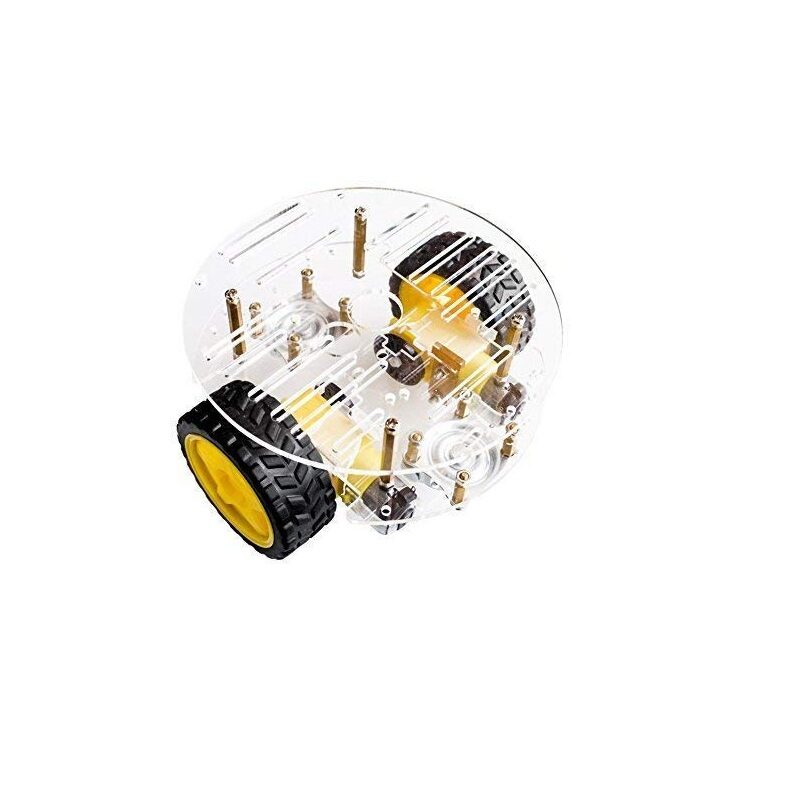
2WD Mini Round Double-Deck Smart Robot Car Chassis DIY Kit
Build your first sensor-equipped robot on this double-deck chassis. Mount IR sensors below and ultrasonic sensors in front for a complete obstacle-avoiding robot in one compact package.
Ultrasonic Sensors: HC-SR04 and Beyond
Ultrasonic sensors work by emitting a short burst of 40 kHz sound (above human hearing range) and measuring the time for the echo to return. Distance = (echo time × speed of sound) / 2. The HC-SR04 is the most popular ultrasonic sensor in the maker world — available for around ₹80–120, it measures 2 cm to 400 cm with ±3 mm accuracy.
HC-SR04 Key Specifications
- Range: 2 cm – 400 cm
- Accuracy: ±3 mm at close range, ±1% at longer ranges
- Beam angle: ~15 degrees (effective cone)
- Update rate: ~40 Hz maximum (25 ms measurement cycle)
- Supply voltage: 5V DC, ~15 mA current
- Interface: Trigger (10µs pulse) + Echo (pulse width = 2× flight time)
The HC-SR04’s advantages over IR sensors: it works equally well on dark and light surfaces, it is not affected by ambient light (sunlight, fluorescent lights), and it gives accurate distance measurements in centimetres rather than a simple threshold. Its 15-degree beam angle is a double-edged sword — wide enough to detect objects without precise aiming, but too wide to distinguish closely spaced obstacles or detect objects in narrow gaps.
JSN-SR04T (Waterproof Ultrasonic)
For outdoor robots or robots operating in dusty/humid environments, the JSN-SR04T provides the same HC-SR04 interface but with a waterproof transducer in a threaded metal housing. It has a 25 cm minimum range (higher than HC-SR04’s 2 cm) but is otherwise compatible with HC-SR04 code. Essential for outdoor rover builds.
US-100 (Temperature-Compensated)
The speed of sound varies with temperature (approximately 0.6 m/s per °C near room temperature). The US-100 includes a built-in temperature sensor and automatically compensates the speed-of-sound calculation, giving accurate distance measurements across a wide temperature range. Particularly useful for outdoor applications where temperature swings of 20–30°C are common.
LIDAR Sensors: Overview and Arduino Options
LIDAR (Light Detection And Ranging) uses laser pulses to measure distance with extreme precision and speed. Unlike ultrasonic sensors that emit a broad cone of sound, LIDAR systems typically use a rotating mirror or phased array to build a 2D or 3D map of the surrounding environment. For robotics, LIDAR provides the ability to simultaneously detect hundreds of objects in a 360-degree sweep — enabling complete environmental mapping, simultaneous localisation and mapping (SLAM), and navigation in complex, dynamic environments.
TF-Luna (Benewake) – Single-Point LIDAR
The TF-Luna is the most affordable LIDAR option for Arduino makers in India, priced around ₹800–1200. It uses Time-of-Flight (ToF) laser measurement to measure a single point straight ahead, with a range of 0.2–8 m, accuracy of ±6 cm, and a 250 Hz update rate — making it 6× faster than an HC-SR04. It connects via UART or I2C and is directly compatible with 3.3V and 5V Arduino boards. Use TF-Luna as a high-performance single-point distance sensor for fast robots where HC-SR04 latency is too slow.
RPLIDAR A1 – 360° Scanning LIDAR
The RPLIDAR A1 from Slamtec is a rotating 2D LIDAR scanner that sweeps 360 degrees at 5.5 Hz, collecting 4,000+ distance measurements per revolution. Range is 0.2–12 m with ±1% accuracy. It connects via USB/UART and is supported by the official RPLIDAR SDK, with ROS drivers available. This is what you see on hobby-level SLAM robots and TurtleBot-class platforms. At around ₹6,000–9,000, it is significantly more expensive than ultrasonic sensors but enables capabilities that ultrasonic arrays cannot approach — full 2D environment mapping and robust obstacle avoidance in cluttered spaces.
VL53L0X – Time-of-Flight Sensor (Not True LIDAR)
The VL53L0X from ST Microelectronics is technically a Time-of-Flight sensor, not a full LIDAR — it measures a single point up to 2 m with ±3% accuracy and a 50 Hz update rate. It connects via I2C and runs on 2.8–3.3V (use level shifter with 5V Arduino). Multiple VL53L0X units can be chained on one I2C bus (using XSHUT pin to assign different addresses). A ring of 8 VL53L0X sensors gives 360° proximity detection at much lower cost than a scanning LIDAR — a popular solution for mid-range maze solvers and indoor navigation robots.
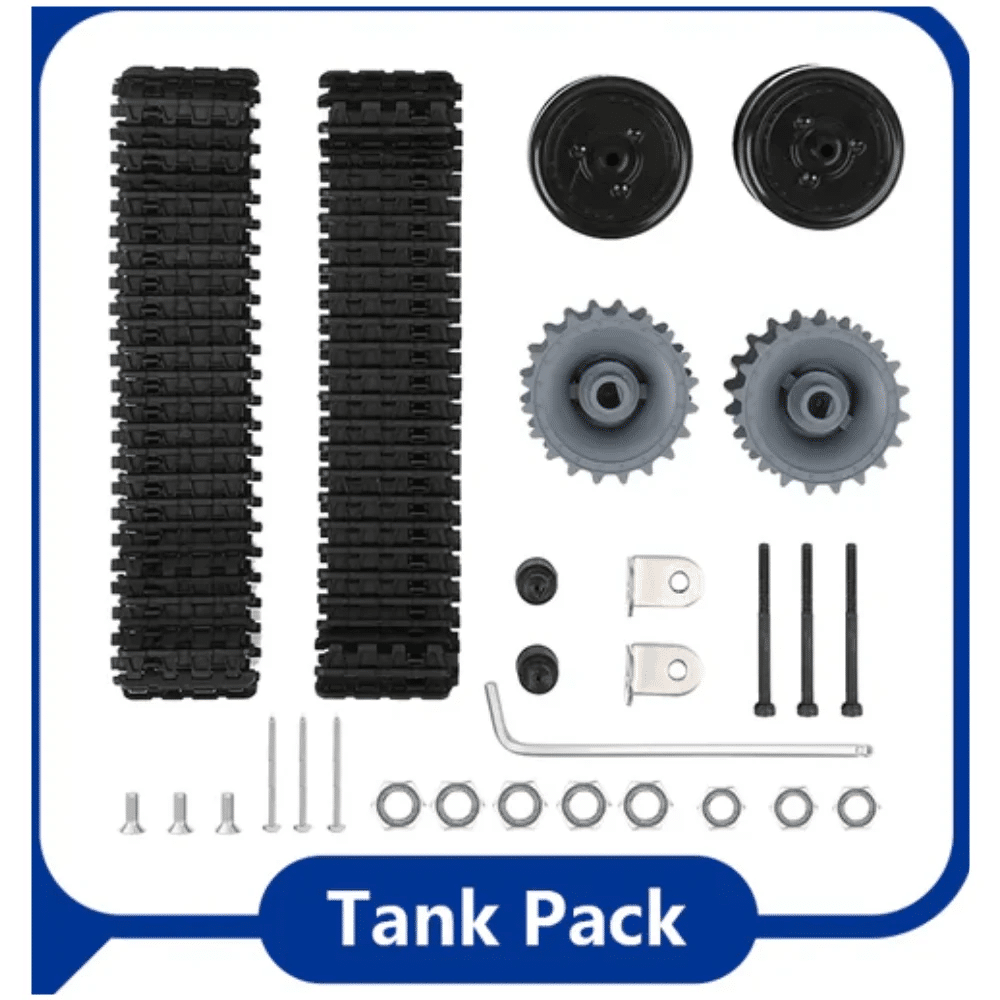
ACEBOTT ESP32 Tank Robot Car Expansion Pack
The ESP32 tank chassis provides a solid base for mounting multiple sensors — attach IR sensors below, ultrasonic to the sides, and a ToF LIDAR in front for comprehensive environment sensing.
Side-by-Side Specifications Comparison
| Specification | IR Proximity | HC-SR04 Ultrasonic | TF-Luna LIDAR |
|---|---|---|---|
| Range | 2–30 cm | 2–400 cm | 20–800 cm |
| Accuracy | Threshold only | ±3 mm | ±6 cm |
| Update Rate | >1 kHz | 40 Hz | 250 Hz |
| Sunlight Immunity | Poor | Excellent | Good |
| Dark Surface Detection | Poor | Excellent | Excellent |
| Cost (approx) | ₹30–80 | ₹80–150 | ₹800–1,200 |
| Arduino Pins | 1 digital | 2 digital | UART or I2C |
Wiring and Arduino Code for Each Sensor
HC-SR04 Ultrasonic – Arduino Code
#define TRIG 9
#define ECHO 10

void setup() {
  pinMode(TRIG, OUTPUT);
  pinMode(ECHO, INPUT);
  Serial.begin(9600);
}

long readDistanceCM() {
  digitalWrite(TRIG, LOW);
  delayMicroseconds(2);
  digitalWrite(TRIG, HIGH);
  delayMicroseconds(10);
  digitalWrite(TRIG, LOW);
  long duration = pulseIn(ECHO, HIGH, 25000); // 25ms timeout
  return duration / 58; // Convert to cm
}

void loop() {
  long dist = readDistanceCM();
  Serial.print("Distance: ");
  Serial.print(dist);
  Serial.println(" cm");
  delay(100);
}
IR Proximity – Arduino Code
#define IR_PIN 8  // Digital output from FC-51/TCRT5000 module

void setup() {
  pinMode(IR_PIN, INPUT);
  Serial.begin(9600);
}

void loop() {
  int state = digitalRead(IR_PIN);
  // LOW = object detected (reflected IR)
  // HIGH = no object
  Serial.println(state == LOW ? "Object detected!" : "Clear");
  delay(100);
}
Obstacle Avoidance: Which Sensor Wins?
For a standard obstacle-avoiding robot running indoors at walking speed, the HC-SR04 is the best choice — it is cheap, accurate, easy to use, and immune to lighting conditions. Mount one on the front and one on each side for 3-sided detection. Use a servo to pan a single HC-SR04 left and right for a wider field of view without additional sensors.
For outdoor robots, high-speed robots (over 1 m/s), or robots in environments with glass, foam, or angled surfaces, switch to a TF-Luna LIDAR. Its 250 Hz update rate is critical for fast reaction times, and its laser beam is not affected by wind (which can carry ultrasonic echoes off-axis at high speeds).
For full environment mapping — navigating unknown spaces, SLAM, or operating in rooms with complex layouts — you need a scanning LIDAR (RPLIDAR A1 or similar). No number of point-measuring sensors equals the situational awareness of a 360-degree 2D scan. This is the sensor choice for serious autonomous navigation research.
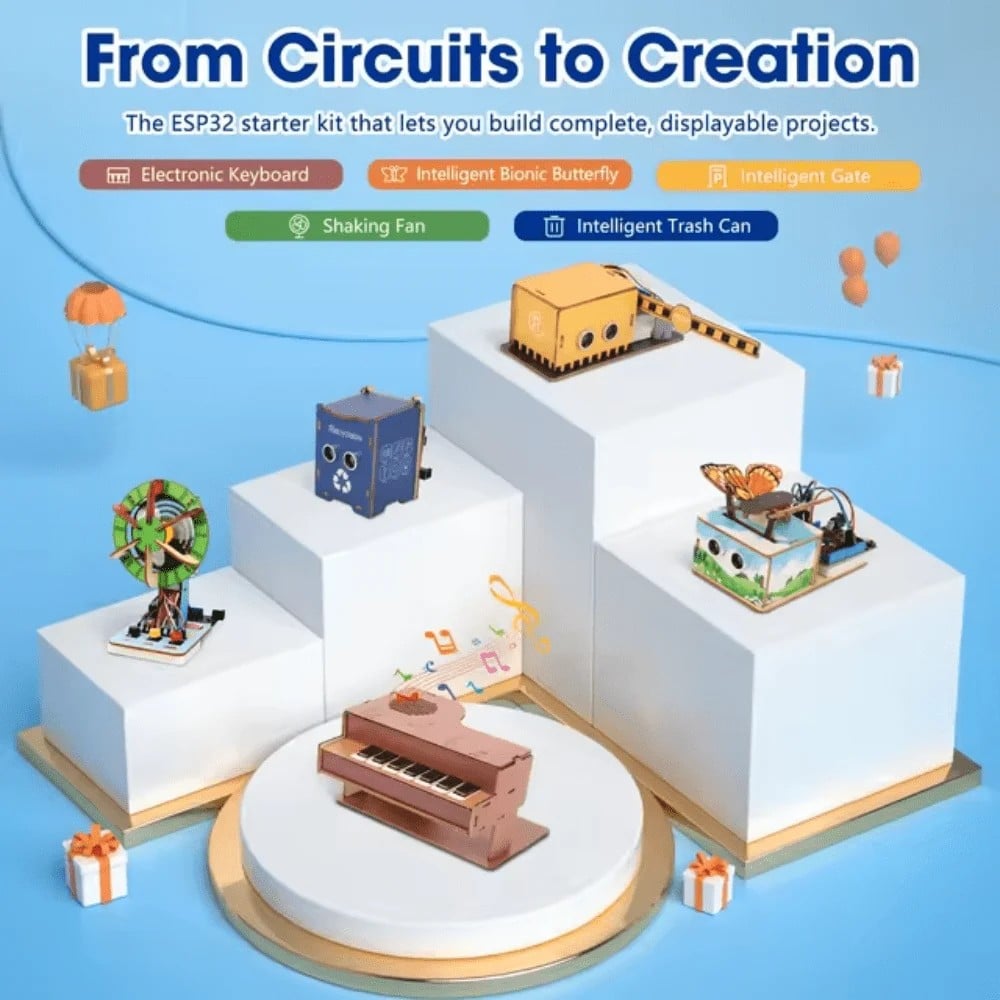
ACEBOTT ESP32 Basic Starter Kit – QE201
Get started with robot sensor projects using the ACEBOTT ESP32 kit. Includes the microcontroller and essential components to begin experimenting with IR, ultrasonic, and other sensors immediately.
Cost vs Performance Analysis
For a budget robot (under ₹1,000 total BOM), use IR proximity sensors exclusively — they give basic obstacle detection at minimal cost. For a mid-range robot (₹1,000–5,000), combine IR sensors for line following with 3 HC-SR04 sensors for obstacle avoidance. This combination covers 95% of competition and hobby use cases in India. For an advanced autonomous robot (₹5,000–20,000), add a TF-Luna LIDAR for high-speed obstacle detection and an MPU6050 IMU for heading stability. For a research-grade platform (above ₹20,000), invest in an RPLIDAR A1, wheel encoders, and a Raspberry Pi running ROS for full SLAM capability.
How to Choose the Right Sensor
Ask these four questions before selecting your sensor: (1) What is your operating environment? Outdoors or dusty? Eliminate IR proximity sensors. (2) Do you need distance measurement or presence detection only? Distance: ultrasonic or LIDAR. Presence: IR proximity is cheaper and simpler. (3) What is your speed? Under 0.5 m/s: HC-SR04 is fine. Over 1 m/s: use LIDAR (TF-Luna). (4) What is your budget? Under ₹200 per sensor: HC-SR04 or IR. Up to ₹1,500: TF-Luna. Above ₹6,000: scanning LIDAR. In practice, most successful Indian college competition robots use a combination: IR array underneath for line following, 3× HC-SR04 for maze wall detection, and an MPU6050 for heading. This triple combination costs under ₹800 total and covers virtually all indoor competition scenarios.
100pcs 5mm LED Assorted Kit
Add visual sensor status indicators to your robot. Use LEDs to show which sensors are detecting obstacles — invaluable for debugging sensor placement and calibration during development.
Frequently Asked Questions
Can I use multiple HC-SR04 sensors simultaneously?
Yes, but avoid triggering them simultaneously — ultrasonic echo from one sensor can be picked up by another (cross-talk). Trigger each sensor in sequence, with at least 60 ms between triggers. If you need true simultaneous measurements (for a fast robot), use sensors with coded pulses (MaxBotix EZ series) that filter out foreign echoes.
Why does my HC-SR04 give wrong readings near walls?
The HC-SR04 measures the first echo received. A wall at an angle (not perpendicular to the sensor axis) may reflect the ultrasonic burst away from the sensor rather than back, causing a missed echo (timeout = max range reading). Highly absorbent surfaces (heavy curtains, foam) absorb the sound and also produce no echo. Tilt the sensor to face walls perpendicularly, and add retries (take 3 measurements, discard outliers) for reliability.
Is IR or ultrasonic better for detecting glass?
Neither is reliable for glass. IR sensors fail because glass is transparent to IR — the beam passes through and reflects off whatever is behind the glass, giving incorrect distance readings. Ultrasonic sensors fail because glass reflects sound at most angles, but smooth glass at a perpendicular angle can return very strong echoes. LIDAR is also unreliable on glass — the laser beam passes through transparent glass. The most reliable glass detector is a capacitive sensor or a camera with computer vision.
What is the minimum distance for an HC-SR04?
The HC-SR04 has a 2 cm minimum range. Objects closer than 2 cm (about 20 mm) may not be detected, or may give wildly incorrect readings, because the trigger pulse and the echo return overlap in time before the module finishes transmitting. For close-range detection (under 5 cm), use an IR proximity sensor or a VL53L0X ToF sensor (minimum range 5 cm).
Can LIDAR work in sunlight?
Scanning LIDARs like the RPLIDAR A1 are rated for indoor use and can be affected by intense direct sunlight (which has IR components at the laser wavelength). The TF-Luna LIDAR uses a modulated signal and bandpass filter that provides good sunlight rejection, rated for use up to 70,000 lux (equivalent to full outdoor sunlight). Check the datasheet for your specific LIDAR’s ambient light immunity specification before deploying outdoors.
How many HC-SR04 sensors can one Arduino support?
An Arduino Uno has 13 digital pins. Each HC-SR04 requires 2 pins (Trig + Echo), so theoretically you could connect 6 sensors (12 pins, leaving 1 for other uses). In practice, 3–4 sensors is the comfortable maximum on an Uno. For more sensors, use an Arduino Mega (54 digital pins = up to 27 HC-SR04 sensors), or use an I2C multiplexer with VL53L0X ToF sensors (all share 2 I2C pins).
Selecting the right sensor technology fundamentally determines what your robot can and cannot do. Start with ultrasonic sensors for your first obstacle-avoiding robot — the HC-SR04 is the best balance of cost, ease of use, and performance for beginners. As your projects grow in complexity, layer in IR sensors for line detection and eventually LIDAR for environments that demand real mapping capability. Shop for all your robot sensor needs at Zbotic’s Robotics section and get everything delivered quickly across India.





Add comment