
Servo motors are the muscles of modern robots. Whether you are building a robotic arm, a hexapod walker, a pan-tilt camera gimbal, or a biped robot, the servo motors you choose will determine how much weight your robot can handle, how precisely it moves, and how long the batteries last. But not all servos are created equal — the difference between a ₹150 SG90 and a ₹2000 high-torque metal gear servo can be 30× in torque output.
This buying guide compares high torque servo motors for robotics from the popular MG996R all the way up to industrial-grade DS3225 and similar digital servos, so you can make the right choice for your project.
Servo Motor Basics for Robotics
A servo motor is a self-contained unit with a DC motor, gearbox, position feedback potentiometer, and control electronics — all in one compact package. You command it with a PWM signal (typically 50Hz), and it automatically moves to and holds the commanded angle.
Standard hobby servos operate between 0° and 180°. Some continuous rotation servos spin freely and use PWM to control speed and direction instead of position. For most robotic joint applications, you want a standard 180° position servo.
Key parameters to evaluate when choosing a servo:
- Torque (kg·cm or N·m) — force at 1cm moment arm
- Speed (sec/60°) — how fast it moves without load
- Voltage range — typically 4.8V–7.2V, some up to 8.4V
- Gear material — plastic, metal alloy, or titanium
- Analog or digital — determines resolution and response
- Weight and dimensions — affects robot’s total mass and joint design
Understanding Torque Ratings
Torque is stated in kg·cm (or sometimes N·m, where 1 kg·cm ≈ 0.098 N·m). The rating tells you the maximum force at a 1cm moment arm before the servo stalls.
Practical example: An MG996R rated at 13 kg·cm can hold a 1.3 kg weight on a 10cm arm, or a 130g weight on a 100cm arm. For a robotic forearm 20cm long holding a 500g gripper and payload: you need at least 500g × 20cm = 10,000 g·cm = 10 kg·cm at the elbow servo.
Always apply a safety factor of 2–3× in robotics because:
- Dynamic loads during movement are higher than static loads
- Servo ratings assume ideal temperature and fresh batteries
- Gear backlash absorbs some energy under rapid direction changes
- Degradation over time reduces effective torque
Analog vs Digital Servos
Analog servos
Analog servos update their motor output based on the PWM input signal at 50Hz (every 20ms). The control loop runs at this frequency, which limits response speed and position holding accuracy. Under load, an analog servo may flex or drift between update cycles.
Analog servos are less expensive and perfectly adequate for low-speed, low-precision applications like camera pan/tilt mounts, simple robot arms, and RC cars.
Digital servos
Digital servos use a microcontroller internally to process the PWM input and run their control loop at 300–400Hz — 6–8× faster than analog servos. Benefits include:
- Much better holding torque under static load
- Faster response to position commands
- Configurable parameters (dead band, speed, direction) on programmable models
- More consistent performance across temperature range
DS3225, DS3218, and similar “DS” series servos are digital. They cost more but are the right choice for precision robotics, humanoid robots, and applications where holding torque under load matters.
Gear Materials: Plastic, Metal & Titanium
| Material | Durability | Noise Level | Best For |
|---|---|---|---|
| Plastic (nylon) | Low — strips under high load or shock | Quiet | Light loads, prototyping, learning |
| Metal alloy (zinc/brass) | Good — handles moderate shock loads | Moderate whine | Most robotics applications |
| Steel | Excellent — heavy-duty applications | Higher whine | Industrial robots, heavy arms |
| Titanium alloy | Outstanding — aerospace/competition grade | Low despite hardness | Competition robots, demanding projects |
Servo Comparison: SG90 to DS3225
| Model | Type | Torque | Speed | Voltage | Weight |
|---|---|---|---|---|---|
| SG90 | Analog, plastic | 1.8 kg·cm | 0.1 sec/60° | 4.8–6V | 9g |
| MG90S | Analog, metal | 2.2 kg·cm | 0.08 sec/60° | 4.8–6V | 13.4g |
| MG996R | Analog, metal | 13 kg·cm | 0.20 sec/60° | 4.8–7.2V | 55g |
| DS3218 | Digital, metal | 20 kg·cm | 0.16 sec/60° | 4.8–6.8V | 60g |
| DS3225 | Digital, metal | 25 kg·cm | 0.13 sec/60° | 4.8–8.4V | 60g |
Deep Dive: MG996R
The MG996R is the most popular high-torque servo in the hobbyist market worldwide — and for good reason. At 13 kg·cm (at 6V), it delivers genuine muscle in the same standard servo form factor as the tiny SG90. It is used in countless robotic arm designs, hexapod robots, RC car steering systems, and pan-tilt gimbals.
Technical specifications
- Torque: 9.4 kg·cm at 4.8V / 13 kg·cm at 6V (high quality variant)
- Speed: 0.15 sec/60° at 4.8V / 0.13 sec/60° at 6V
- Operating voltage: 4.8V to 7.2V
- Dead band width: 5 µs
- Gear train: Metal alloy
- Rotation range: 180°
- Dimensions: 40.7 × 19.7 × 42.9 mm
Quality variation warning
The MG996R market is flooded with both genuine and clone versions. Genuine high-quality MG996R motors use 6-pole motors and brass/steel gears. Lower-quality variants use weaker motors and softer metal alloys that strip under shock loads. Look for sellers that specifically list “high quality” or “genuine” variants.
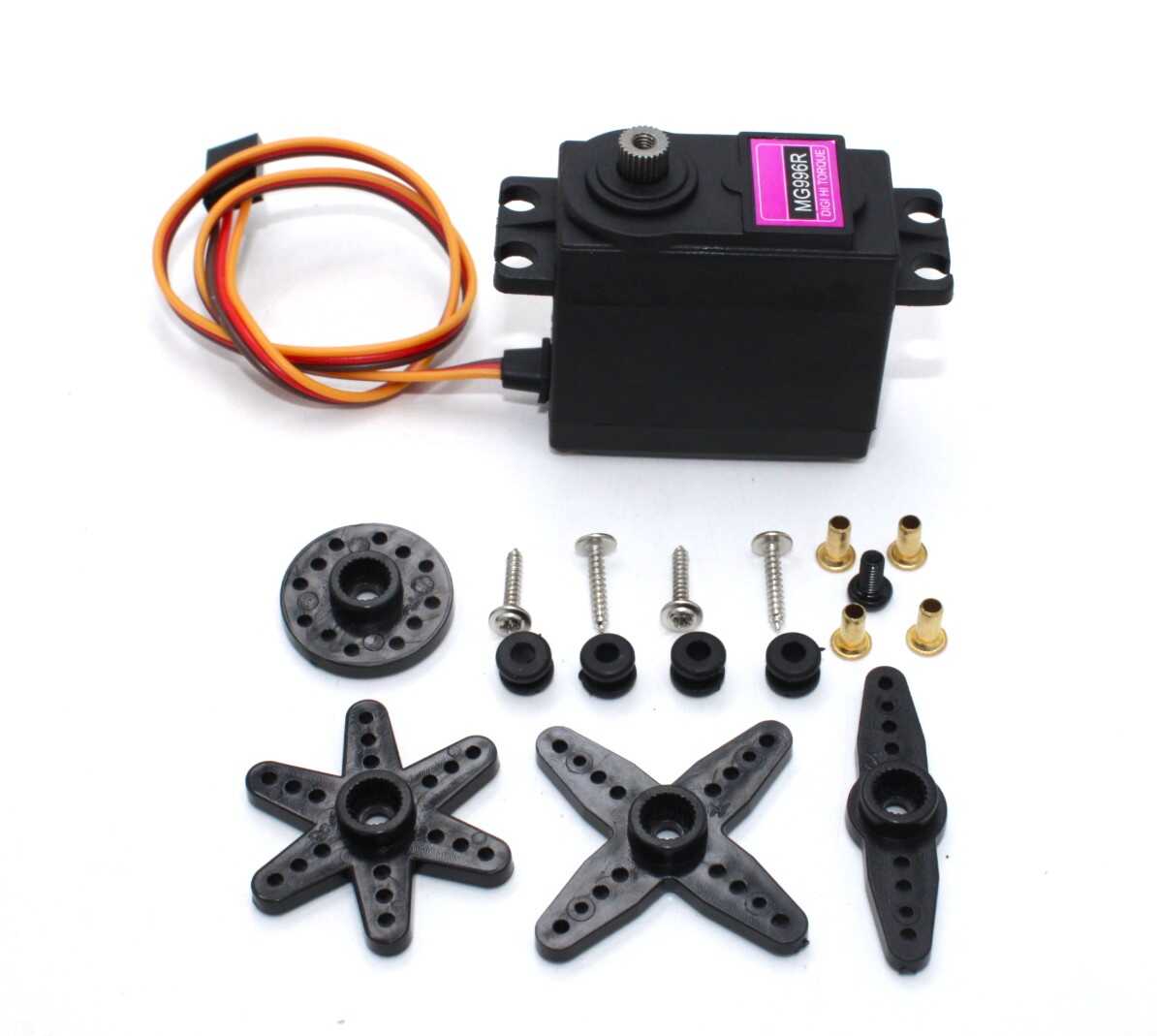
Servo MG996 13KG 180 Degree (High Quality)
The gold standard for hobbyist robotics — 13 kg·cm metal gear servo with genuine high-quality construction for robotic arms, hexapods, and RC systems.
High Torque Options: 20 kg·cm and Beyond
When the MG996R is not enough, these higher-torque options are available:
DS3218 (20 kg·cm digital)
A digital servo that steps up from the MG996R with 20 kg·cm at 6V. Uses a waterproof design in some variants. The digital controller provides much better position holding under load — excellent for shoulder joints in robotic arms where static holding matters.
DS3225 (25 kg·cm digital)
Currently one of the highest-torque standard-size servos available at the hobbyist level. At 25 kg·cm with an 8.4V supply, the DS3225 can handle demanding joint applications that would stall lesser servos. The all-metal gear train handles shock loads well. This is the servo used in many open-source humanoid robot designs.
Full-metal coreless motors (35–40 kg·cm)
Beyond DS3225, you enter the territory of Dynamixel-class smart servos and industrial servo systems. These include RS-485 or TTL buses for daisy-chaining, current sensing, temperature monitoring, and closed-loop feedback. They are used in Robotis Darwin, NAO, and similar research-grade robots.
Control Signals & Microcontroller Compatibility
All standard hobby servos use the same 3-wire interface: VCC (red), GND (brown/black), and Signal (orange/white/yellow). The PWM signal standard is:
- Frequency: 50 Hz (20ms period)
- Pulse width: 1ms = 0° position, 1.5ms = 90°, 2ms = 180°
- Logic level: 3.3V signal works with most servos despite 5V supply
On Arduino, the built-in Servo.h library handles all timing automatically:
#include <Servo.h>
Servo myServo;

void setup() {
  myServo.attach(9);    // Signal wire to pin 9
}

void loop() {
  myServo.write(0);     // Move to 0°
  delay(1000);
  myServo.write(90);    // Move to 90°
  delay(1000);
  myServo.write(180);   // Move to 180°
  delay(1000);
}
For precise microsecond control (especially useful with digital servos that accept finer resolution):
myServo.writeMicroseconds(1500); // Center position (90°)
myServo.writeMicroseconds(1000); // 0° position
myServo.writeMicroseconds(2000); // 180° position
Power Supply Requirements
This is the most common source of problems in servo-based robot projects. Critical rules:
Never power servos from the Arduino 5V pin
An MG996R stalls at 2.5A. The Arduino’s USB power trace is rated for 500mA. Even a single high-torque servo will brownout the Arduino under load, causing reset loops. Always use a dedicated power supply for servos.
Recommended power supply approach
- 1–2 small servos (SG90/MG90S): Can use a quality 5V 2A adapter
- 1–3 MG996R servos: 6V 5A regulated supply minimum
- Robot arm with 4–6 MG996R: 6V 10A supply or 2S LiPo battery (7.4V) with voltage regulator
- DS3225 servos at 8.4V: 2S LiPo (7.4V) or 3S LiPo (11.1V) + buck converter to 8.4V
Share the GND
Connect the GND of the servo power supply to the GND of your Arduino/microcontroller. If they are on separate grounds, the PWM signal reference is wrong and the servos will behave erratically.
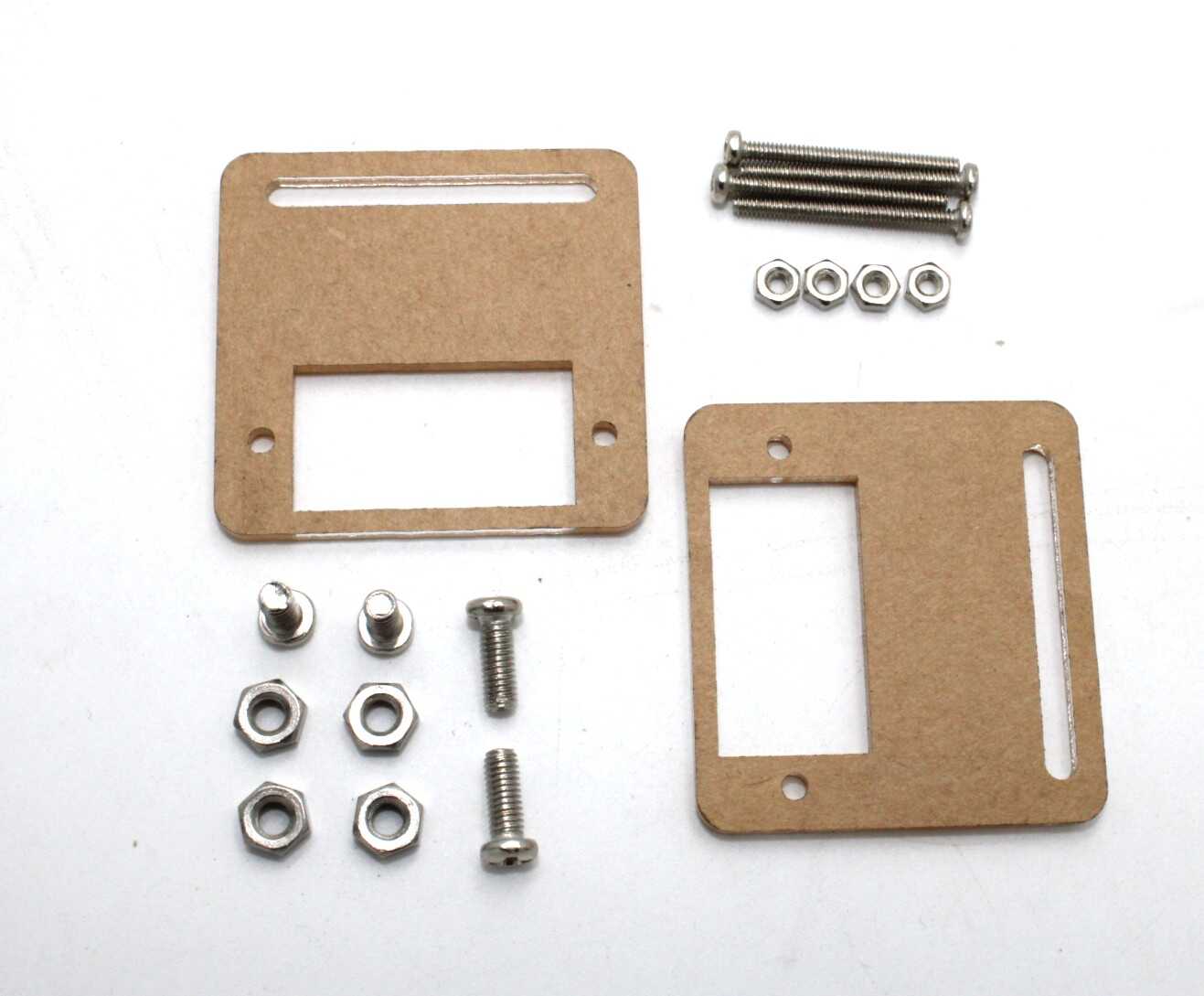
Servo Mount Holder Bracket for SG90/MG90 (Pack of 2)
Aluminium mounting brackets for cleanly integrating servo motors into robot frames, pan-tilt mounts, and mechanical linkages — fits SG90 and MG90 series.
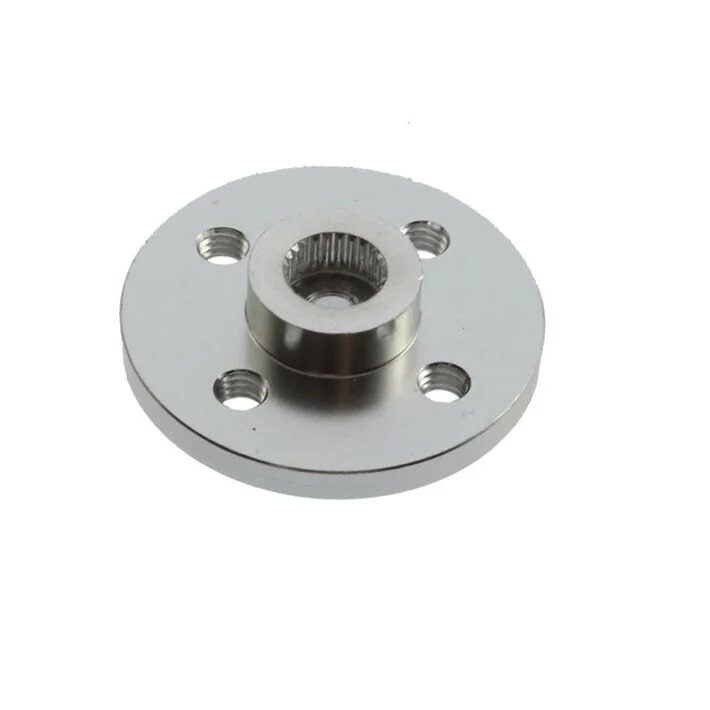
Aluminum Servo Horn/Arm 25T Round Disc for MG995/MG996
Heavy-duty aluminium servo horn for MG996R — much stronger than plastic horns for high-torque linkages, arms, and structural robot joints.
Recommended Servos at Zbotic
Zbotic stocks genuine high-quality servo motors, mounting hardware, and servo extension cables for robot builders across India. Here is a quick recommendation guide:
- Learning/prototyping: TowerPro SG90 or Servo SG90 — inexpensive, available, easy to use
- Intermediate robotics (robot arm, quadruped): MG996R High Quality — proven workhorse
- High-performance projects: DS3225 or DS3218 digital servos for demanding joint loads
- Mounting hardware: Aluminium servo horns and bracket packs keep your build professional
Frequently Asked Questions
What is the difference between MG996R and MG995?
The MG996R is the updated version of the MG995 with a revised gear train and slightly better torque consistency. Both have similar torque ratings, but the MG996R uses improved metal alloy gears. For new projects, always choose the MG996R over the MG995.
How many MG996R servos can an Arduino control?
The Arduino Servo library supports up to 12 servos on most Arduino boards and up to 48 on the Mega. The limiting factor is power: each MG996R can draw up to 2.5A stall current, so a 6-servo robot arm needs a 15A supply. The signal wires can all come from the Arduino (share ground with servo power supply).
What does “kg·cm” mean in servo specs?
It means the servo can exert a force of 1 kg at a distance of 1 cm from the rotation centre. So 13 kg·cm means 13 kg at 1cm, or 6.5 kg at 2cm, or 1.3 kg at 10cm. Multiply the load weight (kg) by the moment arm length (cm) to get the required torque in kg·cm.
Are digital servos worth the extra cost for hobby robots?
Yes, if your robot has joints that must hold position under load or respond quickly to changing commands. Digital servos update their control loop 6–8× faster, which means much better position holding and less drift. For a robotic arm holding an object, the difference is immediately noticeable. For a simple pan/tilt mount, analog is fine.
Can I use servo extension cables to reach distant servo mounts?
Yes, but keep extension cable length under 50cm for most applications. Longer cables increase signal line capacitance, which can round the PWM pulse edges and cause jitter in analog servos. Use shielded cables or twisted pair for runs over 30cm, and add a 100nF capacitor between signal and GND at the servo end.
From beginner SG90 motors to 25 kg·cm DS3225 digital servos, Zbotic has the complete servo range with fast delivery across India. Browse Servo Motors at Zbotic




Add comment