
If you’ve ever tried to build a DIY 18650 battery pack, you know that soldering directly onto battery cells is a bad idea — excessive heat damages cells and can even cause thermal runaway. A battery spot welder for 18650 pack connector builds solves this problem elegantly by using short, high-current pulses to fuse nickel strips to cell terminals without transferring heat deep into the cell. In India, where lithium battery packs for e-bikes, power walls, and custom UPS systems are becoming mainstream, building your own spot welder is both practical and cost-effective.
Why Spot Welding for 18650 Packs?
Lithium-ion 18650 cells — the same cells used in laptop batteries and Tesla power walls — are extremely heat-sensitive. When you solder to them, the iron tip temperature (~350°C) stays in contact with the terminal for several seconds, which heats the internal chemistry and degrades capacity. In severe cases, it vents the cell or causes a short.
Spot welding uses a capacitor bank or a salvaged microwave oven transformer (MOT) to dump a massive current (hundreds to thousands of amps) for just 1–10 milliseconds. This creates enough localised resistive heating to fuse a 0.1–0.2 mm nickel strip to the terminal without the heat travelling further than a fraction of a millimetre into the cell body. The result is a mechanically strong, low-resistance connection — exactly what a multi-cell pack needs.
For Indian makers building e-bike packs, DIY power walls, or custom 18650-based UPS systems, a spot welder is an essential tool. Commercial units start at ₹3,000–₹8,000 for the basic kWeld-style capacitor machines, but a DIY build using recycled laptop battery packs or a salvaged MOT can cost under ₹1,500 for the hardware.
How a Battery Spot Welder Works
There are two mainstream approaches for DIY spot welders:
1. Capacitor Bank / Supercapacitor Welder
A bank of large electrolytic capacitors (or ultracapacitors) is charged to a fixed voltage. When the electrode tips are pressed against the nickel strip and the trigger fires, the capacitors discharge through the weld joint in a single, controlled pulse. The pulse energy is predictable and repeatable, making this the preferred method for precision pack building. The kWeld, Malectrics welder, and many commercial units use this principle.
2. MOT (Microwave Oven Transformer) Welder
A salvaged transformer from a microwave oven has its secondary winding replaced with a few turns of thick copper cable (4–6 AWG). The primary runs on 230V AC and the secondary outputs 2–3V at 600–1,000A. A foot pedal or relay controls the pulse duration (typically 50–200ms). MOT welders are powerful and cheap but harder to control precisely — they are better for 0.2mm+ thick strips and thicker bus bars.
3. High-Drain 18650 / LiPo Welder
Some DIY designs use a series/parallel pack of high-drain 18650 cells or a LiPo pack as the energy source. The Arduino-controlled MOSFET switch dumps a timed pulse. This is compact, portable, and popular for field repairs. The 737G-style commercial mini welders use this principle.
Components You Need to Build One
Here is a practical component list for a capacitor-bank spot welder suitable for 0.1–0.15mm nickel strips on standard 18650 cells:
- Energy source: 2–6 salvaged laptop battery 18650 cells in parallel (high discharge rate, >10A continuous) OR a LiPo pack (3S–4S, 1000–2200mAh, 25C+)
- MOSFET switch: IRFP4568 or IRFP3006 (dual paralleled), or an IRLB3034 for lower voltage builds
- Gate driver IC: IR2110 or TC4420/TC4422
- Microcontroller: Arduino Nano or ESP32 for pulse timing (1–50ms range)
- Electrodes: 6mm diameter copper rod, sharpened to a blunt point, mounted in a pen body or 3D-printed holder
- Cables: 10 AWG or thicker silicone wire for the high-current path; keep it as short as possible
- Connectors: XT60 for the battery connection; banana plugs for the electrode leads
- Protection: Fuse on the battery positive (50–100A blade fuse or ANL fuse)
- Display: OLED or 16×2 LCD for pulse time and weld count display
- Trigger: Foot pedal micro switch or hand trigger (NO switch, 10A rated)
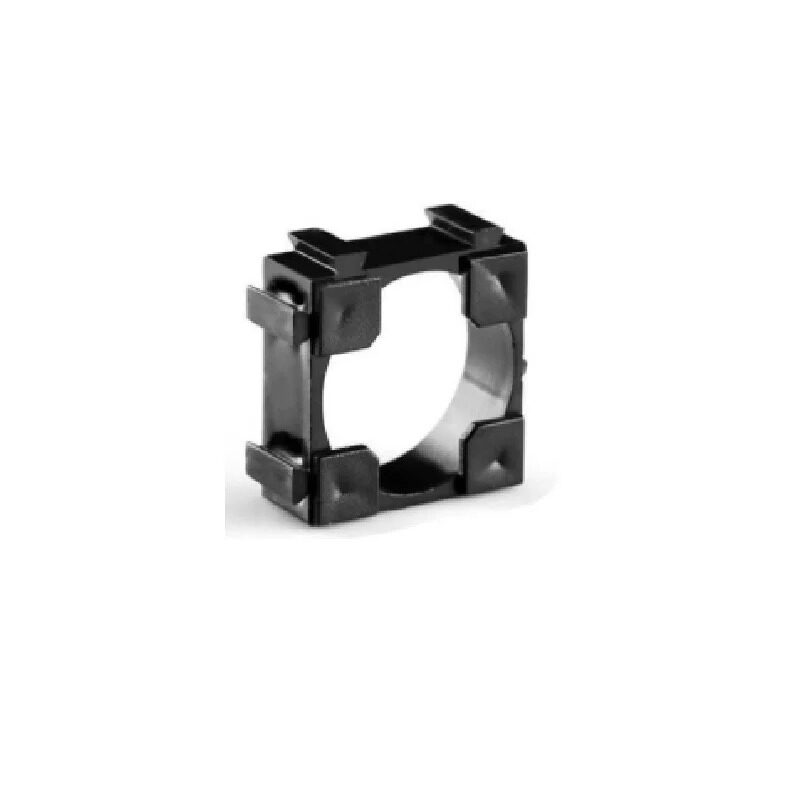
1 x 18650 Battery Holder with 18.4MM Bore Diameter – pack of 4
These holders let you securely mount individual 18650 cells in your welder’s energy storage pack. The 18.4mm bore fits standard flat-top and button-top cells. Pack of 4 makes it easy to build a 2P or 4P cell array.
Step-by-Step Build Guide
Step 1 — Design the Power Stage
Choose your energy source first. For a portable, safe build for home use, go with a 3S LiPo (11.1V, 1500mAh, 25C) or a pack of 4 parallel 18650 cells salvaged from old laptop batteries. Check each cell with a capacity tester — discard any cell below 1500mAh or with high internal resistance (>100mΩ). The total output current during a weld will be in the 200–600A range for just a few milliseconds, so cell internal resistance and wire gauge are critical.
Step 2 — Build the MOSFET Switch
Use two IRFP4568 MOSFETs in parallel on a heatsink. Connect their gates together through a 10Ω gate resistor each. Drive them with an IR2110 high-side/low-side gate driver, or directly from a TC4420 if the source is grounded. The Arduino Nano outputs a 5V PWM signal; use a logic-level MOSFET or a level shifter if using 3.3V logic from an ESP32. Always add a Schottky diode (like MBR2045) across Drain-Source for freewheeling protection.
Step 3 — Program the Arduino / ESP32
The core firmware is simple: on trigger press, output a HIGH pulse on the MOSFET gate pin for a configurable duration (e.g., 10ms), then pull LOW. Use a rotary encoder to adjust pulse time from 1–50ms in 1ms steps. Display the time on an OLED screen. Add a double-pulse mode (two pulses with a 20ms gap) for better weld penetration on thicker nickel strips. Keep the code interrupt-driven so the trigger is always responsive.
Step 4 — Wire the High-Current Path
This is the most critical part. Use 10 AWG (minimum) or 8 AWG silicone-coated wire from the battery positive → MOSFET Drain → electrode cable → weld tip → workpiece → battery negative. Keep total path length under 60cm. Every extra 10cm adds resistance and reduces weld energy. Use ring terminals and bolted connections, not just push-in connectors, for the high-current joints. A bad connection here causes arcing, heat, and unreliable welds.
Step 5 — Make the Electrode Pen
A simple electrode pen can be made from a large marker or PVC pipe body. Drill a 6mm hole through the barrel. Insert two 6mm copper rods with 5mm spacing between tips. Connect each rod to the two high-current leads. The tip ends should be slightly rounded — too sharp causes the nickel strip to pierce rather than weld. Keep the electrode leads twisted together to minimise inductance.
Step 6 — Test with Calibration Welds
Before touching real cells, practice on scrap nickel strips placed over a steel plate. Start at 8ms pulse width. A good weld leaves two clean circular marks on the strip that require visible force to peel. If the strip peels with gentle pressure, increase pulse time by 2ms. If you see sparking or burning, reduce by 2ms. For 0.15mm nickel strip, typical sweet spot is 8–15ms on a fresh 3S LiPo at 11.1V.
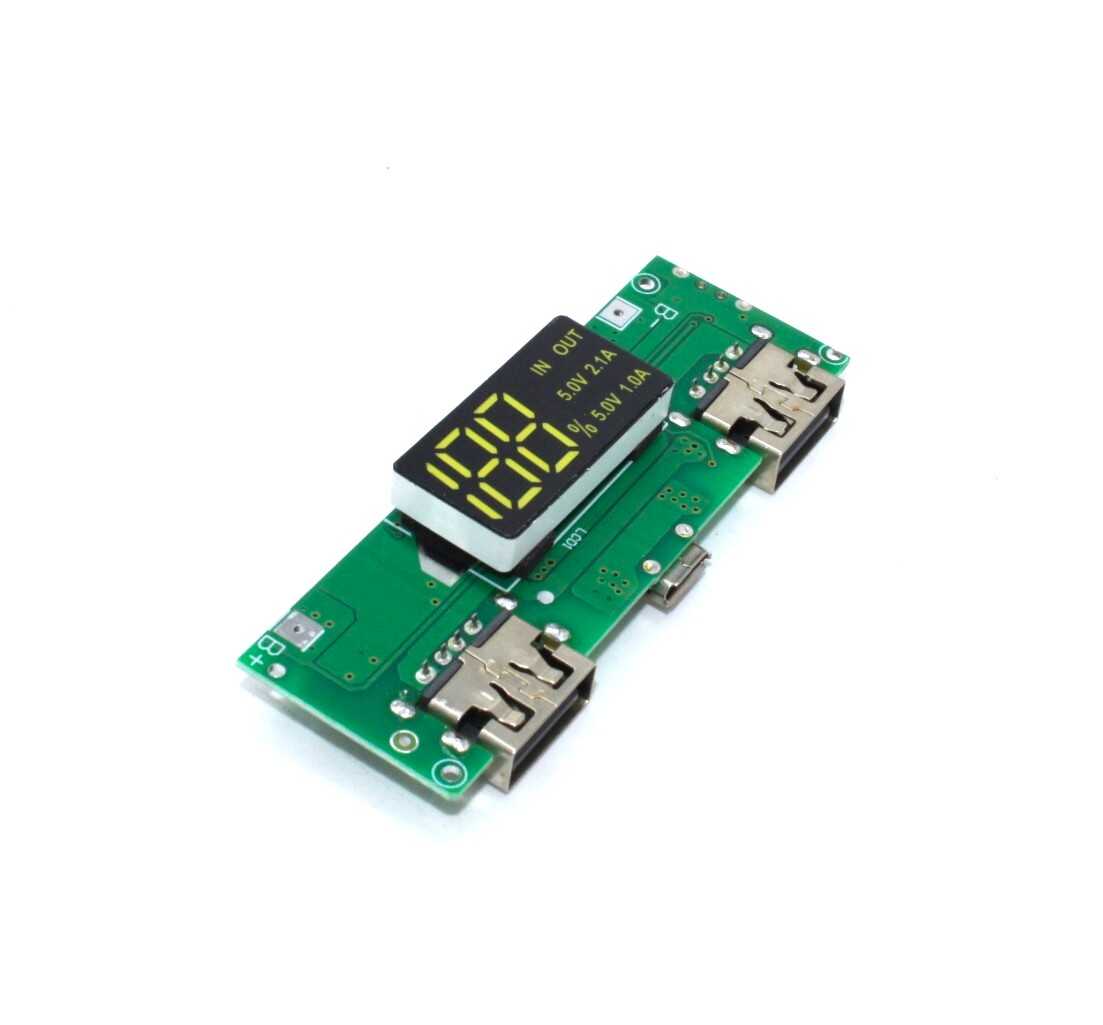
18650 5V 1A/2A Lithium Battery Digital Display & Charging Module
Use this module to safely charge the 18650 cells in your welder’s energy pack via USB. Built-in protection and voltage display make it ideal for maintaining your spot welder’s power cells.
Welding Nickel Strips: Tips and Techniques
The quality of your pack depends as much on technique as on hardware. Here are field-tested tips:
- Clean the cell terminals: Wipe 18650 terminals with isopropyl alcohol before welding. Oxidation and contamination dramatically reduce weld quality.
- Use pure nickel strip, not nickel-plated steel: Nickel-plated steel (cheaper) has higher resistance and is harder to weld cleanly. For battery packs, pure nickel strip (0.1–0.15mm × 8mm) is the right choice.
- Consistent electrode pressure: Press the electrode pen firmly and consistently on each weld point. Variable pressure = variable weld quality. Some builders make a spring-loaded holder for reproducibility.
- Two welds per connection: Always make two spot welds per terminal per strip end. This provides redundancy and lowers contact resistance.
- Check with a peel test: After welding a full row, gently try to peel the first strip. It should require significant force and leave a thinned circle on the strip, not peel cleanly. If it peels, re-weld with more energy.
- Cell configuration: For a typical 13S4P e-bike pack (48V, ~10Ah), you’ll make 13 groups of 4 cells in parallel, then connect those 13 groups in series. Plan your nickel strip routing before welding to avoid rework.
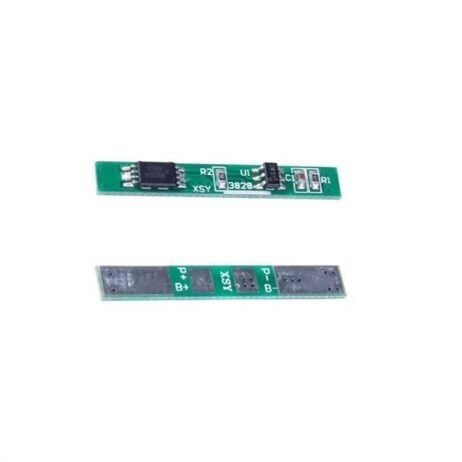
1S 3.7V 2A 1MOS BMS Li-ion 18650 Battery Protection Board
Essential protection board for individual 18650 cells. Provides over-charge, over-discharge, and short-circuit protection. Perfect for protecting each parallel group in your DIY battery pack.
Safety Precautions
A spot welder handles energy levels that can cause serious injury if misused. Follow these rules without exception:
- Never weld on a charged lithium cell above 3.6V per cell — the cell can vent or catch fire if the weld punctures the terminal. Fully discharge cells to storage voltage (3.7–3.8V per cell) before welding into packs, or weld on individual cells at 50% charge.
- Work on a non-conductive surface: Rubber mat, wooden board, or silicone sheet. Avoid metal workbenches.
- Wear safety glasses: Even small sparks can cause eye injury. Always wear rated eye protection.
- Disconnect the power source when connecting/disconnecting electrodes or adjusting the circuit.
- Have a CO2 or dry powder extinguisher nearby, not a water extinguisher. Lithium fires react violently with water.
- Test the MOSFET gate drive independently before connecting the high-current path. An always-on MOSFET with a charged battery is a short circuit.
- Fuse the battery positive: A 100A blade fuse or ANL fuse provides final protection against catastrophic shorts.
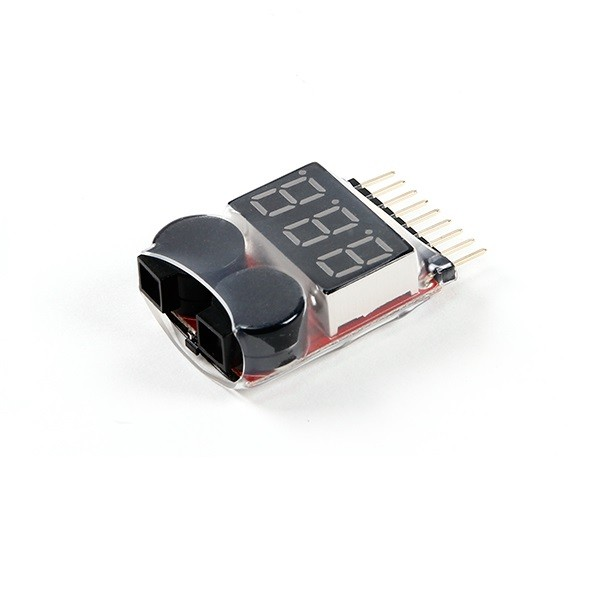
1-8S Lipo Battery Voltage Tester without alarm
Check the voltage of each cell in your welder’s LiPo energy pack before and after welding sessions. Ensures you’re always welding with a safely charged source battery and prevents deep discharge damage.
Frequently Asked Questions
Can I use a car battery as a spot welder power source?
Yes, a 12V car battery can be used as an MOT-style welder’s DC source, but it is far harder to control pulse duration precisely and the energy levels can be dangerously high. For 18650 cell welding, a controlled MOSFET-based build with a LiPo or 18650 pack is much safer and produces cleaner welds.
What thickness of nickel strip should I use for 18650 packs?
For standard 18650 packs (under 20A continuous), 0.1mm × 8mm pure nickel strip is adequate. For e-bike packs handling 20–40A, use 0.15mm × 8mm or double-layer 0.1mm. For high-drain packs above 40A, use 0.2mm or copper-nickel sandwich strips.
My welds are popping off — what’s wrong?
Most common causes: dirty terminals (clean with IPA), insufficient pulse energy (increase time by 2ms), worn/oxidised electrode tips (re-polish or replace), or nickel-plated steel strip instead of pure nickel. Check each factor systematically.
Is it legal to build and use a DIY battery pack in India for an e-bike?
DIY e-bike battery packs are not type-approved for use on public roads in India under CMVR regulations. For personal use and hobby projects, there are no specific restrictions, but always follow fire safety guidelines when storing and charging lithium packs.
What’s the minimum number of cells needed for the welder’s energy source?
A minimum of 3 series cells (11.1V) with 2–3 cells in parallel (to get 10–15Ah equivalent capacity for discharge) gives adequate energy for 0.1mm nickel strip on standard cells. More cells = more weld energy available before voltage sags.
Start Building Your Battery Packs Today
Building a DIY battery spot welder is one of the most rewarding projects for any serious electronics maker. Once you have the welder, you can build 18650 packs for e-bikes, power banks, solar storage, and workshop UPS systems at a fraction of the commercial cost. The key is investing time in calibrating the pulse energy correctly and following safe cell-handling practices every single time.
Zbotic stocks all the 18650 battery holders, protection boards, charging modules, and accessories you need to go from bare cells to a finished, tested pack. Browse our Batteries & Power category to get started.






Add comment