PCB Design Guidelines
Impedance Control
Controlled impedance is available for high-speed digital and RF designs. Use the impedance calculator when ordering to specify your target impedance, trace width, and dielectric thickness.

Panelization Guidelines
- V-Cut: For rectangular boards only. Minimum board thickness: 0.6mm
- Tab routing: For irregular shapes. Minimum 3 tabs per board
- Stamp holes: 0.5mm holes with 0.75mm spacing between them
- Panel rails: minimum 5mm width recommended
- Fiducial marks: 1mm diameter, 2mm clearance from edge
BGA Design Recommendations
- Use NSMD (Non-Solder Mask Defined) pads for better solder joint reliability
- Via-in-pad: use filled and capped vias to prevent solder wicking
- Minimum pad pitch: 0.4mm (requires 4+ layer boards)
- Add test points for boundary scan testing
Minimum Design Rules
| Parameter | 1-2 Layer | 4+ Layer |
|---|---|---|
| Min trace width | 0.127mm (5mil) | 0.1mm (3.94mil) |
| Min spacing | 0.127mm (5mil) | 0.1mm (3.94mil) |
| Min via diameter | 0.3mm | 0.2mm |
| Min via drill | 0.15mm | 0.15mm |
| Min annular ring | 0.13mm | 0.1mm |
| Min solder mask bridge | 0.2mm | 0.1mm |
Edge Plating
Include edge plating requirements in your Gerber file as copper on the board edge. Add a picture and note in remarks: “Edge plating required.”

Aluminum Substrate Notes
- White and black silkscreen supported
- White silkscreen on green/black solder mask; black on white solder mask
- Silkscreen on bare aluminum not recommended (poor adhesion)
Countersink Holes
Countersink holes are supported. Specify the hole diameter, countersink diameter, and angle in your design files or remarks.
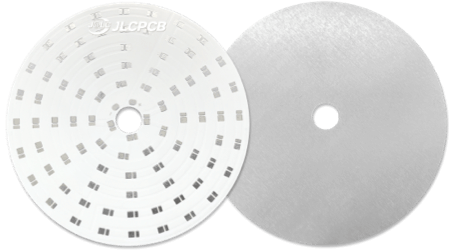
Aluminum PCB

Metal core PCBs
Preventing Breakage
For boards with narrow sections (< 2mm width), add support rails or panelize to prevent breakage during manufacturing and shipping.